Straight Line & Solution of Tr
Cheatsheet Content
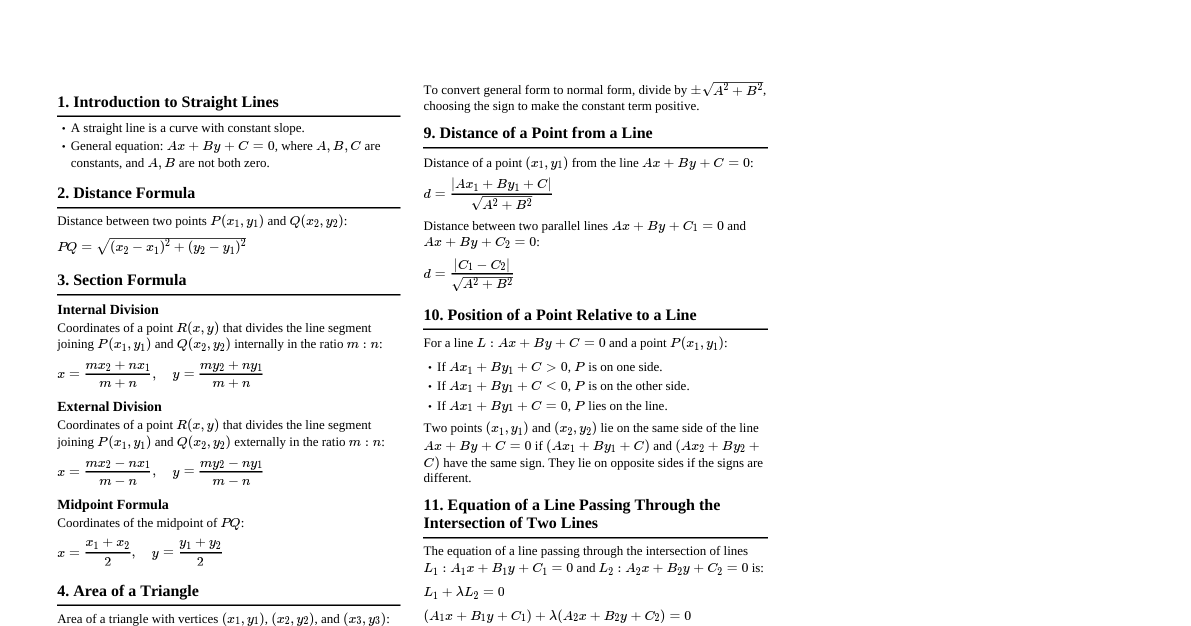
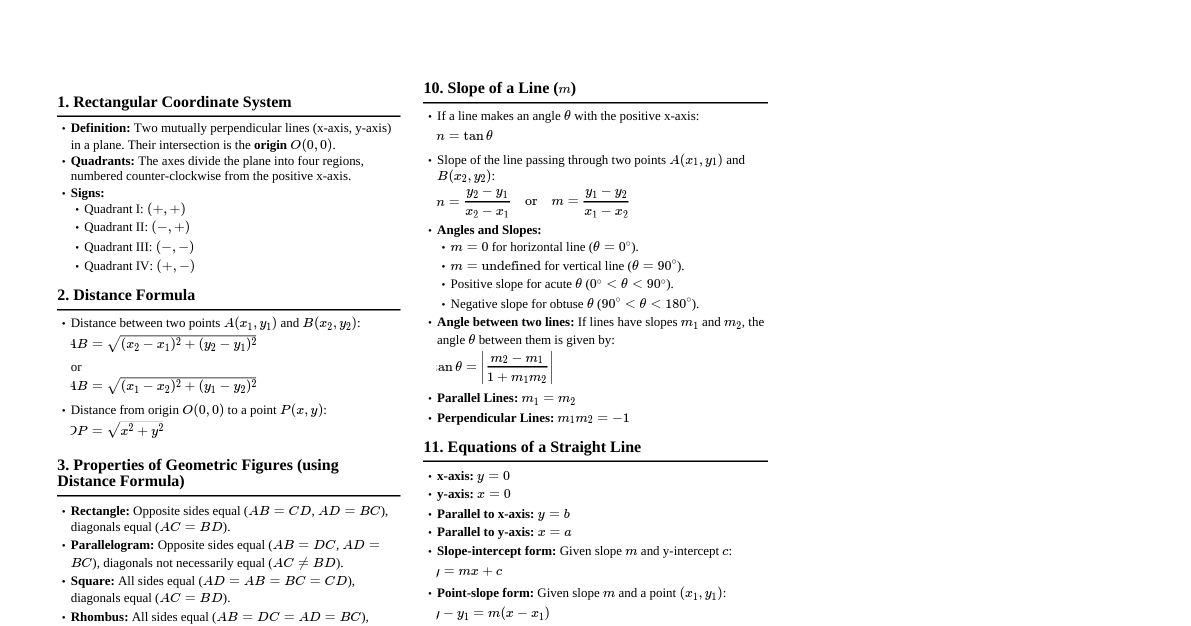
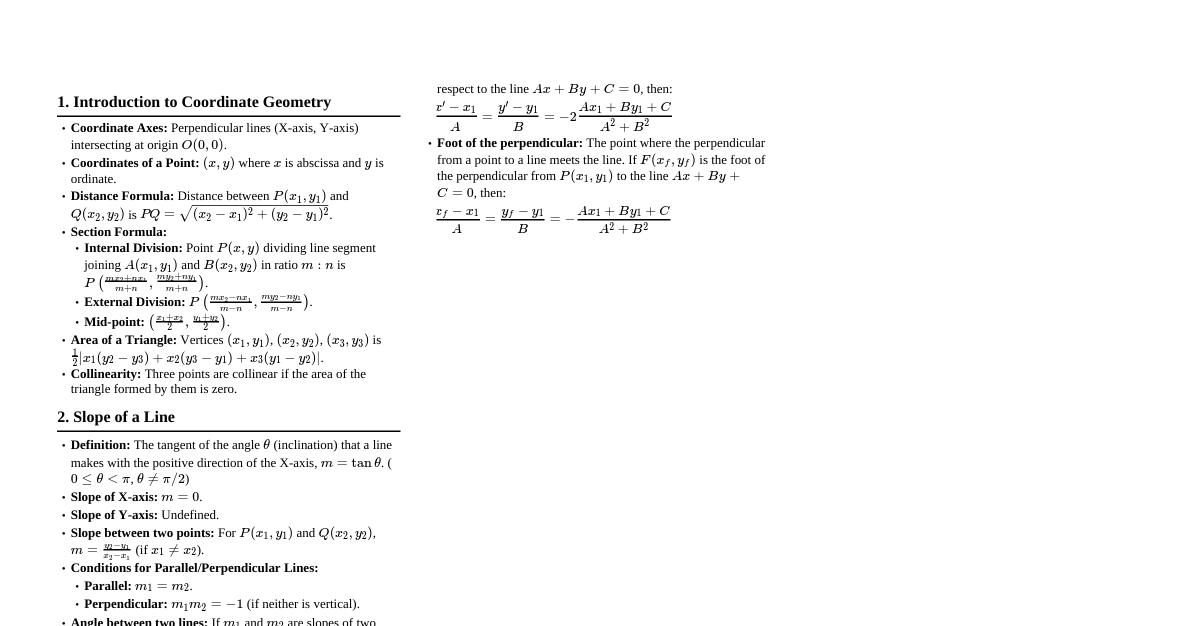
### Rectangular Coordinate System - **Definition:** Two perpendicular directed lines (x-axis and y-axis) intersecting at the origin O. - **Coordinates:** A point P is represented as $(x, y)$, where $x$ is the abscissa (directed distance from y-axis) and $y$ is the ordinate (directed distance from x-axis). - **Quadrants:** - 1st Quadrant: $(+, +)$ - 2nd Quadrant: $(-, +)$ - 3rd Quadrant: $(-, -)$ - 4th Quadrant: $(+, -)$ - **Axes Equations:** - x-axis: $y=0$ - y-axis: $x=0$ ### Polar Coordinates - **Definition:** An ordered pair $(r, \theta)$ where $r$ is the radius vector (distance from origin) and $\theta$ is the vectorial angle (angle with positive x-axis). - **Relation to Cartesian Coordinates:** - $x = r \cos \theta$ - $y = r \sin \theta$ - $\tan \theta = y/x$ - $x^2 + y^2 = r^2$ - **Conventions:** - $\theta$ is usually taken in radians, within $(-\pi, \pi]$ or $[0, 2\pi)$. - $r$ can be positive or negative depending on the direction of $\theta$. - **Conversion Tips:** - To convert from Cartesian $(x,y)$ to Polar $(r, \theta)$: - $r = \sqrt{x^2 + y^2}$ - $\alpha = \tan^{-1}|y/x|$ - $\theta$ is determined by the quadrant of $(x,y)$: - 1st Quadrant: $\theta = \alpha$ - 2nd Quadrant: $\theta = \pi - \alpha$ - 3rd Quadrant: $\theta = \pi + \alpha$ (or $-\pi + \alpha$) - 4th Quadrant: $\theta = -\alpha$ (or $2\pi - \alpha$) ### Distance Formula - **Between two points $P_1(x_1, y_1)$ and $P_2(x_2, y_2)$:** $$d = \sqrt{(x_2 - x_1)^2 + (y_2 - y_1)^2}$$ - **In Polar Coordinates (between $P_1(r_1, \theta_1)$ and $P_2(r_2, \theta_2)$):** $$d = \sqrt{r_1^2 + r_2^2 - 2r_1r_2 \cos(\theta_2 - \theta_1)}$$ ### Section Formula - **Internal Division:** Point P(x, y) divides the line segment joining $A(x_1, y_1)$ and $B(x_2, y_2)$ in the ratio $m:n$. $$x = \frac{mx_2 + nx_1}{m+n}, \quad y = \frac{my_2 + ny_1}{m+n}$$ *Tip:* Multiply $m$ with coordinates of the opposite point $B$, and $n$ with coordinates of $A$. - **External Division:** Point P(x, y) divides the line segment joining $A(x_1, y_1)$ and $B(x_2, y_2)$ in the ratio $m:n$. $$x = \frac{mx_2 - nx_1}{m-n}, \quad y = \frac{my_2 - ny_1}{m-n}$$ - **Midpoint Formula:** $$x = \frac{x_1 + x_2}{2}, \quad y = \frac{y_1 + y_2}{2}$$ - **Working Rule for Ratio:** If the ratio is $\lambda:1$: - $\lambda > 0$: Internal division - $\lambda ### Area of Triangle - **Using Cartesian Coordinates (Vertices $(x_1, y_1), (x_2, y_2), (x_3, y_3)$):** $$A = \frac{1}{2} |x_1(y_2 - y_3) + x_2(y_3 - y_1) + x_3(y_1 - y_2)|$$ Can also be written as a determinant: $$A = \frac{1}{2} \begin{vmatrix} x_1 & y_1 & 1 \\ x_2 & y_2 & 1 \\ x_3 & y_3 & 1 \end{vmatrix}$$ *Note:* For area to be positive, vertices should be taken in an order such that the triangle is always on the left (usually counter-clockwise). - **With Origin as a Vertex:** If one vertex is $(0,0)$, then $A = \frac{1}{2} |x_1y_2 - x_2y_1|$. - **Using Polar Coordinates (Vertices $(r_1, \theta_1), (r_2, \theta_2), (r_3, \theta_3)$):** $$A = \frac{1}{2} |r_1r_2 \sin(\theta_1 - \theta_2) + r_2r_3 \sin(\theta_2 - \theta_3) + r_3r_1 \sin(\theta_3 - \theta_1)|$$ - **Using Line Equations (Sides $a_1x+b_1y+c_1=0$, etc.):** $$A = \frac{1}{2} \frac{(C_1C_2C_3)^2}{|C_1'C_2'C_3'|}$$ where $C_i$ are cofactors of $c_i$ in $\begin{vmatrix} a_1 & b_1 & c_1 \\ a_2 & b_2 & c_2 \\ a_3 & b_3 & c_3 \end{vmatrix}$. - **Collinearity Condition:** If points are collinear, the area of the triangle formed by them is 0. ### Slope of a Line - **Definition:** The tangent of the inclination ($\alpha$) of the line with the positive x-axis. $m = \tan \alpha$. - **From two points $(x_1, y_1)$ and $(x_2, y_2)$:** $$m = \frac{y_2 - y_1}{x_2 - x_1}$$ - **Special Cases:** - Line parallel to x-axis: $m=0$ - Line parallel to y-axis: $m$ is undefined - Line equally inclined to axes: $m = \pm 1$ (angle $45^\circ$ or $135^\circ$) - **Collinearity of three points A, B, C:** Slope of AB = Slope of BC = Slope of AC. ### Equations of a Straight Line 1. **Slope-Intercept Form:** $$y = mx + c$$ where $m$ is the slope and $c$ is the y-intercept. - If line passes through origin, $y=mx$. 2. **Point-Slope Form:** $$y - y_1 = m(x - x_1)$$ where $m$ is the slope and $(x_1, y_1)$ is a point on the line. 3. **Two-Point Form:** $$y - y_1 = \frac{y_2 - y_1}{x_2 - x_1}(x - x_1)$$ Can also be written as a determinant: $\begin{vmatrix} x & y & 1 \\ x_1 & y_1 & 1 \\ x_2 & y_2 & 1 \end{vmatrix} = 0$. 4. **Intercept Form:** $$\frac{x}{a} + \frac{y}{b} = 1$$ where $a$ is the x-intercept and $b$ is the y-intercept. 5. **Normal Form:** $$x \cos \alpha + y \sin \alpha = p$$ where $p$ is the length of the perpendicular from the origin to the line, and $\alpha$ is the angle the perpendicular makes with the positive x-axis. 6. **Parametric/Symmetric Form:** $$\frac{x - x_1}{\cos \theta} = \frac{y - y_1}{\sin \theta} = r$$ where $(x_1, y_1)$ is a point on the line, $\theta$ is its inclination, and $r$ is the distance from $(x_1, y_1)$ to $(x, y)$. - Point $(x,y)$ on the line: $(x_1 + r \cos \theta, y_1 + r \sin \theta)$. - $r$ is positive if the point is above $(x_1, y_1)$ and negative if below. ### Angle Between Two Straight Lines - **Acute Angle $\theta$ between lines with slopes $m_1, m_2$:** $$\tan \theta = \left| \frac{m_1 - m_2}{1 + m_1m_2} \right|$$ - **Condition for Parallel Lines:** $m_1 = m_2$. - For general form $a_1x+b_1y+c_1=0$ and $a_2x+b_2y+c_2=0$: $a_1b_2 = b_1a_2$. - **Condition for Perpendicular Lines:** $m_1m_2 = -1$. - For general form $a_1x+b_1y+c_1=0$ and $a_2x+b_2y+c_2=0$: $a_1a_2 + b_1b_2 = 0$. ### Family of Lines - **Parallel to $ax+by+c=0$:** $ax+by+k=0$ - **Perpendicular to $ax+by+c=0$:** $bx-ay+k=0$ - **Through Intersection of $L_1=0$ and $L_2=0$:** $L_1 + \lambda L_2 = 0$ ### Concurrency of Straight Lines - **Three lines $a_1x+b_1y+c_1=0$, $a_2x+b_2y+c_2=0$, $a_3x+b_3y+c_3=0$ are concurrent if:** $$\begin{vmatrix} a_1 & b_1 & c_1 \\ a_2 & b_2 & c_2 \\ a_3 & b_3 & c_3 \end{vmatrix} = 0$$ ### Perpendicular Distance - **From point $(\alpha, \beta)$ to line $ax+by+c=0$:** $$p = \frac{|a\alpha + b\beta + c|}{\sqrt{a^2 + b^2}}$$ - **From origin $(0,0)$ to line $ax+by+c=0$:** $$p = \frac{|c|}{\sqrt{a^2 + b^2}}$$ - **Between parallel lines $ax+by+c_1=0$ and $ax+by+c_2=0$:** $$d = \frac{|c_1 - c_2|}{\sqrt{a^2 + b^2}}$$ ### Angle Bisectors - **Between two lines $a_1x+b_1y+c_1=0$ and $a_2x+b_2y+c_2=0$:** $$\frac{a_1x+b_1y+c_1}{\sqrt{a_1^2+b_1^2}} = \pm \frac{a_2x+b_2y+c_2}{\sqrt{a_2^2+b_2^2}}$$ - **Acute/Obtuse Angle Bisector:** - If $a_1a_2+b_1b_2 > 0$: '+' sign gives obtuse bisector, '-' sign gives acute bisector. - If $a_1a_2+b_1b_2 ### Foot of Perpendicular and Image of a Point - **Foot of Perpendicular $R(x_2, y_2)$ from $P(x_1, y_1)$ to line $ax+by+c=0$:** $$\frac{x_2 - x_1}{a} = \frac{y_2 - y_1}{b} = -\frac{ax_1+by_1+c}{a^2+b^2}$$ - **Image $Q(x_2, y_2)$ of $P(x_1, y_1)$ across line $ax+by+c=0$:** $$\frac{x_2 - x_1}{a} = \frac{y_2 - y_1}{b} = -2\frac{ax_1+by_1+c}{a^2+b^2}$$ ### Reflection of Light - **Angle of incidence = Angle of reflection.** Used to find the equation of the reflected ray. ### Locus and its Equation - **Definition:** The path traced by a point satisfying given geometrical conditions. - **How to find:** 1. Let the moving point be $(x_1, y_1)$. 2. Apply the given conditions to $(x_1, y_1)$ to form an equation. 3. Replace $(x_1, y_1)$ with $(x, y)$ to get the locus equation. *Tip:* Square both sides if there are square roots. ### Shifting and Rotation of Axes - **Translation (Shifting Origin to $(h,k)$):** - Old coordinates $(x,y)$, new coordinates $(X,Y)$. - $x = X+h, \quad y = Y+k$. - Used to simplify equations by eliminating certain terms. - **Rotation (Rotating Axes by $\theta$):** - Old coordinates $(x,y)$, new coordinates $(X,Y)$. - $x = X \cos \theta - Y \sin \theta$ - $y = X \sin \theta + Y \cos \theta$ - Inverse: $X = x \cos \theta + y \sin \theta$, $Y = y \cos \theta - x \sin \theta$. - Used to simplify equations by eliminating $xy$ term. ### Solution of Triangle: Introduction - **Elements:** 3 sides (a, b, c) and 3 angles (A, B, C). - **Angle Sum Property:** $A+B+C = \pi = 180^\circ$. - **Area of Triangle (General):** - $A = \frac{1}{2} \text{base} \times \text{height}$ - $A = \frac{1}{2}bc \sin A = \frac{1}{2}ca \sin B = \frac{1}{2}ab \sin C$ - **Hero's Formula:** $A = \sqrt{s(s-a)(s-b)(s-c)}$, where $s = \frac{a+b+c}{2}$ (semi-perimeter). ### Sine Rule - **Formula:** $$\frac{a}{\sin A} = \frac{b}{\sin B} = \frac{c}{\sin C} = 2R$$ where $R$ is the circumradius (radius of the circumcircle). ### Cosine Rule - **Formula:** - $a^2 = b^2 + c^2 - 2bc \cos A$ - $b^2 = c^2 + a^2 - 2ca \cos B$ - $c^2 = a^2 + b^2 - 2ab \cos C$ - **Derived for Angles:** - $\cos A = \frac{b^2+c^2-a^2}{2bc}$ - $\cos B = \frac{c^2+a^2-b^2}{2ca}$ - $\cos C = \frac{a^2+b^2-c^2}{2ab}$ ### Projection Formula - **Formula:** - $a = b \cos C + c \cos B$ - $b = c \cos A + a \cos C$ - $c = a \cos B + b \cos A$ ### Half-Angle Formulae - **Sine:** - $\sin \frac{A}{2} = \sqrt{\frac{(s-b)(s-c)}{bc}}$ - $\sin \frac{B}{2} = \sqrt{\frac{(s-a)(s-c)}{ac}}$ - $\sin \frac{C}{2} = \sqrt{\frac{(s-a)(s-b)}{ab}}$ - **Cosine:** - $\cos \frac{A}{2} = \sqrt{\frac{s(s-a)}{bc}}$ - $\cos \frac{B}{2} = \sqrt{\frac{s(s-b)}{ac}}$ - $\cos \frac{C}{2} = \sqrt{\frac{s(s-c)}{ab}}$ - **Tangent:** - $\tan \frac{A}{2} = \sqrt{\frac{(s-b)(s-c)}{s(s-a)}} = \frac{A}{s(s-a)}$ - $\tan \frac{B}{2} = \sqrt{\frac{(s-a)(s-c)}{s(s-b)}} = \frac{A}{s(s-b)}$ - $\tan \frac{C}{2} = \sqrt{\frac{(s-a)(s-b)}{s(s-c)}} = \frac{A}{s(s-c)}$ ### Napier's Analogy (Tangent Rule) - **Formula:** - $\tan \frac{B-C}{2} = \frac{b-c}{b+c} \cot \frac{A}{2}$ - $\tan \frac{C-A}{2} = \frac{c-a}{c+a} \cot \frac{B}{2}$ - $\tan \frac{A-B}{2} = \frac{a-b}{a+b} \cot \frac{C}{2}$ ### Circles Connected with Triangle 1. **Circumcircle:** - **Circumradius $R$:** $R = \frac{a}{2\sin A} = \frac{b}{2\sin B} = \frac{c}{2\sin C} = \frac{abc}{4A}$ 2. **Incircle:** - **Inradius $r$:** - $r = \frac{A}{s}$ - $r = (s-a)\tan \frac{A}{2} = (s-b)\tan \frac{B}{2} = (s-c)\tan \frac{C}{2}$ - $r = 4R \sin \frac{A}{2} \sin \frac{B}{2} \sin \frac{C}{2}$ 3. **Escribed Circles (Excircles):** - **Exradii $r_a, r_b, r_c$:** - $r_a = \frac{A}{s-a} = s \tan \frac{A}{2} = 4R \sin \frac{A}{2} \cos \frac{B}{2} \cos \frac{C}{2}$ - $r_b = \frac{A}{s-b} = s \tan \frac{B}{2} = 4R \cos \frac{A}{2} \sin \frac{B}{2} \cos \frac{C}{2}$ - $r_c = \frac{A}{s-c} = s \tan \frac{C}{2} = 4R \cos \frac{A}{2} \cos \frac{B}{2} \sin \frac{C}{2}$ ### Important Triangle Points 1. **Orthocentre (H):** Intersection of altitudes. - Distances from vertices: $HA = 2R \cos A, HB = 2R \cos B, HC = 2R \cos C$. - Distances from sides: $HD = 2R \cos B \cos C$, etc. - Coordinates: $\left(\frac{x_1 \tan A + x_2 \tan B + x_3 \tan C}{\tan A + \tan B + \tan C}, \frac{y_1 \tan A + y_2 \tan B + y_3 \tan C}{\tan A + \tan B + \tan C}\right)$ 2. **Circumcentre (O):** Intersection of perpendicular bisectors of sides. - Distances from vertices: $OA=OB=OC=R$. - Distances from sides: $OM = R \cos A$, etc. - Coordinates: $\left(\frac{x_1 \sin 2A + x_2 \sin 2B + x_3 \sin 2C}{\sin 2A + \sin 2B + \sin 2C}, \frac{y_1 \sin 2A + y_2 \sin 2B + y_3 \sin 2C}{\sin 2A + \sin 2B + \sin 2C}\right)$ 3. **Incentre (I):** Intersection of angle bisectors. - Coordinates: $\left(\frac{ax_1 + bx_2 + cx_3}{a+b+c}, \frac{ay_1 + by_2 + cy_3}{a+b+c}\right)$ 4. **Excentres ($I_A, I_B, I_C$):** Intersection of one internal and two external angle bisectors. - $I_A = \left(\frac{-ax_1 + bx_2 + cx_3}{-a+b+c}, \frac{-ay_1 + by_2 + cy_3}{-a+b+c}\right)$ - Similarly for $I_B, I_C$. 5. **Centroid (G):** Intersection of medians. - Divides medians in ratio $2:1$. - Coordinates: $\left(\frac{x_1+x_2+x_3}{3}, \frac{y_1+y_2+y_3}{3}\right)$ 6. **Euler Line:** Orthocentre (H), Centroid (G), and Circumcentre (O) are collinear. - G divides HO in ratio $2:1$ internally ($HG:GO = 2:1$). ### Ambiguous Case (SSA) - Given two sides (e.g., $b, c$) and a non-included angle (e.g., $B$). - If $b c \sin B$ and $b c$: One triangle.