Women, Caste, and Reform (Class 8 Histor
Cheatsheet Content
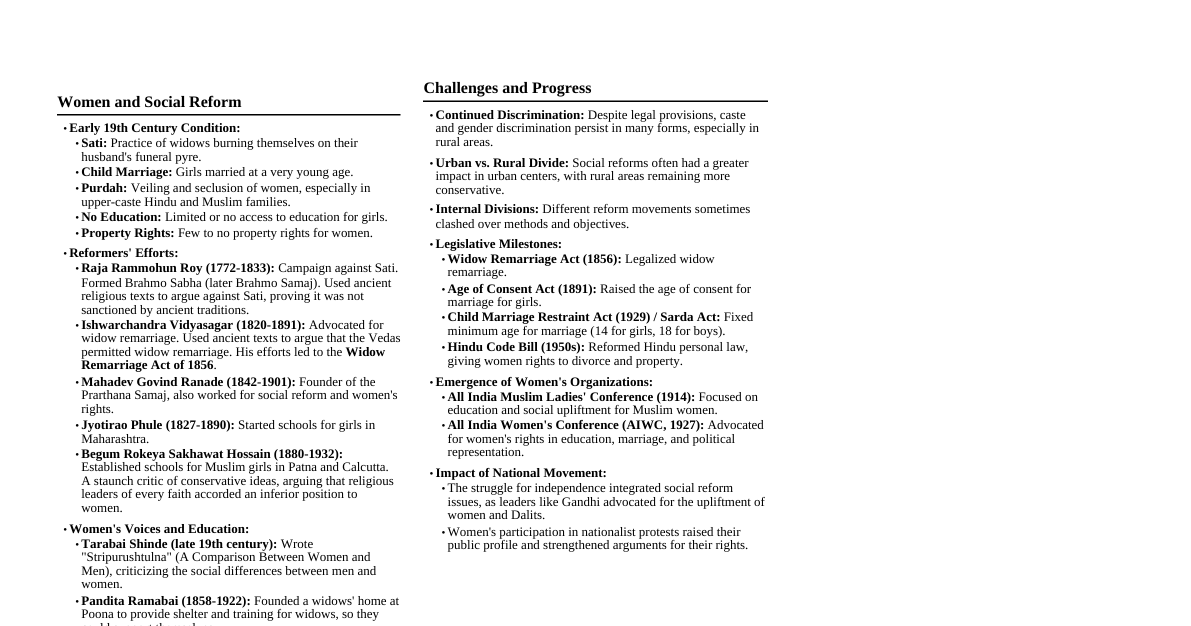
1. Women and Social Reform Status of Women in the 19th Century: Child marriage, Sati (widow burning), purdah (veiling). Lack of education, property rights. Widows often lived miserable lives. Reformers and their Efforts: Raja Rammohun Roy (1772-1833): Founded Brahmo Sabha (later Brahmo Samaj). Advocated against Sati. Used ancient texts to show Sati was not sanctioned. Sati banned in 1829 by Lord William Bentinck. Ishwarchandra Vidyasagar (1820-1891): Advocated for widow remarriage. Married a widow himself. Hindu Widow Remarriage Act passed in 1856. Swami Dayanand Saraswati (1824-1883): Founded Arya Samaj (1875). Supported widow remarriage and women's education. Jyotirao Phule (1827-1890): Opened schools for girls in Maharashtra. Wife, Savitribai Phule, taught in these schools. Tarabai Shinde (late 19th century): Wrote Stri Purush Tulana , criticizing gender inequalities. Pandita Ramabai (1858-1922): Founded a widows' home at Poona. Championed education for women. Women's Own Voices: From early 20th century, women began organizing. Begum Rokeya Sakhawat Hossain started schools for Muslim girls in Patna and Calcutta. Establishment of women's associations like All India Women's Conference (AIWC). Child Marriage Restraint Act (1929): Fixed minimum age for marriage ($18$ for boys, $14$ for girls). Later raised. 2. Caste and Social Reform Caste System in the 19th Century: Rigid hierarchy, untouchability. Brahmins and Kshatriyas considered "upper" castes. "Untouchables" faced severe discrimination, denied access to temples, public wells, schools. Challenges to Caste System: Christian Missionaries: Set up schools for tribal groups and "lower" castes. Offered opportunities for change. City Life: New jobs in factories, municipalities. Anonymity of cities allowed people to break caste norms. Demand for labor from "low" castes. Plantation Workers: Many "low" caste people migrated to work in plantations (Assam, Mauritius, Fiji). Caste Reform Movements: Jyotirao Phule (1827-1890): Attacked the Brahmin claim of superiority. Wrote Gulamgiri (1873) on slavery and caste oppression. Founded the Satnami Movement. Argued that "upper" castes were foreign invaders. Envisioned a society free of caste inequality. Ghasidas (Central India): Founded the Satnami Movement for leatherworkers. Organized a movement to improve the social status of Chamars. Haridas Thakur (Bengal): Matua sect, worked among Chandala cultivators. Challenged Brahmanical texts. Periyar E.V. Ramaswamy Naicker (1879-1973): Founder of the Self-Respect Movement (South India). Argued that religion was used to maintain caste hierarchy. Criticized untouchability, Brahmin dominance. Advocated for a society where all castes had equal rights. Organized temple entry movements. Dr. B.R. Ambedkar (1891-1956): Born into a Mahar (untouchable) family. Studied in the US and UK. Organized temple entry movements (e.g., Mahad $1927$). Led the struggle for Dalit rights. Chief architect of the Indian Constitution. Converted to Buddhism with followers. 3. Temple Entry Movement Why? "Untouchables" were not allowed into temples. Ambedkar's Role: Led three temple entry movements between $1927$ and $1935$. Impact: Made the caste system visible to the whole country and aimed to challenge its rigid norms. 4. Nationalist Movement and Caste/Gender Issues Many nationalists, though supporting independence, did not fully endorse radical reforms for caste and gender. Mahatma Gandhi called "untouchables" Harijans (Children of God) and worked for their upliftment. The Indian Constitution, adopted in $1950$, outlawed untouchability and guaranteed equality for all citizens, irrespective of caste, religion, or gender.