Cell Division (Class 11)
Cheatsheet Content
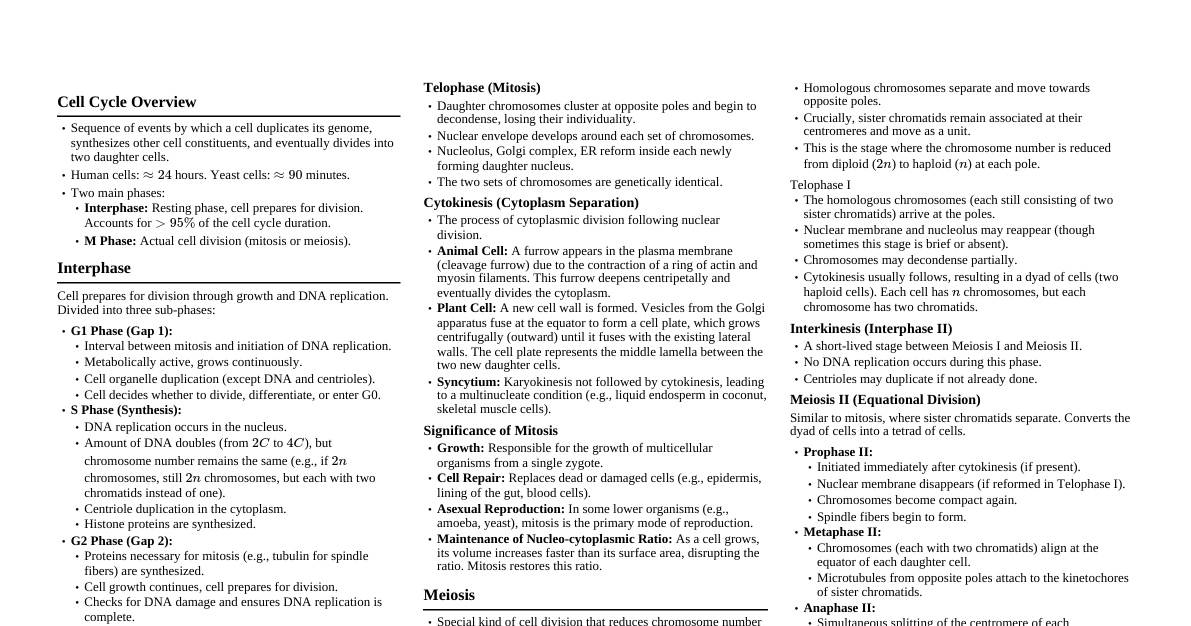
### Introduction to Cell Division - **Definition:** The process by which a parent cell divides into two or more daughter cells. - **Importance:** Growth, repair, reproduction, and development in multicellular organisms. - **Types:** - **Mitosis:** Somatic cell division, results in two identical diploid daughter cells. - **Meiosis:** Germ cell division, results in four haploid daughter cells, genetically diverse. ### The Cell Cycle - **Definition:** The series of events that take place in a cell leading to its division and duplication. - **Phases:** - **Interphase:** Preparatory phase (G1, S, G2) - **M Phase:** Mitosis or Meiosis (Karyokinesis, Cytokinesis) #### Interphase - **G1 Phase (First Gap):** - Cell grows, synthesizes proteins and organelles. - Prepares for DNA replication. - Cell checkpoint: Ensures readiness for S phase. - **S Phase (Synthesis):** - DNA replication occurs. - Chromosome number remains the same, but DNA content doubles (e.g., 2C to 4C). - Each chromosome now consists of two sister chromatids. - **G2 Phase (Second Gap):** - Cell continues to grow and synthesizes proteins required for mitosis. - Prepares for cell division. - Cell checkpoint: Ensures DNA replication is complete and damage-free. - **G0 Phase (Quiescent Stage):** - Cells that do not divide further exit G1 phase and enter G0. - Metabolically active but no longer proliferate (e.g., mature nerve cells, heart cells). ### Mitosis (M-Phase) - **Definition:** Equational division, produces two genetically identical diploid daughter cells from a single diploid parent cell. - **Occurs in:** Somatic cells. - **Purpose:** Growth, repair, asexual reproduction. #### Karyokinesis (Nuclear Division) - **Prophase:** - Chromatin condenses into visible chromosomes. - Centrioles (in animal cells) move to opposite poles, forming aster. - Spindle fibers begin to form. - Nucleolus disappears, nuclear envelope starts to disintegrate. - **Metaphase:** - Chromosomes align at the equatorial plate (metaphase plate). - Each chromosome is attached to spindle fibers from both poles by its kinetochore. - Metaphase checkpoint: Ensures all chromosomes are correctly attached to spindle fibers. - **Anaphase:** - Sister chromatids separate and move to opposite poles. - Now referred to as individual chromosomes. - Centromere divides. - Shortest phase of mitosis. - **Telophase:** - Chromosomes decondense at opposite poles. - Nuclear envelope reforms around each set of chromosomes. - Nucleolus reappears. - Spindle fibers disappear. - Two new nuclei are formed. #### Cytokinesis (Cytoplasmic Division) - **Animal Cells:** - Formation of a cleavage furrow. - Furrow deepens, pinching off the cell into two. - **Plant Cells:** - Formation of a cell plate in the center. - Cell plate grows outwards, fusing with the existing cell wall, dividing the cell. ### Meiosis - **Definition:** Reductional division, produces four haploid daughter cells from a single diploid parent cell. - **Occurs in:** Germ cells (for gamete formation). - **Purpose:** Sexual reproduction, genetic variation. - **Stages:** Meiosis I and Meiosis II. #### Meiosis I (Reductional Division) - **Prophase I:** - Longest and most complex phase. - Sub-stages: - **Leptotene:** Chromatin condenses, chromosomes become visible. - **Zygotene:** Homologous chromosomes pair up (synapsis) to form bivalents (tetrads). Synaptonemal complex forms. - **Pachytene:** Crossing over occurs between non-sister chromatids of homologous chromosomes, leading to genetic recombination. Chiasmata become visible. - **Diplotene:** Synaptonemal complex dissolves, homologous chromosomes begin to separate but remain attached at chiasmata. - **Diakinesis:** Chiasmata terminalize, nuclear envelope and nucleolus disappear, spindle fibers form. - **Metaphase I:** - Homologous chromosome pairs (bivalents) align at the equatorial plate. - Spindle fibers attach to the centromere of each homologous chromosome. - **Anaphase I:** - Homologous chromosomes separate and move to opposite poles. - Sister chromatids remain attached at their centromeres. - **Reductional phase:** Chromosome number is halved. - **Telophase I:** - Chromosomes arrive at the poles, decondense slightly. - Nuclear envelope and nucleolus may reappear. - Followed by cytokinesis, forming two haploid cells. - **Interkinesis:** Short interphase between Meiosis I and Meiosis II, no DNA replication. ### Meiosis II (Equational Division) - Similar to mitosis, but occurs in haploid cells. - **Prophase II:** - Nuclear envelope disappears, chromosomes condense. - Centrioles move to poles, spindle fibers form. - **Metaphase II:** - Chromosomes align at the equatorial plate. - Kinetochores of sister chromatids attach to spindle fibers from opposite poles. - **Anaphase II:** - Sister chromatids separate and move to opposite poles. - Centromere divides. - **Telophase II:** - Chromosomes decondense at poles. - Nuclear envelope reforms, nucleolus reappears. - Followed by cytokinesis. #### Result of Meiosis - Four haploid daughter cells. - Genetically distinct due to crossing over and independent assortment. ### Comparison: Mitosis vs. Meiosis | Feature | Mitosis | Meiosis | |-------------------|---------------------------------------------|--------------------------------------------------| | **Cell Type** | Somatic cells | Germ cells | | **Number of Divisions** | One | Two | | **Daughter Cells**| Two | Four | | **Chromosome Number** | Diploid (2n) -> Diploid (2n) | Diploid (2n) -> Haploid (n) | | **Genetic Identity** | Identical to parent cell | Genetically different from parent cell | | **Crossing Over** | Absent | Present (Prophase I) | | **Homologous Chromosomes** | Do not pair | Pair up (synapsis) in Prophase I | | **Purpose** | Growth, repair, asexual reproduction | Sexual reproduction, genetic variation | ### Significance - **Mitosis:** - Growth and development of multicellular organisms. - Repair of damaged tissues and replacement of old cells. - Asexual reproduction in some organisms. - **Meiosis:** - Maintains constant chromosome number in sexually reproducing organisms (by halving it in gametes). - Increases genetic variation through crossing over and independent assortment, crucial for evolution. - Ensures genetic stability across generations for species.