Rotational Motion Assignment
Shared 5/8/2026•1 views
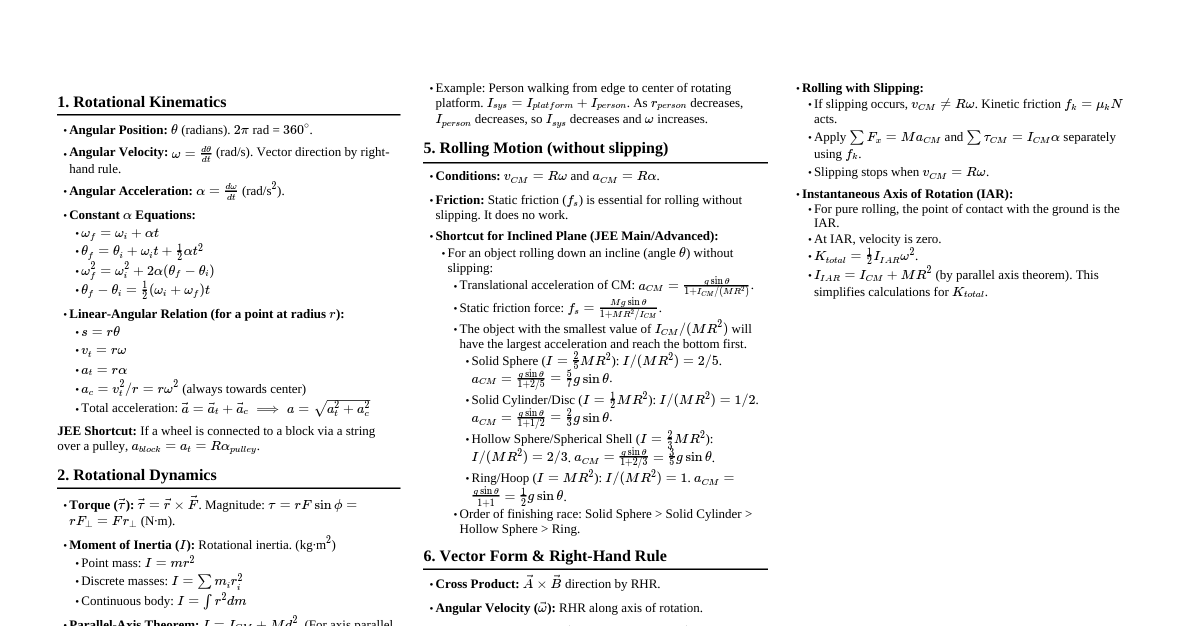
### Rotational Kinematics 1. A rigid body rotates about a fixed axis with an angular acceleration $\alpha(t) = (6t^2 - 2t)$ rad/s$^2$. At $t=0$, the angular velocity is $\omega_0 = 5$ rad/s and the angular position is $\theta_0 = 1$ rad. a. Derive the expressions for angular velocity $\omega(t)$ and angular position $\theta(t)$. b. Calculate the average angular velocity between $t=1$ s and $t=3$ s. c. Determine the instantaneous angular velocity and angular acceleration at $t=2$ s. d. Find the total angular displacement between $t=0$ s and $t=4$ s. ### Moment of Inertia 1. Consider a thin, uniform rod of mass $M$ and length $L$. a. Calculate its moment of inertia about an axis perpendicular to the rod and passing through its center. b. Using the parallel-axis theorem, calculate its moment of inertia about an axis perpendicular to the rod and passing through one end. 2. A composite object consists of a solid cylinder of mass $M_1=2$ kg and radius $R_1=0.1$ m, and a thin ring of mass $M_2=0.5$ kg and radius $R_2=0.15$ m. Both are concentric and rotate about a common axis through their center. a. Determine the moment of inertia of the composite object about this axis. b. If a point mass $m=0.1$ kg is attached to the outer edge of the ring, what is the new moment of inertia? ### Rotational Dynamics 1. A uniform solid sphere of mass $M=5$ kg and radius $R=0.2$ m is initially at rest. A constant tangential force $F=10$ N is applied to its surface for 4 seconds. a. Calculate the angular acceleration of the sphere. b. What is the angular velocity of the sphere after 4 seconds? c. How many revolutions does the sphere complete during this time? 2. A pulley system consists of a solid disk of mass $M=3$ kg and radius $R=0.1$ m. A string is wrapped around its circumference, and a block of mass $m=1$ kg hangs from the string. a. Draw a free-body diagram for both the block and the pulley. b. Apply Newton's second law for linear motion to the block and for rotational motion to the pulley. c. Determine the acceleration of the block and the tension in the string. (Assume no slipping and no friction at the axle). ### Rotational Kinetic Energy and Work 1. A flywheel (solid disk) with mass $M=10$ kg and radius $R=0.3$ m is rotating at 120 rpm. a. Calculate its rotational kinetic energy. b. If a braking torque of $2.5$ N·m is applied, how many revolutions will it make before coming to rest? c. What is the work done by the braking torque? 2. A uniform rod of mass $M$ and length $L$ is pivoted at one end and released from rest in a horizontal position. a. Using conservation of energy, find the angular speed of the rod when it reaches the vertical position. b. What is the linear speed of the free end of the rod at this instant? ### Angular Momentum 1. A particle of mass $m=0.2$ kg moves in the xy-plane with velocity $\vec{v} = (3\hat{i} - 4\hat{j})$ m/s. Its position vector is $\vec{r} = (1\hat{i} + 2\hat{j})$ m. a. Calculate the angular momentum of the particle about the origin. b. If a force $\vec{F} = (5\hat{i} + 2\hat{j})$ N acts on the particle, calculate the torque about the origin. c. Verify that $\vec{\tau} = \frac{d\vec{L}}{dt}$. 2. A figure skater with an initial moment of inertia $I_1=4$ kg·m$^2$ is spinning at $\omega_1=2$ rad/s. She pulls her arms in, reducing her moment of inertia to $I_2=1.5$ kg·m$^2$. a. What is her new angular speed? b. Calculate the change in her rotational kinetic energy. Account for this change. ### Rolling Motion 1. A solid cylinder, a hollow cylinder, and a solid sphere, all having the same mass $M$ and radius $R$, are released from rest at the top of an incline of height $H$. a. Calculate the moment of inertia for each object. b. Using conservation of energy, determine the linear speed of the center of mass for each object when it reaches the bottom of the incline, assuming they roll without slipping. c. Which object reaches the bottom first? Explain why. 2. A billiard ball of mass $m=0.17$ kg and radius $R=0.028$ m is struck by a cue stick such that its initial linear speed is $v_0=5$ m/s and it is not rotating ($\omega_0=0$). The coefficient of kinetic friction between the ball and the table is $\mu_k=0.15$. a. Describe the motion of the ball immediately after being struck. b. Calculate the time it takes for the ball to start rolling without slipping. c. What is the linear speed of the ball once it starts rolling without slipping? ### Final Answers **Rotational Kinematics** 1. a. $\omega(t) = 2t^3 - t^2 + 5$ rad/s; $\theta(t) = \frac{1}{2}t^4 - \frac{1}{3}t^3 + 5t + 1$ rad b. $\omega_{avg} \approx 20.67$ rad/s c. $\omega(2) = 17$ rad/s; $\alpha(2) = 20$ rad/s$^2$ d. $\Delta\theta \approx 126.67$ rad **Moment of Inertia** 1. a. $I_{center} = \frac{1}{12}ML^2$ b. $I_{end} = \frac{1}{3}ML^2$ 2. a. $I_{total} = 0.02125$ kg·m$^2$ b. $I_{new} = 0.0235$ kg·m$^2$ **Rotational Dynamics** 1. a. $\alpha = 25$ rad/s$^2$ b. $\omega = 100$ rad/s c. Revolutions $\approx 31.83$ 2. a. Free-body diagrams should show forces correctly (block: $mg$ down, $T$ up; pulley: $Mg$ down, Normal up, $T$ tangent down) b. Block: $mg - T = ma$; Pulley: $TR = I\alpha$ with $I = \frac{1}{2}MR^2$ and $\alpha = a/R$. c. $a = 3.92$ m/s$^2$; $T = 5.88$ N **Rotational Kinetic Energy and Work** 1. a. $K_{rot} \approx 35.53$ J b. Revolutions $\approx 2.26$ c. $W = -35.53$ J 2. a. $\omega = \sqrt{\frac{3g}{L}}$ b. $v = \sqrt{3gL}$ **Angular Momentum** 1. a. $\vec{L} = -2.0\hat{k}$ kg·m$^2$/s b. $\vec{\tau} = -8\hat{k}$ N·m c. The relation $\vec{\tau} = \frac{d\vec{L}}{dt}$ is verified. 2. a. $\omega_2 \approx 5.33$ rad/s b. $\Delta K \approx 13.31$ J. This energy comes from the internal work done by the skater. **Rolling Motion** 1. a. Solid cylinder: $I_{sc} = \frac{1}{2}MR^2$; Hollow cylinder: $I_{hc} = MR^2$; Solid sphere: $I_{ss} = \frac{2}{5}MR^2$ b. Solid cylinder: $v_{sc} = \sqrt{\frac{4gh}{3}}$; Hollow cylinder: $v_{hc} = \sqrt{gh}$; Solid sphere: $v_{ss} = \sqrt{\frac{10gh}{7}}$ c. The solid sphere reaches the bottom first because it has the smallest moment of inertia relative to its mass and radius ($I/MR^2$), converting more potential energy to translational kinetic energy. 2. a. The ball initially slips, with backward kinetic friction slowing its linear speed and increasing its angular speed until it rolls without slipping. b. $t \approx 0.97$ s c. $v_{final} \approx 3.57$ m/s