Real Numbers Detailed
Cheatsheet Content
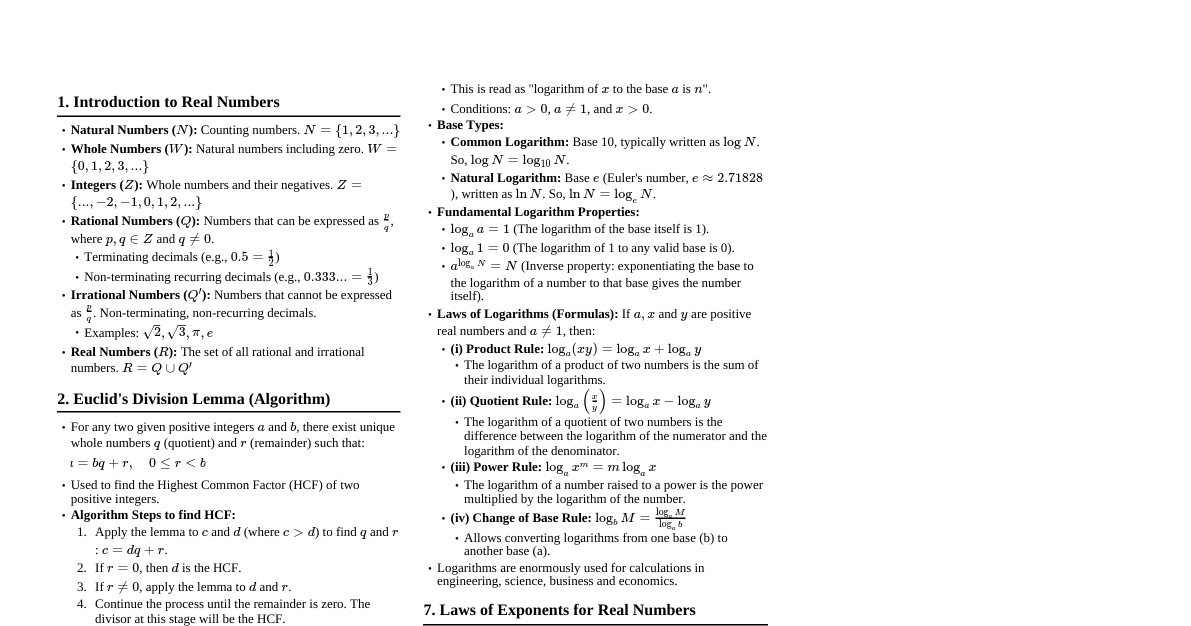
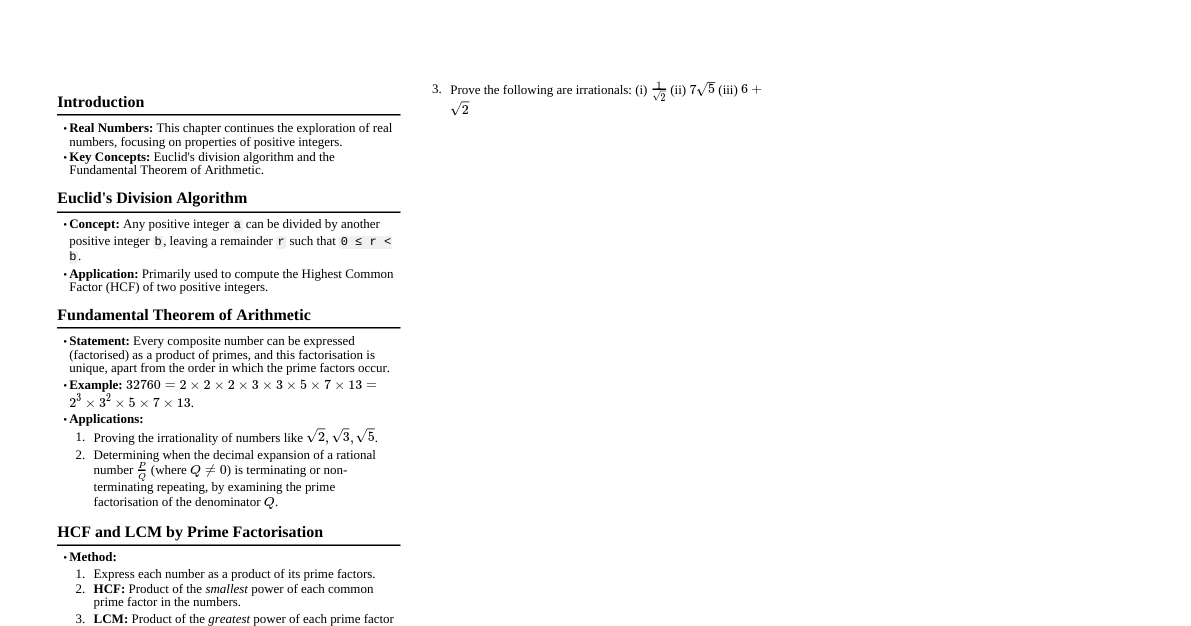
Real Numbers ($\mathbb{R}$) The set of all rational and irrational numbers. They can be represented as points on an infinitely long number line. 1. Number Systems Hierarchy Natural Numbers ($\mathbb{N}$): Counting numbers $\{1, 2, 3, ...\}$ (some definitions include 0). Whole Numbers ($\mathbb{W}$): Natural numbers including zero $\{0, 1, 2, 3, ...\}$. Integers ($\mathbb{Z}$): Whole numbers and their negatives $\{..., -2, -1, 0, 1, 2, ...\}$. Rational Numbers ($\mathbb{Q}$): Numbers that can be expressed as a fraction $p/q$ where $p, q \in \mathbb{Z}$ and $q \neq 0$. Decimal representation is terminating or repeating (e.g., $0.5$, $0.333...$). Irrational Numbers ($\mathbb{I}$): Numbers that cannot be expressed as a simple fraction. Decimal representation is non-terminating and non-repeating (e.g., $\sqrt{2} \approx 1.41421356...$, $\pi \approx 3.14159265...$, $e \approx 2.71828182...$). Real Numbers ($\mathbb{R}$): $\mathbb{Q} \cup \mathbb{I}$. Complex Numbers ($\mathbb{C}$): Numbers of the form $a + bi$, where $a, b \in \mathbb{R}$ and $i = \sqrt{-1}$. 2. Properties of Real Numbers 2.1. Algebraic Properties (Field Axioms) For any real numbers $a, b, c \in \mathbb{R}$: Closure: Addition: $a+b \in \mathbb{R}$ Multiplication: $a \cdot b \in \mathbb{R}$ Commutativity: Addition: $a+b = b+a$ Multiplication: $a \cdot b = b \cdot a$ Associativity: Addition: $(a+b)+c = a+(b+c)$ Multiplication: $(a \cdot b) \cdot c = a \cdot (b \cdot c)$ Identity Elements: Additive Identity: $a+0 = a$ (0 is the unique additive identity) Multiplicative Identity: $a \cdot 1 = a$ (1 is the unique multiplicative identity) Inverse Elements: Additive Inverse: For every $a$, there exists $-a$ such that $a+(-a) = 0$ Multiplicative Inverse: For every $a \neq 0$, there exists $a^{-1}$ such that $a \cdot a^{-1} = 1$ Distributivity: $a \cdot (b+c) = a \cdot b + a \cdot c$ 2.2. Order Properties Real numbers are an ordered field. For any $a, b, c \in \mathbb{R}$: Trichotomy Law: Exactly one of these is true: $a b$. Transitivity: If $a Addition: If $a Multiplication: If $a 0$, then $ac If $a bc$. 2.3. Completeness Property Every non-empty set of real numbers that is bounded above has a least upper bound (supremum) in $\mathbb{R}$. Similarly, every non-empty set of real numbers that is bounded below has a greatest lower bound (infimum) in $\mathbb{R}$. This property distinguishes real numbers from rational numbers (e.g., the set $\{x \in \mathbb{Q} : x^2 3. Intervals of Real Numbers Subsets of real numbers that contain all real numbers between two specified endpoints. Notation Inequality Description $[a, b]$ $a \le x \le b$ Closed interval (includes endpoints) $(a, b)$ $a Open interval (excludes endpoints) $[a, b)$ $a \le x Half-open/half-closed $(a, b]$ $a Half-open/half-closed $[a, \infty)$ $x \ge a$ Unbounded above $(a, \infty)$ $x > a$ Unbounded above (excludes $a$) $(-\infty, b]$ $x \le b$ Unbounded below $(-\infty, b)$ $x Unbounded below (excludes $b$) $(-\infty, \infty)$ All real numbers $\mathbb{R}$ 4. Absolute Value The absolute value of a real number $x$, denoted $|x|$, is its distance from zero on the number line. Definition: $$|x| = \begin{cases} x & \text{if } x \ge 0 \\ -x & \text{if } x Properties: $|x| \ge 0$ $|x| = |-x|$ $|x \cdot y| = |x| \cdot |y|$ $|x/y| = |x|/|y|$ (for $y \neq 0$) $|x+y| \le |x|+|y|$ (Triangle Inequality) $|x-y| \ge ||x|-|y||$ If $|x| = a$ (where $a > 0$), then $x = a$ or $x = -a$. If $|x| 0$), then $-a If $|x| > a$ (where $a > 0$), then $x a$. 5. Exponents and Roots 5.1. Integer Exponents $a^n = a \cdot a \cdot ... \cdot a$ ($n$ times) for $n \in \mathbb{N}$ $a^0 = 1$ (for $a \neq 0$) $a^{-n} = 1/a^n$ (for $a \neq 0$) 5.2. Rational Exponents (Roots) $a^{1/n} = \sqrt[n]{a}$ (the $n$-th root of $a$) If $n$ is even, $a \ge 0$. If $n$ is odd, $a$ can be any real number. $a^{m/n} = (\sqrt[n]{a})^m = \sqrt[n]{a^m}$ 5.3. Properties of Exponents $a^m \cdot a^n = a^{m+n}$ $(a^m)^n = a^{mn}$ $(ab)^n = a^n b^n$ $(a/b)^n = a^n / b^n$ $a^m / a^n = a^{m-n}$ 6. Logarithms If $b^y = x$, then $\log_b x = y$. ($b > 0, b \neq 1, x > 0$). Common Logarithm: $\log x = \log_{10} x$ Natural Logarithm: $\ln x = \log_e x$ (where $e \approx 2.71828$) 6.1. Properties of Logarithms $\log_b (MN) = \log_b M + \log_b N$ $\log_b (M/N) = \log_b M - \log_b N$ $\log_b (M^p) = p \log_b M$ $\log_b b = 1$ $\log_b 1 = 0$ Change of Base Formula: $\log_b x = \frac{\log_c x}{\log_c b}$