Real Numbers
Cheatsheet Content
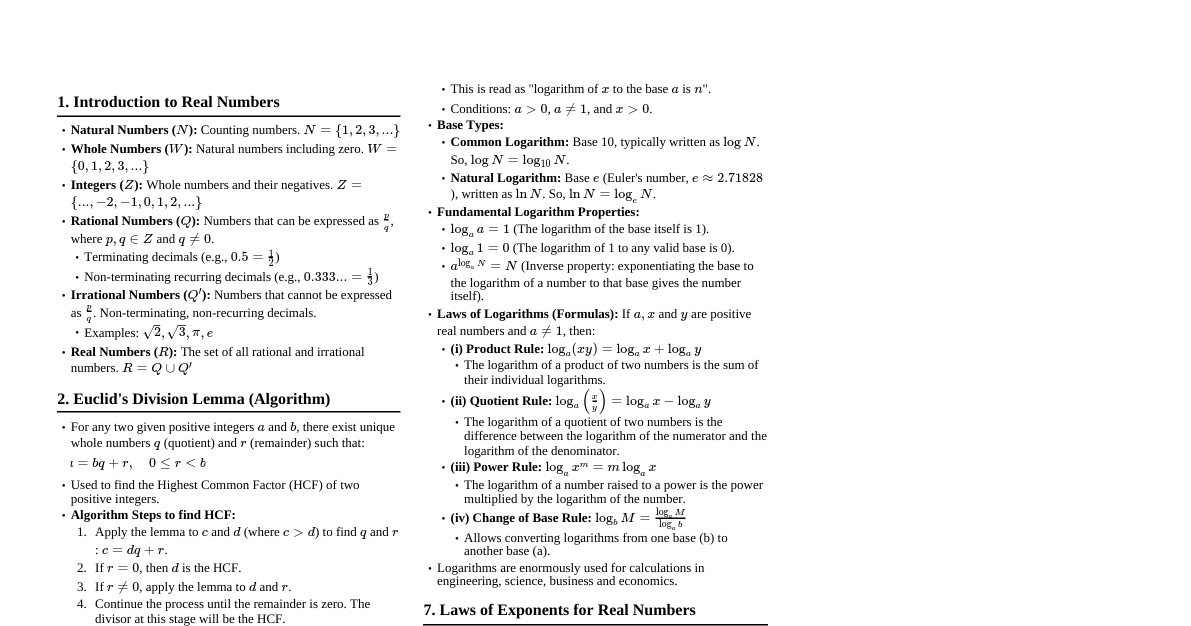
### Introduction - **Real Numbers:** This chapter continues the exploration of real numbers, focusing on properties of positive integers. - **Key Concepts:** Euclid's division algorithm and the Fundamental Theorem of Arithmetic. ### Euclid's Division Algorithm - **Concept:** Any positive integer `a` can be divided by another positive integer `b`, leaving a remainder `r` such that `0 ≤ r ### Fundamental Theorem of Arithmetic - **Statement:** Every composite number can be expressed (factorised) as a product of primes, and this factorisation is unique, apart from the order in which the prime factors occur. - **Example:** $32760 = 2 \times 2 \times 2 \times 3 \times 3 \times 5 \times 7 \times 13 = 2^3 \times 3^2 \times 5 \times 7 \times 13$. - **Applications:** 1. Proving the irrationality of numbers like $\sqrt{2}, \sqrt{3}, \sqrt{5}$. 2. Determining when the decimal expansion of a rational number $\frac{P}{Q}$ (where $Q \ne 0$) is terminating or non-terminating repeating, by examining the prime factorisation of the denominator $Q$. ### HCF and LCM by Prime Factorisation - **Method:** 1. Express each number as a product of its prime factors. 2. **HCF:** Product of the *smallest* power of each common prime factor in the numbers. 3. **LCM:** Product of the *greatest* power of each prime factor involved in the numbers. - **Relationship:** For any two positive integers `a` and `b`, $HCF(a, b) \times LCM(a, b) = a \times b$. - This relationship does **not** hold for three or more numbers. - **Example 1: HCF and LCM of 6 and 20** - $6 = 2^1 \times 3^1$ - $20 = 2^2 \times 5^1$ - $HCF(6, 20) = 2^1 = 2$ - $LCM(6, 20) = 2^2 \times 3^1 \times 5^1 = 60$ ### Revisiting Irrational Numbers - **Definition:** A number 's' is called irrational if it cannot be written in the form $\frac{P}{Q}$, where `p` and `q` are integers and $q \ne 0$. - **Examples:** $\sqrt{2}, \sqrt{3}, \sqrt{15}, \pi$, $0.10110111011110...$ - **Theorem 1.2:** If `p` is a prime number and `p` divides $a^2$, then `p` divides `a`, where `a` is a positive integer. (This theorem is crucial for proving irrationality). - **Proof Technique:** Proof by contradiction. #### Proving $\sqrt{2}$ is Irrational 1. **Assume:** $\sqrt{2}$ is rational, so $\sqrt{2} = \frac{a}{b}$ where `a` and `b` are coprime integers ($b \ne 0$). 2. **Rearrange & Square:** $b\sqrt{2} = a \implies 2b^2 = a^2$. 3. **Implication:** $a^2$ is divisible by 2, so by Theorem 1.2, `a` is divisible by 2. Let $a = 2c$ for some integer `c`. 4. **Substitute:** $2b^2 = (2c)^2 \implies 2b^2 = 4c^2 \implies b^2 = 2c^2$. 5. **Implication:** $b^2$ is divisible by 2, so by Theorem 1.2, `b` is divisible by 2. 6. **Contradiction:** Both `a` and `b` are divisible by 2, contradicting the assumption that `a` and `b` are coprime. 7. **Conclusion:** The initial assumption that $\sqrt{2}$ is rational must be false. Therefore, $\sqrt{2}$ is irrational. #### Proving $5 - \sqrt{3}$ is Irrational 1. **Assume:** $5 - \sqrt{3}$ is rational. Let $5 - \sqrt{3} = \frac{a}{b}$, where `a` and `b` are coprime integers ($b \ne 0$). 2. **Rearrange:** $\sqrt{3} = 5 - \frac{a}{b} = \frac{5b - a}{b}$. 3. **Implication:** Since `a` and `b` are integers, $\frac{5b - a}{b}$ is rational. This implies $\sqrt{3}$ is rational. 4. **Contradiction:** We know $\sqrt{3}$ is irrational. 5. **Conclusion:** $5 - \sqrt{3}$ is irrational. #### Proving $3\sqrt{2}$ is Irrational 1. **Assume:** $3\sqrt{2}$ is rational. Let $3\sqrt{2} = \frac{a}{b}$, where `a` and `b` are coprime integers ($b \ne 0$). 2. **Rearrange:** $\sqrt{2} = \frac{a}{3b}$. 3. **Implication:** Since `a`, `b`, and 3 are integers, $\frac{a}{3b}$ is rational. This implies $\sqrt{2}$ is rational. 4. **Contradiction:** We know $\sqrt{2}$ is irrational. 5. **Conclusion:** $3\sqrt{2}$ is irrational. #### Properties of Irrationals - The sum or difference of a rational and an irrational number is irrational. - The product and quotient of a non-zero rational and irrational number is irrational. ### Exercises 1. Prove that $\sqrt{5}$ is irrational. 2. Prove that $3 + 2\sqrt{5}$ is irrational. 3. Prove the following are irrationals: (i) $\frac{1}{\sqrt{2}}$ (ii) $7\sqrt{5}$ (iii) $6 + \sqrt{2}$