Real Numbers - Telangana SSC
Cheatsheet Content
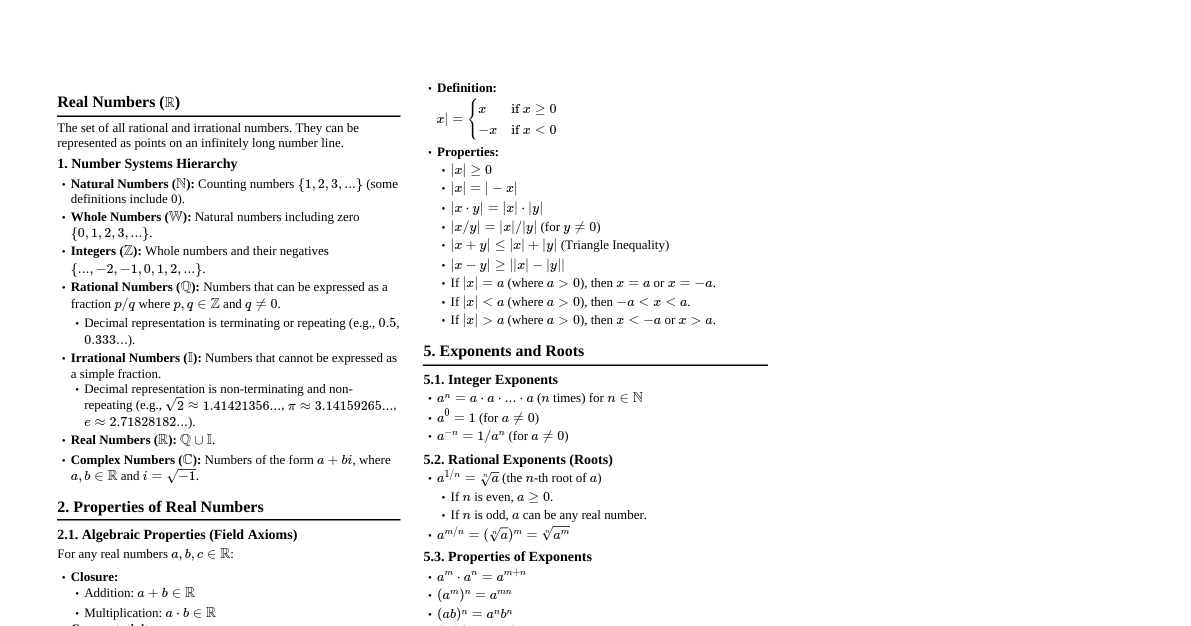
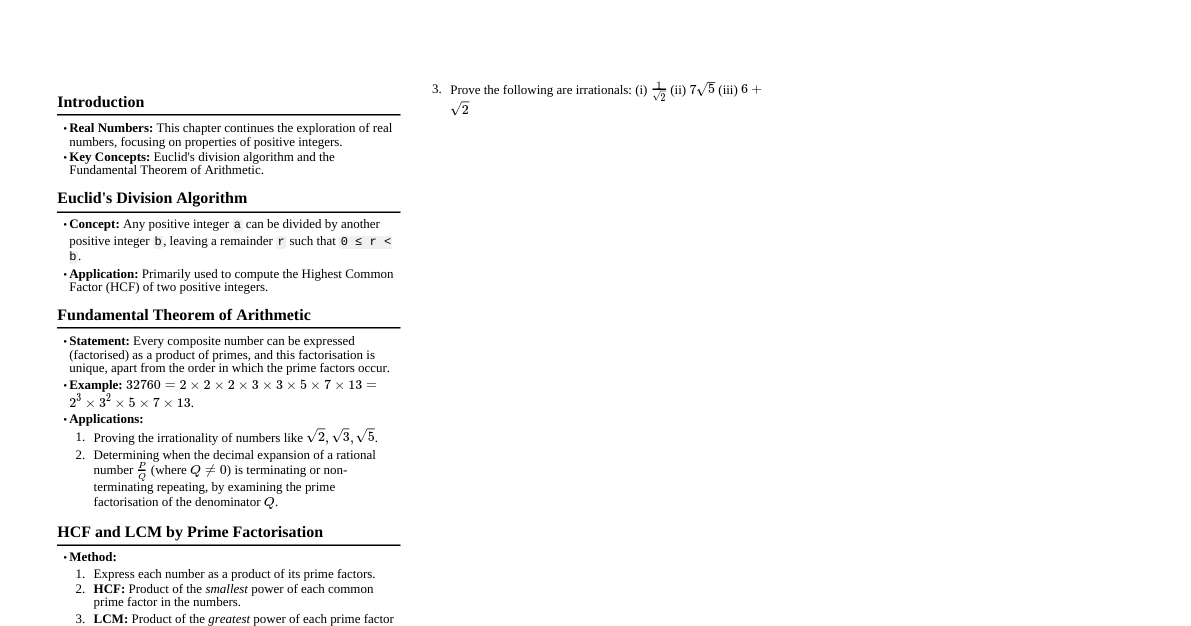
1. Introduction to Real Numbers Natural Numbers ($N$): Counting numbers. $N = \{1, 2, 3, ...\}$ Whole Numbers ($W$): Natural numbers including zero. $W = \{0, 1, 2, 3, ...\}$ Integers ($Z$): Whole numbers and their negatives. $Z = \{..., -2, -1, 0, 1, 2, ...\}$ Rational Numbers ($Q$): Numbers that can be expressed as $\frac{p}{q}$, where $p, q \in Z$ and $q \neq 0$. Terminating decimals (e.g., $0.5 = \frac{1}{2}$) Non-terminating recurring decimals (e.g., $0.333... = \frac{1}{3}$) Irrational Numbers ($Q'$): Numbers that cannot be expressed as $\frac{p}{q}$. Non-terminating, non-recurring decimals. Examples: $\sqrt{2}, \sqrt{3}, \pi, e$ Real Numbers ($R$): The set of all rational and irrational numbers. $R = Q \cup Q'$ 2. Euclid's Division Lemma (Algorithm) For any two given positive integers $a$ and $b$, there exist unique whole numbers $q$ (quotient) and $r$ (remainder) such that: $$a = bq + r, \quad 0 \le r Used to find the Highest Common Factor (HCF) of two positive integers. Algorithm Steps to find HCF: Apply the lemma to $c$ and $d$ (where $c > d$) to find $q$ and $r$: $c = dq + r$. If $r = 0$, then $d$ is the HCF. If $r \neq 0$, apply the lemma to $d$ and $r$. Continue the process until the remainder is zero. The divisor at this stage will be the HCF. 3. Fundamental Theorem of Arithmetic Every composite number can be expressed (factorized) as a product of primes, and this factorization is unique, apart from the order in which the prime factors occur. Example: $12 = 2 \times 2 \times 3 = 2^2 \times 3$ Applications: Finding HCF and LCM of numbers using prime factorization. If $x = p_1^{a_1} p_2^{a_2} ... p_k^{a_k}$ and $y = p_1^{b_1} p_2^{b_2} ... p_k^{b_k}$, where $p_i$ are prime numbers and $a_i, b_i \ge 0$. Highest Common Factor (HCF): The product of the smallest power of each common prime factor in the numbers. $$\text{HCF}(x, y) = p_1^{\min(a_1, b_1)} p_2^{\min(a_2, b_2)} ... p_k^{\min(a_k, b_k)}$$ Lowest Common Multiple (LCM): The product of the greatest power of each prime factor involved in the numbers. $$\text{LCM}(x, y) = p_1^{\max(a_1, b_1)} p_2^{\max(a_2, b_2)} ... p_k^{\max(a_k, b_k)}$$ For any two positive integers $a, b$: $\text{HCF}(a, b) \times \text{LCM}(a, b) = a \times b$ Note: This relation holds only for two numbers. 4. Revisiting Irrational Numbers A number $s$ is irrational if it cannot be written in the form $\frac{p}{q}$, where $p$ and $q$ are integers and $q \neq 0$. Theorem: If $p$ is a prime number and $p$ divides $a^2$, then $p$ divides $a$, where $a$ is a positive integer. Proof by Contradiction: Used to prove numbers like $\sqrt{2}, \sqrt{3}, \sqrt{5}$ are irrational. Assume the number is rational (e.g., $\sqrt{2} = \frac{a}{b}$ where $a, b$ are coprime integers). Derive a contradiction to the initial assumption (e.g., $a$ and $b$ both sharing a common factor, contradicting they are coprime). Conclude that the initial assumption was false, hence the number is irrational. 5. Revisiting Rational Numbers and Their Decimal Expansions Theorem 1: Let $x = \frac{p}{q}$ be a rational number, such that the prime factorization of the denominator $q$ is of the form $2^n 5^m$, where $n, m$ are non-negative integers. Then $x$ has a terminating decimal expansion. Theorem 2: Let $x = \frac{p}{q}$ be a rational number, such that the prime factorization of the denominator $q$ is NOT of the form $2^n 5^m$, where $n, m$ are non-negative integers. Then $x$ has a non-terminating repeating (recurring) decimal expansion. These theorems help determine if a rational number's decimal expansion is terminating or non-terminating without actual division. Example: $\frac{3}{8} = \frac{3}{2^3 5^0}$ (terminating) $\frac{1}{7}$ (non-terminating recurring, since 7 is not $2^n 5^m$) 6. Logarithms: Definition and Rules Definition: Logarithms are the inverse operation to exponentiation. Exponential Form: $a^n = x$ Logarithmic Form: $\log_a x = n$ This is read as "logarithm of $x$ to the base $a$ is $n$". Conditions: $a > 0$, $a \neq 1$, and $x > 0$. Base Types: Common Logarithm: Base 10, typically written as $\log N$. So, $\log N = \log_{10} N$. Natural Logarithm: Base $e$ (Euler's number, $e \approx 2.71828$), written as $\ln N$. So, $\ln N = \log_e N$. Fundamental Logarithm Properties: $\log_a a = 1$ (The logarithm of the base itself is 1). $\log_a 1 = 0$ (The logarithm of 1 to any valid base is 0). $a^{\log_a N} = N$ (Inverse property: exponentiating the base to the logarithm of a number to that base gives the number itself). Laws of Logarithms (Formulas): If $a, x$ and $y$ are positive real numbers and $a \neq 1$, then: (i) Product Rule: $\log_a (xy) = \log_a x + \log_a y$ The logarithm of a product of two numbers is the sum of their individual logarithms. (ii) Quotient Rule: $\log_a \left(\frac{x}{y}\right) = \log_a x - \log_a y$ The logarithm of a quotient of two numbers is the difference between the logarithm of the numerator and the logarithm of the denominator. (iii) Power Rule: $\log_a x^m = m \log_a x$ The logarithm of a number raised to a power is the power multiplied by the logarithm of the number. (iv) Change of Base Rule: $\log_b M = \frac{\log_a M}{\log_a b}$ Allows converting logarithms from one base (b) to another base (a). Logarithms are enormously used for calculations in engineering, science, business and economics. 7. Laws of Exponents for Real Numbers If $a, b$ are real numbers, where $a \neq 0, b \neq 0$, and $m, n$ are integers, then: (i) Product Rule: $a^m \cdot a^n = a^{m+n}$ (ii) Quotient Rule: $\frac{a^m}{a^n} = a^{m-n}$ (iii) Power of a Power Rule: $(a^m)^n = a^{mn}$ (iv) Power of a Product Rule: $(ab)^m = a^m b^m$ (v) Power of a Quotient Rule: $\left(\frac{a}{b}\right)^m = \frac{a^m}{b^m}$ (vi) Zero Exponent: $a^0 = 1$ (for $a \neq 0$) (vii) Negative Exponent: $a^{-m} = \frac{1}{a^m}$ (for $a \neq 0$)