P-Block Elements (NCERT)
Cheatsheet Content
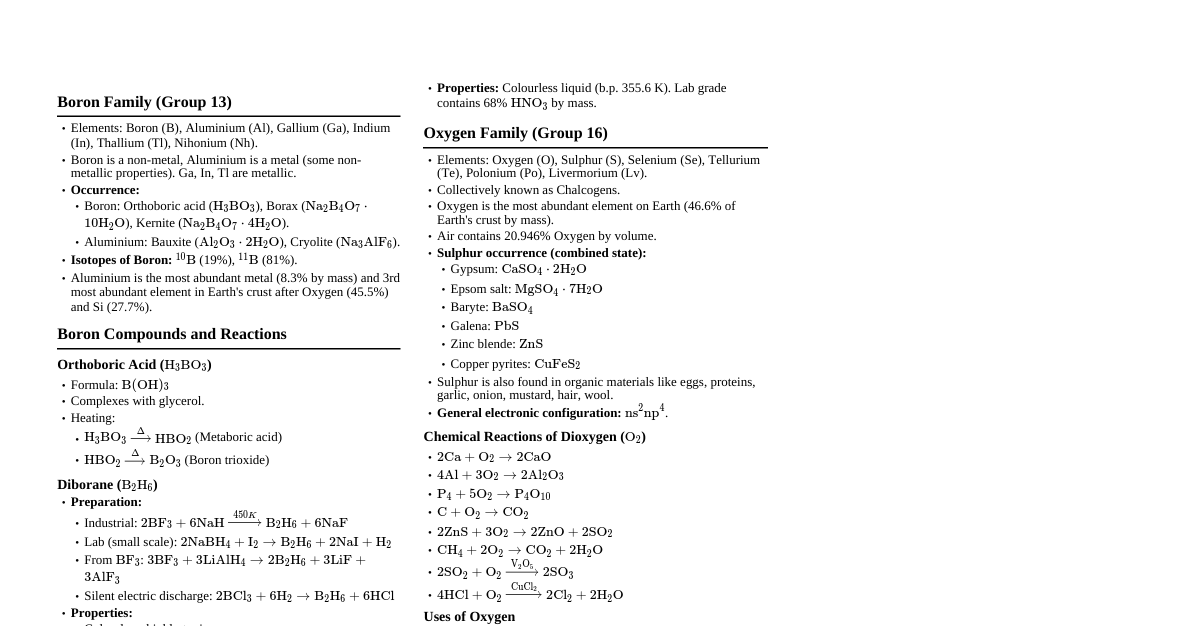
### Group 13 Elements: The Boron Family - **Electronic Configuration:** $[Ne] 3s^2 3p^1$ to $[Xe] 6s^2 6p^1$ - **Atomic and Ionic Radii:** Increase down the group. Ga has slightly smaller radius than Al due to poor shielding of d-electrons. - **Ionization Enthalpy:** Decreases from B to Al, then increases slightly for Ga, In, and Tl (due to d and f electrons). - **Electronegativity:** Decreases from B to Al, then increases slightly down the group. - **Oxidation States:** +3 is common. +1 becomes more stable down the group (inert pair effect, e.g., Tl+). - **Chemical Reactivity:** - **Air:** Form oxides ($M_2O_3$) and nitrides. Boron is unreactive in crystalline form. - **Acids/Bases:** Al dissolves in both (amphoteric). B is unreactive with acids/bases. - **Halogens:** Form trihalides ($MX_3$). #### Important Compounds of Boron - **Borax ($Na_2B_4O_7 \cdot 10H_2O$):** - **Structure:** Contains $B_4O_5(OH)_4^{2-}$ units. - **Borax Bead Test:** $Na_2B_4O_7 \xrightarrow{\Delta} 2NaBO_2 + B_2O_3$. $B_2O_3$ forms colored beads with transition metal oxides. - **Boric Acid ($H_3BO_3$):** - **Preparation:** From borax with acid. $Na_2B_4O_7 + 2HCl + 5H_2O \rightarrow 2NaCl + 4H_3BO_3$. - **Structure:** Planar $BO_3$ units linked by H-bonds. - **Nature:** Weak monobasic Lewis acid (accepts $OH^-$). $B(OH)_3 + 2H_2O \rightleftharpoons [B(OH)_4]^- + H_3O^+$. - **Diborane ($B_2H_6$):** - **Preparation:** $2NaBH_4 + I_2 \rightarrow B_2H_6 + 2NaI + H_2$. - **Structure:** Two $BH_2$ groups linked by two bridging H atoms (banana bonds, 3-centre-2-electron bonds). - **Reactions:** Reacts with water to form boric acid, with ammonia to form borazine ($B_3N_3H_6$, inorganic benzene). #### Uses of Boron and Aluminium - **Boron:** Bulletproof vests, light composite materials, nuclear reactors (control rods). - **Aluminium:** Alloys (duralumin, magnalium), packaging, electrical cables, paints. ### Group 14 Elements: The Carbon Family - **Electronic Configuration:** $ns^2 np^2$. - **Covalency:** Generally +4. +2 becomes more stable down the group (inert pair effect). - **Allotropy:** C (diamond, graphite, fullerenes), Sn (white, grey, rhombic), Pb (none). - **Catenation:** Maximum for Carbon, decreases down the group. - **Atomic and Ionic Radii:** Increase down the group. - **Ionization Enthalpy:** Decreases down the group. - **Electronegativity:** Slightly decreases down the group. - **Oxidation States:** +4 and +2. +2 stability increases from Si to Pb. - **Reactivity towards Oxygen:** Form monoxides (CO, SiO, GeO, SnO, PbO) and dioxides ($CO_2, SiO_2, GeO_2, SnO_2, PbO_2$). - $CO_2$ is acidic, $SiO_2$ is acidic, $GeO_2$ is acidic, $SnO_2$ is amphoteric, $PbO_2$ is amphoteric. - **Reactivity towards Halogens:** Form tetrahalides ($MX_4$) and dihalides ($MX_2$). $CX_4$ are generally stable. $PbI_4$ does not exist. - **Reactivity towards Water:** C, Si, Ge are unaffected. Sn reacts with steam. Pb is unaffected. #### Important Compounds - **Carbon:** - **Carbon Monoxide (CO):** Colorless, odorless, poisonous. Forms carbonyls with transition metals. - **Carbon Dioxide ($CO_2$):** Acidic oxide, greenhouse gas. - **Silicon Dioxide ($SiO_2$, Silica):** Covalent 3D network structure. Quartz, cristobalite, tridymite. - **Silicones:** Organosilicon polymers with $R_2SiO$ repeating units. Water repellent, heat resistant. - **Silicates:** Minerals containing $SiO_4^{4-}$ units (orthosilicates, pyrosilicates, cyclic, chain, sheet, 3D). - **Zeolites:** Alumino-silicates, 3D network, used as catalysts, ion exchangers. ZSM-5 converts alcohol to gasoline. - **Tin (Sn):** Used in solders, plating. - **Lead (Pb):** Used in batteries, alloys. #### Allotropes of Carbon - **Diamond:** Hardest known substance, covalent 3D network, $sp^3$ hybridization, insulator. - **Graphite:** Soft, layered structure, $sp^2$ hybridization, good conductor (due to delocalized $\pi$ electrons), lubricant. - **Fullerenes:** Cage-like molecules ($C_{60}$ Buckminsterfullerene), $sp^2$ hybridized. ### Group 15 Elements: The Nitrogen Family - **Electronic Configuration:** $ns^2 np^3$. - **Atomic and Ionic Radii:** Increase down the group. - **Ionization Enthalpy:** Decreases down the group. - **Electronegativity:** Decreases down the group. - **Oxidation States:** -3, +3, +5. - Stability of -3 decreases down the group. - Stability of +5 decreases down the group (inert pair effect). - Stability of +3 increases down the group. - **Anomalous behavior of Nitrogen:** Small size, high electronegativity, high ionization enthalpy, absence of d-orbitals. Forms $p\pi-p\pi$ multiple bonds (N≡N). - **Reactivity towards Hydrogen:** Form hydrides ($EH_3$). Basic character decreases down the group. Bond angle decreases down the group. - **Reactivity towards Oxygen:** Form various oxides ($N_2O, NO, N_2O_3, NO_2, N_2O_4, N_2O_5$). Acidic character decreases down the group. - **Reactivity towards Halogens:** Form trihalides ($EX_3$) and pentahalides ($EX_5$). $NCl_3$ is explosive. $BiF_5$ is stable. - **Reactivity towards Metals:** Form binary compounds with metals (e.g., $Ca_3N_2, Ca_3P_2$). #### Important Compounds of Nitrogen - **Dinitrogen ($N_2$):** - **Preparation:** $NH_4Cl + NaNO_2 \rightarrow N_2 + 2H_2O + NaCl$. - **Properties:** Inert, used in food packaging, cryosurgery. - **Ammonia ($NH_3$):** - **Preparation:** Haber's process ($N_2 + 3H_2 \rightleftharpoons 2NH_3$). - **Structure:** Pyramidal, $sp^3$ hybridized, one lone pair. - **Properties:** Basic, forms coordinate compounds. - **Nitric Acid ($HNO_3$):** - **Preparation:** Ostwald process. - **Properties:** Strong oxidizing agent. Reacts with metals depending on concentration. - **Oxides of Nitrogen:** - $N_2O$ (Nitrous oxide): Laughing gas, neutral. - $NO$ (Nitric oxide): Neutral. - $N_2O_3$ (Dinitrogen trioxide): Blue solid, acidic. - $NO_2$ (Nitrogen dioxide): Brown gas, acidic. - $N_2O_4$ (Dinitrogen tetraoxide): Colorless solid/liquid, acidic. - $N_2O_5$ (Dinitrogen pentaoxide): Colorless solid, acidic. #### Important Compounds of Phosphorus - **Allotropes:** White (reactive, tetrahedral $P_4$), Red (polymeric, less reactive), Black (most stable). - **Phosphine ($PH_3$):** - **Preparation:** $Ca_3P_2 + 6H_2O \rightarrow 3Ca(OH)_2 + 2PH_3$. - **Properties:** Highly poisonous, weak base. - **Phosphorus Halides:** - **Phosphorus Trichloride ($PCl_3$):** Pyramidal. $P_4 + 6Cl_2 \rightarrow 4PCl_3$. - **Phosphorus Pentachloride ($PCl_5$):** Trigonal bipyramidal (gas/liquid), ionic ($[PCl_4]^+[PCl_6]^-$) in solid state. - **Oxoacids of Phosphorus:** - **Hypophosphorous acid ($H_3PO_2$):** Monobasic, reducing agent. - **Phosphorous acid ($H_3PO_3$):** Dibasic, reducing agent. - **Orthophosphoric acid ($H_3PO_4$):** Tribasic. ### Group 16 Elements: The Oxygen Family (Chalcogens) - **Electronic Configuration:** $ns^2 np^4$. - **Atomic and Ionic Radii:** Increase down the group. - **Ionization Enthalpy:** Decreases down the group. - **Electronegativity:** Decreases down the group. Oxygen is second most electronegative. - **Oxidation States:** -2, +2, +4, +6. - -2 is common for O, S, Se. - Stability of +4 increases down the group. - Stability of +6 decreases down the group (inert pair effect). - **Anomalous behavior of Oxygen:** Small size, high electronegativity, absence of d-orbitals. Forms H-bonds. - **Hydrides ($H_2E$):** $H_2O, H_2S, H_2Se, H_2Te$. Acidic character increases down the group. Thermal stability decreases down the group. $H_2O$ is liquid due to H-bonding. - **Oxides:** Oxygen forms various oxides. Other elements form $EO_2$ and $EO_3$. acidic character decreases down the group. - **Halides:** Form $EX_6, EX_4, EX_2$. $SF_6$ is exceptionally stable. #### Important Compounds - **Dioxygen ($O_2$):** - **Preparation:** $2H_2O_2 \xrightarrow{MnO_2} 2H_2O + O_2$. - **Properties:** Paramagnetic, supports combustion. - **Ozone ($O_3$):** - **Preparation:** $3O_2 \xrightarrow{silent \ discharge} 2O_3$. - **Structure:** Bent, resonance stabilized. - **Properties:** Powerful oxidizing agent, absorbs UV radiation. - **Sulphur:** - **Allotropes:** Rhombic (alpha), Monoclinic (beta), Plastic. Rhombic is most stable. - **Sulphur Dioxide ($SO_2$):** - **Preparation:** $S + O_2 \rightarrow SO_2$. - **Properties:** Acidic, reducing agent (oxidizing agent with strong reducing agents), bleaching agent. - **Sulphuric Acid ($H_2SO_4$):** - **Preparation:** Contact process. - **Properties:** Strong acid, dehydrating agent, oxidizing agent. - **Oxoacids of Sulphur:** $H_2SO_3$ (sulphurous acid), $H_2SO_4$ (sulphuric acid), $H_2S_2O_7$ (oleum), $H_2S_2O_8$ (peroxodisulphuric acid). ### Group 17 Elements: The Halogen Family - **Electronic Configuration:** $ns^2 np^5$. - **Atomic and Ionic Radii:** Increase down the group. - **Ionization Enthalpy:** Decreases down the group. - **Electronegativity:** Decreases down the group. Fluorine is most electronegative. - **Electron Gain Enthalpy:** Highly negative, Cl has highest negative electron gain enthalpy. - **Oxidation States:** -1 (common). +1, +3, +5, +7 (Cl, Br, I). Fluorine only shows -1. - **Anomalous behavior of Fluorine:** Small size, highest electronegativity, absence of d-orbitals, high dissociation enthalpy of $F_2$. - **Reactivity toward Hydrogen:** Form hydrogen halides ($HX$). Acidic strength increases from HF to HI. Boiling point: HF > HI > HBr > HCl (due to H-bonding in HF). - **Reactivity towards Oxygen:** Form various oxides (e.g., $OF_2, Cl_2O, ClO_2, Cl_2O_7, I_2O_5$). - **Reactivity towards Metals:** Form metal halides ($MX, MX_2, MX_3$). - **Reactivity towards other Halogens:** Form interhalogen compounds (e.g., $ClF_3, BrF_5, IF_7$). #### Important Compounds - **Chlorine ($Cl_2$):** - **Preparation:** Deacon's process ($4HCl + O_2 \xrightarrow{CuCl_2} 2Cl_2 + 2H_2O$). - **Properties:** Oxidizing agent, bleaching agent. - **Hydrogen Chloride ($HCl$):** - **Preparation:** $NaCl + H_2SO_4 \xrightarrow{420K} NaHSO_4 + HCl$. - **Properties:** Strong acid. - **Oxoacids of Halogens:** - Hypohalous acids ($HOX$): $HClO$ - Halous acids ($HOXO$): $HClO_2$ - Halic acids ($HOXO_2$): $HClO_3$ - Perhalic acids ($HOXO_3$): $HClO_4$ - Acidic strength increases with oxidation state ($HClO ### Group 18 Elements: The Noble Gases - **Electronic Configuration:** $ns^2 np^6$ (except He, $1s^2$). - **Atomic Radii:** Increase down the group. - **Ionization Enthalpy:** Very high, decreases down the group. - **Electron Gain Enthalpy:** Positive (no tendency to accept electrons). - **Boiling Points:** Very low, increase down the group. - **Chemical Properties:** Extremely unreactive due to stable electronic configuration. - **Discovery of Noble Gas Compounds:** Neil Bartlett prepared $XePtF_6$. - **Compounds of Xenon:** - **Xenon Fluorides:** $XeF_2, XeF_4, XeF_6$. - **$XeF_2$:** Linear. - **$XeF_4$:** Square planar. - **$XeF_6$:** Distorted octahedral. - **Xenon Oxides:** $XeO_3$ (pyramidal), $XeOF_4$ (square pyramidal). - **Xenon Oxyfluorides:** $XeO_2F_2$ (seesaw). - **Uses:** - **Helium:** Non-flammable, lighter-than-air, used in balloons, cryogenics, diving apparatus. - **Neon:** Neon signs. - **Argon:** Inert atmosphere for welding, light bulbs. - **Krypton & Xenon:** Special purpose lamps. - **Radon:** Radioactive, used in cancer therapy.