D- and F-Block Elements
Cheatsheet Content
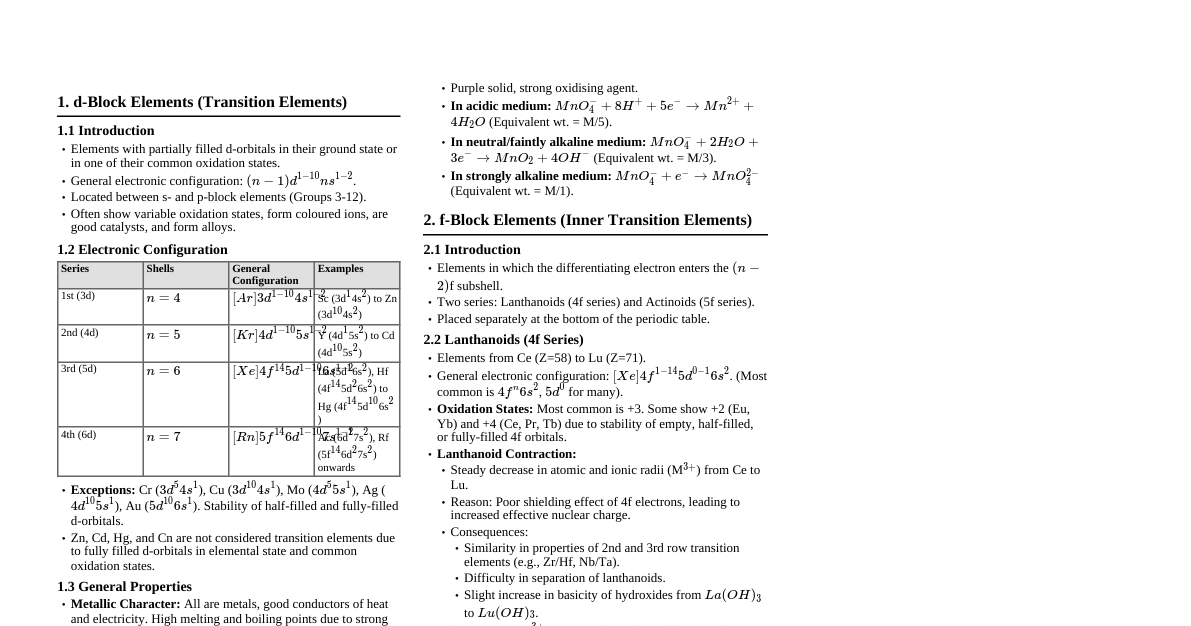
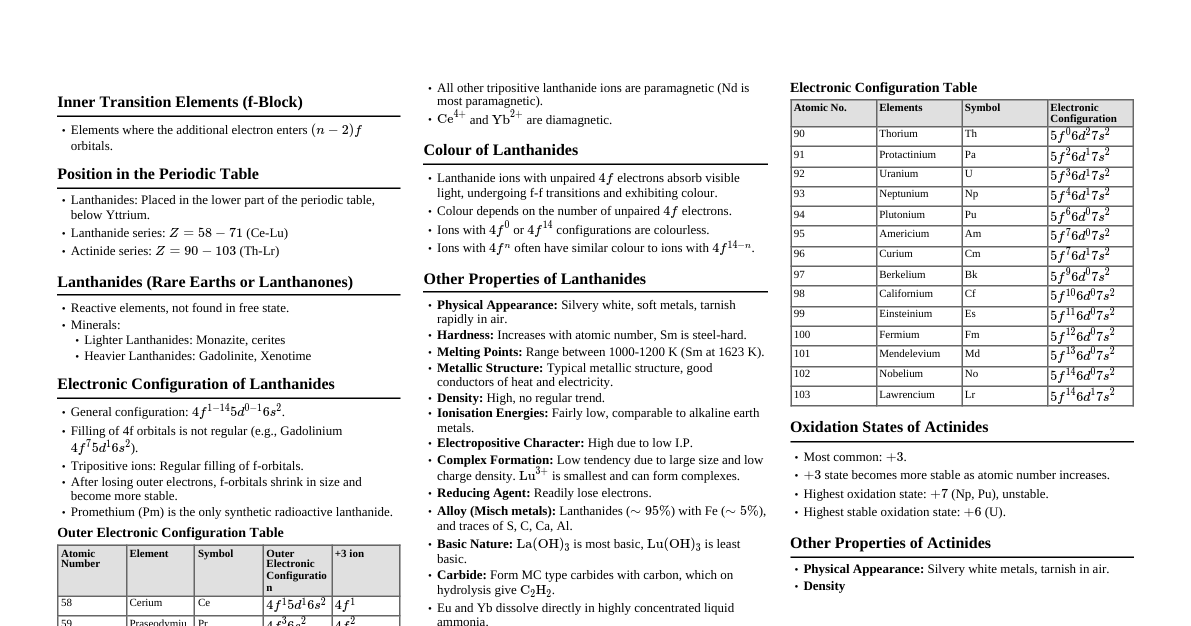
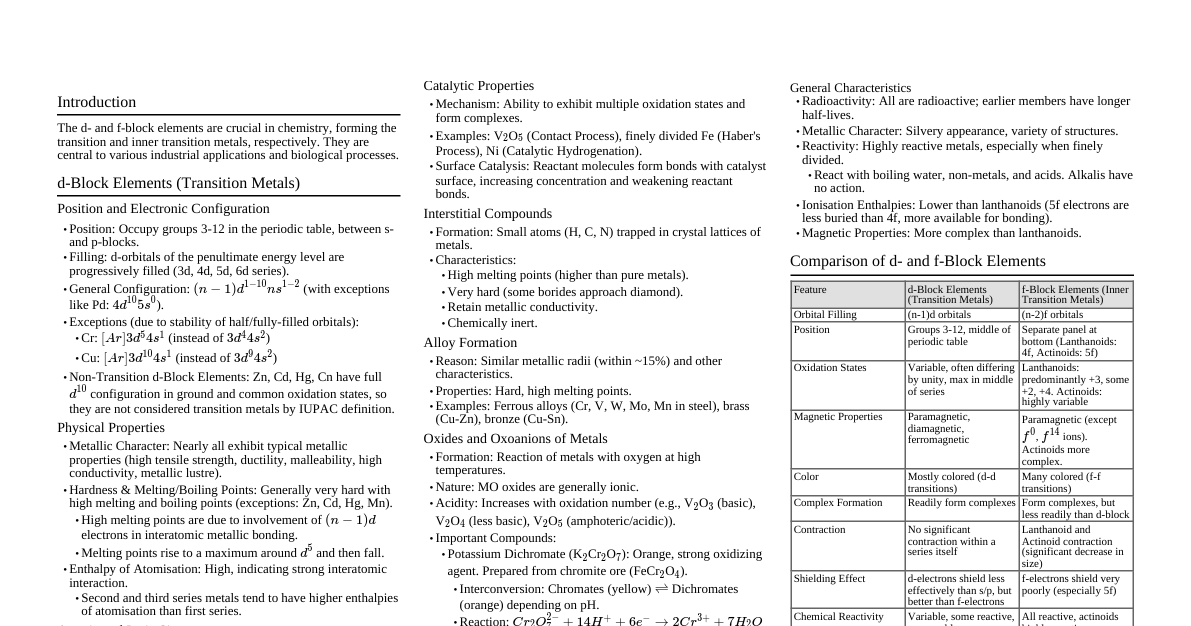
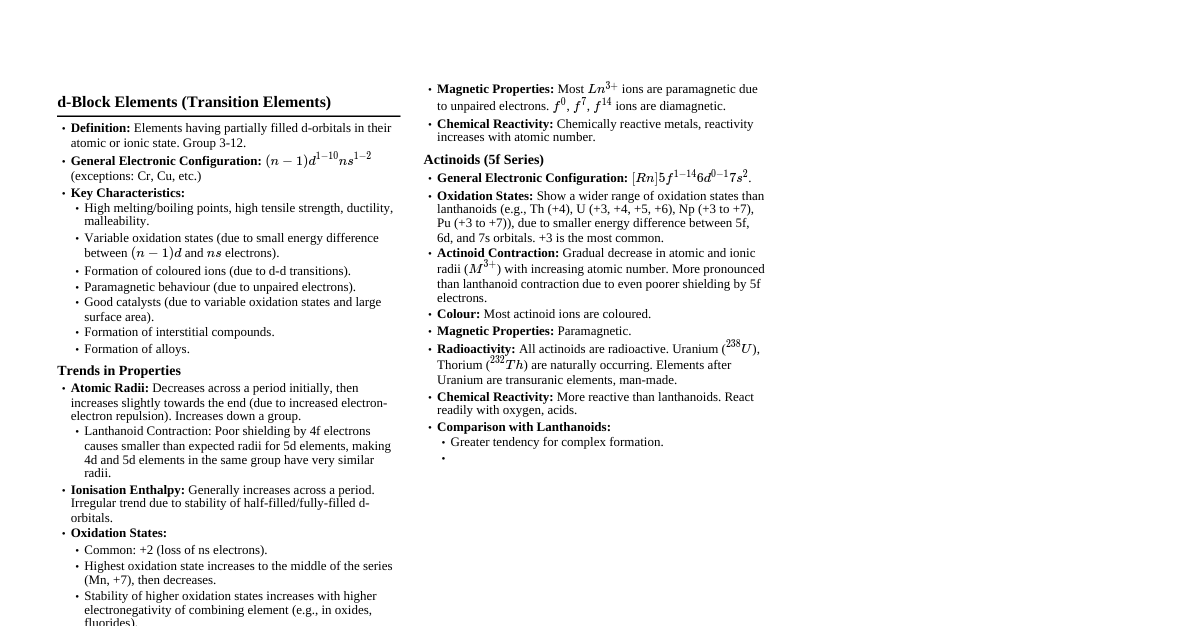
### D-Block Elements (Transition Elements) - **Definition:** Elements in groups 3-12 where d-orbitals are progressively filled. - **Location:** Middle section of the periodic table, between s- and p-blocks. - **Series:** - 1st series: 3d (Sc to Zn) - 2nd series: 4d (Y to Cd) - 3rd series: 5d (La and Hf to Hg) - 4th series: 6d (Ac and Rf to Cn) ### Electronic Configuration (d-Block) - **General:** $(n-1)d^{1-10}ns^{1-2}$ (exceptions exist due to stability of half-filled/fully-filled orbitals, e.g., Cr: $3d^54s^1$, Cu: $3d^{10}4s^1$). - **Zn, Cd, Hg, Cn:** Have full $d^{10}$ configuration in ground state and common oxidation states, thus not considered transition metals by IUPAC definition (incomplete d-subshell). ### General Properties (d-Block) #### Physical Properties - **Metallic Character:** High tensile strength, ductility, malleability, high thermal/electrical conductivity, metallic lustre. - **Melting/Boiling Points:** High (except Zn, Cd, Hg) due to strong interatomic metallic bonding involving $(n-1)d$ and $ns$ electrons. Maxima occur around $d^5$ configuration. - **Enthalpy of Atomization:** High, generally increasing from 1st to 2nd/3rd series. - **Atomic & Ionic Sizes:** - Decrease across a period due to increasing nuclear charge. - 2nd and 3rd series elements have very similar radii due to **Lanthanoid Contraction**. - **Density:** Generally increases across a period due to combined effect of decreasing atomic radius and increasing atomic mass. #### Oxidation States - **Variety:** Exhibit multiple oxidation states due to small energy difference between $(n-1)d$ and $ns$ orbitals. - **Common:** Lowest common oxidation state is +2. - **Maximum:** Highest oxidation state typically occurs in the middle of the series (e.g., Mn: +2 to +7). - **Stability:** Higher oxidation states are stabilized by oxygen and fluorine (e.g., MnF$_4$, Mn$_2$O$_7$). #### Ionization Enthalpies - **Trends:** Generally increase across a period but less steeply than p-block elements. - **Irregularities:** Due to stability of $d^0$, $d^5$, $d^{10}$ configurations and exchange energy. #### Chemical Reactivity and E° Values - **Reactivity:** Most are electropositive; dissolve in mineral acids (except Cu with non-oxidizing acids). - **E° values:** Irregular trends across the series due to variations in ionization enthalpies and hydration enthalpies. - **Reducing/Oxidizing Agents:** - Strong oxidizers: Mn$^{3+}$, Co$^{3+}$ - Strong reducers: Ti$^{2+}$, V$^{2+}$, Cr$^{2+}$ #### Magnetic Properties - **Paramagnetism:** Arises from unpaired electrons in d-orbitals. - **Ferromagnetism:** Extreme form of paramagnetism (e.g., Fe, Co, Ni). - **Magnetic Moment ($\mu$):** Calculated using 'spin-only' formula: $\mu = \sqrt{n(n+2)}$ BM, where $n$ is the number of unpaired electrons. #### Formation of Coloured Ions - **Cause:** $d-d$ transitions (excitation of electrons from lower to higher d-orbitals) absorbing visible light. - **Complementary Color:** The observed color is complementary to the absorbed color. #### Formation of Complex Compounds - **Reason:** Small size, high ionic charges, and availability of vacant d-orbitals. #### Catalytic Properties - **Mechanism:** Ability to adopt multiple oxidation states and form complexes, providing surface for reactions and lowering activation energy. E.g., V$_2$O$_5$ (Contact Process), Fe (Haber's Process). #### Interstitial Compounds - **Formation:** Small atoms (H, C, N) trapped in metal crystal lattices. - **Properties:** High melting points, very hard, retain metallic conductivity, chemically inert. #### Alloy Formation - **Reason:** Similar atomic radii (within 15%), enabling homogeneous solid solutions. - **Properties:** Hard, high melting points (e.g., steels, brass). #### Oxides and Oxoanions - **Formation:** Reaction of metals with oxygen at high temperatures. - **Acidity:** Increases with oxidation number (e.g., V$_2$O$_3$ basic, V$_2$O_5_ amphoteric/acidic). - **Potassium Dichromate (K$_2$Cr$_2$O$_7$):** Orange, strong oxidizing agent, interconvertible with yellow chromate (CrO$_4^{2-}$). - Acidic: Cr$_2$O$_7^{2-}$ + 14H$^+$ + 6e$^-$ → 2Cr$^{3+}$ + 7H$_2$O - **Potassium Permanganate (KMnO$_4$):** Dark purple, strong oxidizing agent. - Acidic: MnO$_4^-$ + 8H$^+$ + 5e$^-$ → Mn$^{2+}$ + 4H$_2$O ### F-Block Elements (Inner Transition Elements) - **Location:** Separate panel at the bottom of the periodic table. - **Series:** - **Lanthanoids (4f series):** Ce to Lu - **Actinoids (5f series):** Th to Lr ### Lanthanoids - **Electronic Configuration:** $4f^{1-14}5d^06s^2$ (except Gd: $4f^75d^16s^2$, Lu: $4f^{14}5d^16s^2$). - **Stable Oxidation State:** +3 is most stable. - **Other Oxidation States:** +2 and +4 occur occasionally (stability due to $f^0$, $f^7$, $f^{14}$ configurations). - Ce$^{4+}$ (strong oxidant), Eu$^{2+}$ (strong reductant), Yb$^{2+}$ (reductant). - **Lanthanoid Contraction:** - **Definition:** Gradual decrease in atomic and ionic radii from La to Lu. - **Cause:** Poor shielding effect of 4f electrons. - **Consequences:** Similar radii and chemical properties of 2nd and 3rd series d-block elements (e.g., Zr and Hf). - **Physical Properties:** - Silvery-white, soft metals (hardness increases with atomic number). - Good conductors of heat and electricity. - Most trivalent ions are colored due to $f-f$ transitions (La$^{3+}$ and Lu$^{3+}$ are colorless). - Most are paramagnetic. - **Chemical Properties:** - Reactive, similar to Ca, reactivity decreases across the series. - Form oxides (M$_2$O$_3$), hydroxides (M(OH)$_3$), hydrides (MH$_2$), carbides, and halides. ### Actinoids - **Electronic Configuration:** $5f^{1-14}6d^07s^2$ (exceptions exist, e.g., Th: $6d^27s^2$, Pa: $5f^26d^17s^2$). - **Oxidation States:** - Greater range than lanthanoids due to comparable energies of 5f, 6d, and 7s orbitals. - +3 is most common. - Higher states (up to +7) observed in early members (e.g., U, Np). - **Ionic Sizes:** - **Actinoid Contraction:** Gradual decrease in atomic/ionic radii across the series. - **Magnitude:** Greater than lanthanoid contraction due to poorer shielding by 5f electrons. - **Physical Properties:** - Silvery appearance, variable structures. - All are radioactive. - Magnetic properties are more complex than lanthanoids. - **Chemical Properties:** - Highly reactive metals, especially when finely divided. - Form oxides, hydrides, and react with non-metals. - Hydrochloric acid attacks all metals; nitric acid forms protective oxide layers. ### Applications (d- & f-Block Elements) - **Construction Materials:** Iron and steels (alloyed with Cr, Mn, Ni). - **Catalysts:** V$_2$O$_5$ (SO$_2$ oxidation), TiCl$_4$ (polymerization), Fe (Haber process), Ni (hydrogenation), PdCl$_2$ (Wacker process). - **Pigments:** TiO$_2$. - **Batteries:** MnO$_2$ (dry cells), Zn, Ni/Cd. - **Coinage Metals:** Ag, Au, Cu. - **Mischmetall (Lanthanoid alloy):** Used in Mg-based alloys (bullets, lighter flints). - **Nuclear Energy:** Th, Pa, U (inner transition elements). - **Fluorescent Surfaces:** Individual Ln oxides.