d- and f-Block Elements
Cheatsheet Content
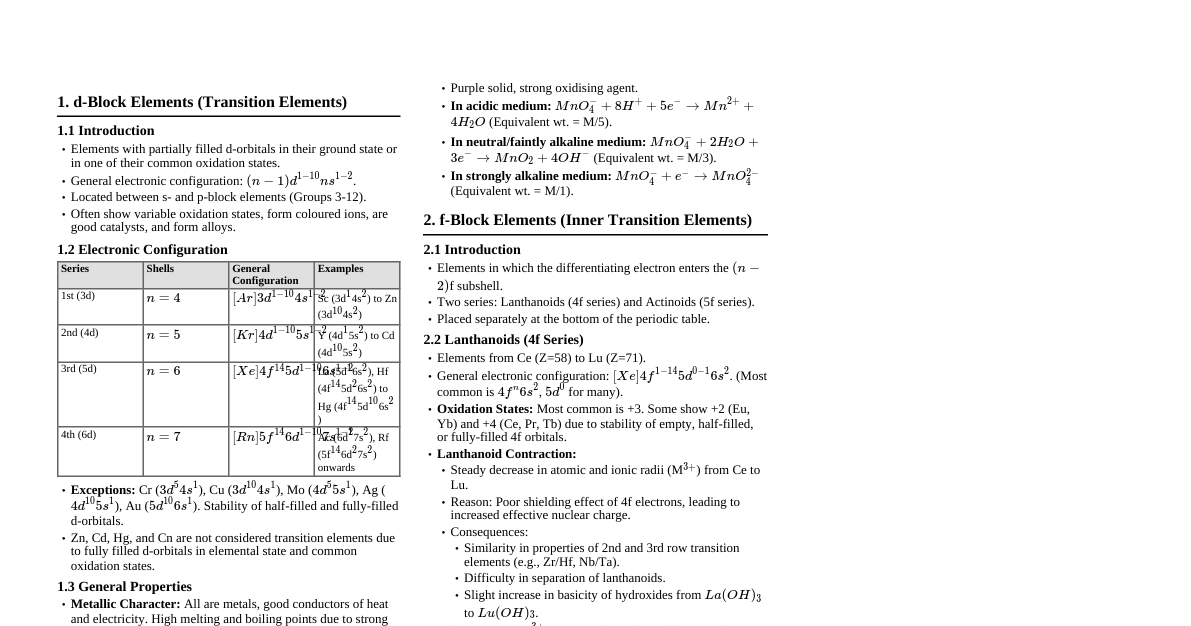
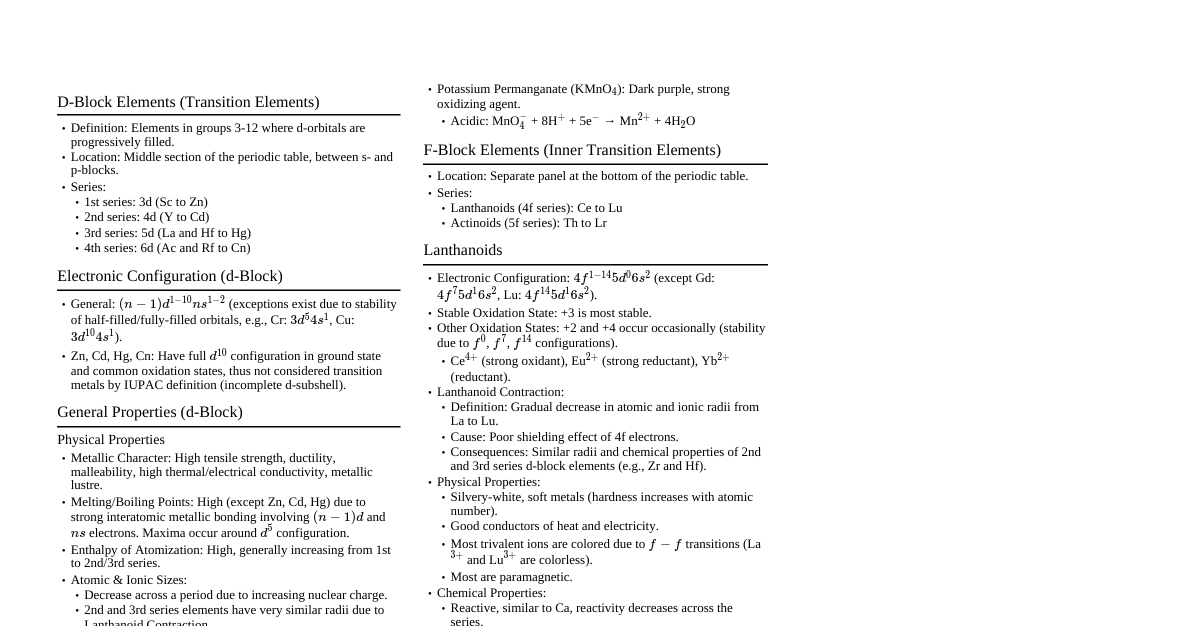
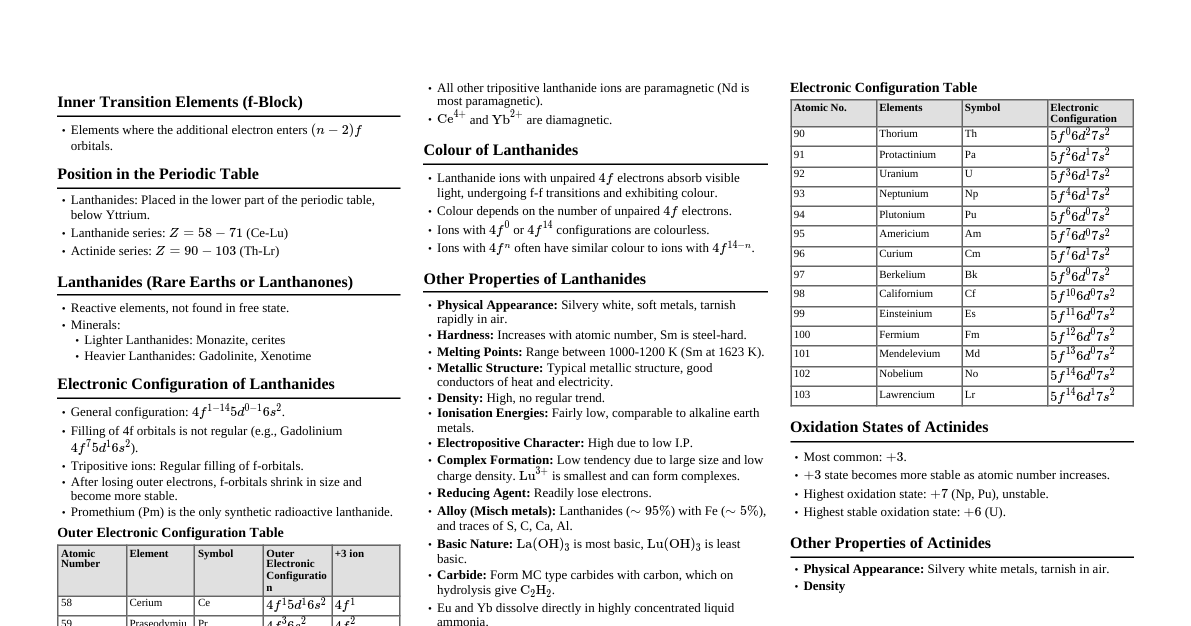
### Introduction The d- and f-block elements are crucial in chemistry, forming the transition and inner transition metals, respectively. They are central to various industrial applications and biological processes. ### d-Block Elements (Transition Metals) #### Position and Electronic Configuration - **Position:** Occupy groups 3-12 in the periodic table, between s- and p-blocks. - **Filling:** d-orbitals of the penultimate energy level are progressively filled (3d, 4d, 5d, 6d series). - **General Configuration:** $(n-1)d^{1-10}ns^{1-2}$ (with exceptions like Pd: $4d^{10}5s^0$). - **Exceptions (due to stability of half/fully-filled orbitals):** - **Cr:** $[Ar]3d^54s^1$ (instead of $3d^44s^2$) - **Cu:** $[Ar]3d^{10}4s^1$ (instead of $3d^94s^2$) - **Non-Transition d-Block Elements:** Zn, Cd, Hg, Cn have full $d^{10}$ configuration in ground and common oxidation states, so they are not considered transition metals by IUPAC definition. #### Physical Properties - **Metallic Character:** Nearly all exhibit typical metallic properties (high tensile strength, ductility, malleability, high conductivity, metallic lustre). - **Hardness & Melting/Boiling Points:** Generally very hard with high melting and boiling points (exceptions: Zn, Cd, Hg, Mn). - High melting points are due to involvement of $(n-1)d$ electrons in interatomic metallic bonding. - Melting points rise to a maximum around $d^5$ and then fall. - **Enthalpy of Atomisation:** High, indicating strong interatomic interaction. - Second and third series metals tend to have higher enthalpies of atomisation than first series. #### Atomic and Ionic Sizes - **Trend:** Progressive decrease in radius across a series due to increasing nuclear charge and ineffective shielding by d-electrons. - **Lanthanoid Contraction Effect:** Radii of 5d series elements are very similar to their 4d counterparts (e.g., Zr (160 pm) and Hf (159 pm)) due to the intervention of 4f orbitals before 5d filling, which causes a significant decrease in atomic radii. #### Ionisation Enthalpies - **Trend:** Generally increase across a series, but less steeply than non-transition elements due to filling of inner d-orbitals. - **Exceptions:** Irregularities occur due to stability of $d^0$, $d^5$, $d^{10}$ configurations. - Cr and Cu show unusually high second ionization enthalpies due to stable $d^5$ and $d^{10}$ configurations in M$^+$ ions. - Zn has a low second ionization enthalpy due to forming a stable $d^{10}$ configuration. #### Oxidation States - **Variability:** Exhibit a wide variety of oxidation states, often differing by unity (e.g., $V^{II}, V^{III}, V^{IV}, V^V$). - **Common:** +2 is the lowest common state. - **Maximum:** Attained in the middle of the series (Mn exhibits +2 to +7). - Lesser states at ends (Sc, Ti: few electrons to lose; Cu, Zn: many d-electrons, fewer orbitals for sharing). - **Stability:** Higher oxidation states are stabilized by oxygen (forming oxides/oxoanions) and fluorine (forming fluorides). - Example: MnF$_4$ (highest fluoride) vs Mn$_2$O$_7$ (highest oxide). - **Zero Oxidation State:** Observed in complex compounds with $\pi$-acceptor ligands, e.g., Ni(CO)$_4$, Fe(CO)$_5$. #### Chemical Reactivity and E° Values - **Reactivity:** Most are electropositive and dissolve in mineral acids (except "noble" metals like Pt, Au). Copper is an exception due to positive E° value. - **E° (M²⁺/M) Trend:** Generally decreases across the series. Mn, Ni, Zn have more negative E° values than expected. - **E° (M³⁺/M²⁺) Trend:** - Mn³⁺/Mn²⁺: Most positive E° (+1.57 V), making Mn³⁺ a strong oxidizing agent (Mn²⁺ ($d^5$) is highly stable). - Fe³⁺/Fe²⁺: +0.77 V. - Cr³⁺/Cr²⁺: -0.41 V, making Cr²⁺ a strong reducing agent (Cr³⁺ ($d^3$, half-filled t$_{2g}$) is highly stable). - Co³⁺/Co²⁺: +1.97 V, making Co³⁺ a strong oxidizing agent. #### Magnetic Properties - **Paramagnetism:** Arises from unpaired electrons, common in transition metal ions. - **Ferromagnetism:** Extreme form of paramagnetism (e.g., Fe, Co, Ni). - **Magnetic Moment (Spin-only formula):** $\mu = \sqrt{n(n+2)}$ BM, where $n$ is the number of unpaired electrons. - **Diamagnetism:** Occurs when all electrons are paired. #### Coloured Ions - **Cause:** d-d transitions (electron excitation from lower to higher d-orbital) upon absorbing light in the visible region. The observed color is the complementary color. - **Factors:** Nature of ligand, oxidation state, and coordination geometry. #### Complex Compounds - **Formation:** Transition metals readily form complex compounds due to: - Small size of metal ions. - High ionic charges. - Availability of vacant d-orbitals for bond formation. #### Catalytic Properties - **Mechanism:** Ability to exhibit multiple oxidation states and form complexes. - **Examples:** V$_2$O$_5$ (Contact Process), finely divided Fe (Haber's Process), Ni (Catalytic Hydrogenation). - **Surface Catalysis:** Reactant molecules form bonds with catalyst surface, increasing concentration and weakening reactant bonds. #### Interstitial Compounds - **Formation:** Small atoms (H, C, N) trapped in crystal lattices of metals. - **Characteristics:** - High melting points (higher than pure metals). - Very hard (some borides approach diamond). - Retain metallic conductivity. - Chemically inert. #### Alloy Formation - **Reason:** Similar metallic radii (within ~15%) and other characteristics. - **Properties:** Hard, high melting points. - **Examples:** Ferrous alloys (Cr, V, W, Mo, Mn in steel), brass (Cu-Zn), bronze (Cu-Sn). #### Oxides and Oxoanions of Metals - **Formation:** Reaction of metals with oxygen at high temperatures. - **Nature:** MO oxides are generally ionic. - **Acidity:** Increases with oxidation number (e.g., V$_2$O$_3$ (basic), V$_2$O$_4$ (less basic), V$_2$O$_5$ (amphoteric/acidic)). - **Important Compounds:** - **Potassium Dichromate (K$_2$Cr$_2$O$_7$):** Orange, strong oxidizing agent. Prepared from chromite ore (FeCr$_2$O$_4$). - Interconversion: Chromates (yellow) $\rightleftharpoons$ Dichromates (orange) depending on pH. - Reaction: $Cr_2O_7^{2-} + 14H^+ + 6e^- \rightarrow 2Cr^{3+} + 7H_2O$ - **Potassium Permanganate (KMnO$_4$):** Dark purple, strong oxidizing agent. Prepared from MnO$_2$. - Reaction: $MnO_4^- + 8H^+ + 5e^- \rightarrow Mn^{2+} + 4H_2O$ - Manganate ion (green, paramagnetic) and permanganate ion (purple, diamagnetic). ### f-Block Elements (Inner Transition Metals) #### Lanthanoids (4f Series) ##### Position and Electronic Configuration - **Position:** 14 elements following Lanthanum (Ce to Lu). - **Filling:** 4f orbitals are progressively filled. - **General Configuration:** Atoms have $6s^2$ and variable 4f occupancy. - **Tripositive Ions (most stable):** $4f^n$ (n=1 to 14). ##### Lanthanoid Contraction - **Definition:** Gradual decrease in atomic and ionic radii from La to Lu. - **Cause:** Imperfect shielding of one 4f electron by another, leading to increased effective nuclear charge. - **Consequences:** - Radii of 4d and 5d series elements become very similar. - Difficulty in separating lanthanoids due to similar properties. ##### Oxidation States - **Predominant:** +3 oxidation state. - **Occasional:** +2 and +4 states due to stability of empty ($f^0$), half-filled ($f^7$), or completely filled ($f^{14}$) f-subshells. - **Ce⁴⁺:** Strong oxidant ($f^0$ configuration). - **Eu²⁺, Yb²⁺:** Strong reducing agents ($f^7$ and $f^{14}$ configurations, respectively). - **Tb⁴⁺:** Oxidant ($f^7$ configuration). ##### General Characteristics - **Metallic Character:** Silvery white, soft metals, tarnish rapidly. - **Melting Points:** Range from 1000 to 1200 K (exception: Sm melts at 1623 K). - **Color:** Many trivalent ions are colored (due to f-f transitions), except $f^0$ (La³⁺, Ce⁴⁺) and $f^{14}$ (Yb²⁺, Lu³⁺). - **Magnetic Properties:** Most ions are paramagnetic, except $f^0$ and $f^{14}$ ions. - **Chemical Reactivity:** Early members are very reactive (like Ca), later members are more like Al. - React with H$_2$, C, halogens, acids, O$_2$ (form M$_2$O$_3$), and form hydroxides M(OH)$_3$. - **Uses:** Alloy steels (mischmetall), catalysts, phosphors. #### Actinoids (5f Series) ##### Position and Electronic Configuration - **Position:** 14 elements following Actinium (Th to Lr). - **Filling:** 5f orbitals are progressively filled. - **General Configuration:** $7s^2$ and variable 5f and 6d occupancy. - **Irregularities:** Due to stability of $f^0$, $f^7$, $f^{14}$ configurations. ##### Actinoid Contraction - **Definition:** Gradual decrease in atomic and ionic radii across the series. - **Comparison to Lanthanoids:** Greater from element to element due to poorer shielding by 5f electrons. ##### Oxidation States - **Predominant:** +3 oxidation state. - **Variety:** Greater range of oxidation states than lanthanoids (due to comparable energies of 5f, 6d, 7s orbitals). - Maximum states increase to +4 (Th), +5 (Pa), +6 (U), +7 (Np), then decrease. - **Stability:** +3 and +4 ions tend to hydrolyze. ##### General Characteristics - **Radioactivity:** All are radioactive; earlier members have longer half-lives. - **Metallic Character:** Silvery appearance, variety of structures. - **Reactivity:** Highly reactive metals, especially when finely divided. - React with boiling water, non-metals, and acids. Alkalis have no action. - **Ionisation Enthalpies:** Lower than lanthanoids (5f electrons are less buried than 4f, more available for bonding). - **Magnetic Properties:** More complex than lanthanoids. ### Comparison of d- and f-Block Elements | Feature | d-Block Elements (Transition Metals) | f-Block Elements (Inner Transition Metals) | |--------------------------|-------------------------------------------------------------------------|--------------------------------------------------------------------------| | **Orbital Filling** | (n-1)d orbitals | (n-2)f orbitals | | **Position** | Groups 3-12, middle of periodic table | Separate panel at bottom (Lanthanoids: 4f, Actinoids: 5f) | | **Oxidation States** | Variable, often differing by unity, max in middle of series | Lanthanoids: predominantly +3, some +2, +4. Actinoids: highly variable | | **Magnetic Properties** | Paramagnetic, diamagnetic, ferromagnetic | Paramagnetic (except $f^0$, $f^{14}$ ions). Actinoids more complex. | | **Color** | Mostly colored (d-d transitions) | Many colored (f-f transitions) | | **Complex Formation** | Readily form complexes | Form complexes, but less readily than d-block | | **Contraction** | No significant contraction within a series itself | Lanthanoid and Actinoid contraction (significant decrease in size) | | **Shielding Effect** | d-electrons shield less effectively than s/p, but better than f-electrons | f-electrons shield very poorly (especially 5f) | | **Chemical Reactivity** | Variable, some reactive, some noble | All reactive, actinoids highly reactive | | **Radioactivity** | Generally non-radioactive (except some isotopes) | All actinoids are radioactive | ### Applications - **Iron and Steels:** Construction materials (Fe, Cr, Mn, Ni). - **Pigments:** TiO (titanium dioxide). - **Batteries:** MnO$_2$, Zn, Ni/Cd. - **Coinage Metals:** Ag, Au (historically), Cu. - **Catalysts:** V$_2$O$_5$, TiCl$_4$, Fe, Ni, PdCl$_2$. - **Photographic Industry:** AgBr. - **Lanthanoids:** Mischmetall (alloys in bullets, flints), catalysts, phosphors.