Genetics - NEET Essentials
Cheatsheet Content
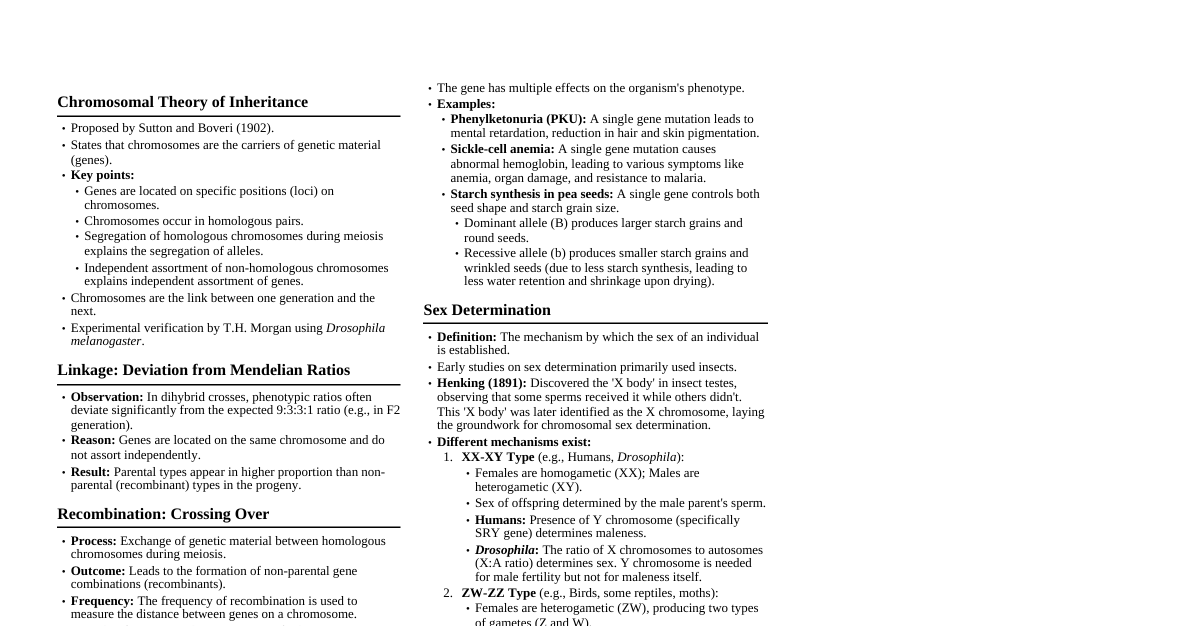
Chromosomal Theory of Inheritance Proposed by Sutton and Boveri (1902). States that chromosomes are the carriers of genetic material (genes). Key points: Genes are located on specific positions (loci) on chromosomes. Chromosomes occur in homologous pairs. Segregation of homologous chromosomes during meiosis explains the segregation of alleles. Independent assortment of non-homologous chromosomes explains independent assortment of genes. Chromosomes are the link between one generation and the next. Experimental verification by T.H. Morgan using Drosophila melanogaster . Linkage and Recombination Linkage Definition: Tendency of genes located on the same chromosome to be inherited together. Linkage Group: All genes on a single chromosome form a linkage group. The number of linkage groups equals the haploid number of chromosomes. Complete Linkage: Genes located very close on the same chromosome, showing no recombination. Rare. Incomplete Linkage: Genes located far apart on the same chromosome, allowing some recombination due to crossing over. More common. Morgan's Experiment: Studied linkage in Drosophila (e.g., body color and eye color). Found that genes on X-chromosome exhibited linkage. Recombination Definition: Generation of new combinations of alleles (non-parental gene combinations) during sexual reproduction. Occurs mainly due to crossing over between homologous chromosomes during meiosis I (prophase I). Leads to genetic variation within a population. Recombination Frequency: Percentage of recombinant progeny. Calculated as: $\frac{\text{Number of recombinants}}{\text{Total progeny}} \times 100$ Used to construct genetic maps (chromosome maps). 1% recombination frequency = 1 centiMorgan (cM) or 1 map unit. Distance between linked genes is directly proportional to recombination frequency. Polygenic (Polymeric) Inheritance Definition: Inheritance of traits controlled by two or more genes , where each gene contributes additively to the phenotype. Also known as quantitative inheritance . Results in a continuous variation of the phenotype (e.g., bell-shaped curve). Examples: Human skin color: Controlled by 3 main genes (A, B, C), each with two alleles. Darker alleles (A, B, C) contribute to more melanin; lighter alleles (a, b, c) contribute to less. Human height Kernel color in wheat Often influenced by environmental factors. Pleiotropy Definition: A single gene affecting multiple phenotypic traits . The gene has multiple effects on the organism's phenotype. Examples: Phenylketonuria (PKU): A single gene mutation leads to mental retardation, reduction in hair and skin pigmentation. Sickle-cell anemia: A single gene mutation causes abnormal hemoglobin, leading to various symptoms like anemia, organ damage, and resistance to malaria. Starch synthesis in pea seeds: A single gene controls both seed shape and starch grain size. Dominant allele (B) produces larger starch grains and round seeds. Recessive allele (b) produces smaller starch grains and wrinkled seeds (due to less starch synthesis, leading to less water retention and shrinkage upon drying). Sex Determination Definition: The mechanism by which the sex of an individual is established. Early studies on sex determination primarily used insects . Henking (1891): Discovered the 'X body' in insect testes, observing that some sperms received it while others didn't. This 'X body' was later identified as the X chromosome, laying the groundwork for chromosomal sex determination. Different mechanisms exist: 1. XX-XY Type (e.g., Humans, Drosophila ): Females are homogametic (XX) ; Males are heterogametic (XY) . Sex of offspring determined by the male parent's sperm. Humans: Presence of Y chromosome (specifically SRY gene) determines maleness. Drosophila : The ratio of X chromosomes to autosomes (X:A ratio) determines sex. Y chromosome is needed for male fertility but not for maleness itself. 2. ZW-ZZ Type (e.g., Birds, some reptiles, moths): Females are heterogametic (ZW) , producing two types of gametes (Z and W). Males are homogametic (ZZ) , producing only one type of gamete (Z). Sex of offspring determined by the female parent's egg. 3. XO-XX Type (e.g., Grasshoppers and a large number of insects): Females are homogametic (XX) . Males are heterogametic (XO) , possessing only one X chromosome and no Y. Sex of offspring determined by the male parent, based on whether the sperm carries an X or no X. 4. Haplodiploidy (e.g., Honeybees): Females (queen, workers) develop from fertilized eggs (diploid, $2n=32$ chromosomes). Males (drones) develop from unfertilized eggs via parthenogenesis (haploid, $n=16$ chromosomes). Males have no father and thus no sons, but they have a grandfather and can have grandsons (through their daughters). Sex determined by the number of chromosome sets, not sex chromosomes. Environmental Sex Determination: In some reptiles (e.g., turtles, crocodiles), temperature during egg incubation determines sex. Mutation Definition: A sudden, heritable change in the genetic material (DNA sequence or chromosome structure). Mutations are the ultimate source of new alleles and genetic variation . Recombination shuffles existing alleles. Can be spontaneous (due to errors in replication) or induced (by mutagens). Types of Mutations: A. Gene/Point Mutations: Change in a single base pair of DNA. Substitution: One base replaced by another. Silent: No change in amino acid sequence. Missense: Changes amino acid. (e.g., Sickle-cell anemia - Glu to Val). Nonsense: Changes to a stop codon, premature termination of protein synthesis. Frameshift: Insertion or deletion of one or two nucleotides, altering the reading frame. (e.g., Tay-Sachs disease, Cystic fibrosis). B. Chromosomal Mutations: Changes in chromosome structure or number. 1. Chromosomal Aberrations (Structural Changes): Deletion: Loss of a segment of a chromosome. Duplication: Repetition of a segment. Inversion: A segment is flipped 180 degrees. Translocation: Movement of a segment to a non-homologous chromosome. Often seen in cancer cells (e.g., Philadelphia chromosome in Chronic Myeloid Leukemia). 2. Aneuploidy (Change in Chromosome Number): Gain or loss of one or more chromosomes. Monosomy ($2n-1$): Loss of one chromosome (e.g., Turner's Syndrome, XO). Trisomy ($2n+1$): Gain of one chromosome (e.g., Down's Syndrome, Trisomy 21; Klinefelter's Syndrome, XXY). 3. Polyploidy: Presence of more than two complete sets of chromosomes ($3n, 4n$, etc.). Common in plants, rare in animals. Mutagens: Agents that cause mutations. Physical: UV radiation, X-rays, gamma rays. Chemical: Mustard gas, colchicine, base analogs.