Economics Cheatsheet
Cheatsheet Content
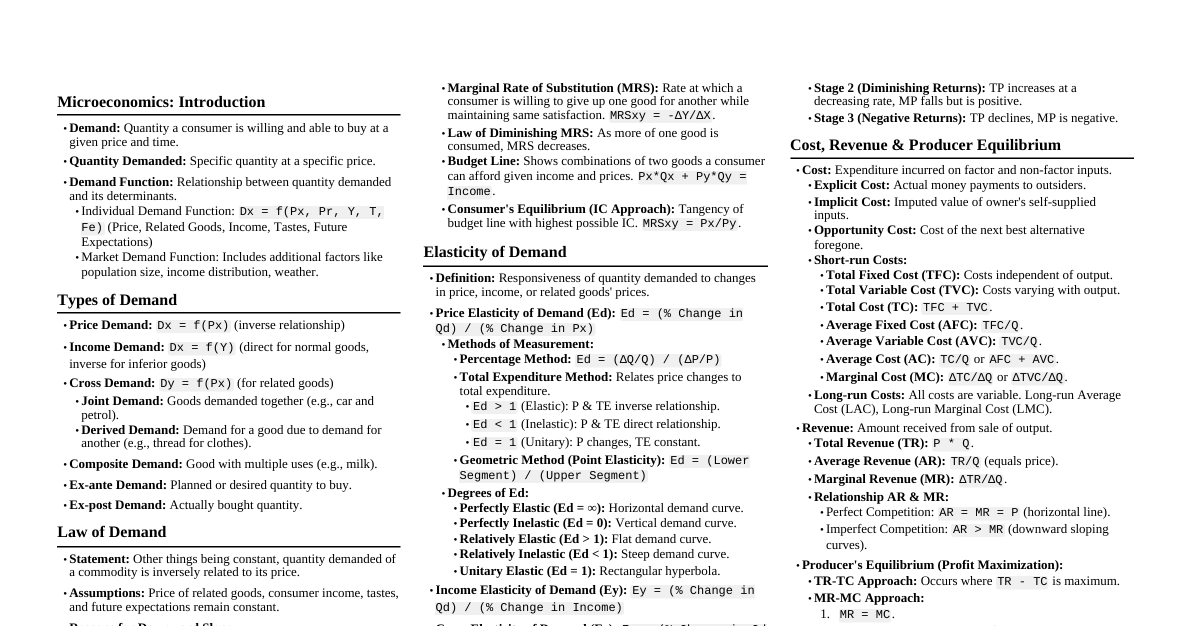
Section A: Microeconomics Basics 1. Budget Line and Consumer Choice Budget Line (CD): Represents combinations of two goods (Good A, Good B) a consumer can afford given their income and prices. Point G: A point inside the budget line indicates that the consumer is spending less than their entire money income on the combination of two goods. Mathematically, if income is $M$ and prices are $P_A, P_B$, then $P_A \cdot Q_A + P_B \cdot Q_B \le M$. 2. Utility and Marginal Utility Total Utility (TU): The total satisfaction derived from consuming a certain quantity of a good. Marginal Utility (MU): The additional satisfaction gained from consuming one more unit of a good. $MU_n = TU_n - TU_{n-1}$ Example: If $TU_4 = 11$ utils and $TU_5 = 9$ utils (after 6 mangoes implies $TU_6 = 9$, $TU_5 = 11$), then $MU_6 = TU_6 - TU_5 = 9 - 11 = -2$ utils. (Note: The provided question had a slight ambiguity on the mango count, assuming the total utility of 9 utils is for 6 mangoes and 11 utils for 5 mangoes, then $MU_6 = 9 - 11 = -2$ util. If 11 utils for 4 mangoes and 9 utils for 6 mangoes, then insufficient info for $MU_6$ without $TU_5$.) 3. Law of Variable Proportions Definition: States that as more and more units of a variable factor are combined with fixed factors, the marginal product initially rises, then falls, and eventually becomes negative. NOT Applicable When: All factor inputs increase in the same proportion (this relates to returns to scale, not variable proportions). Technology remains constant. All units of variable input are equally efficient. Applicable When: One factor is variable and others are fixed. The time period is short enough that some factors are fixed. 4. Market Equilibrium (MR=MC) E1 E2 Output Cost & Revenue 0 Q1 Q2 MC MR Equilibrium: Occurs where Marginal Revenue (MR) equals Marginal Cost (MC). Point E1: Represents an equilibrium point where $MR = MC$. Point E2: Beyond E1, if $MC > MR$, the firm is producing too much; if $MC MR$ beyond this point. 5. Assertion and Reason Questions Assertion-Reason Logic: Evaluate if both statements are true and if the reason correctly explains the assertion. Example 1 (Demand): Assertion: Rise in price of burger at Burger Bliss raises demand for burgers at Burger Heaven. (True, they are substitutes). Reason: Negative relationship between demand for a good and price of complementary good. (True, but irrelevant here; Burger Bliss and Heaven are substitutes). Conclusion: Both are true, but Reason is NOT the correct explanation. Example 2 (Banking): Assertion: Commercial banks can deposit surplus funds with RBI. (True). Reason: High reverse repo rate enables commercial banks to earn income. (True). Conclusion: Both are true, and Reason IS the correct explanation. 6. Explicit and Implicit Costs Explicit Cost: Direct monetary payments for inputs (e.g., buying a Xerox machine, paying wages). Implicit Cost: The opportunity cost of using resources the firm already owns (e.g., foregone interest on savings, foregone salary for self-employment). Example: Amit withdraws ₹50,000 from savings for business. Buys Xerox machine for ₹30,000. Explicit Cost: ₹30,000 (cost of Xerox machine). Implicit Cost: Foregone interest on ₹50,000 (savings used) and foregone salary (Amit's own labor). 7. Cost-Push Inflation Definition: Inflation caused by an increase in the cost of production (e.g., higher wages, raw material prices). Minimum Wage Act: If wages increase due to this act, it raises the cost of labor for firms, leading to higher production costs, which are then passed on to consumers as higher prices, thus causing cost-push inflation. 8. Selective Credit Control (SCC) Definition: Measures used by the central bank to regulate the flow of credit for specific purposes. Example: To enable Sagarika to get a maximum loan for a car: The central bank might reduce margin requirements for car loans. Margin Requirement: The percentage of the loan value that the borrower must pay from their own funds. Lowering this allows for a higher loan amount relative to the asset's value. Section B: Macroeconomics & Market Structures 1. Money Supply Measures (India) M1: Currency with public + Demand deposits + Other deposits with RBI. M2: M1 + Savings deposits of post office savings banks. M3: M1 + Time deposits with commercial banks. (The correct statement from the options). M4: M3 + All deposits with post office savings organizations (excluding National Saving Certificates). 2. Balance of Payments (BoP) Definition: A record of all economic transactions between residents of a country and the rest of the world over a period. Current Account Deficit/Surplus: Deficit: Total payments > Total receipts. (e.g., ₹1526 Cr payments vs ₹1045 Cr receipts). Improvements (reduce deficit/increase surplus): Foreign Institutional Investors (FII) buying shares of Indian companies (inflow of foreign currency). Worsening (increase deficit/decrease surplus): Indian tourists buying souvenirs abroad (outflow). Indian students joining foreign universities (outflow). Value of US dollar falling against Indian rupee (makes imports cheaper, exports costlier, potentially increasing deficit). 3. Types of Tax Systems Degressive Tax System: A tax system where the tax rate increases with income up to a certain limit, but then becomes constant or decreases for incomes beyond that limit. Example: Ruhi's income tax: 10% on ₹10,000, 15% on ₹20,000, and then 15% on ₹30,000. The rate increases then stays constant. Progressive: Tax rate increases as income increases. Proportional: Tax rate remains constant regardless of income. 4. Foreign Exchange Rate and Supply Supply of Foreign Exchange: Comes from exports, foreign investment, remittances, etc. Effect of Increased Exchange Rate (e.g., $1 = ₹80 to $1 = ₹85): Makes domestic goods cheaper for foreigners, increasing exports. Makes foreign investment in the domestic country more attractive. Both lead to an increased inflow of foreign currency, thus increasing the supply of foreign exchange. 5. Primary Deficit Definition: Fiscal deficit minus interest payments on previous borrowings. Formula: Primary Deficit = Fiscal Deficit - Interest Payments. It indicates the government's borrowing requirement to meet expenses other than interest payments. 6. Output and Supply Law of Supply: Other things being equal, as the price of a good increases, its quantity supplied also increases. Exception (Non-conformity): If a producer's income increases significantly, they might choose to work less and enjoy more leisure, leading to a decrease in supply despite higher prices (e.g., Ibrahim story). This indicates a backward-bending supply curve of labor. Supply Curve: Illustrates the relationship between price and quantity supplied. Normally upward sloping. 7. Price Elasticity of Demand ($E_d$) Formula: $E_d = \frac{\% \Delta Q_d}{\% \Delta P} = \frac{\Delta Q_d / Q_1}{\Delta P / P_1}$ (initial point method) or $\frac{\Delta Q_d}{\Delta P} \cdot \frac{P_1}{Q_1}$ Given: $P_1 = 40$, $P_2 = 20$, $\Delta Q_d = 20$ units, $E_d = -0.5$. $\Delta P = P_2 - P_1 = 20 - 40 = -20$. $-0.5 = \frac{20/Q_1}{-20/40} = \frac{20/Q_1}{-0.5}$ $0.25 = 20/Q_1 \implies Q_1 = 80$ units. New quantity demanded ($Q_2$) = $Q_1 + \Delta Q_d = 80 + 20 = 100$ units. 8. Average Revenue (AR) and Marginal Revenue (MR) Units Price TR AR MR 1 15 15 15 15 2 14 28 14 13 3 13 39 13 11 Total Revenue (TR): Price $\times$ Quantity. Average Revenue (AR): TR / Quantity (equals Price in perfect competition, and in this table). Marginal Revenue (MR): Change in TR from selling one more unit. $MR = TR_n - TR_{n-1}$. Relationship: When AR is falling, MR is less than AR and falls faster than AR. 9. Simultaneous Shifts in Demand and Supply If both demand and supply decrease proportionally and simultaneously: Equilibrium Quantity: Will definitely decrease. Equilibrium Price: The effect on price is indeterminate and depends on the relative magnitudes of the shifts. If the decrease in demand equals the decrease in supply, price might remain unchanged. 10. Fixed Costs (Short Run Phenomenon) Fixed Costs (FC): Costs that do not vary with the level of output (e.g., rent, machinery cost). Short Run: A period where at least one factor of production is fixed. Fixed costs exist only in the short run. Long Run: A period long enough for all factors of production to be variable. In the long run, there are no fixed costs. Total Fixed Cost (TFC) Curve: A horizontal line, indicating it remains constant regardless of output. Output Cost TFC 11. Law of Increasing Returns to a Factor Total Product (TP): Increases at an increasing rate. Average Product (AP): Rises. Marginal Product (MP): Rises and is greater than AP. Reason: Factors like better utilization of fixed factors, division of labor, and increased efficiency of variable factors lead to increasing returns initially. 12. Market Structures Monopolistic Competition: Blend of: Perfect competition (many sellers, free entry/exit) and monopoly (product differentiation, some control over price). Reasons: Many sellers offering differentiated products (like perfect competition) but each firm has a downward-sloping demand curve due to product differentiation (like monopoly). Oligopoly (from passage): Definition: Small number of competitors, relatively homogeneous product, aware of one another's presence, strategic interdependence. Examples: Automobile industry, telecommunications, cement. Features: Few firms, interdependence, product differentiation (sometimes), barriers to entry, non-price competition. Demand Curve: Kinked demand curve (reflecting price rigidity due to fear of price wars and assumption that rivals will match price cuts but not price increases). Section C: National Income Accounting 1. Investment Multiplier ($\alpha$) Definition: The ratio of the total change in income to the initial change in investment. Formula: $\alpha = \frac{1}{1 - MPC}$ or $\alpha = \frac{1}{MPS}$ Relation to MPC: A higher Marginal Propensity to Consume (MPC) leads to a larger multiplier, as a greater proportion of additional income is spent, creating more rounds of spending. 2. Inflationary Gap 45° Line E G Yf Y Income Aggregate Demand AD1 AD Gap EG: Represents the inflationary gap. It occurs when actual aggregate demand (AD) is greater than the aggregate supply at the full employment level (45° line). This leads to inflation. Measures to Combat Inflationary Gap: Fiscal Measures: Increase taxes, decrease government expenditure. Monetary Measures: Increase policy rates (repo rate), increase cash reserve ratio (CRR), sell government securities (open market operations). 3. Double Counting Problem: Occurs when the value of certain goods and services is counted more than once while estimating national income. This leads to an overestimation of national income. Example: Value of flour, then bread, then sandwich. If all are counted, flour is counted thrice. Solution: Value Added Method: Sum of value added at each stage of production. Final Product Method: Only include the value of final goods and services. 4. Calculation of NDPFC and NNPFC S.No. Items ₹ (in crores) (a) Value of output of primary sector 1300 (b) Value of output of other sectors 700 (c) Raw materials purchased by primary sector 800 (d) Raw materials purchased by the other sectors 600 (e) Consumption of fixed capital (Depreciation) 85 (f) Subsidies 40 (g) Indirect taxes 120 (h) Factor income paid to the rest of the world (NFIA outflow) 30 (i) Factor income received from rest of the world (NFIA inflow) 15 1. Gross Value Added at Market Price (GVA$_{\text{MP}}$) / GDP$_{\text{MP}}$ (by production method): Value of Output - Intermediate Consumption Value of Output = (a) + (b) = $1300 + 700 = 2000$ Intermediate Consumption = (c) + (d) = $800 + 600 = 1400$ GVA$_{\text{MP}}$ = $2000 - 1400 = 600$ crores 2. Net Domestic Product at Factor Cost (NDP$_{\text{FC}}$): NDP$_{\text{FC}}$ = GVA$_{\text{MP}}$ - Consumption of fixed capital (e) - Net Indirect Taxes Net Indirect Taxes = Indirect taxes (g) - Subsidies (f) = $120 - 40 = 80$ NDP$_{\text{FC}}$ = $600 - 85 - 80 = 435$ crores 3. Net National Product at Factor Cost (NNP$_{\text{FC}}$) / National Income: NNP$_{\text{FC}}$ = NDP$_{\text{FC}}$ + Net Factor Income from Abroad (NFIA) NFIA = Factor income received from abroad (i) - Factor income paid abroad (h) = $15 - 30 = -15$ NNP$_{\text{FC}}$ = $435 + (-15) = 420$ crores 5. GDP as an Indicator of Welfare Reasons NOT to consider GDP a true indicator of economic welfare: Distribution of Income: A high GDP might hide vast income inequalities. Non-monetary Exchanges: Excludes non-market transactions (e.g., household work, barter). Externalities: Doesn't account for negative externalities (pollution) or positive externalities (public parks). Quality of Life: Doesn't measure education, health, leisure, or safety. Composition of Output: A country producing more weapons than food might have high GDP but low welfare. 6. Calculation of GDP$_{\text{MP}}$ and National Income (NNP$_{\text{FC}}$) S.No. Items ₹ (in crores) (a) Net fixed capital formation 500 (b) Change in stock 60 (c) Private final consumption expenditure 2500 (d) Rent 250 (e) Interest 200 (f) Net Indirect Taxes 500 (g) Net exports 30 (h) Government final consumption expenditure 700 (i) Net factor income from abroad (NFIA) (-) 30 (j) Consumption of fixed capital (Depreciation) 120 1. Gross Domestic Product at Market Price (GDP$_{\text{MP}}$) (Expenditure Method): GDP$_{\text{MP}}$ = Private Final Consumption Exp. (c) + Govt. Final Consumption Exp. (h) + Gross Domestic Capital Formation + Net Exports (g) Gross Domestic Capital Formation = Net fixed capital formation (a) + Change in stock (b) + Consumption of fixed capital (j) Gross Domestic Capital Formation = $500 + 60 + 120 = 680$ GDP$_{\text{MP}}$ = $2500 + 700 + 680 + 30 = 3910$ crores 2. National Income (NNP$_{\text{FC}}$): NNP$_{\text{FC}}$ = GDP$_{\text{MP}}$ - Consumption of fixed capital (j) - Net Indirect Taxes (f) + Net Factor Income from Abroad (i) NNP$_{\text{FC}}$ = $3910 - 120 - 500 + (-30) = 3260$ crores 7. Balance of Payments: Current Account Impacts Rising Retail Inflation: Makes domestic goods relatively more expensive, discouraging exports. Makes foreign goods relatively cheaper, encouraging imports. This tends to worsen the current account balance (increase deficit or decrease surplus). Tata Motors' Purchase of Jaguar Land Rover ($2.3 billion): This is an outflow of foreign exchange from India to acquire a foreign asset. It will be recorded on the Debit side of the Capital Account of India's Balance of Payments. Reason: It represents an outward investment, which is a payment to the rest of the world.