JEE Last Minute Revision
Cheatsheet Content
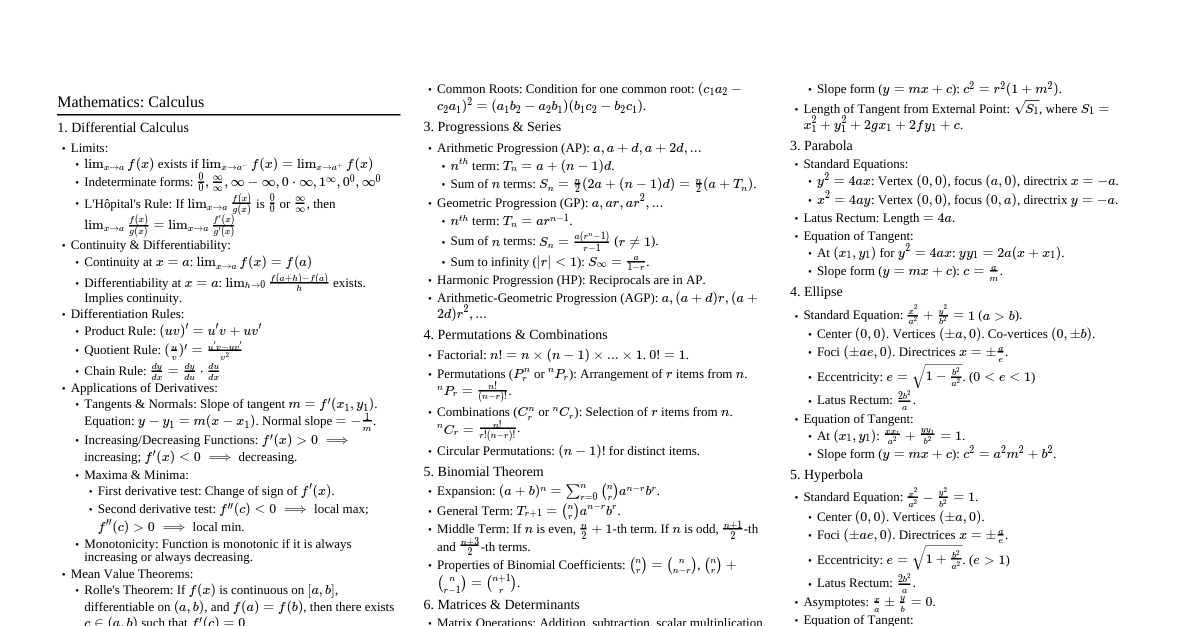
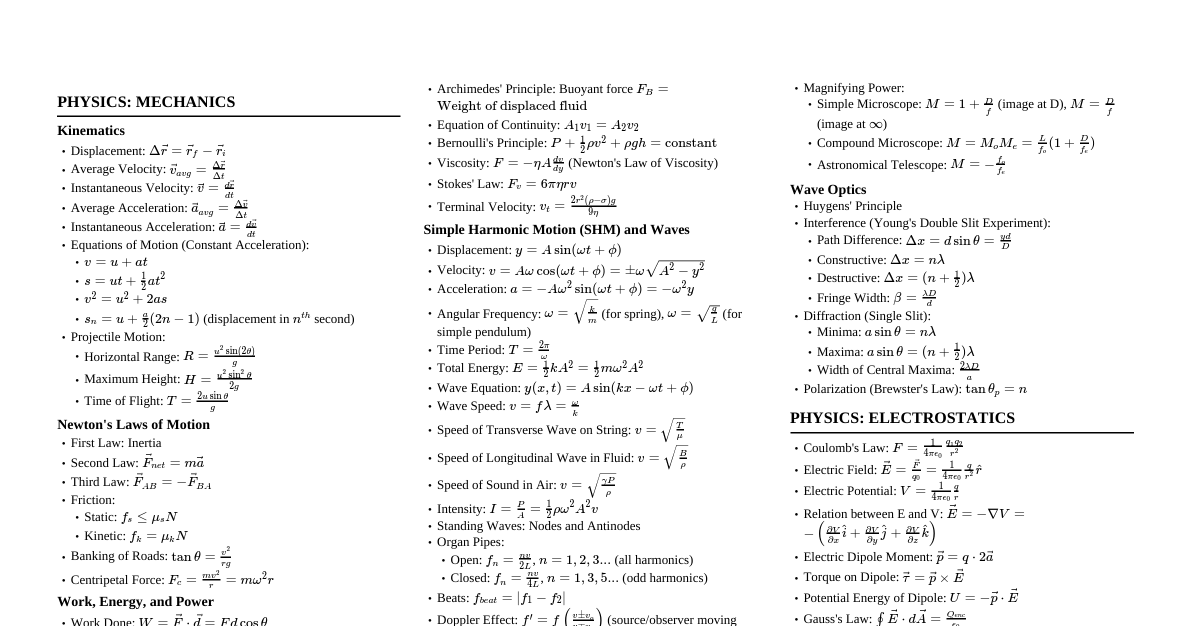
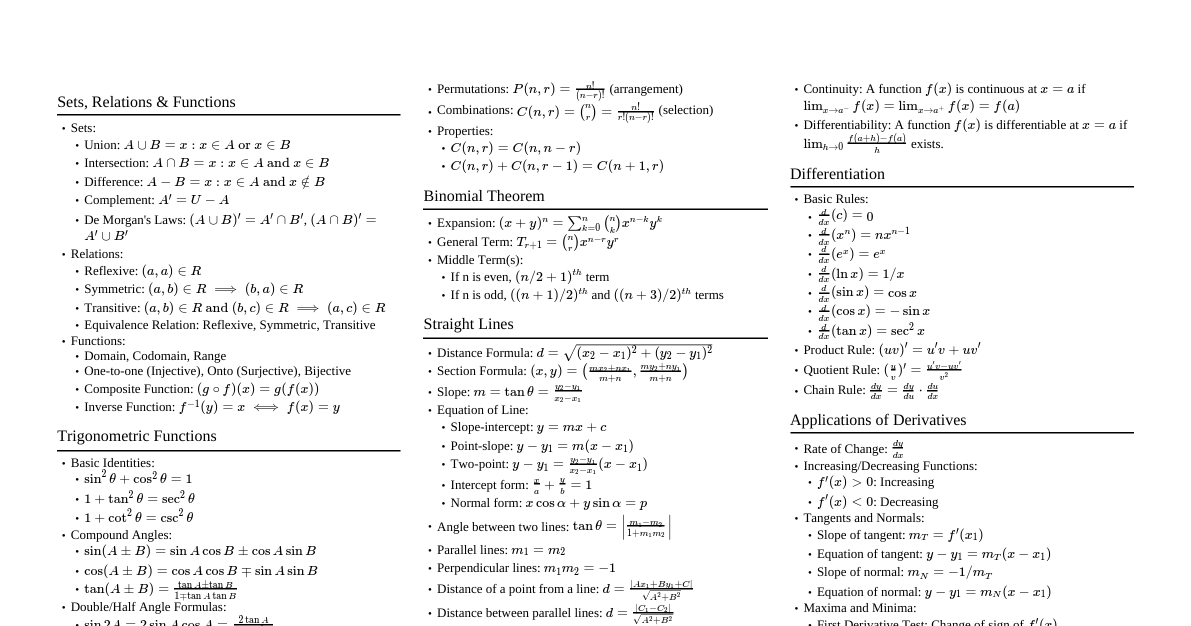
### Mathematics: Calculus #### 1. Differential Calculus - **Limits:** - $\lim_{x \to a} f(x)$ exists if $\lim_{x \to a^-} f(x) = \lim_{x \to a^+} f(x)$ - Indeterminate forms: $\frac{0}{0}, \frac{\infty}{\infty}, \infty - \infty, 0 \cdot \infty, 1^\infty, 0^0, \infty^0$ - L'Hôpital's Rule: If $\lim_{x \to a} \frac{f(x)}{g(x)}$ is $\frac{0}{0}$ or $\frac{\infty}{\infty}$, then $\lim_{x \to a} \frac{f(x)}{g(x)} = \lim_{x \to a} \frac{f'(x)}{g'(x)}$ - **Continuity & Differentiability:** - **Continuity at $x=a$:** $\lim_{x \to a} f(x) = f(a)$ - **Differentiability at $x=a$:** $\lim_{h \to 0} \frac{f(a+h) - f(a)}{h}$ exists. Implies continuity. - **Differentiation Rules:** - Product Rule: $(uv)' = u'v + uv'$ - Quotient Rule: $(\frac{u}{v})' = \frac{u'v - uv'}{v^2}$ - Chain Rule: $\frac{dy}{dx} = \frac{dy}{du} \cdot \frac{du}{dx}$ - **Applications of Derivatives:** - **Tangents & Normals:** Slope of tangent $m = f'(x_1, y_1)$. Equation: $y - y_1 = m(x - x_1)$. Normal slope $= -\frac{1}{m}$. - **Increasing/Decreasing Functions:** $f'(x) > 0 \implies$ increasing; $f'(x) 0 \implies$ local min. - **Monotonicity:** Function is monotonic if it is always increasing or always decreasing. - **Mean Value Theorems:** - **Rolle's Theorem:** If $f(x)$ is continuous on $[a,b]$, differentiable on $(a,b)$, and $f(a)=f(b)$, then there exists $c \in (a,b)$ such that $f'(c)=0$. - **Lagrange's MVT:** If $f(x)$ is continuous on $[a,b]$ and differentiable on $(a,b)$, then there exists $c \in (a,b)$ such that $f'(c) = \frac{f(b)-f(a)}{b-a}$. #### 2. Integral Calculus - **Indefinite Integrals:** - Basic formulas: $\int x^n dx = \frac{x^{n+1}}{n+1} + C$, $\int \frac{1}{x} dx = \ln|x| + C$, $\int \sin x dx = -\cos x + C$, etc. - Integration by Parts: $\int u dv = uv - \int v du$ - Partial Fractions: For rational functions. - **Definite Integrals:** - Fundamental Theorem of Calculus: $\int_a^b f(x) dx = F(b) - F(a)$, where $F'(x) = f(x)$. - Properties of Definite Integrals: - $\int_a^b f(x) dx = \int_a^b f(a+b-x) dx$ - $\int_0^a f(x) dx = \int_0^a f(a-x) dx$ - $\int_{-a}^a f(x) dx = 2\int_0^a f(x) dx$ if $f(x)$ is even; $0$ if $f(x)$ is odd. - **Area Under Curves:** - Area between curve $y=f(x)$ and x-axis from $x=a$ to $x=b$: $\int_a^b |f(x)| dx$. - Area between two curves $y=f(x)$ and $y=g(x)$: $\int_a^b |f(x) - g(x)| dx$. - **Differential Equations:** - **Order & Degree:** Order is highest derivative. Degree is power of highest derivative after making polynomial in derivatives. - **Formation of DE:** Eliminate arbitrary constants. - **Methods of Solving:** - Variable Separable: $\int f(x) dx = \int g(y) dy$ - Homogeneous: Substitute $y=vx$, then variable separable. - Linear DE: $\frac{dy}{dx} + P(x)y = Q(x)$. Integrating Factor (IF) $= e^{\int P(x) dx}$. Solution: $y \cdot IF = \int Q(x) \cdot IF dx + C$. ### Mathematics: Algebra #### 1. Complex Numbers - **Definition:** $z = x + iy$, where $i = \sqrt{-1}$. - **Conjugate:** $\bar{z} = x - iy$. - **Modulus:** $|z| = \sqrt{x^2 + y^2}$. - **Argand Plane:** Representation of complex numbers. - **Polar Form:** $z = r(\cos\theta + i\sin\theta)$, where $r = |z|$ and $\theta = \arg(z)$. - **Euler's Form:** $z = re^{i\theta}$. - **De Moivre's Theorem:** $(cos\theta + i\sin\theta)^n = \cos(n\theta) + i\sin(n\theta)$. - **Roots of Unity:** $z^n = 1 \implies z = e^{i\frac{2k\pi}{n}}$ for $k=0,1,...,n-1$. #### 2. Quadratic Equations - **Form:** $ax^2 + bx + c = 0$ ($a \neq 0$). - **Roots:** $x = \frac{-b \pm \sqrt{b^2 - 4ac}}{2a}$. - **Discriminant:** $\Delta = b^2 - 4ac$. - $\Delta > 0$: Two distinct real roots. - $\Delta = 0$: Two equal real roots. - $\Delta ### Mathematics: Coordinate Geometry #### 1. Straight Lines - **Distance Formula:** $\sqrt{(x_2-x_1)^2 + (y_2-y_1)^2}$. - **Section Formula:** $(x,y) = (\frac{m x_2 + n x_1}{m+n}, \frac{m y_2 + n y_1}{m+n})$. - **Slope:** $m = \tan\theta = \frac{y_2-y_1}{x_2-x_1}$. - **Equation of a Line:** - Point-slope form: $y - y_1 = m(x - x_1)$. - Slope-intercept form: $y = mx + c$. - Two-point form: $y - y_1 = \frac{y_2-y_1}{x_2-x_1}(x - x_1)$. - Intercept form: $\frac{x}{a} + \frac{y}{b} = 1$. - Normal form: $x\cos\alpha + y\sin\alpha = p$. - **Angle between two lines:** $\tan\theta = |\frac{m_1 - m_2}{1 + m_1 m_2}|$. - Parallel lines: $m_1 = m_2$. - Perpendicular lines: $m_1 m_2 = -1$. - **Distance of a point from a line:** $\frac{|Ax_1 + By_1 + C|}{\sqrt{A^2 + B^2}}$. - **Concurrency of three lines:** $\begin{vmatrix} A_1 & B_1 & C_1 \\ A_2 & B_2 & C_2 \\ A_3 & B_3 & C_3 \end{vmatrix} = 0$. #### 2. Circles - **Standard Equation:** $(x-h)^2 + (y-k)^2 = r^2$. (Center $(h,k)$, radius $r$) - **General Equation:** $x^2 + y^2 + 2gx + 2fy + c = 0$. (Center $(-g,-f)$, radius $\sqrt{g^2+f^2-c}$) - **Condition for a circle:** Coefficient of $x^2$ = Coefficient of $y^2$ and no $xy$ term. - **Equation of Tangent:** - At $(x_1, y_1)$: $xx_1 + yy_1 + g(x+x_1) + f(y+y_1) + c = 0$. - Slope form ($y=mx+c$): $c^2 = r^2(1+m^2)$. - **Length of Tangent from External Point:** $\sqrt{S_1}$, where $S_1 = x_1^2 + y_1^2 + 2gx_1 + 2fy_1 + c$. #### 3. Parabola - **Standard Equations:** - $y^2 = 4ax$: Vertex $(0,0)$, focus $(a,0)$, directrix $x=-a$. - $x^2 = 4ay$: Vertex $(0,0)$, focus $(0,a)$, directrix $y=-a$. - **Latus Rectum:** Length $= 4a$. - **Equation of Tangent:** - At $(x_1, y_1)$ for $y^2=4ax$: $yy_1 = 2a(x+x_1)$. - Slope form ($y=mx+c$): $c = \frac{a}{m}$. #### 4. Ellipse - **Standard Equation:** $\frac{x^2}{a^2} + \frac{y^2}{b^2} = 1$ ($a>b$). - Center $(0,0)$. Vertices $(\pm a, 0)$. Co-vertices $(0, \pm b)$. - Foci $(\pm ae, 0)$. Directrices $x = \pm \frac{a}{e}$. - Eccentricity: $e = \sqrt{1 - \frac{b^2}{a^2}}$. ($0 1$) - Latus Rectum: $\frac{2b^2}{a}$. - **Asymptotes:** $\frac{x}{a} \pm \frac{y}{b} = 0$. - **Equation of Tangent:** - At $(x_1, y_1)$: $\frac{xx_1}{a^2} - \frac{yy_1}{b^2} = 1$. - Slope form ($y=mx+c$): $c^2 = a^2m^2 - b^2$. #### 6. 3D Geometry - **Direction Cosines (l, m, n):** $l = \cos\alpha, m = \cos\beta, n = \cos\gamma$. $l^2+m^2+n^2=1$. - **Direction Ratios (a, b, c):** Proportional to direction cosines. - **Equation of a Line:** - Vector form: $\vec{r} = \vec{a} + \lambda\vec{b}$. - Cartesian form: $\frac{x-x_1}{a} = \frac{y-y_1}{b} = \frac{z-z_1}{c}$. - **Equation of a Plane:** - Normal form: $\vec{r} \cdot \hat{n} = d$. - Cartesian form: $Ax+By+Cz+D=0$. - Intercept form: $\frac{x}{a} + \frac{y}{b} + \frac{z}{c} = 1$. - **Angle between two lines:** $\cos\theta = |\frac{\vec{b_1} \cdot \vec{b_2}}{|\vec{b_1}||\vec{b_2}|}|$. - **Angle between two planes:** $\cos\theta = |\frac{\vec{n_1} \cdot \vec{n_2}}{|\vec{n_1}||\vec{n_2}|}|$. - **Distance of a point from a plane:** $\frac{|Ax_1 + By_1 + Cz_1 + D|}{\sqrt{A^2+B^2+C^2}}$. ### Mathematics: Vectors - **Scalar Product (Dot Product):** $\vec{a} \cdot \vec{b} = |\vec{a}||\vec{b}|\cos\theta = a_xb_x + a_yb_y + a_zb_z$. - $\vec{a} \cdot \vec{a} = |\vec{a}|^2$. - If $\vec{a} \cdot \vec{b} = 0$, then $\vec{a} \perp \vec{b}$. - **Vector Product (Cross Product):** $\vec{a} \times \vec{b} = (|\vec{a}||\vec{b}|\sin\theta)\hat{n} = \begin{vmatrix} \hat{i} & \hat{j} & \hat{k} \\ a_x & a_y & a_z \\ b_x & b_y & b_z \end{vmatrix}$. - $|\vec{a} \times \vec{b}|$ = Area of parallelogram. - If $\vec{a} \times \vec{b} = 0$, then $\vec{a} || \vec{b}$. - **Scalar Triple Product (Box Product):** $[\vec{a} \vec{b} \vec{c}] = \vec{a} \cdot (\vec{b} \times \vec{c}) = \begin{vmatrix} a_x & a_y & a_z \\ b_x & b_y & b_z \\ c_x & c_y & c_z \end{vmatrix}$. - Volume of parallelepiped. - If $[\vec{a} \vec{b} \vec{c}] = 0$, vectors are coplanar. - **Vector Triple Product:** $\vec{a} \times (\vec{b} \times \vec{c}) = (\vec{a} \cdot \vec{c})\vec{b} - (\vec{a} \cdot \vec{b})\vec{c}$. ### Mathematics: Trigonometry #### 1. Trigonometric Ratios & Identities - **Basic Ratios:** $\sin\theta = \frac{P}{H}, \cos\theta = \frac{B}{H}, \tan\theta = \frac{P}{B}$. - **Identities:** $\sin^2\theta + \cos^2\theta = 1$, $1 + \tan^2\theta = \sec^2\theta$, $1 + \cot^2\theta = \csc^2\theta$. - **Compound Angles:** - $\sin(A \pm B) = \sin A \cos B \pm \cos A \sin B$. - $\cos(A \pm B) = \cos A \cos B \mp \sin A \sin B$. - $\tan(A \pm B) = \frac{\tan A \pm \tan B}{1 \mp \tan A \tan B}$. - **Multiple & Submultiple Angles:** - $\sin 2A = 2\sin A \cos A = \frac{2\tan A}{1+\tan^2 A}$. - $\cos 2A = \cos^2 A - \sin^2 A = 2\cos^2 A - 1 = 1 - 2\sin^2 A = \frac{1-\tan^2 A}{1+\tan^2 A}$. - $\tan 2A = \frac{2\tan A}{1-\tan^2 A}$. - $\sin 3A = 3\sin A - 4\sin^3 A$. - $\cos 3A = 4\cos^3 A - 3\cos A$. - $\tan 3A = \frac{3\tan A - \tan^3 A}{1 - 3\tan^2 A}$. - **Transformation Formulas:** - $2\sin A \cos B = \sin(A+B) + \sin(A-B)$. - $2\cos A \sin B = \sin(A+B) - \sin(A-B)$. - $2\cos A \cos B = \cos(A+B) + \cos(A-B)$. - $2\sin A \sin B = \cos(A-B) - \cos(A+B)$. - $\sin C + \sin D = 2\sin(\frac{C+D}{2})\cos(\frac{C-D}{2})$. - $\cos C + \cos D = 2\cos(\frac{C+D}{2})\cos(\frac{C-D}{2})$. #### 2. Inverse Trigonometric Functions - **Principal Value Branches:** - $\sin^{-1}x: [-\frac{\pi}{2}, \frac{\pi}{2}]$ - $\cos^{-1}x: [0, \pi]$ - $\tan^{-1}x: (-\frac{\pi}{2}, \frac{\pi}{2})$ - **Properties:** - $\sin^{-1}x + \cos^{-1}x = \frac{\pi}{2}$. - $\tan^{-1}x + \tan^{-1}y = \tan^{-1}(\frac{x+y}{1-xy})$. #### 3. Solutions of Triangles - **Sine Rule:** $\frac{a}{\sin A} = \frac{b}{\sin B} = \frac{c}{\sin C} = 2R$ (R = circumradius). - **Cosine Rule:** $a^2 = b^2 + c^2 - 2bc\cos A$. - **Area of Triangle:** $\frac{1}{2}bc\sin A = \frac{1}{2}ca\sin B = \frac{1}{2}ab\sin C$. - **Hero's Formula:** $\sqrt{s(s-a)(s-b)(s-c)}$, where $s = \frac{a+b+c}{2}$. ### Physics: Mechanics #### 1. Units, Dimensions & Measurement - **Units:** SI system (meter, kg, second, Ampere, Kelvin, mole, candela). - **Dimensions:** $[L], [M], [T], [A], [K], [mol], [cd]$. - **Dimensional Analysis:** Check consistency, derive relations. - **Error Analysis:** - Absolute Error: $\Delta A = |A_{mean} - A_{measured}|$. - Relative Error: $\frac{\Delta A_{mean}}{A_{mean}}$. - Percentage Error: $\frac{\Delta A_{mean}}{A_{mean}} \times 100\%$. #### 2. Kinematics - **Equations of Motion (Constant Acceleration):** - $v = u + at$. - $S = ut + \frac{1}{2}at^2$. - $v^2 = u^2 + 2aS$. - $S_n = u + \frac{a}{2}(2n-1)$ ($n^{th}$ second distance). - **Projectile Motion:** - Time of flight: $T = \frac{2u\sin\theta}{g}$. - Max height: $H = \frac{u^2\sin^2\theta}{2g}$. - Range: $R = \frac{u^2\sin(2\theta)}{g}$. Max range at $\theta=45^\circ$. - **Relative Motion:** $\vec{V}_{AB} = \vec{V}_A - \vec{V}_B$. #### 3. Newton's Laws of Motion - **First Law:** Inertia. - **Second Law:** $\vec{F} = m\vec{a} = \frac{d\vec{p}}{dt}$. - **Third Law:** Action-reaction pairs. - **Momentum:** $\vec{p} = m\vec{v}$. - **Impulse:** $\vec{J} = \Delta\vec{p} = \int \vec{F} dt$. - **Conservation of Momentum:** If $\vec{F}_{ext} = 0$, then $\vec{p}_{total} = \text{constant}$. - **Friction:** - Static friction: $f_s \le \mu_s N$. - Kinetic friction: $f_k = \mu_k N$. ($\mu_k ### Physics: Thermodynamics #### 1. Thermal Properties of Matter - **Heat Capacity:** $C = \frac{\Delta Q}{\Delta T}$. - **Specific Heat Capacity:** $c = \frac{C}{m}$. - **Latent Heat:** $Q = mL$. - **Thermal Expansion:** - Linear: $L = L_0(1 + \alpha\Delta T)$. - Area: $A = A_0(1 + \beta\Delta T)$, $\beta = 2\alpha$. - Volume: $V = V_0(1 + \gamma\Delta T)$, $\gamma = 3\alpha$. - **Heat Transfer:** - Conduction: $\frac{dQ}{dt} = -KA\frac{dT}{dx}$. - Convection: Fluid motion. - Radiation: Stefan-Boltzmann Law $P = e\sigma AT^4$. Wien's Displacement Law $\lambda_m T = b$. #### 2. Thermodynamics Laws - **Zeroth Law:** Defines temperature. - **First Law:** $\Delta U = Q - W$. ($Q$ = heat added, $W$ = work done by system) - Work done by gas: $W = \int P dV$. - **Thermodynamic Processes:** - Isothermal: $T = \text{constant}$. $PV = \text{constant}$. $W = nRT \ln(\frac{V_2}{V_1})$. - Adiabatic: $Q = 0$. $PV^\gamma = \text{constant}$. $T V^{\gamma-1} = \text{constant}$. $P^{1-\gamma} T^\gamma = \text{constant}$. - Isobaric: $P = \text{constant}$. $W = P(V_2 - V_1)$. - Isochoric: $V = \text{constant}$. $W = 0$. - **Second Law:** Heat flows from hot to cold. Entropy of isolated system never decreases. - Carnot Engine Efficiency: $\eta = 1 - \frac{T_C}{T_H}$. #### 3. Kinetic Theory of Gases - **Assumptions:** Point particles, random motion, elastic collisions. - **Pressure:** $P = \frac{1}{3}\frac{N}{V}m\overline{v^2}$. - **Average KE per molecule:** $\frac{3}{2}kT$. - **RMS Speed:** $v_{rms} = \sqrt{\frac{3RT}{M}} = \sqrt{\frac{3kT}{m}}$. - **Degrees of Freedom (f):** Monatomic (3), Diatomic (5), Polyatomic (6). - **Internal Energy:** $U = \frac{f}{2}nRT$. - **Mayer's Relation:** $C_P - C_V = R$. - **Ratio of specific heats:** $\gamma = \frac{C_P}{C_V} = 1 + \frac{2}{f}$. ### Physics: Waves and Optics #### 1. Waves - **Wave Equation:** $y(x,t) = A\sin(kx - \omega t + \phi)$. - $k = \frac{2\pi}{\lambda}$ (wave number), $\omega = 2\pi f$ (angular frequency). - Wave Speed: $v = f\lambda = \frac{\omega}{k}$. - **Speed of Sound:** $v = \sqrt{\frac{B}{\rho}}$ (fluids), $v = \sqrt{\frac{Y}{\rho}}$ (solids). - **Superposition Principle:** Resultant displacement is sum of individual displacements. - **Standing Waves:** Nodes (zero displacement), Antinodes (max displacement). - String fixed at both ends: $\lambda_n = \frac{2L}{n}$, $f_n = \frac{nv}{2L}$. Fundamental $n=1$. - Open organ pipe: $\lambda_n = \frac{2L}{n}$, $f_n = \frac{nv}{2L}$. - Closed organ pipe: $\lambda_n = \frac{4L}{(2n-1)}$, $f_n = \frac{(2n-1)v}{4L}$. Only odd harmonics. - **Beats:** $f_{beat} = |f_1 - f_2|$. - **Doppler Effect:** $f' = f \frac{v \pm v_o}{v \mp v_s}$. (+ observer towards, - source towards). #### 2. Ray Optics - **Reflection:** Angle of incidence = Angle of reflection. - Mirror Formula: $\frac{1}{f} = \frac{1}{v} + \frac{1}{u}$. - Magnification: $m = -\frac{v}{u} = \frac{h_i}{h_o}$. - **Refraction:** Snell's Law: $n_1\sin\theta_1 = n_2\sin\theta_2$. - Lens Maker's Formula: $\frac{1}{f} = (n-1)(\frac{1}{R_1} - \frac{1}{R_2})$. - Lens Formula: $\frac{1}{f} = \frac{1}{v} - \frac{1}{u}$. - Magnification: $m = \frac{v}{u} = \frac{h_i}{h_o}$. - **Total Internal Reflection (TIR):** Occurs when light goes from denser to rarer medium and $\theta > \theta_c$, where $\sin\theta_c = \frac{n_2}{n_1}$. - **Prism:** $\delta = (n-1)A$. (Small angle prism) - **Optical Instruments:** - Simple Microscope: $M = 1 + \frac{D}{f}$ (image at D), $M = \frac{D}{f}$ (image at $\infty$). - Compound Microscope: $M = \frac{v_o}{u_o}(1 + \frac{D}{f_e})$. - Telescope: $M = -\frac{f_o}{f_e}$. #### 3. Wave Optics - **Huygens' Principle:** Every point on a wavefront is a source of secondary wavelets. - **Interference (Young's Double Slit Experiment):** - Path difference: $\Delta x = d\sin\theta$. - Bright Fringes (constructive): $\Delta x = n\lambda$. - Dark Fringes (destructive): $\Delta x = (n + \frac{1}{2})\lambda$. - Fringe Width: $\beta = \frac{\lambda D}{d}$. - **Diffraction (Single Slit):** - Minima: $a\sin\theta = n\lambda$. - Maxima: $a\sin\theta = (n + \frac{1}{2})\lambda$. - **Polarization:** Transverse waves can be polarized. - Brewster's Law: $\tan i_p = n$. Reflected light is completely polarized. - Malus' Law: $I = I_0\cos^2\theta$. ### Physics: Electromagnetism #### 1. Electrostatics - **Coulomb's Law:** $F = \frac{1}{4\pi\epsilon_0} \frac{q_1q_2}{r^2}$. - **Electric Field:** $\vec{E} = \frac{\vec{F}}{q_0}$. For point charge: $E = \frac{1}{4\pi\epsilon_0} \frac{q}{r^2}$. - **Electric Potential:** $V = \frac{W}{q_0}$. For point charge: $V = \frac{1}{4\pi\epsilon_0} \frac{q}{r}$. - **Relation between E and V:** $\vec{E} = -\nabla V$. - **Electric Dipole:** - Dipole moment: $\vec{p} = q(2\vec{a})$. - Field on axial line: $E = \frac{1}{4\pi\epsilon_0} \frac{2p}{r^3}$. - Field on equatorial line: $E = \frac{1}{4\pi\epsilon_0} \frac{p}{r^3}$. - Torque on dipole in uniform E-field: $\vec{\tau} = \vec{p} \times \vec{E}$. - Potential Energy: $U = -\vec{p} \cdot \vec{E}$. - **Gauss's Law:** $\oint \vec{E} \cdot d\vec{A} = \frac{Q_{enc}}{\epsilon_0}$. - **Capacitance:** $C = \frac{Q}{V}$. - Parallel plate capacitor: $C = \frac{\epsilon_0 A}{d}$. - With dielectric: $C = \frac{K\epsilon_0 A}{d}$. - Series combination: $\frac{1}{C_{eq}} = \sum \frac{1}{C_i}$. - Parallel combination: $C_{eq} = \sum C_i$. - Energy stored: $U = \frac{1}{2}CV^2 = \frac{1}{2}\frac{Q^2}{C} = \frac{1}{2}QV$. #### 2. Current Electricity - **Ohm's Law:** $V = IR$. - **Resistance:** $R = \rho \frac{L}{A}$. - **Temperature dependence of Resistance:** $R_T = R_0(1 + \alpha\Delta T)$. - **Series combination of Resistors:** $R_{eq} = \sum R_i$. - **Parallel combination of Resistors:** $\frac{1}{R_{eq}} = \sum \frac{1}{R_i}$. - **Kirchhoff's Laws:** - Current Law (KCL): Sum of currents entering a junction = sum of currents leaving. (Conservation of charge) - Voltage Law (KVL): Sum of potential drops around a closed loop = 0. (Conservation of energy) - **Wheatstone Bridge:** Balanced when $\frac{P}{Q} = \frac{R}{S}$. - **Metre Bridge:** Uses Wheatstone bridge principle. - **Potentiometer:** Measures emf and compares emfs. #### 3. Magnetic Effects of Current & Magnetism - **Biot-Savart Law:** $d\vec{B} = \frac{\mu_0}{4\pi} \frac{I d\vec{l} \times \vec{r}}{r^3}$. - **Magnetic Field due to:** - Straight wire: $B = \frac{\mu_0 I}{2\pi r}$. - Circular loop at center: $B = \frac{\mu_0 I}{2R}$. - Solenoid: $B = \mu_0 nI$. - Toroid: $B = \mu_0 nI$. - **Ampere's Circuital Law:** $\oint \vec{B} \cdot d\vec{l} = \mu_0 I_{enc}$. - **Lorentz Force:** $\vec{F} = q(\vec{E} + \vec{v} \times \vec{B})$. - **Force on current-carrying conductor in B-field:** $\vec{F} = I(\vec{l} \times \vec{B})$. - **Torque on current loop:** $\vec{\tau} = \vec{M} \times \vec{B}$, where $\vec{M} = NI\vec{A}$ (magnetic moment). - **Moving Coil Galvanometer:** $\tau = NIAB = k\phi$. - **Earth's Magnetism:** Angle of dip, angle of declination. - **Magnetic Properties of Materials:** Dia-, Para-, Ferro-magnetism. #### 4. Electromagnetic Induction (EMI) & Alternating Current (AC) - **Magnetic Flux:** $\Phi = \vec{B} \cdot \vec{A} = BA\cos\theta$. - **Faraday's Laws of EMI:** Induced EMF $\mathcal{E} = -\frac{d\Phi}{dt}$. - **Lenz's Law:** Direction of induced current opposes the change in magnetic flux. - **Motional EMF:** $\mathcal{E} = Blv$. - **Self-Inductance:** $\Phi = LI$, $\mathcal{E} = -L\frac{dI}{dt}$. Energy stored $U = \frac{1}{2}LI^2$. - **Mutual Inductance:** $\Phi_2 = MI_1$, $\mathcal{E}_2 = -M\frac{dI_1}{dt}$. - **AC Circuits:** - RMS values: $V_{rms} = \frac{V_0}{\sqrt{2}}$, $I_{rms} = \frac{I_0}{\sqrt{2}}$. - Reactance: $X_L = \omega L$, $X_C = \frac{1}{\omega C}$. - Impedance: $Z = \sqrt{R^2 + (X_L - X_C)^2}$. - Phase angle: $\tan\phi = \frac{X_L - X_C}{R}$. - Power in AC circuit: $P = V_{rms}I_{rms}\cos\phi$ (Power Factor $\cos\phi$). - Resonance: $X_L = X_C \implies \omega_0 = \frac{1}{\sqrt{LC}}$. - Transformer: $\frac{V_s}{V_p} = \frac{N_s}{N_p} = \frac{I_p}{I_s}$. #### 5. Electromagnetic Waves (EM Waves) - **Properties:** Transverse waves, do not require medium. - **Speed in vacuum:** $c = \frac{1}{\sqrt{\mu_0\epsilon_0}}$. - **Maxwell's Equations:** Summarize electromagnetism. - **EM Spectrum:** Radio, Microwave, Infrared, Visible, UV, X-ray, Gamma ray (increasing freq, decreasing wavelength). ### Physics: Modern Physics #### 1. Dual Nature of Radiation & Matter - **Photoelectric Effect:** - Einstein's equation: $KE_{max} = h\nu - \phi_0$, where $\phi_0 = h\nu_0$ (work function, threshold freq). - Intensity affects number of photoelectrons, not KE. - **Photon properties:** Energy $E = h\nu = \frac{hc}{\lambda}$. Momentum $p = \frac{E}{c} = \frac{h}{\lambda}$. - **De Broglie Wavelength:** $\lambda = \frac{h}{p} = \frac{h}{mv}$. - For electron accelerated by V volts: $\lambda = \frac{1.227}{\sqrt{V}} \text{ nm}$. - **Davisson-Germer Experiment:** Confirmed wave nature of electrons. #### 2. Atoms - **Rutherford's Model:** Nucleus at center, electrons orbit. Failed to explain stability and line spectra. - **Bohr's Model:** - Quantized orbits and energy levels. - Angular momentum $L = n\frac{h}{2\pi}$. - Energy of $n^{th}$ orbit: $E_n = -\frac{13.6}{n^2}Z^2 \text{ eV}$. - Radius of $n^{th}$ orbit: $r_n = 0.529 \frac{n^2}{Z} \text{ Å}$. - Velocity of $n^{th}$ orbit: $v_n = \frac{2.18 \times 10^6 Z}{n} \text{ m/s}$. - **Hydrogen Spectrum:** Lyman (UV), Balmer (Visible), Paschen, Brackett, Pfund (IR). - Wavelength: $\frac{1}{\lambda} = RZ^2 (\frac{1}{n_1^2} - \frac{1}{n_2^2})$. (R = Rydberg constant) - **X-rays:** Production by Coolidge tube. - Moseley's Law: $\sqrt{\nu} = a(Z-b)$. Related atomic number to X-ray frequency. #### 3. Nuclei - **Atomic Mass Unit (amu):** $1 \text{ amu} = 1.66 \times 10^{-27} \text{ kg}$. - **Mass Defect:** $\Delta m = (Zm_p + (A-Z)m_n) - M_{nucleus}$. - **Binding Energy:** $BE = \Delta m c^2$. - **Nuclear Fission:** Heavy nucleus splits into lighter nuclei. - **Nuclear Fusion:** Lighter nuclei combine to form heavier nucleus. - **Radioactivity:** - Alpha decay: $(Z,A) \to (Z-2, A-4) + \alpha$. - Beta decay: $(Z,A) \to (Z+1, A) + \beta^- + \bar{\nu}$ or $(Z,A) \to (Z-1, A) + \beta^+ + \nu$. - Gamma decay: Nucleus emits photon to de-excite. - **Half-life:** $T_{1/2} = \frac{\ln 2}{\lambda} = \frac{0.693}{\lambda}$. - **Mean life:** $\tau = \frac{1}{\lambda}$. - **Radioactive Decay Law:** $N = N_0 e^{-\lambda t}$. #### 4. Semiconductor Electronics - **Conductors, Insulators, Semiconductors:** Based on band theory (valence band, conduction band, band gap). - **Intrinsic Semiconductors:** Pure Si or Ge. - **Extrinsic Semiconductors:** Doped. - N-type: Doped with pentavalent impurities (e.g., P, As). Majority carriers are electrons. - P-type: Doped with trivalent impurities (e.g., B, Al). Majority carriers are holes. - **P-N Junction Diode:** - Forward bias: Low resistance, current flows. - Reverse bias: High resistance, very small current. - Rectifier: Converts AC to DC. (Half-wave, Full-wave). - **Zener Diode:** Used as voltage regulator. Operates in reverse breakdown region. - **Transistor (BJT):** NPN or PNP. Used as amplifier or switch. - Common Emitter configuration: Current gain $\beta = \frac{\Delta I_C}{\Delta I_B}$. - **Logic Gates:** AND, OR, NOT, NAND, NOR, XOR, XNOR. - Truth tables. Boolean algebra. ### Chemistry: Physical Chemistry #### 1. Mole Concept & Stoichiometry - **Mole:** $6.022 \times 10^{23}$ particles (Avogadro's Number). - **Molar Mass:** Mass of one mole of a substance. - **Stoichiometry:** Balancing equations, limiting reagent, percentage yield. - **Concentration Terms:** - Molarity (M): Moles of solute / Volume of solution (L). - Molality (m): Moles of solute / Mass of solvent (kg). - Mole Fraction ($x$): Moles of component / Total moles. - Mass Percentage: (Mass of component / Total mass) $\times 100$. #### 2. Atomic Structure - **Bohr's Model:** (Refer Physics section). - **Quantum Numbers:** - Principal (n): Energy level, size. (1, 2, 3...) - Azimuthal (l): Subshell, shape. (0 to n-1; s, p, d, f) - Magnetic ($m_l$): Orientation. (-l to +l) - Spin ($m_s$): Electron spin. ($\pm \frac{1}{2}$) - **Aufbau Principle:** Fill orbitals in increasing order of energy. - **Pauli's Exclusion Principle:** No two electrons can have all four quantum numbers same. - **Hund's Rule:** Maximize spin multiplicity in degenerate orbitals. - **Heisenberg's Uncertainty Principle:** $\Delta x \cdot \Delta p \ge \frac{h}{4\pi}$. #### 3. States of Matter - **Gases:** - Boyle's Law: $P_1V_1 = P_2V_2$. - Charles's Law: $\frac{V_1}{T_1} = \frac{V_2}{T_2}$. - Gay-Lussac's Law: $\frac{P_1}{T_1} = \frac{P_2}{T_2}$. - Avogadro's Law: $V \propto n$. - Ideal Gas Equation: $PV = nRT$. - Dalton's Law of Partial Pressures: $P_{total} = P_1 + P_2 + ...$ - Graham's Law of Diffusion: $\frac{r_1}{r_2} = \sqrt{\frac{M_2}{M_1}}$. - Real Gases: Van der Waals equation $(P + \frac{an^2}{V^2})(V - nb) = nRT$. - **Liquids:** Intermolecular forces, viscosity, surface tension, vapor pressure. - **Solids:** Crystalline vs. Amorphous. Unit cells (SC, BCC, FCC). Packing efficiency. - Defects: Point defects (vacancy, interstitial), line defects. #### 4. Chemical Bonding & Molecular Structure - **Ionic Bond:** Transfer of electrons. - **Covalent Bond:** Sharing of electrons. - VSEPR Theory: Predicts molecular geometry based on electron pair repulsion. - Hybridization: $sp, sp^2, sp^3, sp^3d, sp^3d^2$. - Molecular Orbital Theory (MOT): Bonding and anti-bonding orbitals. Bond order. - **Hydrogen Bonding:** Strongest intermolecular force. #### 5. Chemical Thermodynamics - **First Law:** $\Delta U = Q + W$. ($W$ = work done on system). - **Enthalpy ($\Delta H$):** Heat change at constant pressure. $\Delta H = \Delta U + P\Delta V$. - **Hess's Law:** Enthalpy change is independent of path. - **Standard Enthalpies:** Formation, combustion, neutralization. - **Second Law:** $\Delta S_{total} \ge 0$. - **Gibbs Free Energy ($\Delta G$):** $\Delta G = \Delta H - T\Delta S$. - $\Delta G 0$: Non-spontaneous. - **Relation to Equilibrium Constant:** $\Delta G^\circ = -RT \ln K$. #### 6. Chemical Equilibrium - **Law of Mass Action:** For $aA + bB \rightleftharpoons cC + dD$, $K_c = \frac{[C]^c[D]^d}{[A]^a[B]^b}$. - **Relation between $K_p$ and $K_c$:** $K_p = K_c(RT)^{\Delta n_g}$. - **Le Chatelier's Principle:** System shifts to counteract stress (change in P, T, conc). - **Ionic Equilibrium:** - **Acids & Bases:** Arrhenius, Brønsted-Lowry, Lewis theories. - **pH Scale:** $pH = -\log[H^+]$. $pH + pOH = 14$. - **Buffer Solutions:** Resist change in pH. Henderson-Hasselbalch equation: $pH = pK_a + \log\frac{[Salt]}{[Acid]}$. - **Solubility Product ($K_{sp}$):** For sparingly soluble salts. #### 7. Solutions - **Colligative Properties:** Depend on number of solute particles, not nature. - Relative Lowering of Vapor Pressure: $\frac{P^\circ - P_s}{P^\circ} = x_{solute}$. (Raoult's Law) - Elevation in Boiling Point: $\Delta T_b = K_b m$. - Depression in Freezing Point: $\Delta T_f = K_f m$. - Osmotic Pressure: $\pi = iCRT$. - **Van't Hoff Factor (i):** Accounts for dissociation/association. $i = \frac{\text{Observed colligative property}}{\text{Calculated colligative property}}$. #### 8. Electrochemistry - **Electrochemical Cells:** Galvanic (produces electricity), Electrolytic (uses electricity). - **Redox Reactions:** Oxidation (loss of e-), Reduction (gain of e-). - **Standard Electrode Potential ($E^\circ$):** Reduction potential measured against Standard Hydrogen Electrode (SHE). - **Nernst Equation:** $E_{cell} = E^\circ_{cell} - \frac{0.0591}{n} \log Q$. (at 298K) - **Gibbs Free Energy & Cell Potential:** $\Delta G = -nFE_{cell}$. - **Conductance:** $G = \frac{1}{R}$. Specific Conductance $\kappa = \frac{1}{\rho} = G \frac{l}{A}$. - **Molar Conductance:** $\Lambda_m = \frac{\kappa \times 1000}{M}$. - **Kohlrausch's Law:** At infinite dilution, $\Lambda_m^\circ = \sum \lambda_{m,ions}^\circ$. - **Faraday's Laws of Electrolysis:** - 1st Law: $W \propto Q$. - 2nd Law: $\frac{W_1}{W_2} = \frac{E_1}{E_2}$. #### 9. Chemical Kinetics - **Rate of Reaction:** Change in concentration / Change in time. - **Rate Law:** Rate $= k[A]^x[B]^y$. - **Order of Reaction:** $x+y$. (Can be fractional or zero). - **Molecularity:** Number of reacting species in elementary step. - **Integrated Rate Laws:** - Zero Order: $[A]_t = [A]_0 - kt$. $t_{1/2} = \frac{[A]_0}{2k}$. - First Order: $\ln[A]_t = \ln[A]_0 - kt$. $t_{1/2} = \frac{0.693}{k}$. - **Activation Energy ($E_a$):** Minimum energy for reaction. - **Arrhenius Equation:** $k = Ae^{-E_a/RT}$. #### 10. Surface Chemistry - **Adsorption:** Adsorbate adheres to adsorbent surface. - Physisorption (weak, reversible), Chemisorption (strong, irreversible). - **Catalysis:** Speeds up reaction without being consumed. - Homogeneous, Heterogeneous. - **Colloids:** Dispersed phase in dispersion medium. (Size 1nm-1000nm). - Types: Sol, Gel, Emulsion, Foam. - Tyndall Effect, Brownian Motion, Electrophoresis. ### Chemistry: Inorganic Chemistry #### 1. Classification of Elements & Periodicity - **Periodic Law:** Properties are periodic functions of atomic number. - **Trends:** - Atomic Radius: Decreases across period, increases down group. - Ionization Energy: Increases across period, decreases down group. - Electron Affinity: Increases across period (halogens max), decreases down group. - Electronegativity: Increases across period, decreases down group. (F max). #### 2. Hydrogen - Isotopes: Protium, Deuterium, Tritium. - Water: Hardness (temporary, permanent). - Hydrogen Peroxide ($H_2O_2$): Structure, oxidizing/reducing agent. #### 3. S-Block Elements - **Alkali Metals (Group 1):** Highly reactive, low IE, form +1 ions. - **Alkaline Earth Metals (Group 2):** Reactive, form +2 ions. - **Diagonal Relationship:** Li with Mg, Be with Al. #### 4. P-Block Elements - **Group 13 (Boron family):** Borax, Diborane ($B_2H_6$). - **Group 14 (Carbon family):** Allotropes of Carbon (diamond, graphite, fullerene). Silicones, silicates. - **Group 15 (Nitrogen family):** Ammonia, Nitric Acid. Phosphorous allotropes. - **Group 16 (Oxygen family):** Ozone, Sulphuric Acid. - **Group 17 (Halogens):** Highly reactive non-metals. Strong oxidizing agents. Hydrohalic acids. - **Group 18 (Noble Gases):** Inert, full octet. Xe compounds ($XeF_2, XeF_4, XeF_6$). #### 5. D- & F-Block Elements (Transition & Inner Transition Elements) - **Transition Elements:** Variable oxidation states, colored compounds, paramagnetic, good catalysts. - **Coordination Compounds:** Ligands, coordination number, Werner's theory, VBT, CFT, isomerism (geometric, optical). - IUPAC Naming. - **Lanthanoids & Actinoids:** F-block. Lanthanoid contraction. #### 6. Metallurgy - **Ores:** Minerals from which metals can be extracted. - **Extraction Steps:** - Concentration: Gravity separation, froth flotation, magnetic separation, leaching. - Reduction: Calcination, roasting, smelting (reduction with C, CO, or self-reduction). - Refining: Distillation, liquation, electrolysis, zone refining, vapor phase refining. #### 7. Environmental Chemistry - **Pollution:** Air, water, soil. - **Greenhouse Effect:** Global warming. - **Acid Rain:** $SO_x, NO_x$. - **Ozone Depletion:** CFCs. ### Chemistry: Organic Chemistry #### 1. General Organic Chemistry (GOC) - **Nomenclature:** IUPAC naming of organic compounds. - **Isomerism:** Structural (chain, position, functional, metamerism), Stereoisomerism (geometric, optical). - **Electronic Effects:** - Inductive Effect ($\pm I$): Electron displacement along $\sigma$ bond. - Resonance Effect ($\pm R$ or $\pm M$): Delocalization of $\pi$ electrons. - Hyperconjugation: Delocalization of $\sigma$ electrons. - **Reaction Intermediates:** Carbocations, carbanions, free radicals. Stability. - **Reaction Types:** Substitution, addition, elimination, rearrangement. - **Acidity & Basicity:** Factors affecting (inductive, resonance, hybridization). #### 2. Hydrocarbons - **Alkanes:** Saturated. Free radical substitution. - **Alkenes:** Unsaturated. Electrophilic addition. Markovnikov's Rule. Ozonolysis. - **Alkynes:** Unsaturated. Electrophilic addition. Acidity of terminal alkynes. - **Aromatic Compounds (Benzene):** - Aromaticity: Hückel's Rule ($4n+2$ $\pi$ electrons). - Electrophilic Aromatic Substitution (EAS): Nitration, halogenation, sulfonation, Friedel-Crafts (alkylation, acylation). - Activating/Deactivating groups, ortho/para/meta directors. #### 3. Halogen Derivatives - **Alkyl Halides:** $R-X$. - Nucleophilic Substitution ($S_N1, S_N2$): $S_N1$ (tertiary > secondary > primary, carbocation intermediate), $S_N2$ (primary > secondary > tertiary, concerted mechanism). - Elimination ($E1, E2$): Saytzeff's Rule. - **Aryl Halides:** Less reactive to nucleophilic substitution due to resonance. #### 4. Oxygen Containing Organic Compounds - **Alcohols:** $R-OH$. Preparation, reactions (oxidation, dehydration). - **Phenols:** Benzene-OH. Acidic nature. Electrophilic substitution. - **Ethers:** $R-O-R'$. Preparation (Williamson synthesis). - **Aldehydes & Ketones:** $RCHO, RCOR'$. - Nucleophilic Addition. - Aldol Condensation, Cannizzaro Reaction. - Tollen's Test (Ag mirror), Fehling's Test (red ppt) for aldehydes. - **Carboxylic Acids:** $RCOOH$. Acidic nature. Esterification. - **Derivatives of Carboxylic Acids:** Esters, acid chlorides, amides, anhydrides. #### 5. Nitrogen Containing Organic Compounds - **Amines:** $RNH_2, R_2NH, R_3N$. Basic nature. Hoffmann bromamide degradation. Carbylamine reaction. - **Diazonium Salts:** $Ar-N_2^+X^-$. Sandmeyer, Gattermann reactions. Coupling reactions. - **Nitro Compounds:** $RNO_2$. #### 6. Biomolecules - **Carbohydrates:** Monosaccharides (glucose, fructose), Disaccharides (sucrose, lactose), Polysaccharides (starch, cellulose). - **Proteins:** Amino acids (building blocks). Peptide bond. Primary, secondary, tertiary, quaternary structures. Denaturation. - **Vitamins:** Fat soluble (A, D, E, K), Water soluble (B, C). - **Nucleic Acids:** DNA, RNA. Nucleotides (sugar, phosphate, nitrogenous base). #### 7. Polymers - **Classification:** Natural, synthetic. Addition, condensation polymers. - **Examples:** Polyethylene, PVC, Nylon-6,6, Buna-S, Bakelite. #### 8. Chemistry in Everyday Life - **Drugs:** Analgesics, antipyretics, antibiotics, antiseptics, disinfectants, tranquilizers, antacids. - **Food Preservatives:** Antioxidants. Artificial sweeteners. - **Soaps & Detergents:** Cleansing action.