Units and Measurement - Ch 1
Cheatsheet Content
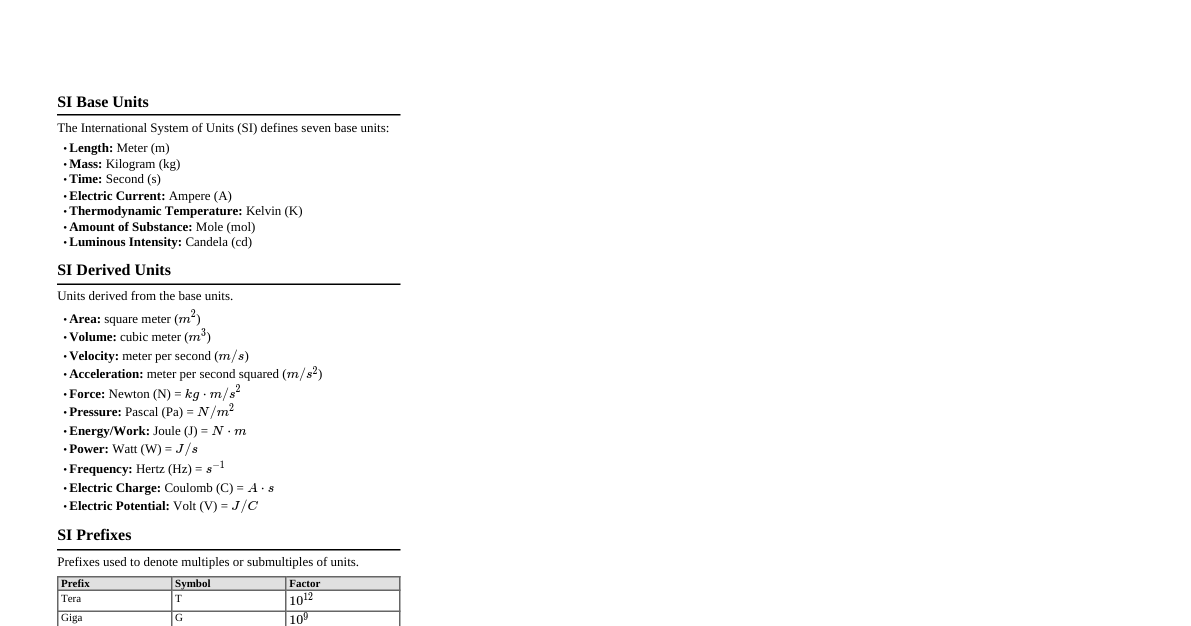
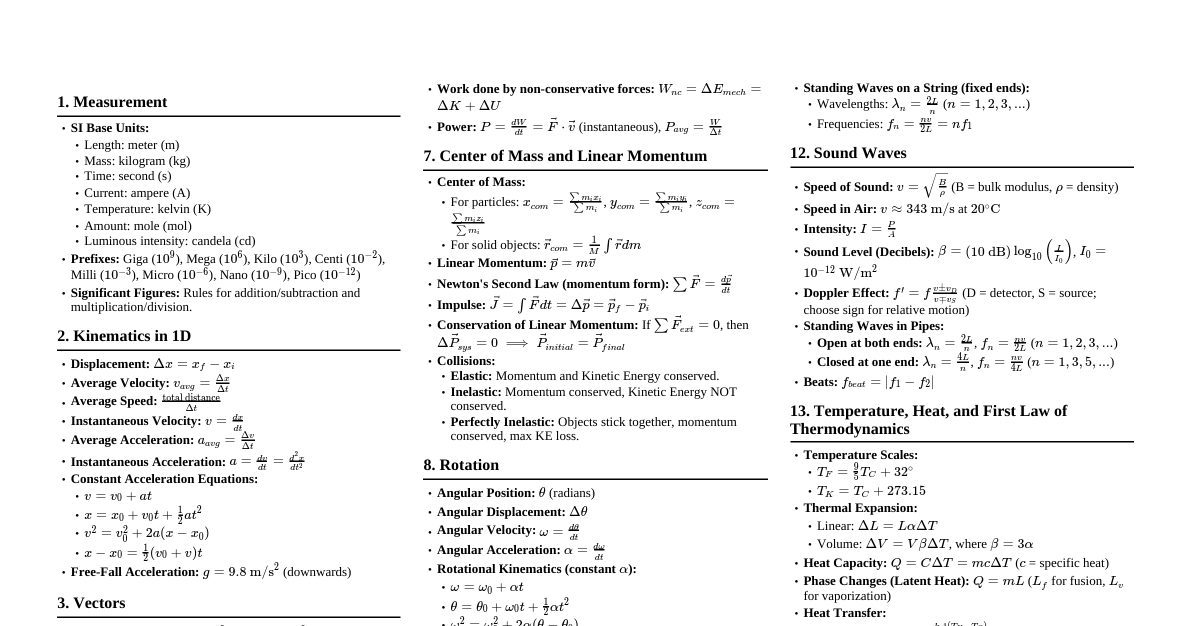
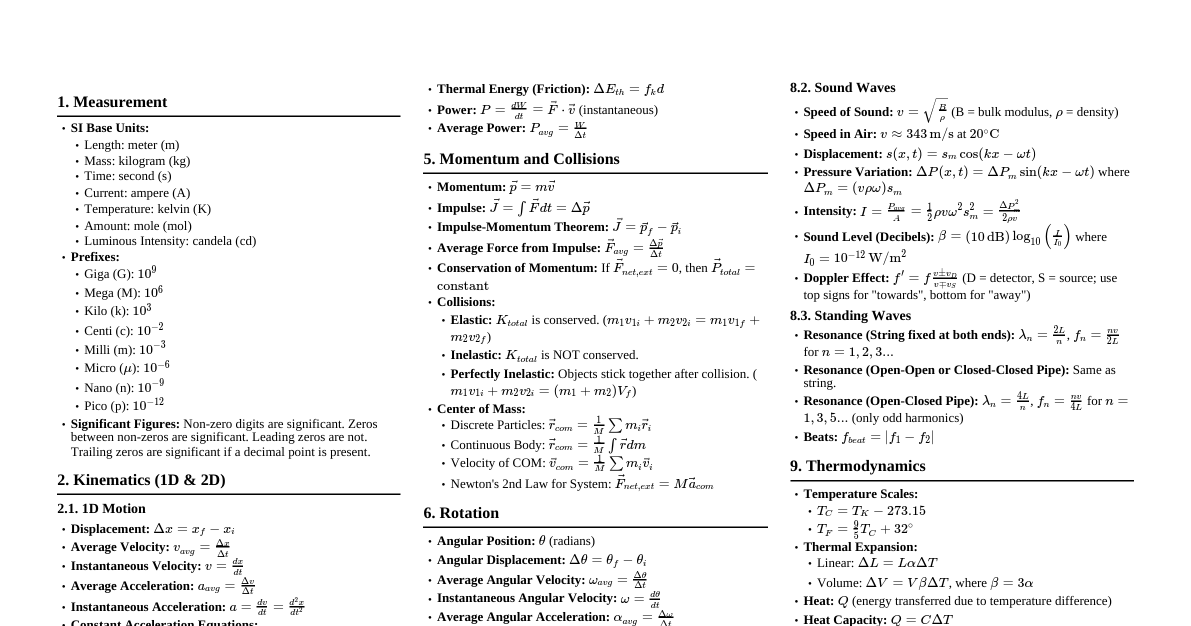
### Introduction to Physics Physics is the natural science that studies matter, its fundamental constituents, its motion and behavior through space and time, and the related entities of energy and force. #### Physical Quantities Quantities that can be measured are called physical quantities. - **Fundamental Quantities:** Independent of other physical quantities. - Length, Mass, Time, Electric Current, Thermodynamic Temperature, Luminous Intensity, Amount of Substance. - **Derived Quantities:** Quantities derived from fundamental quantities. - Area, Volume, Density, Speed, Force, Work, Energy, Power, Pressure, etc. ### Units of Measurement A unit is a standard chosen to measure a physical quantity. #### Characteristics of a Unit - Well-defined - Easily accessible - Reproducible - Invariable - Accepted internationally #### Systems of Units 1. **CGS System:** Centimetre, Gram, Second. 2. **FPS System:** Foot, Pound, Second. 3. **MKS System:** Metre, Kilogram, Second. 4. **SI System (International System of Units):** Modernised and improved form of MKS system. It is widely used and accepted. #### SI Fundamental Units | Quantity | Unit | Symbol | | :------------------- | :--------- | :----- | | Length | Meter | m | | Mass | Kilogram | kg | | Time | Second | s | | Electric Current | Ampere | A | | Temperature | Kelvin | K | | Luminous Intensity | Candela | cd | | Amount of Substance | Mole | mol | #### SI Supplementary Units | Quantity | Unit | Symbol | | :------------ | :------- | :----- | | Plane Angle | Radian | rad | | Solid Angle | Steradian | sr | #### SI Derived Units (Examples) | Quantity | Unit | Symbol | | :------------ | :------------------- | :------------- | | Area | Square meter | m² | | Volume | Cubic meter | m³ | | Density | Kilogram per cubic meter | kg/m³ | | Speed/Velocity | Meter per second | m/s | | Acceleration | Meter per second squared | m/s² | | Force | Newton | N (kg·m/s²) | | Pressure | Pascal | Pa (N/m²) | | Energy/Work | Joule | J (N·m) | | Power | Watt | W (J/s) | | Frequency | Hertz | Hz (s⁻¹) | | Electric Charge | Coulomb | C (A·s) | | Electric Potential | Volt | V (J/C) | ### Measurement of Length Length is the extent of something from end to end. #### Direct Methods - **Meter Scale:** For lengths from `10⁻³ m` to `10² m`. - **Vernier Calipers:** For lengths up to `10⁻⁴ m`. - **Least Count (LC):** `1 MSD - 1 VSD` (MSD = Main Scale Division, VSD = Vernier Scale Division). - Formula: `LC = Smallest division on main scale / Total number of divisions on vernier scale`. - **Screw Gauge:** For lengths up to `10⁻⁵ m`. - **Least Count (LC):** `Pitch / Total number of divisions on circular scale`. - **Pitch:** Distance moved by the screw for one complete rotation of the circular scale. #### Indirect Methods (Large Distances) - **Parallax Method:** Used for measuring distances to planets or stars. - If `D` is the distance of the planet from Earth and `b` is the basis (distance between two observation points on Earth), and `θ` is the parallax angle, then `D = b / θ`. - **Radar Method (Radio Detection And Ranging):** Used to measure the distance of a planet or an aeroplane. - `Distance = (Speed of wave × Time taken) / 2`. - **Laser Method (Light Amplification by Stimulated Emission of Radiation):** Similar to radar, but uses laser light. - **Sonar Method (Sound Navigation And Ranging):** Used to measure the depth of the sea. #### Indirect Methods (Small Distances) - **Avogadro's Hypothesis:** To estimate the size of a molecule. - **Electron Microscope:** To measure distances at atomic scales. ### Measurement of Mass Mass is a fundamental property of matter. - **SI Unit:** Kilogram (kg). - **Atomic Mass Unit (amu or u):** `1 amu = 1.66 × 10⁻²⁷ kg`. Used for atomic and molecular masses. - **Inertial Mass:** Measured by applying a known force and observing the acceleration (`m = F/a`). - **Gravitational Mass:** Measured using a common balance comparing an unknown mass with a known mass. - **Mass of planets/stars:** Measured using gravitational laws and astronomical observations. ### Measurement of Time Time is a measure of duration. - **SI Unit:** Second (s). - **Atomic Clocks:** Use periodic vibrations produced in caesium atoms to measure time with high precision. - **Range of Time:** From `10⁻²⁴ s` (life span of unstable particles) to `10¹⁸ s` (age of the universe). ### Dimensions of Physical Quantities The dimensions of a physical quantity are the powers to which the fundamental units are raised to represent that quantity. - Represented by `[M]`, `[L]`, `[T]`, `[A]`, `[K]`, `[cd]`, `[mol]`. #### Dimensional Formula and Dimensional Equation - **Dimensional Formula:** An expression showing how and which of the fundamental units enter into the quantity. - E.g., `[M¹L¹T⁻²]` for Force. - **Dimensional Equation:** An equation obtained by equating a physical quantity with its dimensional formula. - E.g., `[Force] = [M¹L¹T⁻²]`. #### Examples of Dimensional Formulas | Quantity | Formula | Dimensional Formula | | :--------------- | :-------------------------- | :------------------ | | Area | Length × Breadth | `[L²]` | | Volume | Length × Breadth × Height | `[L³]` | | Density | Mass / Volume | `[ML⁻³]` | | Speed/Velocity | Distance / Time | `[LT⁻¹]` | | Acceleration | Velocity / Time | `[LT⁻²]` | | Force | Mass × Acceleration | `[MLT⁻²]` | | Work/Energy | Force × Distance | `[ML²T⁻²]` | | Power | Work / Time | `[ML²T⁻³]` | | Pressure | Force / Area | `[ML⁻¹T⁻²]` | | Frequency | 1 / Time period | `[T⁻¹]` | | Impulse | Force × Time | `[MLT⁻¹]` | | Momentum | Mass × Velocity | `[MLT⁻¹]` | | Gravitational Constant (G) | `F r²/m₁m₂` | `[M⁻¹L³T⁻²]` | | Planck's Constant (h) | `E/f` | `[ML²T⁻¹]` | | Electric Charge (Q) | Current × Time | `[AT]` | | Resistance (R) | Voltage / Current (`V/I`) | `[ML²T⁻³A⁻²]` | #### Types of Physical Quantities based on Dimensions 1. **Dimensional Constants:** Have dimensions and fixed values. E.g., Gravitational constant (G), Planck's constant (h), Speed of light (c). 2. **Dimensional Variables:** Have dimensions but variable values. E.g., Velocity, Force, Area. 3. **Dimensionless Constants:** Have no dimensions and fixed values. E.g., π, numbers (1, 2, 3...). 4. **Dimensionless Variables:** Have no dimensions but variable values. E.g., Angle, Strain, Specific gravity, Refractive index. #### Uses of Dimensional Analysis 1. **To check the correctness of a physical equation:** Principle of Homogeneity states that dimensions of all terms on both sides of a physical equation must be the same. - E.g., `v = u + at`. - `[v] = [LT⁻¹]` - `[u] = [LT⁻¹]` - `[at] = [LT⁻²][T] = [LT⁻¹]` - Since `[v] = [u] = [at]`, the equation is dimensionally correct. 2. **To derive the relationship between physical quantities:** If we know the factors on which a physical quantity depends. - E.g., `T ∝ mᵃ Lᵇ gᶜ`. - `[T] = [MᵃLᵇ(LT⁻²)ᶜ] = [MᵃLᵇ⁺ᶜT⁻²ᶜ]` - Comparing powers: `a=0`, `b+c=0`, `-2c=1` => `c = -1/2`, `b = 1/2`. - `T = k m⁰ L¹/² g⁻¹/² = k√(L/g)`. 3. **To convert a physical quantity from one system of units to another:** - `n₁u₁ = n₂u₂` (where `n` is the numerical value and `u` is the unit). - `n₂ = n₁ (u₁/u₂) = n₁ ([M₁]ᵃ[L₁]ᵇ[T₁]ᶜ / [M₂]ᵃ[L₂]ᵇ[T₂]ᶜ)`. - E.g., Convert 1 Newton to Dyne. - `Force = [MLT⁻²]`. So `a=1, b=1, c=-2`. - `n₁ = 1 N`. `u₁ = kg m s⁻²`. - `u₂ = g cm s⁻²`. - `n₂ = 1 (kg/g)¹ (m/cm)¹ (s/s)⁻² = 1 (1000g/g)¹ (100cm/cm)¹ (1)⁻² = 1 × 1000 × 100 = 10⁵ dyne`. - So, `1 Newton = 10⁵ Dyne`. #### Limitations of Dimensional Analysis - Cannot determine dimensionless constants. - Cannot be used if a quantity depends on more than three fundamental quantities. - Cannot be used for equations involving trigonometric, exponential, or logarithmic functions. - Cannot distinguish between different physical quantities having the same dimensions (e.g., work and torque). - Cannot be used if the equation contains more than one term on either side, which are added or subtracted. ### Errors in Measurement The uncertainty in the measurement of a physical quantity is called error. #### Types of Errors 1. **Systematic Errors:** Errors that tend to be in one direction (either positive or negative). - **Instrumental Errors:** Due to imperfect design or calibration of the instrument (e.g., zero error in vernier caliper). - **Experimental Technique or Procedure Errors:** Due to improper setting of the experiment or not following proper procedure. - **Personal Errors:** Due to an individual's bias, lack of proper setting of the apparatus, or carelessness in observation. - **Minimization:** Can be minimized by improving experimental techniques, using better instruments, and removing personal bias. 2. **Random Errors:** Errors that occur irregularly and are random with respect to sign and size. - Caused by unpredictable fluctuations in experimental conditions (e.g., temperature, voltage supply, mechanical vibrations). - **Minimization:** Minimized by taking many observations and calculating the arithmetic mean. #### Representation of Errors - **Absolute Error (Δa):** The magnitude of the difference between the true value and the measured value. - If `a₁, a₂, ..., aₙ` are measurements, true value `a_mean = (a₁ + ... + aₙ) / n`. - `Δaᵢ = |a_mean - aᵢ|`. - **Mean Absolute Error (Δa_mean):** The arithmetic mean of all the absolute errors. - `Δa_mean = (Δa₁ + Δa₂ + ... + Δaₙ) / n`. - **Relative Error:** Ratio of the mean absolute error to the mean value. - `Relative Error = Δa_mean / a_mean`. - **Percentage Error:** Relative error expressed as a percentage. - `Percentage Error = (Δa_mean / a_mean) × 100%`. #### Combination of Errors If a quantity `Z` depends on other quantities `A` and `B`, and `ΔA` and `ΔB` are their absolute errors. 1. **Error in Sum/Difference:** `Z = A ± B` - `ΔZ = ΔA + ΔB` (Maximum possible error) - The absolute error in sum or difference is the sum of the absolute errors in the individual quantities. 2. **Error in Product/Division:** `Z = A × B` or `Z = A / B` - `ΔZ / Z = ΔA / A + ΔB / B` (Maximum possible relative error) - The relative error in product or division is the sum of the relative errors in the individual quantities. 3. **Error in Quantity Raised to a Power:** `Z = Aⁿ` - `ΔZ / Z = n (ΔA / A)` - The relative error in a quantity raised to a power is the power multiplied by the relative error in the individual quantity. - If `Z = Aᵖ B / Cʳ`: - `ΔZ / Z = p (ΔA / A) + q (ΔB / B) + r (ΔC / C)`. ### Significant Figures Significant figures (SF) are the reliable digits plus the first uncertain digit in a measurement. #### Rules for Determining Significant Figures 1. **All non-zero digits are significant.** - E.g., `42.3` has 3 SF. `2.45` has 3 SF. 2. **All zeros between two non-zero digits are significant.** - E.g., `2005` has 4 SF. `10.08` has 4 SF. 3. **Trailing zeros (zeros at the end) in a number without a decimal point are NOT significant.** - E.g., `12300` has 3 SF. 4. **Trailing zeros in a number WITH a decimal point ARE significant.** - E.g., `3.400` has 4 SF. `10.0` has 3 SF. 5. **Leading zeros (zeros before a non-zero digit) in a number less than 1 are NOT significant.** - E.g., `0.0023` has 2 SF. `0.010` has 2 SF (the trailing zero is significant). 6. **Exact numbers (from definitions or counting) have infinite significant figures.** - E.g., `2πr`, the `2` has infinite SF. `10 apples` has infinite SF. 7. **Change of units does not change the number of significant figures.** - E.g., `4.700 m = 470.0 cm = 4700 mm`. All have 4 SF. (Note: `4700 mm` implies decimal point after last zero to have 4 SF, otherwise `4700` has 2 SF). To avoid ambiguity, use scientific notation: `4.700 x 10³ mm`. #### Rules for Arithmetic Operations with Significant Figures 1. **Addition and Subtraction:** The result should be rounded to the same number of decimal places as the number with the fewest decimal places. - E.g., `2.34 + 0.3 + 1.2345 = 3.8745`. - `0.3` has 1 decimal place. So, round to 1 decimal place: `3.9`. 2. **Multiplication and Division:** The result should be rounded to the same number of significant figures as the number with the fewest significant figures. - E.g., `1.2 × 2.345 = 2.814`. - `1.2` has 2 SF. So, round to 2 SF: `2.8`. #### Rounding Off - If the digit to be dropped is less than 5, the preceding digit remains unchanged. - E.g., `3.42` rounded to 2 SF is `3.4`. - If the digit to be dropped is greater than 5, the preceding digit is increased by 1. - E.g., `3.48` rounded to 2 SF is `3.5`. - If the digit to be dropped is 5: - If the preceding digit is even, it remains unchanged. - E.g., `3.45` rounded to 2 SF is `3.4`. - If the preceding digit is odd, it is increased by 1. - E.g., `3.35` rounded to 2 SF is `3.4`. ### Order of Magnitude The order of magnitude of a physical quantity is the power of 10 that is closest to its magnitude. - To determine the order of magnitude, express the quantity in scientific notation (`N × 10ˣ`). - If `N` is between `0.5` and `5`, then `x` is the order of magnitude. - If `N 5`, increase `x` by 1. - Alternatively, if `N 5`, order of magnitude is `10⁻³⁰ kg`. - E.g., Speed of light = `3 × 10⁸ m/s`. Since `3 ### Important Physical Constants (Order of Magnitude) | Constant | Value (approx.) | Order of Magnitude | | :------------------------- | :--------------------- | :----------------- | | Speed of light (c) | `3 × 10⁸ m/s` | `10⁸ m/s` | | Gravitational constant (G) | `6.67 × 10⁻¹¹ N m²/kg²` | `10⁻¹⁰ N m²/kg²` | | Planck's constant (h) | `6.63 × 10⁻³⁴ J s` | `10⁻³³ J s` | | Elementary charge (e) | `1.6 × 10⁻¹⁹ C` | `10⁻¹⁹ C` | | Mass of electron (m_e) | `9.1 × 10⁻³¹ kg` | `10⁻³⁰ kg` | | Mass of proton (m_p) | `1.67 × 10⁻²⁷ kg` | `10⁻²⁷ kg` | | Avogadro's number (N_A) | `6.02 × 10²³ mol⁻¹` | `10²³ mol⁻¹` | | Boltzmann constant (k_B) | `1.38 × 10⁻²³ J/K` | `10⁻²³ J/K` | ### Some Practical Units | Quantity | Unit | Value in SI unit | Usage | | :------------ | :----------------- | :-------------------- | :---------------------------------- | | Length | Fermi | `10⁻¹⁵ m` | Nuclear sizes | | | Angstrom (Å) | `10⁻¹⁰ m` | Atomic/molecular sizes, wavelength | | | Nanometer (nm) | `10⁻⁹ m` | Wavelength, molecular sizes | | | Micron (μm) | `10⁻⁶ m` | Microscopic distances | | | Astronomical Unit (AU) | `1.496 × 10¹¹ m` | Distance between Earth and Sun | | | Light Year (ly) | `9.46 × 10¹⁵ m` | Astronomical distances | | | Parsec | `3.08 × 10¹⁶ m` | Largest unit of distance in astronomy | | Mass | Quintal | `100 kg` | Commercial use | | | Metric Ton | `1000 kg` | Commercial use | | | Slug | `14.59 kg` | FPS system | | | Chandrashekhar Limit | `1.4 × Mass of Sun` | Mass limit for white dwarf stars | | Time | Shake | `10⁻⁸ s` | Smallest practical unit of time | | | Day | `86400 s` | Common use | | | Year | `3.156 × 10⁷ s` | Common use |