Calculus Concepts Cheatsheet
Cheatsheet Content
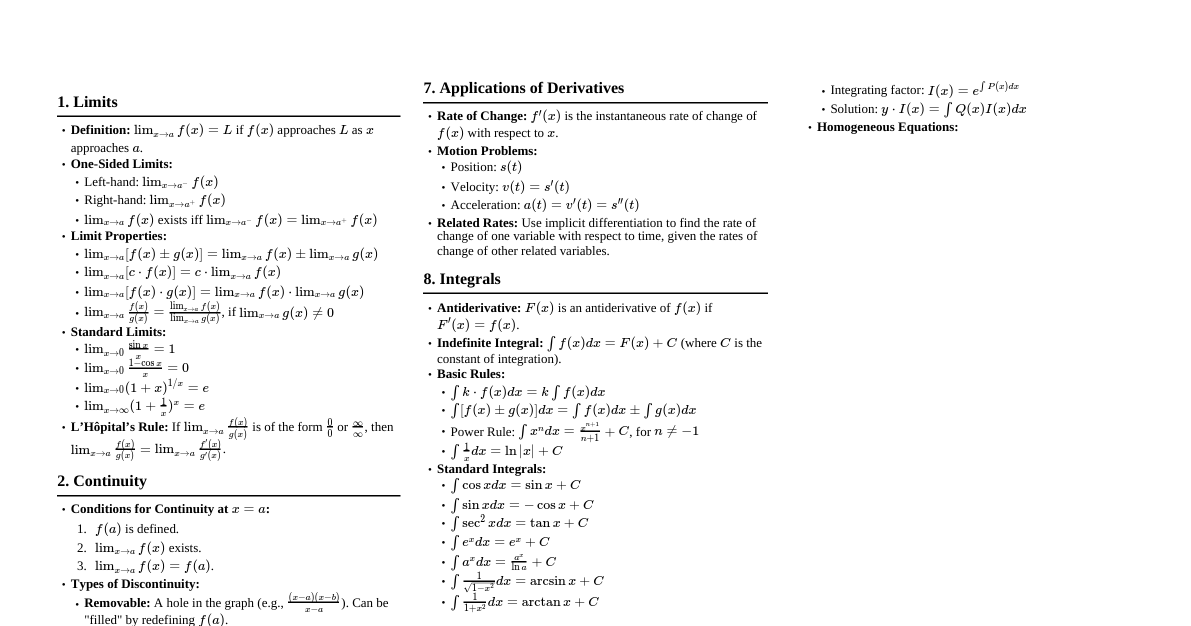
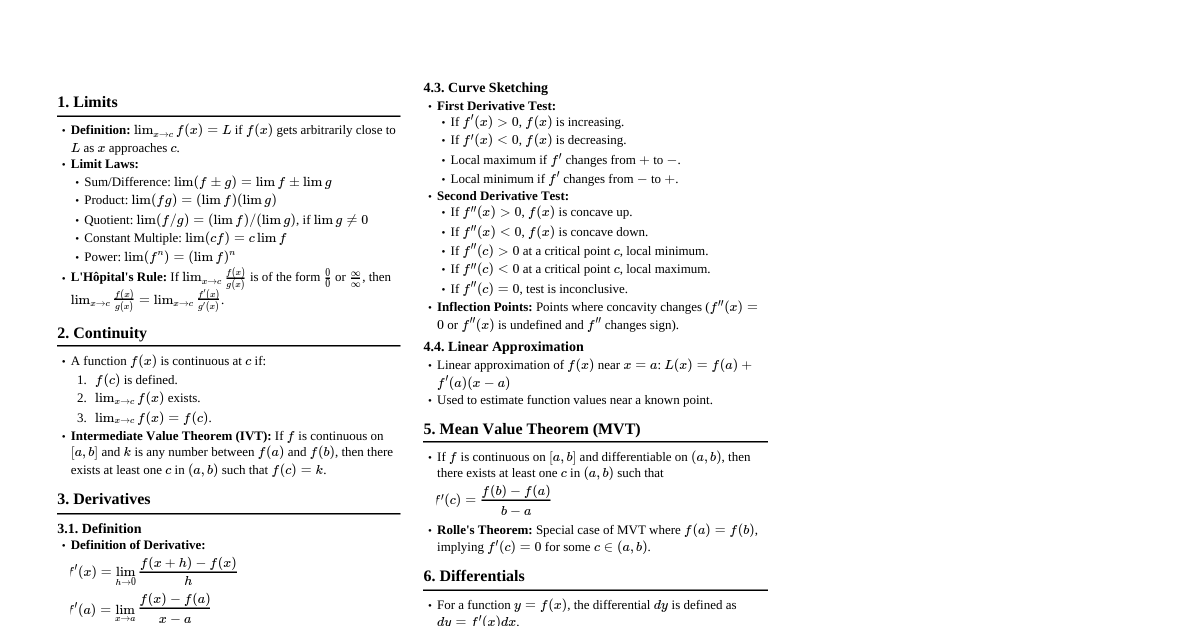
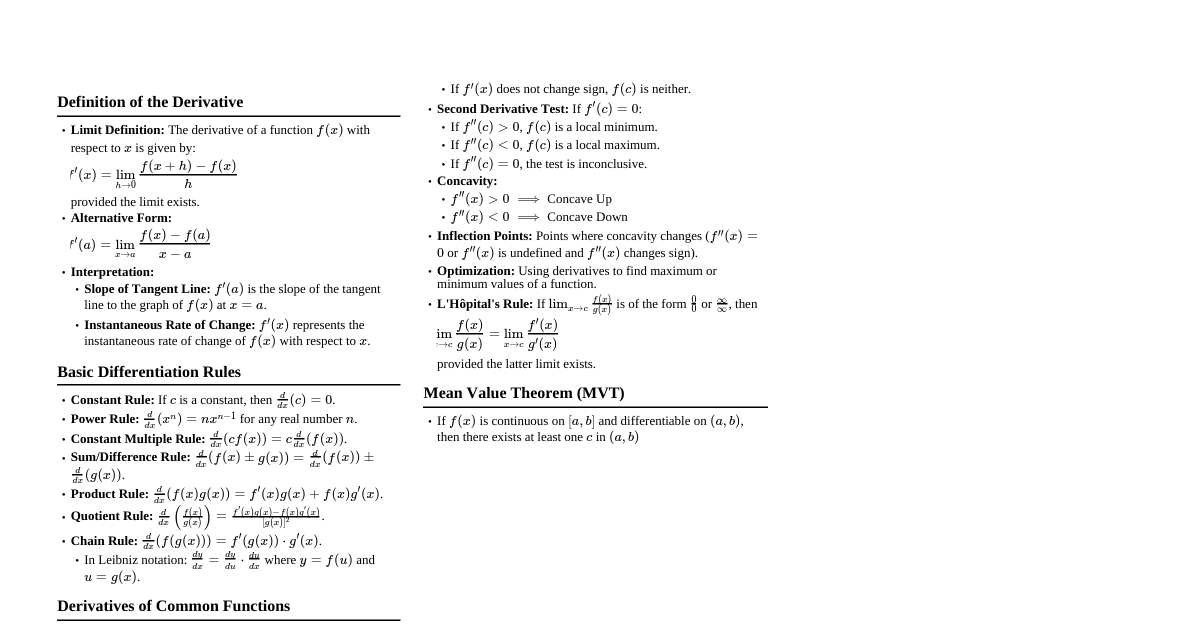
1. Limits 1.1 Definition $\lim_{x \to a} f(x) = L$ if for every $\epsilon > 0$, there exists a $\delta > 0$ such that if $0 1.2 Existence of a Limit A limit $\lim_{x \to a} f(x)$ exists if and only if the left-hand limit and right-hand limit exist and are equal: $\lim_{x \to a^-} f(x) = \lim_{x \to a^+} f(x) = L$. One-sided limits: Left-hand limit: $\lim_{x \to a^-} f(x)$ Right-hand limit: $\lim_{x \to a^+} f(x)$ 1.3 Indeterminate Forms $0/0$, $\infty/\infty$, $0 \cdot \infty$, $\infty - \infty$, $1^\infty$, $0^0$, $\infty^0$. Use L'Hôpital's Rule for $0/0$ or $\infty/\infty$: $\lim_{x \to a} \frac{f(x)}{g(x)} = \lim_{x \to a} \frac{f'(x)}{g'(x)}$. 2. Continuity 2.1 Definition A function $f(x)$ is continuous at a point $x=a$ if all three conditions are met: $f(a)$ is defined. $\lim_{x \to a} f(x)$ exists. $\lim_{x \to a} f(x) = f(a)$. Types of Discontinuities: Removable: The limit exists, but $f(a)$ is undefined or $f(a) \ne \lim_{x \to a} f(x)$. (Hole) Jump: The left-hand and right-hand limits exist but are not equal. Infinite: One or both one-sided limits are $\pm\infty$. (Vertical asymptote) 2.2 Properties of Continuous Functions Sum, difference, product, and quotient (denominator non-zero) of continuous functions are continuous. Composition of continuous functions is continuous. Intermediate Value Theorem (IVT): If $f$ is continuous on $[a,b]$ and $k$ is any number between $f(a)$ and $f(b)$, then there exists at least one $c \in (a,b)$ such that $f(c)=k$. 3. Differentiability 3.1 Definition A function $f(x)$ is differentiable at a point $x=a$ if the derivative $f'(a)$ exists: $$f'(a) = \lim_{h \to 0} \frac{f(a+h) - f(a)}{h}$$ or $$f'(a) = \lim_{x \to a} \frac{f(x) - f(a)}{x-a}$$ If $f(x)$ is differentiable at $x=a$, then $f(x)$ is continuous at $x=a$. The converse is not always true. 3.2 When Differentiability Fails Discontinuities (jump, infinite, removable). Sharp corners or cusps (e.g., $f(x)=|x|$ at $x=0$). Vertical tangent lines (e.g., $f(x)=x^{1/3}$ at $x=0$). 4. Increasing and Decreasing Functions 4.1 Definition A function $f(x)$ is increasing on an interval if for any $x_1 A function $f(x)$ is decreasing on an interval if for any $x_1 f(x_2)$). 4.2 First Derivative Test for Monotonicity If $f'(x) > 0$ on an interval, then $f(x)$ is increasing on that interval. If $f'(x) If $f'(x) = 0$ on an interval, then $f(x)$ is constant on that interval. Critical points: Points where $f'(x)=0$ or $f'(x)$ is undefined. These are potential locations for local extrema. 5. Maxima and Minima (Extrema) 5.1 Local Extrema (Relative Max/Min) A function $f(x)$ has a local maximum at $x=c$ if $f(c) \ge f(x)$ for all $x$ in an open interval containing $c$. A function $f(x)$ has a local minimum at $x=c$ if $f(c) \le f(x)$ for all $x$ in an open interval containing $c$. Local extrema occur at critical points. 5.2 First Derivative Test for Local Extrema Let $c$ be a critical point of $f$. If $f'(x)$ changes from positive to negative at $c$, then $f(c)$ is a local maximum. If $f'(x)$ changes from negative to positive at $c$, then $f(c)$ is a local minimum. If $f'(x)$ does not change sign at $c$, then $f(c)$ is neither a local max nor min. 5.3 Second Derivative Test for Local Extrema Let $c$ be a critical point where $f'(c)=0$ and $f''(c)$ exists. If $f''(c) > 0$, then $f(c)$ is a local minimum. If $f''(c) If $f''(c) = 0$, the test is inconclusive (use the First Derivative Test). 5.4 Absolute Extrema (Global Max/Min) For a continuous function $f$ on a closed interval $[a,b]$: The absolute maximum is the largest value of $f(x)$ on $[a,b]$. The absolute minimum is the smallest value of $f(x)$ on $[a,b]$. Extreme Value Theorem (EVT): A continuous function on a closed interval $[a,b]$ must attain both an absolute maximum and an absolute minimum on that interval. To find absolute extrema on $[a,b]$: Find all critical points in $(a,b)$. Evaluate $f(x)$ at the critical points and at the endpoints $a$ and $b$. The largest value from step 2 is the absolute maximum; the smallest is the absolute minimum. 6. Concavity 6.1 Definition A function $f(x)$ is concave up on an interval if its graph lies above its tangent lines on that interval. A function $f(x)$ is concave down on an interval if its graph lies below its tangent lines on that interval. 6.2 Second Derivative Test for Concavity If $f''(x) > 0$ on an interval, then $f(x)$ is concave up on that interval. If $f''(x) 7. Point of Inflection 7.1 Definition A point of inflection is a point on the graph of a function where the concavity changes (from concave up to concave down, or vice versa). 7.2 Finding Points of Inflection Points of inflection occur where $f''(x)=0$ or $f''(x)$ is undefined, AND $f''(x)$ changes sign at that point. If $f''(c)=0$ or $f''(c)$ is undefined, but $f''(x)$ does not change sign around $c$, then $c$ is not an inflection point.