New sheet - 11/22 07:26
Cheatsheet Content
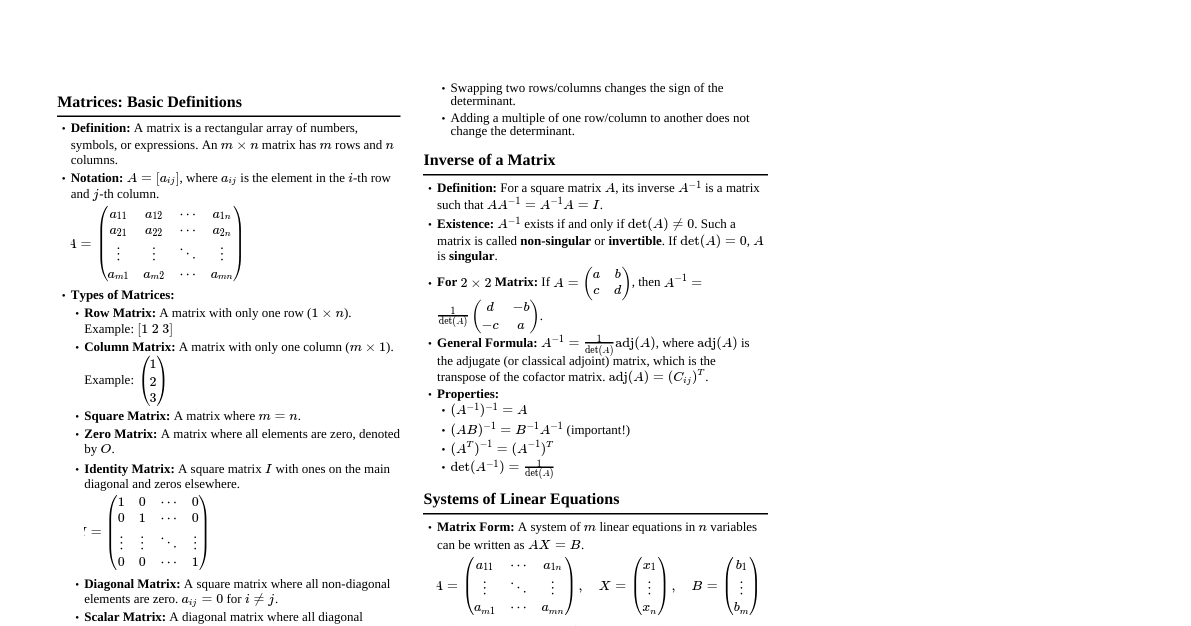
Mathematical Logic Properties of Logical Connectives (Page 5) Idempotent Laws: $p \lor p \equiv p$ $p \land p \equiv p$ Commutative Laws: $p \lor q \equiv q \lor p$ $p \land q \equiv q \land p$ Associative Laws: $(p \lor q) \lor r \equiv p \lor (q \lor r)$ $(p \land q) \land r \equiv p \land (q \land r)$ Distributive Laws: $p \land (q \lor r) \equiv (p \land q) \lor (p \land r)$ $p \lor (q \land r) \equiv (p \lor q) \land (p \lor r)$ De Morgan's Laws: $\sim (p \land q) \equiv \sim p \lor \sim q$ $\sim (p \lor q) \equiv \sim p \land \sim q$ Identity Laws: $p \lor F \equiv p$ $p \land T \equiv p$ $p \lor T \equiv T$ $p \land F \equiv F$ Complement Laws: $p \lor \sim p \equiv T$ $p \land \sim p \equiv F$ $\sim T \equiv F$ $\sim F \equiv T$ Absorption Laws: $p \lor (p \land q) \equiv p$ $p \land (p \lor q) \equiv p$ Important Equivalences (Page 6) Implication: $p \to q \equiv \sim p \lor q$ Double Implication: $p \leftrightarrow q \equiv (p \to q) \land (q \to p)$ Contrapositive: $p \to q \equiv \sim q \to \sim p$ Inverse: $\sim p \to \sim q$ Converse: $q \to p$ Matrices Inverse of a Matrix by Adjoint Method (Page 57) Theorem: If $A$ is a non-singular square matrix, then $A^{-1} = \frac{1}{|A|} \text{adj}(A)$. Asked in Board Exams: March 2013, July 2016, March 2018, July 2019, Oct 2021 Inverse of a Matrix by Elementary Transformations (Page 58) Theorem: Every invertible matrix has a unique inverse. Theorem: If $A$ and $B$ are invertible matrices of the same order, then $(AB)^{-1} = B^{-1}A^{-1}$. Asked in Board Exams: March 2015, July 2017, March 2019, Oct 2020 Trigonometric Functions Sine Rule (Page 89) Theorem: In any $\triangle ABC$, the ratio of each side to the sine of its opposite angle is constant. $$\frac{a}{\sin A} = \frac{b}{\sin B} = \frac{c}{\sin C} = 2R$$ where $R$ is the circumradius of $\triangle ABC$. Asked in Board Exams: March 2014, July 2016, March 2018, July 2021 Cosine Rule (Page 90) Theorem: In any $\triangle ABC$, $a^2 = b^2 + c^2 - 2bc \cos A$ $b^2 = a^2 + c^2 - 2ac \cos B$ $c^2 = a^2 + b^2 - 2ab \cos C$ Asked in Board Exams: March 2013, July 2015, March 2017, Oct 2020 Projection Rule (Page 91) Theorem: In any $\triangle ABC$, $a = b \cos C + c \cos B$ $b = c \cos A + a \cos C$ $c = a \cos B + b \cos A$ Asked in Board Exams: March 2016, July 2018, March 2020 Area of a Triangle (Page 92) Theorem: Area of $\triangle ABC = \frac{1}{2}bc \sin A = \frac{1}{2}ac \sin B = \frac{1}{2}ab \sin C$. Heron's Formula: Area of $\triangle ABC = \sqrt{s(s-a)(s-b)(s-c)}$, where $s = \frac{a+b+c}{2}$. Pair of Straight Lines Combined Equation of a Pair of Lines Passing Through the Origin (Page 115) Theorem: The combined equation of a pair of lines passing through the origin is a homogeneous equation of degree two in $x$ and $y$, i.e., $ax^2 + 2hxy + by^2 = 0$. Conversely, every homogeneous equation of degree two in $x$ and $y$ represents a pair of lines passing through the origin. Asked in Board Exams: March 2014, July 2017, March 2019, Oct 2021 Angle Between the Lines Represented by $ax^2 + 2hxy + by^2 = 0$ (Page 118) Theorem: The acute angle $\theta$ between the lines represented by $ax^2 + 2hxy + by^2 = 0$ is given by $$\tan \theta = \left|\frac{2\sqrt{h^2 - ab}}{a+b}\right|$$ If $h^2 - ab = 0$, the lines are coincident. If $a+b = 0$, the lines are perpendicular. Asked in Board Exams: March 2013, July 2015, March 2017, July 2019 Combined Equation of a Pair of Lines (General Second Degree Equation) (Page 121) Theorem: The equation $ax^2 + 2hxy + by^2 + 2gx + 2fy + c = 0$ represents a pair of lines if $$\begin{vmatrix} a & h & g \\ h & b & f \\ g & f & c \end{vmatrix} = 0$$ i.e., $abc + 2fgh - af^2 - bg^2 - ch^2 = 0$. Asked in Board Exams: March 2016, July 2018, March 2020 Vectors Section Formula (Internal Division) (Page 153) Theorem: If $R$ is a point on the line segment $PQ$ dividing it internally in the ratio $m:n$, then the position vector of $R$ is given by $$\vec{r} = \frac{n\vec{p} + m\vec{q}}{m+n}$$ Asked in Board Exams: March 2014, July 2017, March 2019 Section Formula (External Division) (Page 154) Theorem: If $R$ is a point on the line $PQ$ dividing it externally in the ratio $m:n$, then the position vector of $R$ is given by $$\vec{r} = \frac{n\vec{p} - m\vec{q}}{n-m}$$ Asked in Board Exams: July 2016, March 2018 Midpoint Formula (Page 155) Theorem: The position vector of the midpoint $M$ of a line segment $PQ$ is given by $$\vec{m} = \frac{\vec{p} + \vec{q}}{2}$$ Centroid of a Triangle (Page 156) Theorem: If $A(\vec{a})$, $B(\vec{b})$, $C(\vec{c})$ are the vertices of a triangle, then the position vector of its centroid $G$ is given by $$\vec{g} = \frac{\vec{a} + \vec{b} + \vec{c}}{3}$$ Asked in Board Exams: March 2015, July 2019, Oct 2021 Scalar Triple Product (Page 179) Theorem: The scalar triple product of three vectors $\vec{a}, \vec{b}, \vec{c}$ is given by $\vec{a} \cdot (\vec{b} \times \vec{c})$. Geometric interpretation: The magnitude of the scalar triple product represents the volume of the parallelepiped formed by the three vectors as its co-terminus edges. Properties: $\vec{a} \cdot (\vec{b} \times \vec{c}) = (\vec{a} \times \vec{b}) \cdot \vec{c}$ (Cyclic permutation) If $\vec{a}, \vec{b}, \vec{c}$ are coplanar, then $\vec{a} \cdot (\vec{b} \times \vec{c}) = 0$. Asked in Board Exams: March 2013, July 2016, March 2018, July 2020 Three Dimensional Geometry Direction Cosines and Direction Ratios (Page 200) Theorem: If $l, m, n$ are the direction cosines of a line, then $l^2 + m^2 + n^2 = 1$. Asked in Board Exams: March 2014, July 2017, March 2019 Angle Between Two Lines (Page 203) Theorem: If $\theta$ is the angle between two lines with direction cosines $(l_1, m_1, n_1)$ and $(l_2, m_2, n_2)$, then $$\cos \theta = l_1 l_2 + m_1 m_2 + n_1 n_2$$ If the lines are perpendicular, $l_1 l_2 + m_1 m_2 + n_1 n_2 = 0$. If the lines are parallel, $l_1/l_2 = m_1/m_2 = n_1/n_2$. Asked in Board Exams: March 2015, July 2018, March 2020 Equation of a Line Passing Through a Point and Parallel to a Vector (Page 207) Theorem: The vector equation of a line passing through a point $A$ with position vector $\vec{a}$ and parallel to vector $\vec{b}$ is $\vec{r} = \vec{a} + \lambda \vec{b}$, where $\lambda$ is a scalar parameter. The Cartesian equations are $\frac{x-x_1}{a} = \frac{y-y_1}{b} = \frac{z-z_1}{c}$. Asked in Board Exams: March 2016, July 2019, Oct 2021 Equation of a Line Passing Through Two Points (Page 208) Theorem: The vector equation of a line passing through two points $A$ and $B$ with position vectors $\vec{a}$ and $\vec{b}$ is $\vec{r} = \vec{a} + \lambda (\vec{b} - \vec{a})$. The Cartesian equations are $\frac{x-x_1}{x_2-x_1} = \frac{y-y_1}{y_2-y_1} = \frac{z-z_1}{z_2-z_1}$. Asked in Board Exams: March 2017, July 2020 Shortest Distance Between Two Skew Lines (Page 214) Theorem: The shortest distance between two skew lines $\vec{r}_1 = \vec{a}_1 + \lambda \vec{b}_1$ and $\vec{r}_2 = \vec{a}_2 + \mu \vec{b}_2$ is given by $$d = \left| \frac{(\vec{a}_2 - \vec{a}_1) \cdot (\vec{b}_1 \times \vec{b}_2)}{|\vec{b}_1 \times \vec{b}_2|} \right|$$ Asked in Board Exams: March 2013, July 2015, March 2018, July 2021 Equation of a Plane Passing Through a Point and Perpendicular to a Vector (Normal Form) (Page 221) Theorem: The vector equation of a plane passing through a point $A$ with position vector $\vec{a}$ and normal to vector $\vec{n}$ is $(\vec{r} - \vec{a}) \cdot \vec{n} = 0$ or $\vec{r} \cdot \vec{n} = \vec{a} \cdot \vec{n}$. The Cartesian equation is $A(x-x_1) + B(y-y_1) + C(z-z_1) = 0$. Asked in Board Exams: March 2014, July 2016, March 2019 Equation of a Plane Passing Through Three Non-collinear Points (Page 225) Theorem: The vector equation of a plane passing through three non-collinear points $A(\vec{a})$, $B(\vec{b})$, $C(\vec{c})$ is $(\vec{r} - \vec{a}) \cdot [(\vec{b} - \vec{a}) \times (\vec{c} - \vec{a})] = 0$. Asked in Board Exams: March 2015, July 2018, March 2020 Linear Programming Fundamental Theorem of Linear Programming (Page 254) Theorem 1: Let $R$ be the feasible region (convex polygon) for a linear programming problem and let $Z = ax+by$ be the objective function. If $R$ is bounded, then the objective function $Z$ has both a maximum and a minimum value on $R$, and these values occur at the corner points (vertices) of $R$. Theorem 2: If $R$ is unbounded, then the objective function $Z$ may or may not have a maximum or minimum value. If it does, it must occur at a corner point. Asked in Board Exams: March 2013, July 2016, March 2018, July 2021, Oct 2021