Differential Calculus Essentials
Cheatsheet Content
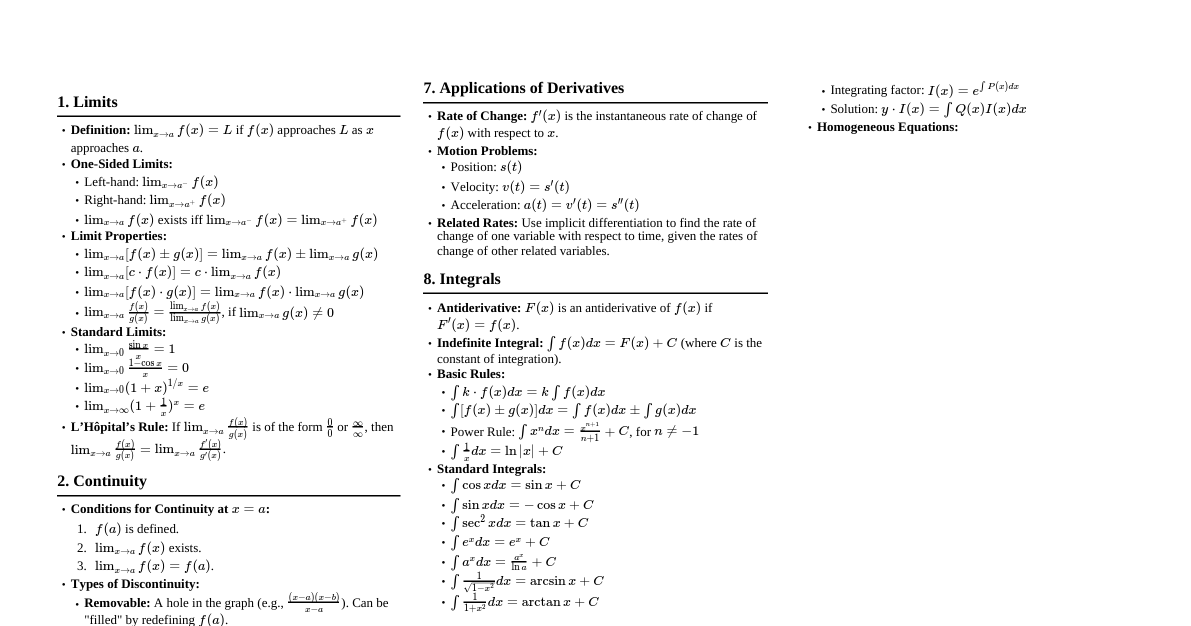
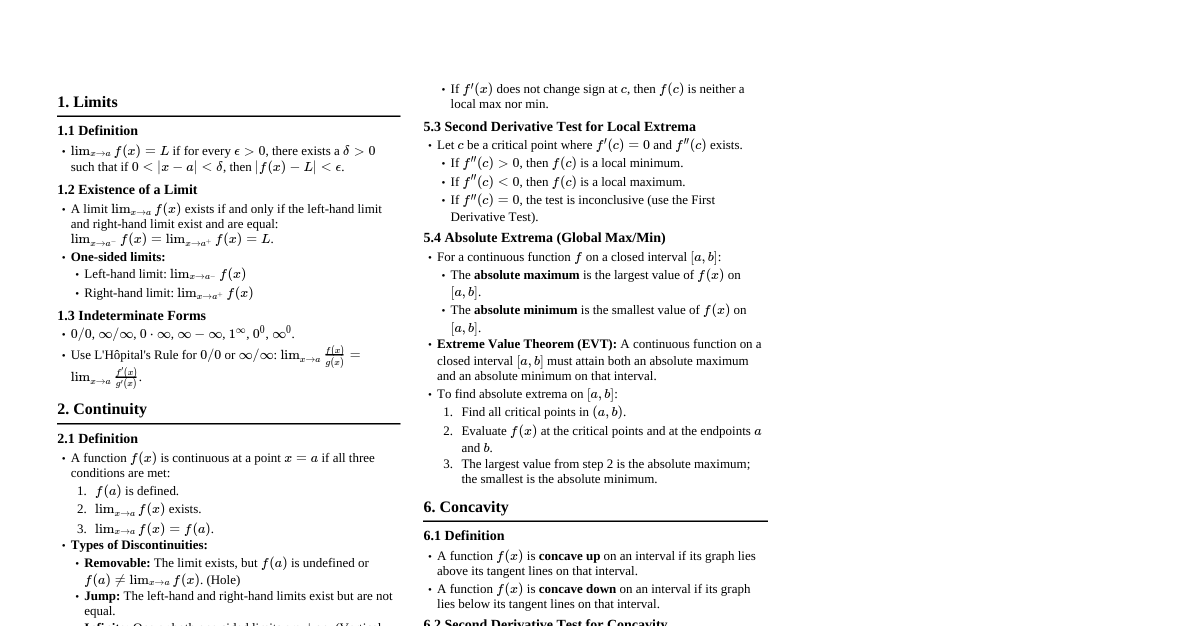
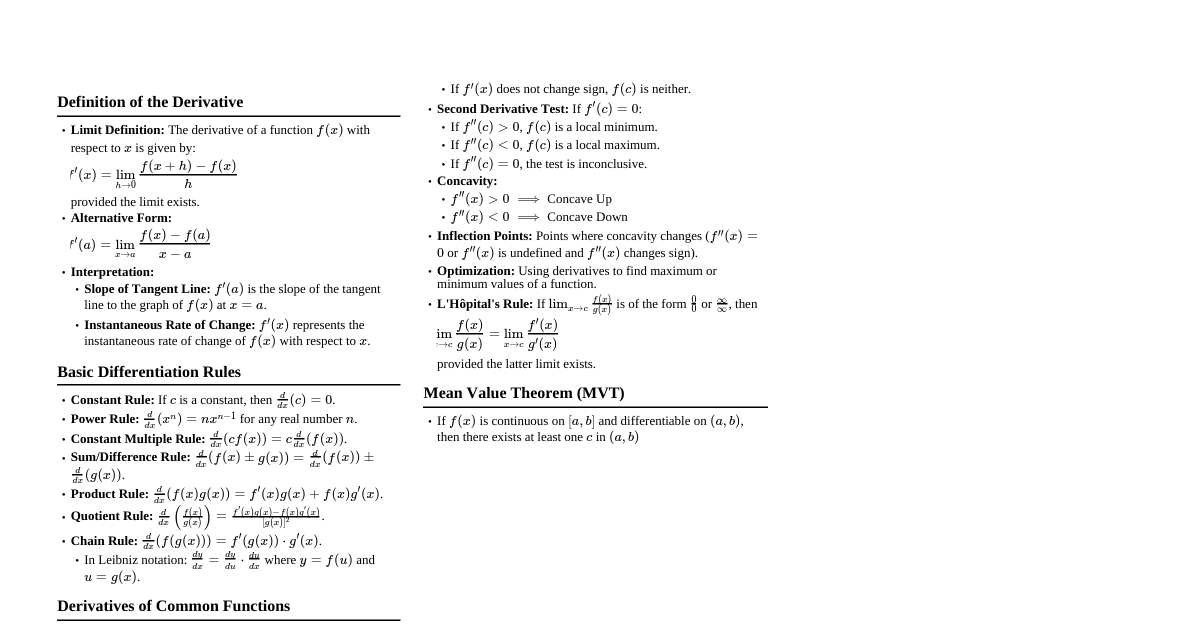
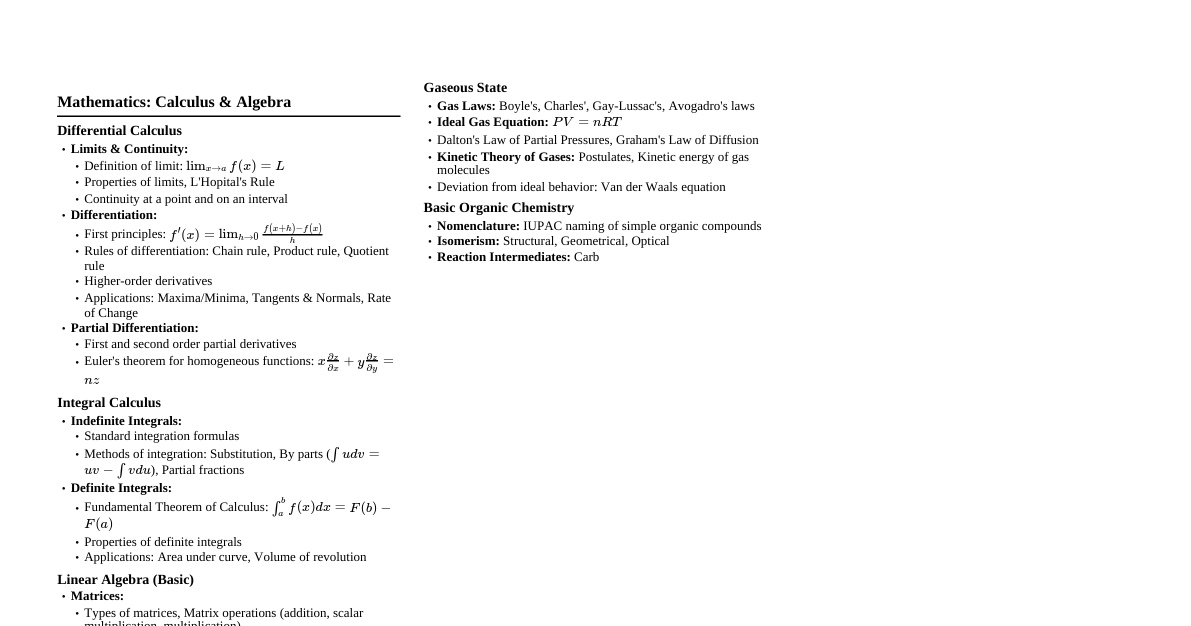
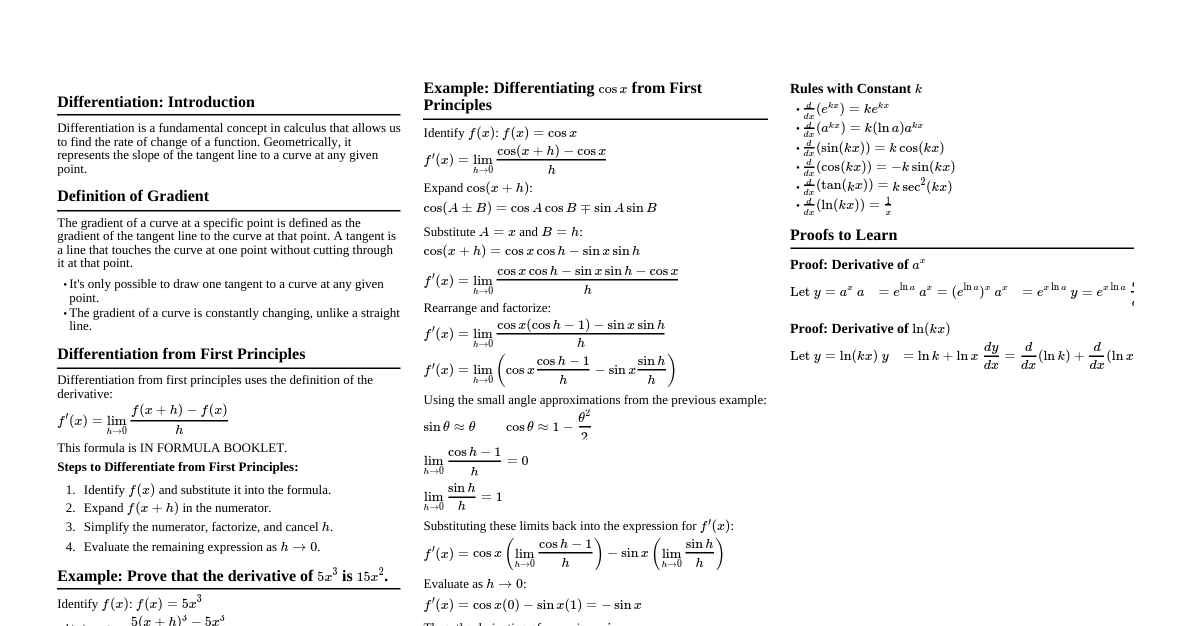
1. Limits Definition: $\lim_{x \to c} f(x) = L$ if $f(x)$ gets arbitrarily close to $L$ as $x$ approaches $c$. Limit Laws: Sum/Difference: $\lim(f \pm g) = \lim f \pm \lim g$ Product: $\lim(fg) = (\lim f)(\lim g)$ Quotient: $\lim(f/g) = (\lim f) / (\lim g)$, if $\lim g \ne 0$ Constant Multiple: $\lim(cf) = c \lim f$ Power: $\lim(f^n) = (\lim f)^n$ L'Hôpital's Rule: If $\lim_{x \to c} \frac{f(x)}{g(x)}$ is of the form $\frac{0}{0}$ or $\frac{\infty}{\infty}$, then $\lim_{x \to c} \frac{f(x)}{g(x)} = \lim_{x \to c} \frac{f'(x)}{g'(x)}$. 2. Continuity A function $f(x)$ is continuous at $c$ if: $f(c)$ is defined. $\lim_{x \to c} f(x)$ exists. $\lim_{x \to c} f(x) = f(c)$. Intermediate Value Theorem (IVT): If $f$ is continuous on $[a, b]$ and $k$ is any number between $f(a)$ and $f(b)$, then there exists at least one $c$ in $(a, b)$ such that $f(c) = k$. 3. Derivatives 3.1. Definition Definition of Derivative: $$f'(x) = \lim_{h \to 0} \frac{f(x+h) - f(x)}{h}$$ $$f'(a) = \lim_{x \to a} \frac{f(x) - f(a)}{x-a}$$ Represents the instantaneous rate of change or the slope of the tangent line to $f(x)$ at $x$. 3.2. Differentiation Rules Constant Rule: $\frac{d}{dx}(c) = 0$ Power Rule: $\frac{d}{dx}(x^n) = nx^{n-1}$ Constant Multiple Rule: $\frac{d}{dx}(cf(x)) = c f'(x)$ Sum/Difference Rule: $\frac{d}{dx}(f(x) \pm g(x)) = f'(x) \pm g'(x)$ Product Rule: $\frac{d}{dx}(f(x)g(x)) = f'(x)g(x) + f(x)g'(x)$ Quotient Rule: $\frac{d}{dx}\left(\frac{f(x)}{g(x)}\right) = \frac{f'(x)g(x) - f(x)g'(x)}{(g(x))^2}$ Chain Rule: $\frac{d}{dx}(f(g(x))) = f'(g(x))g'(x)$ 3.3. Derivatives of Common Functions Function Derivative $x^n$ $nx^{n-1}$ $e^x$ $e^x$ $a^x$ $a^x \ln a$ $\ln x$ $1/x$ $\log_a x$ $1/(x \ln a)$ $\sin x$ $\cos x$ $\cos x$ $-\sin x$ $\tan x$ $\sec^2 x$ $\cot x$ $-\csc^2 x$ $\sec x$ $\sec x \tan x$ $\csc x$ $-\csc x \cot x$ $\arcsin x$ $1/\sqrt{1-x^2}$ $\arccos x$ $-1/\sqrt{1-x^2}$ $\arctan x$ $1/(1+x^2)$ 3.4. Implicit Differentiation Used for equations where $y$ is not explicitly defined as a function of $x$. Differentiate both sides with respect to $x$, treating $y$ as a function of $x$ and applying the chain rule. Example: $x^2 + y^2 = r^2 \Rightarrow 2x + 2y \frac{dy}{dx} = 0 \Rightarrow \frac{dy}{dx} = -\frac{x}{y}$ 3.5. Higher-Order Derivatives Second derivative: $f''(x) = \frac{d}{dx}(f'(x)) = \frac{d^2y}{dx^2}$ Third derivative: $f'''(x) = \frac{d}{dx}(f''(x)) = \frac{d^3y}{dx^3}$ 4. Applications of Derivatives 4.1. Related Rates Involve finding the rate at which a quantity changes by relating it to other known rates of change. Steps: Draw a diagram. Identify knowns and unknowns. Find an equation relating the quantities. Differentiate implicitly with respect to time $t$. Substitute known values and solve. 4.2. Optimization Finding maximum or minimum values of a function. Steps: Identify the quantity to optimize and constraints. Formulate a function of one variable. Find critical points ($f'(x)=0$ or $f'(x)$ is undefined). Use First or Second Derivative Test to classify extrema. Check endpoints for absolute extrema on a closed interval. 4.3. Curve Sketching First Derivative Test: If $f'(x) > 0$, $f(x)$ is increasing. If $f'(x) Local maximum if $f'$ changes from $+$ to $-$. Local minimum if $f'$ changes from $-$ to $+$. Second Derivative Test: If $f''(x) > 0$, $f(x)$ is concave up. If $f''(x) If $f''(c) > 0$ at a critical point $c$, local minimum. If $f''(c) If $f''(c) = 0$, test is inconclusive. Inflection Points: Points where concavity changes ($f''(x)=0$ or $f''(x)$ is undefined and $f''$ changes sign). 4.4. Linear Approximation Linear approximation of $f(x)$ near $x=a$: $L(x) = f(a) + f'(a)(x-a)$ Used to estimate function values near a known point. 5. Mean Value Theorem (MVT) If $f$ is continuous on $[a, b]$ and differentiable on $(a, b)$, then there exists at least one $c$ in $(a, b)$ such that $$f'(c) = \frac{f(b) - f(a)}{b - a}$$ Rolle's Theorem: Special case of MVT where $f(a) = f(b)$, implying $f'(c) = 0$ for some $c \in (a, b)$. 6. Differentials For a function $y = f(x)$, the differential $dy$ is defined as $dy = f'(x) dx$. Used to approximate the change in $y$, $\Delta y \approx dy$.