Electrochemistry
Cheatsheet Content
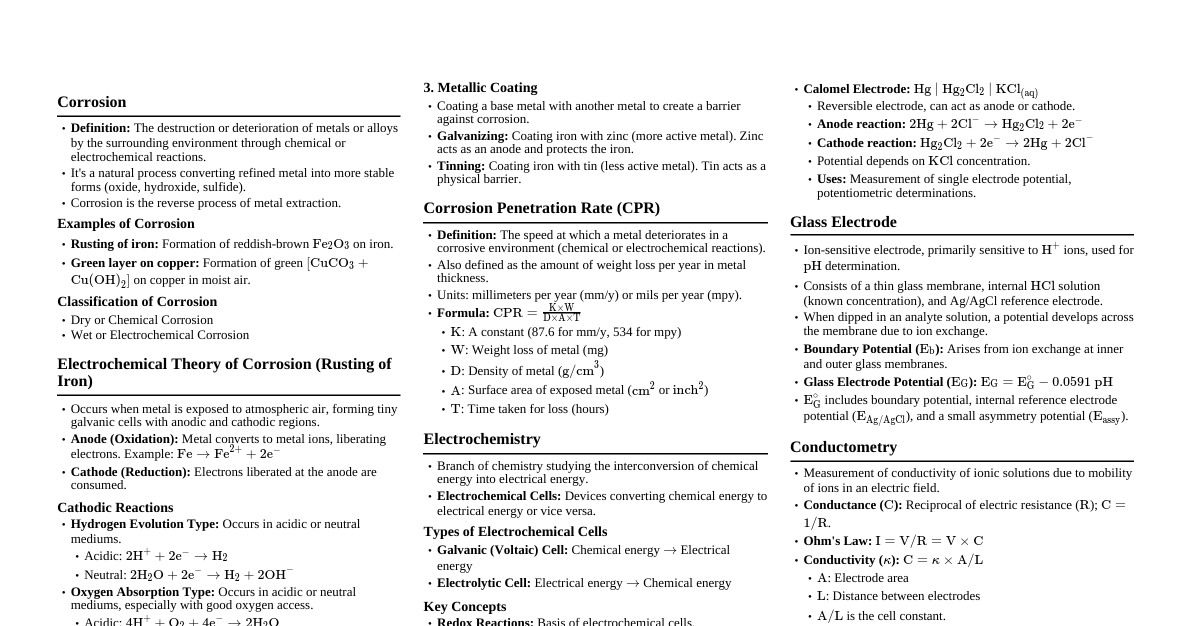
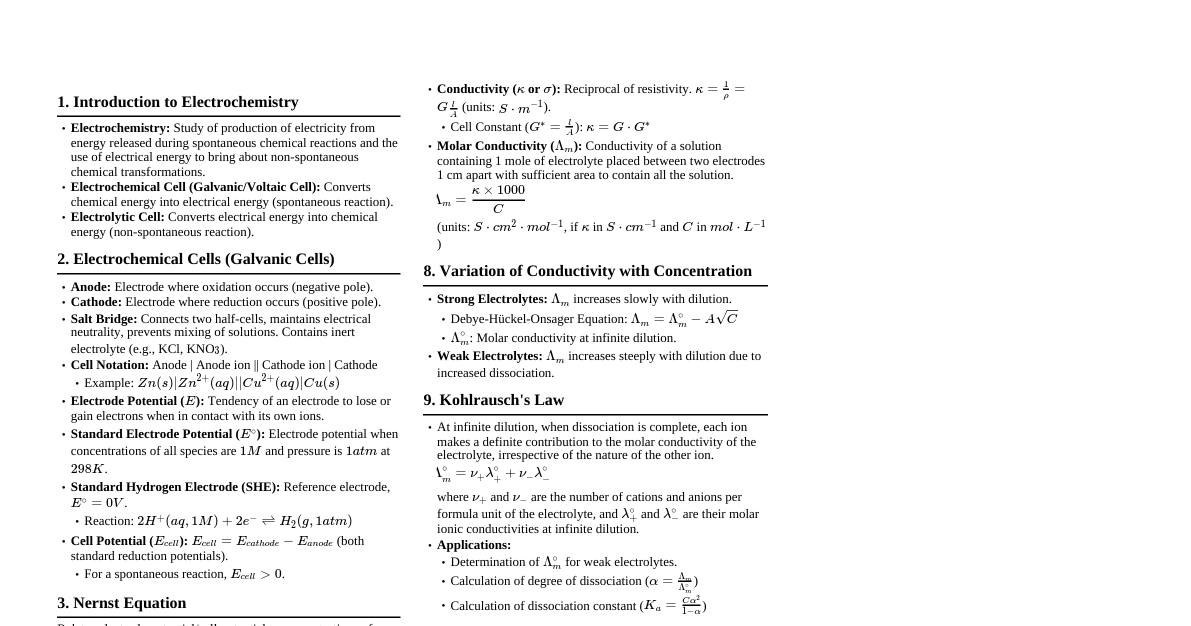
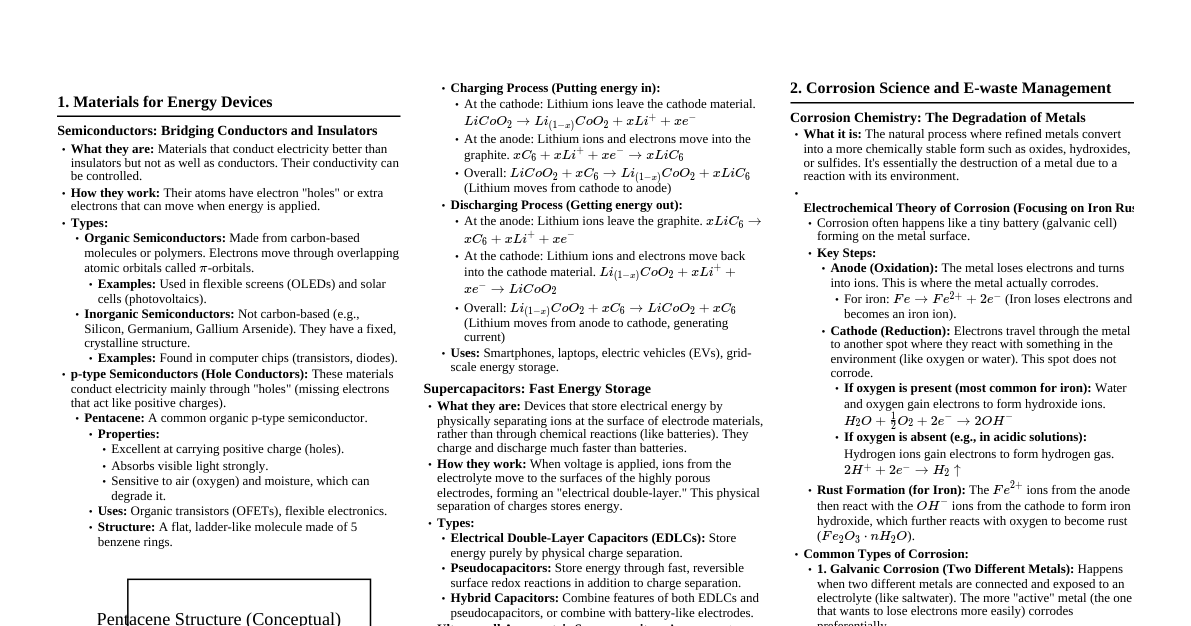
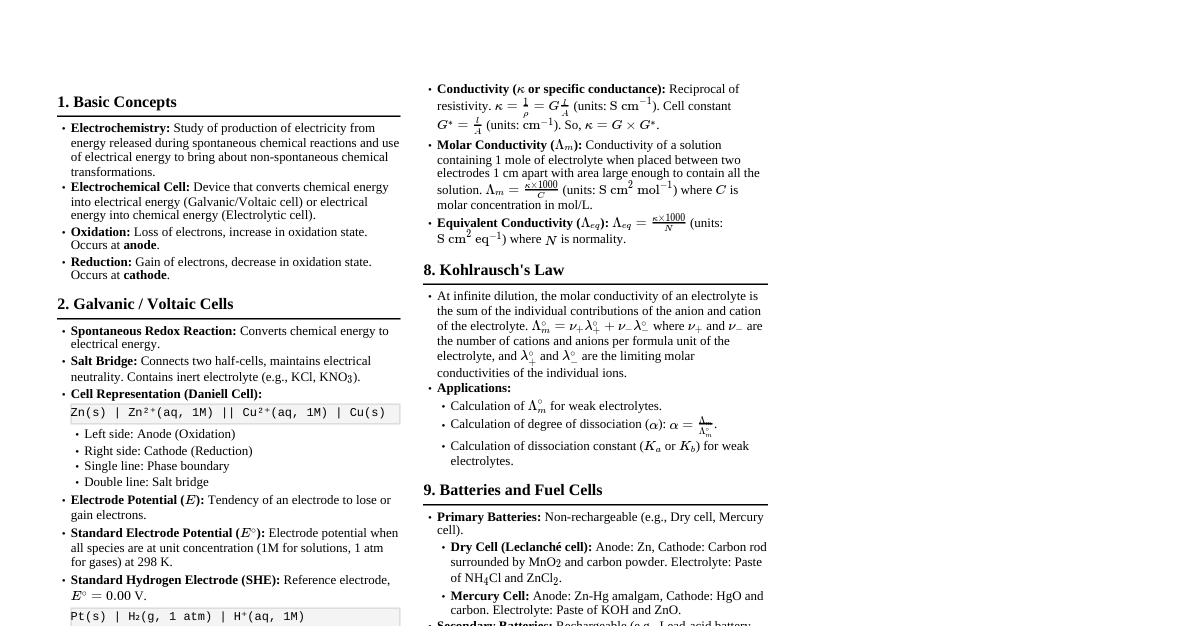
### Introduction to Electrochemistry - **Definition:** Branch of chemistry dealing with the interconversion of electrical and chemical energy. - **Electrochemical Cell:** A device that converts chemical energy into electrical energy (Galvanic cell) or electrical energy into chemical energy (Electrolytic cell). ### Galvanic (Voltaic) Cells - **Definition:** Converts chemical energy spontaneously into electrical energy. - **Components:** Anode (negative electrode, oxidation), Cathode (positive electrode, reduction), Salt bridge (maintains electrical neutrality). - **Example (Daniell Cell):** $\text{Zn(s)} | \text{Zn}^{2+}\text{(aq)} || \text{Cu}^{2+}\text{(aq)} | \text{Cu(s)}$ - **Anode (Oxidation):** $\text{Zn(s)} \rightarrow \text{Zn}^{2+}\text{(aq)} + 2\text{e}^-$ - **Cathode (Reduction):** $\text{Cu}^{2+}\text{(aq)} + 2\text{e}^- \rightarrow \text{Cu(s)}$ - **Overall Reaction:** $\text{Zn(s)} + \text{Cu}^{2+}\text{(aq)} \rightarrow \text{Zn}^{2+}\text{(aq)} + \text{Cu(s)}$ ### Electrode Potential - **Definition:** The potential difference developed between the electrode and the electrolyte. - **Standard Electrode Potential ($E^\circ$):** Electrode potential when concentration of all species is unity (1 M for solutions, 1 atm for gases) and temperature is 298 K. - **Standard Hydrogen Electrode (SHE):** Reference electrode with $E^\circ = 0.00 \text{ V}$. - **Cell Potential ($E_{\text{cell}}$):** $E_{\text{cell}} = E_{\text{cathode}} - E_{\text{anode}}$ (or $E_{\text{right}} - E_{\text{left}}$). - For standard conditions: $E^\circ_{\text{cell}} = E^\circ_{\text{cathode}} - E^\circ_{\text{anode}}$. - **Spontaneity:** A reaction is spontaneous if $E_{\text{cell}} > 0$. ### Nernst Equation - **Purpose:** Relates cell potential to concentrations of reactants and products. - **Equation:** $E_{\text{cell}} = E^\circ_{\text{cell}} - \frac{RT}{nF} \ln Q$ - At 298 K: $E_{\text{cell}} = E^\circ_{\text{cell}} - \frac{0.0592}{n} \log Q$ - Where: - $R$ = Gas constant (8.314 J/mol·K) - $T$ = Temperature in Kelvin - $n$ = Number of electrons transferred in the balanced reaction - $F$ = Faraday constant (96485 C/mol) - $Q$ = Reaction quotient - **Equilibrium Constant ($K_c$):** At equilibrium, $E_{\text{cell}} = 0$, so $E^\circ_{\text{cell}} = \frac{0.0592}{n} \log K_c$. ### Conductance of Electrolytic Solutions - **Resistance ($R$):** $R = \rho \frac{l}{A}$ (Ohm's Law: $V=IR$) - **Resistivity ($\rho$):** Resistance of a material of unit length and unit cross-sectional area. - **Conductance ($G$):** Inverse of resistance, $G = \frac{1}{R}$ (Units: Siemens, S). - **Conductivity ($\kappa$):** Inverse of resistivity, $\kappa = \frac{1}{\rho}$ (Units: S cm$^{-1}$ or S m$^{-1}$). - $\kappa = G \times \frac{l}{A}$ - $\frac{l}{A}$ is called cell constant ($G^*$). - **Molar Conductivity ($\Lambda_m$):** Conductivity of an electrolyte solution containing one mole of electrolyte, placed between two electrodes separated by 1 cm. - $\Lambda_m = \frac{\kappa \times 1000}{C}$ (Units: S cm$^2$ mol$^{-1}$, where $C$ is molarity in mol L$^{-1}$) ### Kohlrausch's Law - **Statement:** At infinite dilution, the molar conductivity of an electrolyte can be expressed as the sum of the individual contributions of the cations and anions of the electrolyte. - **Equation:** $\Lambda^\circ_m = \nu^+ \lambda^\circ_+ + \nu^- \lambda^\circ_-$ - Where: - $\Lambda^\circ_m$ = Molar conductivity at infinite dilution - $\nu^+$, $\nu^-$ = Number of cations and anions per formula unit - $\lambda^\circ_+$, $\lambda^\circ_-$ = Limiting molar conductivities of cation and anion, respectively. - **Applications:** - Calculation of molar conductivities of weak electrolytes at infinite dilution. - Calculation of degree of dissociation ($\alpha$) of weak electrolytes: $\alpha = \frac{\Lambda_m}{\Lambda^\circ_m}$. - Calculation of dissociation constant ($K_a$ or $K_c$). ### Electrolytic Cells and Electrolysis - **Definition:** Converts electrical energy into chemical energy (non-spontaneous reactions). - **Process:** Electrolysis is the process of chemical decomposition of an electrolyte by passing electric current through it. - **Anode:** Positive electrode (oxidation). - **Cathode:** Negative electrode (reduction). - **Predicting Products:** Based on standard reduction potentials and overpotential effects. - At cathode: Species with higher $E^\circ_{\text{red}}$ gets reduced. - At anode: Species with lower $E^\circ_{\text{red}}$ (or higher $E^\circ_{\text{ox}}$) gets oxidized. ### Faraday's Laws of Electrolysis - **First Law:** The mass of any substance deposited or liberated at any electrode is directly proportional to the quantity of electricity passed through the electrolyte. - $w \propto Q$ or $w = ZQ = ZIt$ - Where: - $w$ = Mass of substance - $Q$ = Quantity of electricity (Coulombs, C) = $I \times t$ - $I$ = Current (Amperes, A) - $t$ = Time (seconds, s) - $Z$ = Electrochemical equivalent ($Z = \frac{\text{Molar Mass}}{nF}$) - **Second Law:** When the same quantity of electricity is passed through different electrolytes, the masses of the substances deposited or liberated at the electrodes are directly proportional to their equivalent masses. - $\frac{w_1}{w_2} = \frac{E_1}{E_2}$ (where $E$ is equivalent mass) ### Batteries and Fuel Cells - **Primary Batteries:** Non-rechargeable (e.g., Dry cell, Leclanché cell, Mercury cell). - **Dry Cell:** Anode (Zn), Cathode (Carbon rod in MnO$_2$ and carbon paste). - **Secondary Batteries:** Rechargeable (e.g., Lead-acid battery, Nickel-Cadmium cell). - **Lead-Acid Battery:** Anode (Pb), Cathode (PbO$_2$), Electrolyte (H$_2$SO$_4$). - **Discharging:** $\text{Pb(s)} + \text{PbO}_2\text{(s)} + 2\text{H}_2\text{SO}_4\text{(aq)} \rightarrow 2\text{PbSO}_4\text{(s)} + 2\text{H}_2\text{O(l)}$ - **Recharging:** Reverse of discharging. - **Fuel Cells:** Convert energy from combustion of fuels (like H$_2$, CH$_4$, CH$_3$OH) directly into electrical energy. - **H$_2$-O$_2$ Fuel Cell:** - **Anode:** $\text{H}_2\text{(g)} + 2\text{OH}^-\text{(aq)} \rightarrow 2\text{H}_2\text{O(l)} + 2\text{e}^-$ - **Cathode:** $\text{O}_2\text{(g)} + 2\text{H}_2\text{O(l)} + 4\text{e}^- \rightarrow 4\text{OH}^-\text{(aq)}$ - **Overall:** $2\text{H}_2\text{(g)} + \text{O}_2\text{(g)} \rightarrow 2\text{H}_2\text{O(l)}$ ### Corrosion - **Definition:** The process of gradual degradation of materials (usually metals) by chemical or electrochemical reaction with their environment. - **Electrochemical Theory of Rusting of Iron:** - **Anode (Oxidation):** At specific spots on the surface of iron, oxidation occurs. - $\text{Fe(s)} \rightarrow \text{Fe}^{2+}\text{(aq)} + 2\text{e}^-$ - **Cathode (Reduction):** Electrons move to other spots, where oxygen is reduced (in presence of H$^+$ ions from H$_2$CO$_3$ formed from CO$_2$ and H$_2$O). - $\text{O}_2\text{(g)} + 4\text{H}^+\text{(aq)} + 4\text{e}^- \rightarrow 2\text{H}_2\text{O(l)}$ (acidic medium) - Or $\text{O}_2\text{(g)} + 2\text{H}_2\text{O(l)} + 4\text{e}^- \rightarrow 4\text{OH}^-\text{(aq)}$ (neutral medium) - **Overall:** $\text{Fe}^{2+}$ ions are further oxidized by atmospheric oxygen to $\text{Fe}^{3+}$ which forms hydrated ferric oxide (rust), $\text{Fe}_2\text{O}_3 \cdot x\text{H}_2\text{O}$. - **Prevention of Corrosion:** - **Barrier Protection:** Painting, oiling, greasing, electroplating. - **Sacrificial Protection:** Connecting the metal to a more electropositive metal (e.g., Mg, Zn). - **Cathodic Protection:** Using an external current to make the metal a cathode.