Corrosion & Electrochemistry
Cheatsheet Content
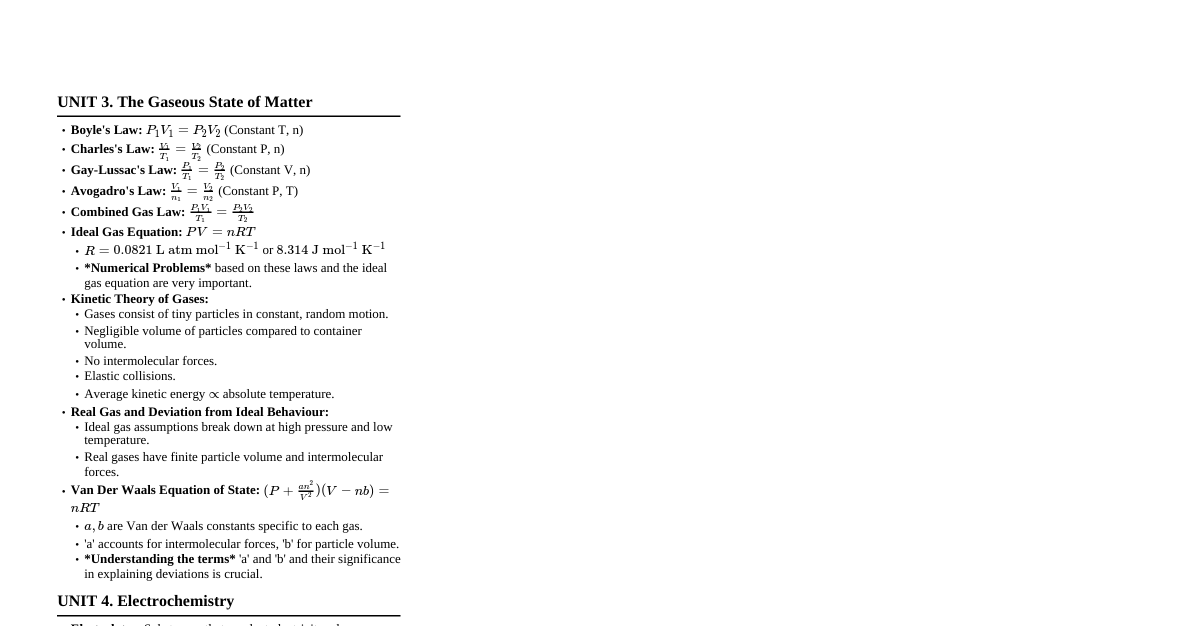
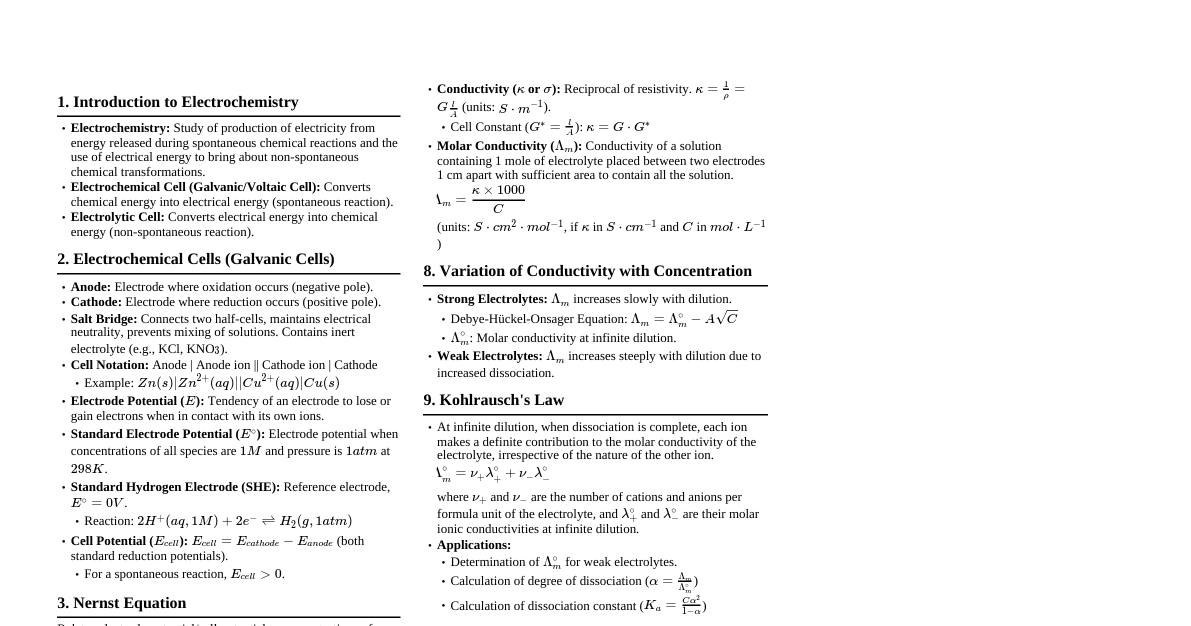
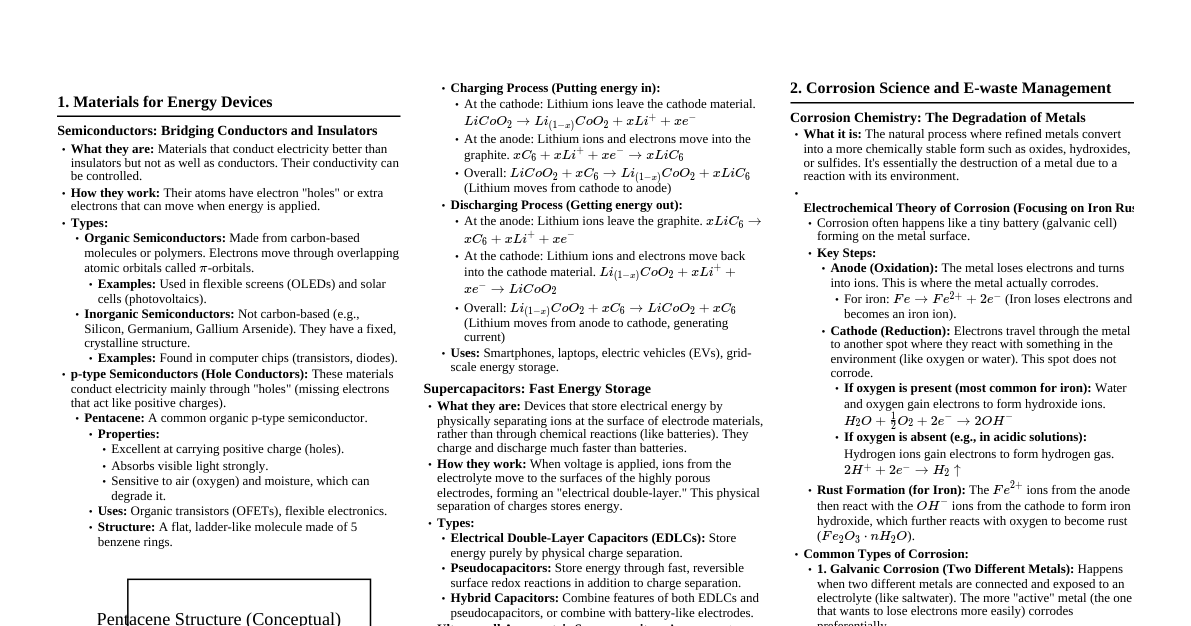
Corrosion Definition: The destruction or deterioration of metals or alloys by the surrounding environment through chemical or electrochemical reactions. It's a natural process converting refined metal into more stable forms (oxide, hydroxide, sulfide). Corrosion is the reverse process of metal extraction. Examples of Corrosion Rusting of iron: Formation of reddish-brown $\text{Fe}_2\text{O}_3$ on iron. Green layer on copper: Formation of green $[\text{CuCO}_3 + \text{Cu(OH)}_2]$ on copper in moist air. Classification of Corrosion Dry or Chemical Corrosion Wet or Electrochemical Corrosion Electrochemical Theory of Corrosion (Rusting of Iron) Occurs when metal is exposed to atmospheric air, forming tiny galvanic cells with anodic and cathodic regions. Anode (Oxidation): Metal converts to metal ions, liberating electrons. Example: $\text{Fe} \rightarrow \text{Fe}^{2+} + 2\text{e}^-$ Cathode (Reduction): Electrons liberated at the anode are consumed. Cathodic Reactions Hydrogen Evolution Type: Occurs in acidic or neutral mediums. Acidic: $2\text{H}^+ + 2\text{e}^- \rightarrow \text{H}_2$ Neutral: $2\text{H}_2\text{O} + 2\text{e}^- \rightarrow \text{H}_2 + 2\text{OH}^-$ Oxygen Absorption Type: Occurs in acidic or neutral mediums, especially with good oxygen access. Acidic: $4\text{H}^+ + \text{O}_2 + 4\text{e}^- \rightarrow 2\text{H}_2\text{O}$ Neutral: $2\text{H}_2\text{O} + \text{O}_2 + 4\text{e}^- \rightarrow 4\text{OH}^-$ Rust Formation Initially, $\text{Fe}^{2+}$ reacts with $\text{OH}^-$ to form $\text{Fe(OH)}_2$. In an oxidizing environment: $4\text{Fe}(\text{OH})_2 + \text{O}_2 + 2\text{H}_2\text{O} \rightarrow 4\text{Fe}(\text{OH})_3 \rightarrow 2\text{Fe}_2\text{O}_3 \cdot 6\text{H}_2\text{O}$ (Brown rust) If oxygen is limited: $3\text{Fe}(\text{OH})_2 + \frac{1}{2}\text{O}_2 \rightarrow \text{Fe}_3\text{O}_4 \cdot 3\text{H}_2\text{O}$ (Black rust) Types of Corrosion 1. Differential Metal Corrosion (Galvanic Corrosion) Occurs when two dissimilar metals are in contact in a corrosive medium. The metal with lower electrode potential acts as the anode and corrodes. The more active metal acts as anode, less active as cathode. Rate depends on potential difference and anodic/cathodic area ratio. Anode: $\text{M} \rightarrow \text{M}^{\text{n}+} + \text{n e}^-$ (Oxidation) Cathode: $2\text{H}^+ + 2\text{e}^- \rightarrow \text{H}_2$ (Hydrogen evolution) or $2\text{H}_2\text{O} + \text{O}_2 + 4\text{e}^- \rightarrow 4\text{OH}^-$ (Oxygen absorption) Example: Zinc in contact with copper. Zinc (lower E) acts as anode, corrodes. 2. Differential Aeration Corrosion Occurs when a metal surface is exposed to varying oxygen concentrations. Part exposed to lower oxygen concentration acts as anode and corrodes. Part exposed to higher oxygen concentration acts as cathode. Anode: $\text{M} \rightarrow \text{M}^{\text{n}+} + \text{n e}^-$ (Oxidation) Cathode: $2\text{H}_2\text{O} + \text{O}_2 + 4\text{e}^- \rightarrow 4\text{OH}^-$ (Oxygen absorption) Examples: Water Line Corrosion, Pitting Corrosion. a. Water Line Corrosion Corrosion just below the water line where oxygen access is limited (anodic). Area above water line is cathodic (more oxygenated). b. Pitting Corrosion Localized corrosion forming pits under deposits (dust, oil) where oxygen is limited (anodic). Exposed surface around the deposit is cathodic (more oxygenated). Corrosion Control 1. Anodizing Increasing corrosion resistance by forming a protective oxide layer on the metal surface. Anodizing of Aluminum: Electrolytic process in acid medium. Oxygen liberated at cathode combines with aluminum to form oxide film ($\text{Al}_2\text{O}_3$). This layer acts as a barrier. Reaction: $2\text{Al} + 3\text{H}_2\text{O} \rightarrow \text{Al}_2\text{O}_3 + 3\text{H}_2$ 2. Cathodic Protection Protecting a metal by making it the cathode in an electrochemical cell. Sacrificial Anode Method: Connecting a more active metal (e.g., Zn, Mg) to the metal to be protected. The active metal acts as anode and corrodes sacrificially. Impressed Current Method: Applying an external DC current to convert the corroding metal into a cathode. An inert electrode (e.g., graphite) acts as the anode. 3. Metallic Coating Coating a base metal with another metal to create a barrier against corrosion. Galvanizing: Coating iron with zinc (more active metal). Zinc acts as an anode and protects the iron. Tinning: Coating iron with tin (less active metal). Tin acts as a physical barrier. Corrosion Penetration Rate (CPR) Definition: The speed at which a metal deteriorates in a corrosive environment (chemical or electrochemical reactions). Also defined as the amount of weight loss per year in metal thickness. Units: millimeters per year (mm/y) or mils per year (mpy). Formula: $\text{CPR} = \frac{\text{K} \times \text{W}}{\text{D} \times \text{A} \times \text{T}}$ $\text{K}$: A constant (87.6 for mm/y, 534 for mpy) $\text{W}$: Weight loss of metal (mg) $\text{D}$: Density of metal ($\text{g/cm}^3$) $\text{A}$: Surface area of exposed metal ($\text{cm}^2$ or $\text{inch}^2$) $\text{T}$: Time taken for loss (hours) Electrochemistry Branch of chemistry studying the interconversion of chemical energy into electrical energy. Electrochemical Cells: Devices converting chemical energy to electrical energy or vice versa. Types of Electrochemical Cells Galvanic (Voltaic) Cell: Chemical energy $\rightarrow$ Electrical energy Electrolytic Cell: Electrical energy $\rightarrow$ Chemical energy Key Concepts Redox Reactions: Basis of electrochemical cells. Oxidation: Loss of electrons, increase in oxidation number. Occurs at the anode . Example: $\text{M} \rightarrow \text{M}^{\text{n}+} + \text{n e}^-$ Reduction: Gain of electrons, decrease in oxidation number. Occurs at the cathode . Example: $\text{M}^{\text{n}+} + \text{n e}^- \rightarrow \text{M}$ Electrode Potential: Potential arising at an electrode in contact with its ionic solution. EMF (Cell Potential): Difference between potentials of two half-cells. Standard Electrode Potential: Tendency of a metallic electrode to lose or gain electrons when dipped in its own salt solution of unit molar concentration at $25^\circ \text{C}$. Nernst Equation Quantitative relationship between electrode potential and electrolyte species concentration. $\text{E} = \text{E}^\circ - \frac{2.303\text{RT}}{\text{nF}} \log_{10} \frac{[\text{Reduced}]}{[\text{Oxidized}]}$ At $298 \text{ K}$: $\text{E} = \text{E}^\circ - \frac{0.0591}{\text{n}} \log_{10} \frac{[\text{Reduced}]}{[\text{Oxidized}]}$ For $\text{M}^{\text{n}+} + \text{n e}^- \rightarrow \text{M}$: $\text{E} = \text{E}^\circ - \frac{0.0591}{\text{n}} \log_{10} \frac{1}{[\text{M}^{\text{n}+}]}$ Electrolyte Concentration Cell Consists of two identical electrodes immersed in the same electrolytic solution but at different concentrations. Cell potential: $\text{E}_{\text{cell}} = \frac{0.0591}{\text{n}} \log_{10} \frac{[\text{C}_{\text{cathode}}]}{[\text{C}_{\text{anode}}]}$ at $298 \text{ K}$ Electrodes Conductor used to make contact with a non-metallic part of a circuit, where electron transfer occurs. Types of Electrodes Metal-Metal Ion Electrode: Metal in contact with its own ions. Example: $\text{Zn} \text{ | } \text{ZnSO}_4$. Metal-Metal Salt Ion Electrode: Metal in contact with a sparingly soluble salt and a solution with a common anion. Example: $\text{Hg} \text{ | } \text{Hg}_2\text{Cl}_2 \text{ | } \text{Cl}^-$. Gas Electrode: Inert electrode (Pt) flushed with gas, dipped in solution containing ions reversible to the gas. Example: $\text{SHE } (\text{Pt} \text{ | } \text{H}_2 \text{(1atm)} \text{ | } \text{H}^+ \text{(1M)})$. Oxidation-Reduction Electrode: Inert electrode (Pt or Au) immersed in a solution containing oxidized and reduced forms of a molecule/ion. Example: $\text{Pt} \text{ | } \text{Fe}^{2+} : \text{Fe}^{3+}$. Amalgam Electrode: Amalgam of a metal in contact with its own metal ions. Example: $\text{Zn(Hg)} \text{ | } \text{Zn}^{2+}$. Ion Selective Electrode: Membrane in contact with a solution, selectively responding to a specific ion. Example: Glass electrode (sensitive to $\text{H}^+$ ions). Reference Electrodes Electrodes with known, constant electrode potentials, used to determine potentials of other electrodes. Primary Reference Electrode Standard Hydrogen Electrode (SHE): Consists of Pt electrode covered with Pt black, immersed in $1 \text{M } \text{HCl}$ solution, with $\text{H}_2$ gas at $1 \text{ atm}$ and $298 \text{ K}$. Potential is conventionally set to zero. Anode: $\frac{1}{2}\text{H}_2 \rightarrow \text{H}^+ + \text{e}^-$ Cathode: $\text{H}^+ + \text{e}^- \rightarrow \frac{1}{2}\text{H}_2$ Limitations: Difficult to maintain $1 \text{ atm H}_2$ pressure and $1 \text{M } \text{H}^+$ concentration, easily poisoned by impurities, cannot be used with oxidizing agents. Secondary Reference Electrode Overcomes limitations of SHE, constant electrode potential. Calomel Electrode: $\text{Hg} \text{ | } \text{Hg}_2\text{Cl}_2 \text{ | } \text{KCl}_{\text{(aq)}}$ Reversible electrode, can act as anode or cathode. Anode reaction: $2\text{Hg} + 2\text{Cl}^- \rightarrow \text{Hg}_2\text{Cl}_2 + 2\text{e}^-$ Cathode reaction: $\text{Hg}_2\text{Cl}_2 + 2\text{e}^- \rightarrow 2\text{Hg} + 2\text{Cl}^-$ Potential depends on $\text{KCl}$ concentration. Uses: Measurement of single electrode potential, potentiometric determinations. Glass Electrode Ion-sensitive electrode, primarily sensitive to $\text{H}^+$ ions, used for $\text{pH}$ determination. Consists of a thin glass membrane, internal $\text{HCl}$ solution (known concentration), and Ag/AgCl reference electrode. When dipped in an analyte solution, a potential develops across the membrane due to ion exchange. Boundary Potential ($\text{E}_{\text{b}}$): Arises from ion exchange at inner and outer glass membranes. Glass Electrode Potential ($\text{E}_{\text{G}}$): $\text{E}_{\text{G}} = \text{E}_{\text{G}}^\circ - 0.0591 \text{ pH}$ $\text{E}_{\text{G}}^\circ$ includes boundary potential, internal reference electrode potential ($\text{E}_{\text{Ag/AgCl}}$), and a small asymmetry potential ($\text{E}_{\text{assy}}$). Conductometry Measurement of conductivity of ionic solutions due to mobility of ions in an electric field. Conductance ($\text{C}$): Reciprocal of electric resistance ($\text{R}$); $\text{C} = 1/\text{R}$. Ohm's Law: $\text{I} = \text{V}/\text{R} = \text{V} \times \text{C}$ Conductivity ($\kappa$): $\text{C} = \kappa \times \text{A/L}$ $\text{A}$: Electrode area $\text{L}$: Distance between electrodes $\text{A/L}$ is the cell constant. Conductivity depends on ion concentrations, charges, and mobilities. Conductometric Titration Based on the principle that during titration, one ion is replaced by another with different ionic conductivity, causing a change in solution conductivity. Example: $\text{HCl} + \text{NaOH} \rightarrow \text{NaCl} + \text{H}_2\text{O}$ Initially, high conductivity due to $\text{H}^+$. As $\text{NaOH}$ is added, $\text{H}^+$ replaced by $\text{Na}^+$ (lower mobility), conductivity decreases. After equivalence point, excess $\text{NaOH}$ adds $\text{Na}^+$ and $\text{OH}^-$ (high mobility), conductivity increases. Equivalence point is determined graphically from the change in conductance vs. volume of titrant. Potentiometric Estimations Involves measuring the potential of a suitable indicator electrode relative to a reference electrode as a function of titrant volume. Provides more reliable data than chemical indicators, especially for colored or turbid solutions. Can be used for precipitation, complex formation, neutralization, and redox titrations. Electrode Types in Potentiometry Reference Electrode: Known, constant potential, independent of analyte concentration. Acts as anode. Example: Calomel electrode. Indicator Electrode: Potential varies with analyte concentration. Example: Metallic indicator electrode, glass electrode. Potentiometric Estimation of Ferrous Ammonium Sulphate (FAS) Titration of $\text{Fe}^{2+}$ (from FAS) with $\text{K}_2\text{Cr}_2\text{O}_7$ (Potassium Dichromate) oxidizes $\text{Fe}^{2+}$ to $\text{Fe}^{3+}$. Reference Electrode: Calomel Electrode (Anode) Indicator Electrode: Platinum Electrode (Cathode) Cell Representation: $\text{Hg} \text{ | } \text{Hg}_2\text{Cl}_2 \text{ | } \text{KCl}_{\text{(sat)}} \text{ || } \text{Fe}^{3+}, \text{Fe}^{2+} \text{ | } \text{Pt}$ Indicator electrode potential: $\text{E}_{\text{Pt}} = \text{E}_{\text{Pt}}^\circ + \frac{0.0591}{1} \log_{10} \frac{[\text{Fe}^{3+}]}{[\text{Fe}^{2+}]}$ During titration, $\text{K}_2\text{Cr}_2\text{O}_7$ increases the $[\text{Fe}^{3+}]/[\text{Fe}^{2+}]$ ratio, increasing the EMF of the cell. At the endpoint, there is a sharp increase in EMF.