Chemistry Cheatsheet
Cheatsheet Content
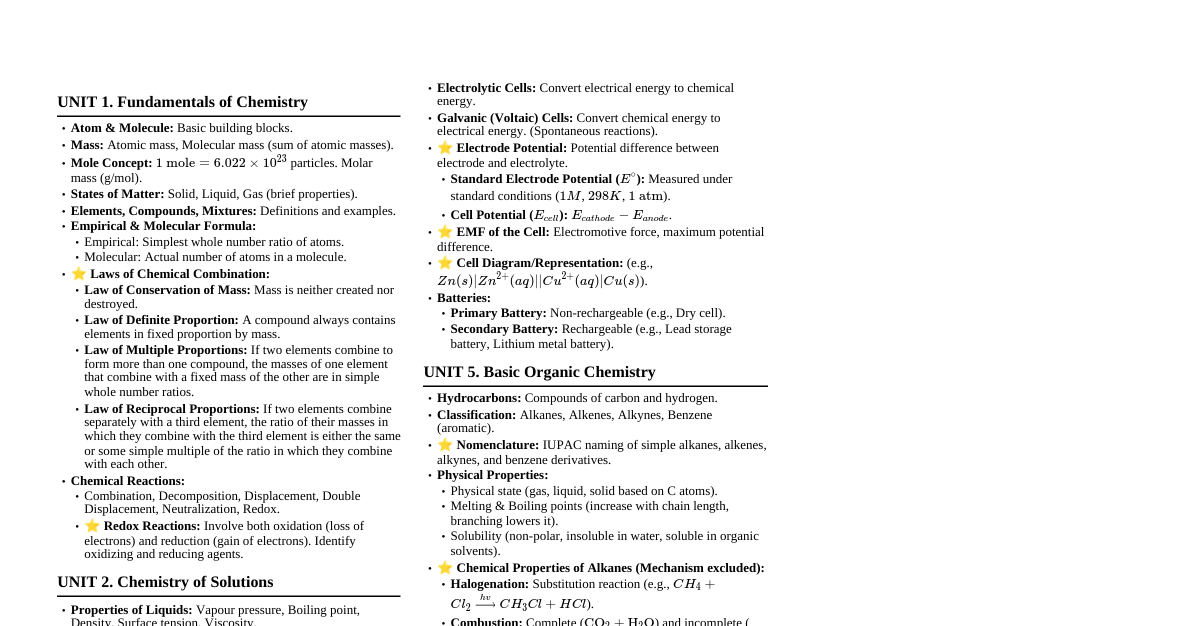
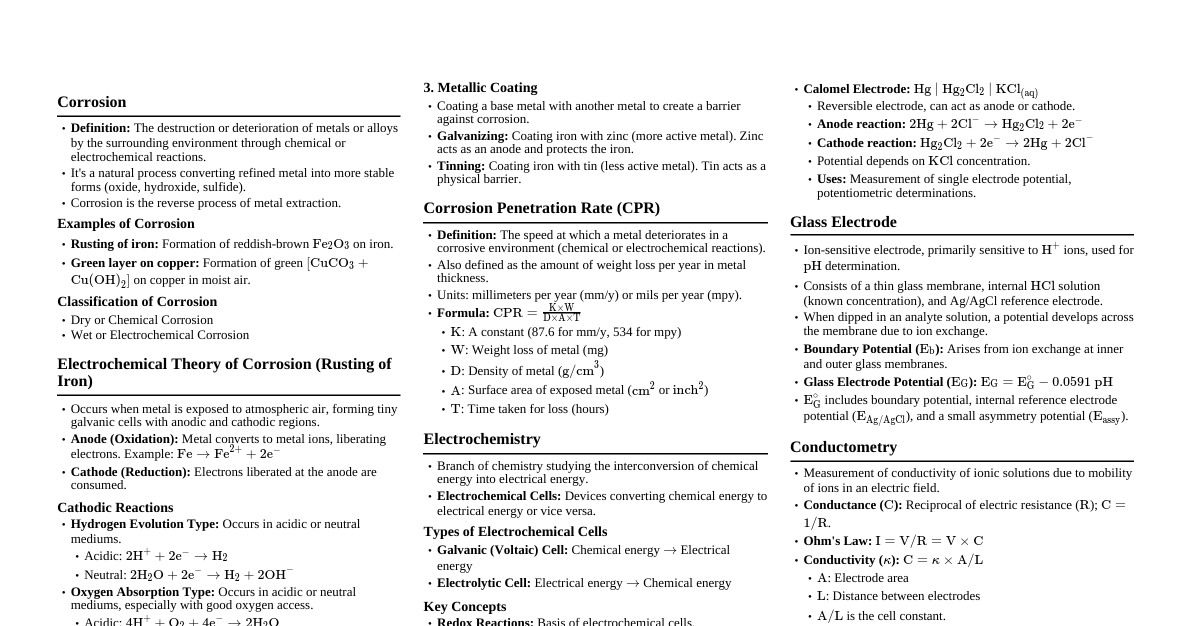
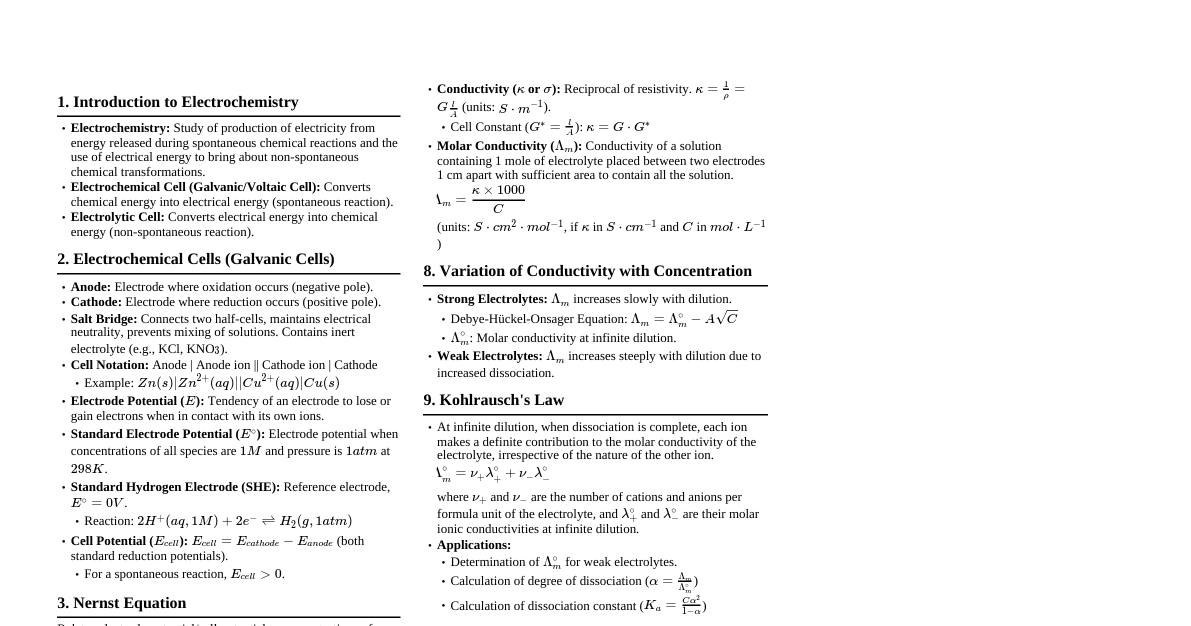
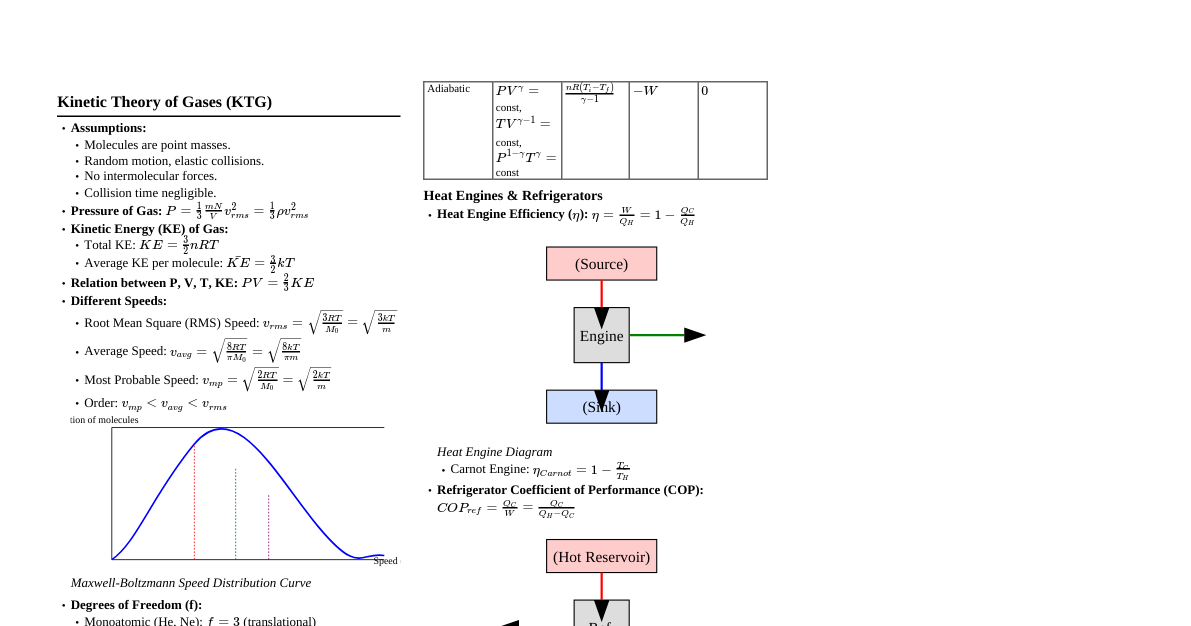
UNIT 3. The Gaseous State of Matter Boyle's Law: $P_1V_1 = P_2V_2$ (Constant T, n) Charles's Law: $\frac{V_1}{T_1} = \frac{V_2}{T_2}$ (Constant P, n) Gay-Lussac's Law: $\frac{P_1}{T_1} = \frac{P_2}{T_2}$ (Constant V, n) Avogadro's Law: $\frac{V_1}{n_1} = \frac{V_2}{n_2}$ (Constant P, T) Combined Gas Law: $\frac{P_1V_1}{T_1} = \frac{P_2V_2}{T_2}$ Ideal Gas Equation: $PV = nRT$ $R = 0.0821 \text{ L atm mol}^{-1}\text{ K}^{-1}$ or $8.314 \text{ J mol}^{-1}\text{ K}^{-1}$ *Numerical Problems* based on these laws and the ideal gas equation are very important. Kinetic Theory of Gases: Gases consist of tiny particles in constant, random motion. Negligible volume of particles compared to container volume. No intermolecular forces. Elastic collisions. Average kinetic energy $\propto$ absolute temperature. Real Gas and Deviation from Ideal Behaviour: Ideal gas assumptions break down at high pressure and low temperature. Real gases have finite particle volume and intermolecular forces. Van Der Waals Equation of State: $(P + \frac{an^2}{V^2})(V - nb) = nRT$ $a, b$ are Van der Waals constants specific to each gas. 'a' accounts for intermolecular forces, 'b' for particle volume. *Understanding the terms* 'a' and 'b' and their significance in explaining deviations is crucial. UNIT 4. Electrochemistry Electrolytes: Substances that conduct electricity when dissolved in water or in molten state. Strong Electrolytes: Completely dissociate/ionize in solution (e.g., strong acids, strong bases, most salts). Weak Electrolytes: Partially dissociate/ionize in solution (e.g., weak acids, weak bases). Electrolysis: Chemical process driven by electrical energy. Electrolysis of Aqueous Copper Sulphate Solution: At cathode: $Cu^{2+}(aq) + 2e^- \to Cu(s)$ At anode: $2H_2O(l) \to O_2(g) + 4H^+(aq) + 4e^-$ (if inert anode) or $Cu(s) \to Cu^{2+}(aq) + 2e^-$ (if copper anode) Electrolytic Cells: Convert electrical energy into chemical energy. Requires external power source. Galvanic (Voltaic) Cells: Convert chemical energy into electrical energy. Spontaneous redox reactions. Electrode Potential ($E$): Potential difference developed at the interface between electrode and electrolyte. *Standard Electrode Potential* ($E^\circ$): Electrode potential when concentrations of all species are 1 M, gas pressure is 1 atm, and temperature is 298 K. Reference: Standard Hydrogen Electrode (SHE), $E^\circ = 0 \text{ V}$. Cell Potential or EMF of the Cell ($E_{cell}$): $E_{cell} = E_{cathode} - E_{anode}$ (using standard reduction potentials) For spontaneous reaction, $E_{cell} > 0$. *Nernst Equation:* $E = E^\circ - \frac{RT}{nF} \ln Q$ or $E = E^\circ - \frac{0.0592}{n} \log Q$ (at 298 K) *Numerical Problems* involving Nernst equation for varying concentrations are key. Cell Diagram or Representation of a Cell: Anode | Anode ion || Cathode ion | Cathode Example: $Zn(s) | Zn^{2+}(aq, 1M) || Cu^{2+}(aq, 1M) | Cu(s)$ Batteries: Primary Battery: Non-rechargeable (e.g., Dry cell, Mercury cell). Secondary Battery: Rechargeable (e.g., Lead-Acid storage battery, Lithium-ion battery). *Lead-Acid Storage Battery:* Anode: Lead ($Pb$) Cathode: Lead dioxide ($PbO_2$) Electrolyte: Sulfuric acid ($H_2SO_4$) Discharge: $Pb(s) + PbO_2(s) + 2H_2SO_4(aq) \to 2PbSO_4(s) + 2H_2O(l)$ *Understanding the reactions* during charging and discharging is important. Lithium-ion Battery: High energy density, rechargeable. Uses lithium ions moving between anode and cathode.