Trigonometry Review
Shared 5/13/2026•1 views
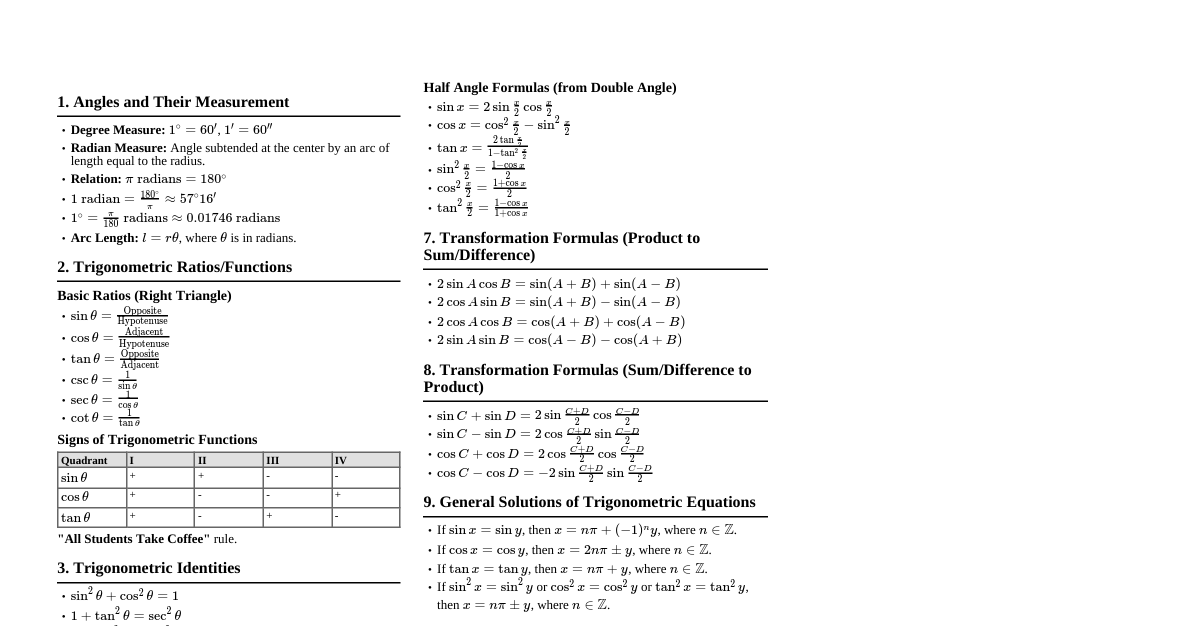
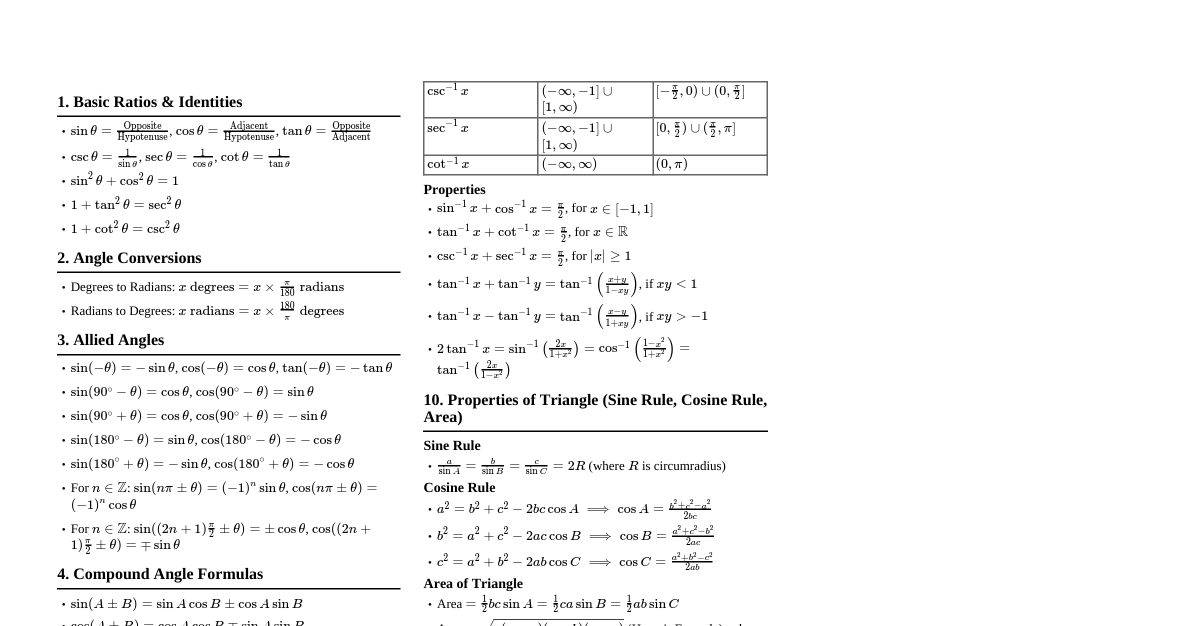
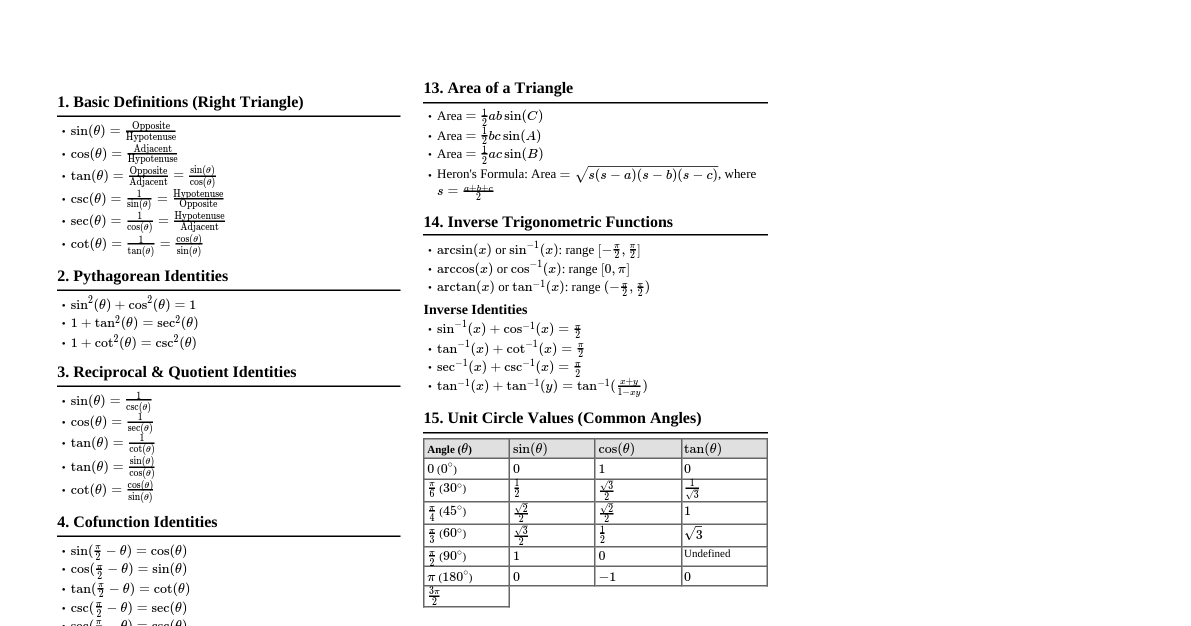
### Quadrants and Sign Rules The coordinate plane is divided into four quadrants: - **First Quadrant (0° to 90°):** All trigonometric functions (sine, cosine, tangent, and their reciprocals) are positive. Represented as $90^\circ - \theta$. - **Second Quadrant (90° to 180°):** Only sine and cosecant are positive. Represented as $90^\circ + \theta$ or $180^\circ - \theta$. - **Third Quadrant (180° to 270°):** Only tangent and cotangent are positive. Represented as $180^\circ + \theta$ or $270^\circ - \theta$. - **Fourth Quadrant (270° to 360°):** Only cosine and secant are positive. Represented as $270^\circ + \theta$ or $360^\circ - \theta$. #### ASTC Rule A common mnemonic to remember the positive functions in each quadrant: - **A**ll in First - **S**ine in Second (and its reciprocal, cosecant) - **T**angent in Third (and its reciprocal, cotangent) - **C**osine in Fourth (and its reciprocal, secant) #### Angle Transformations - Angles involving $90^\circ$ or $270^\circ$ (e.g., $90^\circ \pm \theta$, $270^\circ \pm \theta$) change the trigonometric function: - $\sin \leftrightarrow \cos$ - $\tan \leftrightarrow \cot$ - $\sec \leftrightarrow \csc$ - Angles involving $180^\circ$ or $360^\circ$ (e.g., $180^\circ \pm \theta$, $360^\circ \pm \theta$) do NOT change the trigonometric function. - It's generally safer to use $180^\circ$ and $360^\circ$ transformations to avoid function changes. ### Range of Sine and Cosine - For any angle $\theta$: - $-1 \le \sin\theta \le 1$ - $-1 \le \cos\theta \le 1$ - The maximum value for sine and cosine is 1, and the minimum value is -1. ### Solving Trigonometric Equations To solve equations like $\sin\theta = k$, $\cos\theta = k$, or $\tan\theta = k$: 1. **Determine Quadrants:** Identify the quadrants where the function has the sign of $k$. 2. **Find Reference Angle ($\alpha$):** Calculate $\alpha = \text{inverse function}(|k|)$. This angle is always in the first quadrant. 3. **Find Solutions in Determined Quadrants:** - **First Quadrant:** $\theta = \alpha$ - **Second Quadrant:** $\theta = 180^\circ - \alpha$ - **Third Quadrant:** $\theta = 180^\circ + \alpha$ - **Fourth Quadrant:** $\theta = 360^\circ - \alpha$ #### Example: $\sin\theta = 0.5$ 1. **Quadrants:** Sine is positive in the First and Second Quadrants. 2. **Reference Angle:** $\alpha = \sin^{-1}(0.5) = 30^\circ$. 3. **Solutions:** - First Quadrant: $\theta_1 = 30^\circ$ - Second Quadrant: $\theta_2 = 180^\circ - 30^\circ = 150^\circ$ #### Example: $\sin\theta = -0.5$ 1. **Quadrants:** Sine is negative in the Third and Fourth Quadrants. 2. **Reference Angle:** $\alpha = \sin^{-1}(|-0.5|) = \sin^{-1}(0.5) = 30^\circ$. 3. **Solutions:** - Third Quadrant: $\theta_1 = 180^\circ + 30^\circ = 210^\circ$ - Fourth Quadrant: $\theta_2 = 360^\circ - 30^\circ = 330^\circ$ ### Reciprocal Identities - $\sec\theta = \frac{1}{\cos\theta}$ - $\csc\theta = \frac{1}{\sin\theta}$ - $\cot\theta = \frac{1}{\tan\theta}$ - $\cos\theta = \frac{1}{\sec\theta}$ - $\sin\theta = \frac{1}{\csc\theta}$ - $\tan\theta = \frac{1}{\cot\theta}$ ### Even and Odd Functions - **Odd Functions (Negative sign 'comes out'):** - $\sin(-\theta) = -\sin\theta$ - $\tan(-\theta) = -\tan\theta$ - $\csc(-\theta) = -\csc\theta$ - $\cot(-\theta) = -\cot\theta$ - **Even Functions (Negative sign 'disappears'):** - $\cos(-\theta) = \cos\theta$ - $\sec(-\theta) = \sec\theta$ ### Fundamental Trigonometric Identities - $\sin^2\theta + \cos^2\theta = 1$ - $\sin^2\theta = 1 - \cos^2\theta$ - $\cos^2\theta = 1 - \sin^2\theta$ - $1 + \tan^2\theta = \sec^2\theta$ - $\sec^2\theta - \tan^2\theta = 1$ - $\sec^2\theta - 1 = \tan^2\theta$ - $1 + \cot^2\theta = \csc^2\theta$ - $\csc^2\theta - \cot^2\theta = 1$ - $\csc^2\theta - 1 = \cot^2\theta$ ### General Solutions #### For Cosine If $\cos\theta = \cos\alpha$: $\theta = \pm \alpha + 2\pi n$, where $n \in \mathbb{Z}$ (or $\theta = \pm \alpha + 360^\circ n$) **Example: $\cos\theta = 0.5$** 1. Reference angle: $\alpha = \cos^{-1}(0.5) = 60^\circ = \frac{\pi}{3}$ radians. 2. General solution: $\theta = \pm \frac{\pi}{3} + 2\pi n$ #### For Sine If $\sin\theta = \sin\alpha$: $\theta = \alpha + 2\pi n$ or $\theta = \pi - \alpha + 2\pi n$, where $n \in \mathbb{Z}$ (or $\theta = \alpha + 360^\circ n$ or $\theta = 180^\circ - \alpha + 360^\circ n$) **Example: $\sin\theta = -0.5$** 1. Reference angle: $\alpha = \sin^{-1}(0.5) = 30^\circ = \frac{\pi}{6}$ radians. 2. Since sine is negative, we use angles in the 3rd or 4th quadrant. The principal value is often taken as $-\frac{\pi}{6}$. 3. General solutions: - $\theta = -\frac{\pi}{6} + 2\pi n$ - $\theta = \pi - (-\frac{\pi}{6}) + 2\pi n = \frac{7\pi}{6} + 2\pi n$ (Alternatively, using positive angles: $\theta = \frac{7\pi}{6} + 2\pi n$ and $\theta = \frac{11\pi}{6} + 2\pi n$) #### For Tangent If $\tan\theta = \tan\alpha$: $\theta = \alpha + \pi n$, where $n \in \mathbb{Z}$ (or $\theta = \alpha + 180^\circ n$) **Example: $\tan\theta = -1$** 1. Reference angle: $\alpha = \tan^{-1}(1) = 45^\circ = \frac{\pi}{4}$ radians. 2. Since tangent is negative, we use angles in the 2nd or 4th quadrant. The principal value is often taken as $-\frac{\pi}{4}$. 3. General solution: $\theta = -\frac{\pi}{4} + \pi n$ (Alternatively, using positive angles: $\theta = \frac{3\pi}{4} + \pi n$) #### Special General Solutions - $\sin\theta = 0 \implies \theta = \pi n$ - $\sin\theta = 1 \implies \theta = \frac{\pi}{2} + 2\pi n$ - $\sin\theta = -1 \implies \theta = \frac{3\pi}{2} + 2\pi n$ - $\cos\theta = 0 \implies \theta = \frac{\pi}{2} + \pi n$ - $\cos\theta = 1 \implies \theta = 2\pi n$ - $\cos\theta = -1 \implies \theta = \pi + 2\pi n$ ### Solving Right-Angle Triangles To solve a right-angle triangle (find all unknown sides and angles), you need at least: - One side and one acute angle. - Two sides. #### Pythagorean Theorem - $a^2 + b^2 = c^2$, where $c$ is the hypotenuse. #### SOH CAH TOA - $\sin\theta = \frac{\text{Opposite}}{\text{Hypotenuse}}$ - $\cos\theta = \frac{\text{Adjacent}}{\text{Hypotenuse}}$ - $\tan\theta = \frac{\text{Opposite}}{\text{Adjacent}}$ ### Angle of Elevation and Depression - **Angle of Elevation:** The angle formed by the horizontal line of sight and the line of sight to an object *above* the horizontal. - **Angle of Depression:** The angle formed by the horizontal line of sight and the line of sight to an object *below* the horizontal. - Both angles are measured with respect to a horizontal line. - The angle of elevation from point A to point B is equal to the angle of depression from point B to point A (due to alternate interior angles with parallel horizontal lines). ### Area of Triangles 1. **Using Base and Height:** - Area $= \frac{1}{2} \times \text{base} \times \text{height}$ 2. **Using Two Sides and Included Angle:** - Area $= \frac{1}{2} ab \sin C$ (where $a, b$ are sides and $C$ is the angle between them) 3. **Hero's Formula (Using Three Sides):** - First, calculate the semi-perimeter $s = \frac{a+b+c}{2}$ - Area $= \sqrt{s(s-a)(s-b)(s-c)}$ ### Area of Polygons #### Any Quadrilateral - Area $= \frac{1}{2} d_1 d_2 \sin\theta$, where $d_1, d_2$ are the lengths of the diagonals and $\theta$ is the angle between them. - Note: $\sin\theta = \sin(180^\circ - \theta)$, so using either acute or obtuse angle between diagonals yields the same area. #### Rhombus - Area $= \frac{1}{2} d_1 d_2$ (Since diagonals are perpendicular, $\sin 90^\circ = 1$). #### Square - Area $= s^2$ (side squared) - Area $= \frac{1}{2} d^2$ (half of diagonal squared, since diagonals are equal and perpendicular). #### Area of Any Regular Polygon - Area $= \frac{n x^2}{4 \tan\left(\frac{180^\circ}{n}\right)}$ - $n$: Number of sides - $x$: Length of one side #### Interior Angle of a Regular Polygon - Interior Angle $= \frac{(n-2) \times 180^\circ}{n}$ ### Circular Segments and Sectors #### Circle Basics - Area of Circle $= \pi r^2$ - Circumference of Circle $= 2\pi r$ #### Radian and Degree Conversion - To convert degrees to radians: Radians $=$ Degrees $\times \frac{\pi}{180^\circ}$ - To convert radians to degrees: Degrees $=$ Radians $\times \frac{180^\circ}{\pi}$ #### Length of an Arc - $L = r\theta$, where $L$ is arc length, $r$ is radius, and $\theta$ is the central angle **in radians**. #### Area of a Circular Sector - A sector is a portion of a circle enclosed by two radii and an arc. 1. **Using Arc Length and Radius:** - Area $= \frac{1}{2} Lr$ 2. **Using Central Angle (radians) and Radius:** - Area $= \frac{1}{2} r^2 \theta$, where $\theta$ is in radians. 3. **Using Central Angle (degrees) and Radius:** - Area $= \frac{\theta}{360^\circ} \pi r^2$, where $\theta$ is in degrees. #### Perimeter of a Circular Sector - Perimeter $= 2r + L$ #### Area of a Circular Segment - A segment is the region bounded by a chord and an arc. - Area $= \frac{1}{2} r^2 (\theta - \sin\theta)$, where $\theta$ is the central angle **in radians** (for $\sin\theta$ calculation, use the degree equivalent if your calculator is in degree mode for $\sin$, then convert $\theta$ to radians for the first part of the equation).