Trigonometry Cheatsheet
Cheatsheet Content
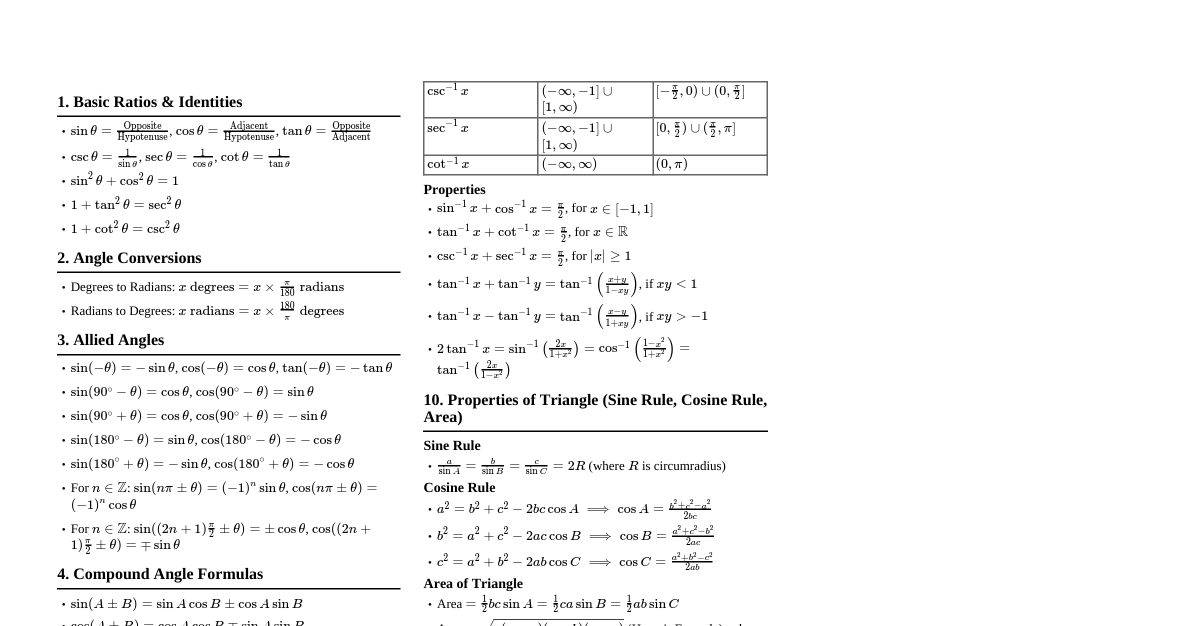
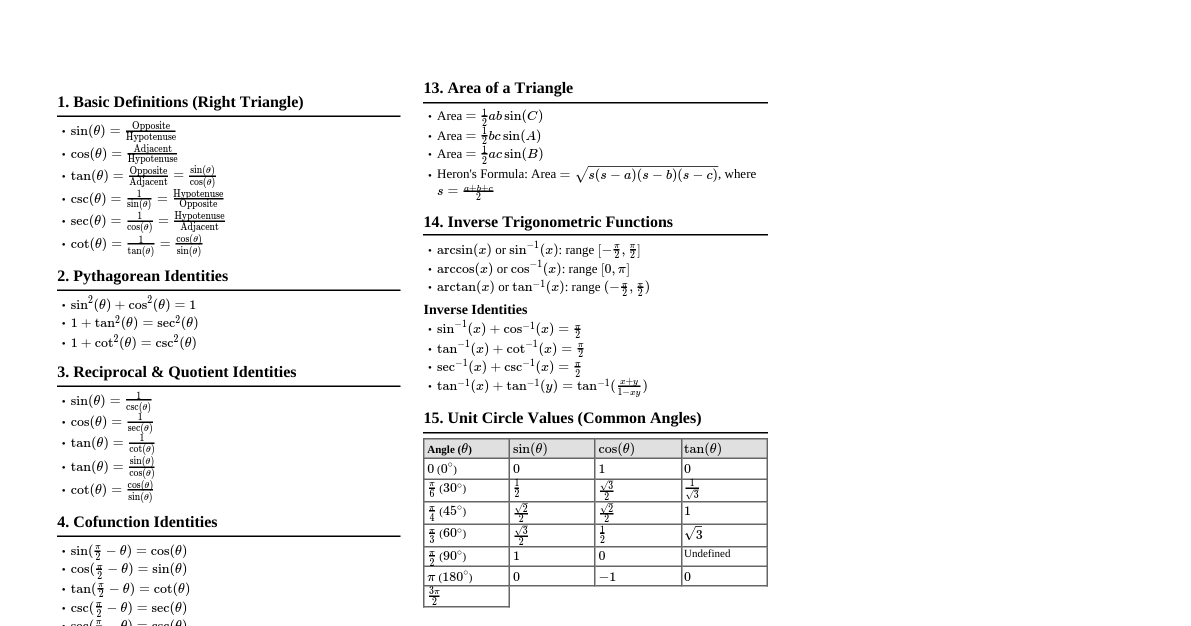
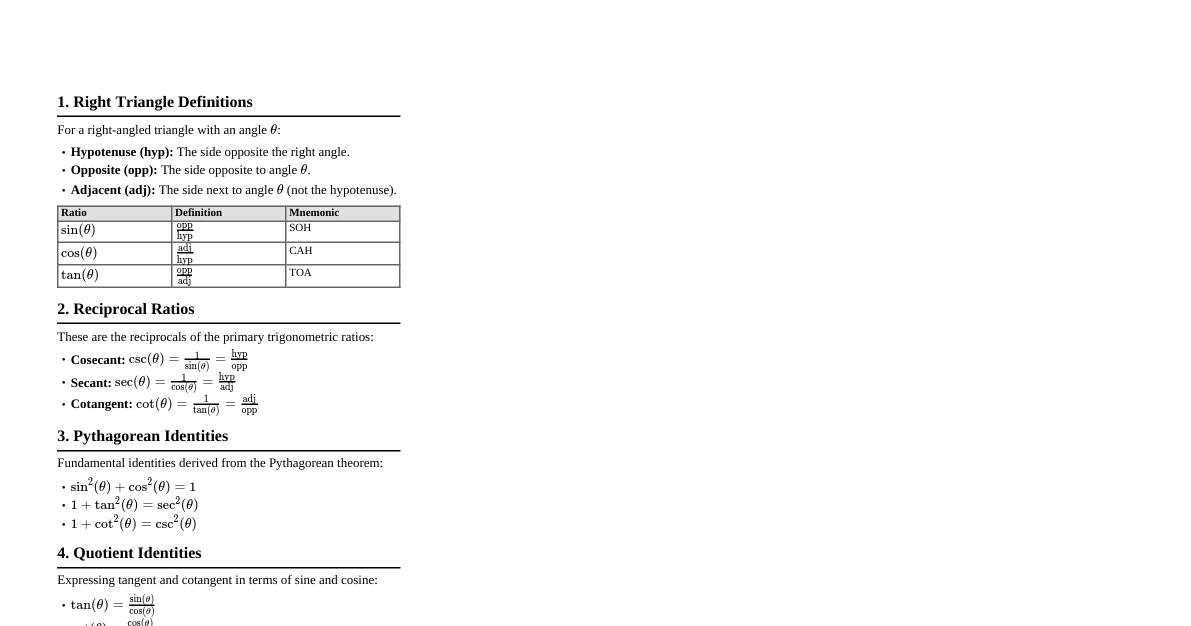
1. Basic Trigonometric Ratios For a right-angled triangle with angle $\theta$: $\sin \theta = \frac{\text{Opposite}}{\text{Hypotenuse}}$ $\cos \theta = \frac{\text{Adjacent}}{\text{Hypotenuse}}$ $\tan \theta = \frac{\text{Opposite}}{\text{Adjacent}} = \frac{\sin \theta}{\cos \theta}$ $\csc \theta = \frac{1}{\sin \theta} = \frac{\text{Hypotenuse}}{\text{Opposite}}$ $\sec \theta = \frac{1}{\cos \theta} = \frac{\text{Hypotenuse}}{\text{Adjacent}}$ $\cot \theta = \frac{1}{\tan \theta} = \frac{\cos \theta}{\sin \theta} = \frac{\text{Adjacent}}{\text{Opposite}}$ 2. Pythagorean Identities $\sin^2 \theta + \cos^2 \theta = 1$ $1 + \tan^2 \theta = \sec^2 \theta$ $1 + \cot^2 \theta = \csc^2 \theta$ 3. Reciprocal Identities $\csc \theta = \frac{1}{\sin \theta}$ $\sec \theta = \frac{1}{\cos \theta}$ $\cot \theta = \frac{1}{\tan \theta}$ 4. Quotient Identities $\tan \theta = \frac{\sin \theta}{\cos \theta}$ $\cot \theta = \frac{\cos \theta}{\sin \theta}$ 5. Angle Conversions Degrees to Radians: $1^\circ = \frac{\pi}{180}$ radians Radians to Degrees: $1 \text{ radian} = \frac{180}{\pi}$ degrees Arc Length: $s = r\theta$ (where $\theta$ is in radians) Area of Sector: $A = \frac{1}{2}r^2\theta$ (where $\theta$ is in radians) 6. Trigonometric Values for Standard Angles Angle ($\theta$) $\sin \theta$ $\cos \theta$ $\tan \theta$ $0^\circ$ (0 rad) 0 1 0 $30^\circ$ ($\pi/6$ rad) $1/2$ $\sqrt{3}/2$ $1/\sqrt{3}$ $45^\circ$ ($\pi/4$ rad) $1/\sqrt{2}$ $1/\sqrt{2}$ 1 $60^\circ$ ($\pi/3$ rad) $\sqrt{3}/2$ $1/2$ $\sqrt{3}$ $90^\circ$ ($\pi/2$ rad) 1 0 Undefined 7. Signs of Ratios in Quadrants (CAST Rule) Quadrant I (All): All ratios positive Quadrant II (Sine): $\sin \theta, \csc \theta$ positive Quadrant III (Tan): $\tan \theta, \cot \theta$ positive Quadrant IV (Cos): $\cos \theta, \sec \theta$ positive 8. Allied Angles $\sin(-\theta) = -\sin \theta$ $\cos(-\theta) = \cos \theta$ $\tan(-\theta) = -\tan \theta$ $\sin(90^\circ - \theta) = \cos \theta$ $\cos(90^\circ - \theta) = \sin \theta$ $\tan(90^\circ - \theta) = \cot \theta$ $\sin(90^\circ + \theta) = \cos \theta$ $\cos(90^\circ + \theta) = -\sin \theta$ $\tan(90^\circ + \theta) = -\cot \theta$ $\sin(180^\circ - \theta) = \sin \theta$ $\cos(180^\circ - \theta) = -\cos \theta$ $\tan(180^\circ - \theta) = -\tan \theta$ $\sin(180^\circ + \theta) = -\sin \theta$ $\cos(180^\circ + \theta) = -\cos \theta$ $\tan(180^\circ + \theta) = \tan \theta$ $\sin(270^\circ - \theta) = -\cos \theta$ $\cos(270^\circ - \theta) = -\sin \theta$ $\tan(270^\circ - \theta) = \cot \theta$ $\sin(270^\circ + \theta) = -\cos \theta$ $\cos(270^\circ + \theta) = \sin \theta$ $\tan(270^\circ + \theta) = -\cot \theta$ $\sin(360^\circ - \theta) = -\sin \theta$ $\cos(360^\circ - \theta) = \cos \theta$ $\tan(360^\circ - \theta) = -\tan \theta$ $\sin(n \cdot 360^\circ + \theta) = \sin \theta$ $\cos(n \cdot 360^\circ + \theta) = \cos \theta$ $\tan(n \cdot 360^\circ + \theta) = \tan \theta$ 9. Compound Angle Formulas $\sin(A \pm B) = \sin A \cos B \pm \cos A \sin B$ $\cos(A \pm B) = \cos A \cos B \mp \sin A \sin B$ $\tan(A \pm B) = \frac{\tan A \pm \tan B}{1 \mp \tan A \tan B}$ $\cot(A \pm B) = \frac{\cot A \cot B \mp 1}{\cot B \pm \cot A}$ 10. Double Angle Formulas $\sin 2A = 2 \sin A \cos A = \frac{2 \tan A}{1 + \tan^2 A}$ $\cos 2A = \cos^2 A - \sin^2 A = 2 \cos^2 A - 1 = 1 - 2 \sin^2 A = \frac{1 - \tan^2 A}{1 + \tan^2 A}$ $\tan 2A = \frac{2 \tan A}{1 - \tan^2 A}$ 11. Triple Angle Formulas $\sin 3A = 3 \sin A - 4 \sin^3 A$ $\cos 3A = 4 \cos^3 A - 3 \cos A$ $\tan 3A = \frac{3 \tan A - \tan^3 A}{1 - 3 \tan^2 A}$ 12. Half Angle Formulas $\sin \frac{A}{2} = \pm \sqrt{\frac{1 - \cos A}{2}}$ $\cos \frac{A}{2} = \pm \sqrt{\frac{1 + \cos A}{2}}$ $\tan \frac{A}{2} = \pm \sqrt{\frac{1 - \cos A}{1 + \cos A}} = \frac{1 - \cos A}{\sin A} = \frac{\sin A}{1 + \cos A}$ 13. Sum and Difference to Product Formulas $\sin C + \sin D = 2 \sin \left(\frac{C+D}{2}\right) \cos \left(\frac{C-D}{2}\right)$ $\sin C - \sin D = 2 \cos \left(\frac{C+D}{2}\right) \sin \left(\frac{C-D}{2}\right)$ $\cos C + \cos D = 2 \cos \left(\frac{C+D}{2}\right) \cos \left(\frac{C-D}{2}\right)$ $\cos C - \cos D = -2 \sin \left(\frac{C+D}{2}\right) \sin \left(\frac{C-D}{2}\right) = 2 \sin \left(\frac{C+D}{2}\right) \sin \left(\frac{D-C}{2}\right)$ 14. Product to Sum and Difference Formulas $2 \sin A \cos B = \sin(A+B) + \sin(A-B)$ $2 \cos A \sin B = \sin(A+B) - \sin(A-B)$ $2 \cos A \cos B = \cos(A+B) + \cos(A-B)$ $2 \sin A \sin B = \cos(A-B) - \cos(A+B)$ 15. General Solutions of Trigonometric Equations If $\sin \theta = \sin \alpha$, then $\theta = n\pi + (-1)^n \alpha$, where $n \in \mathbb{Z}$ If $\cos \theta = \cos \alpha$, then $\theta = 2n\pi \pm \alpha$, where $n \in \mathbb{Z}$ If $\tan \theta = \tan \alpha$, then $\theta = n\pi + \alpha$, where $n \in \mathbb{Z}$ If $\sin^2 \theta = \sin^2 \alpha$, then $\theta = n\pi \pm \alpha$, where $n \in \mathbb{Z}$ If $\cos^2 \theta = \cos^2 \alpha$, then $\theta = n\pi \pm \alpha$, where $n \in \mathbb{Z}$ If $\tan^2 \theta = \tan^2 \alpha$, then $\theta = n\pi \pm \alpha$, where $n \in \mathbb{Z}$ 16. Inverse Trigonometric Functions Principal Value Branches: $\sin^{-1} x$: Domain $[-1, 1]$, Range $[-\frac{\pi}{2}, \frac{\pi}{2}]$ $\cos^{-1} x$: Domain $[-1, 1]$, Range $[0, \pi]$ $\tan^{-1} x$: Domain $(-\infty, \infty)$, Range $(-\frac{\pi}{2}, \frac{\pi}{2})$ $\csc^{-1} x$: Domain $(-\infty, -1] \cup [1, \infty)$, Range $[-\frac{\pi}{2}, \frac{\pi}{2}] - \{0\}$ $\sec^{-1} x$: Domain $(-\infty, -1] \cup [1, \infty)$, Range $[0, \pi] - \{\frac{\pi}{2}\}$ $\cot^{-1} x$: Domain $(-\infty, \infty)$, Range $(0, \pi)$ Properties: $\sin^{-1} x + \cos^{-1} x = \frac{\pi}{2}$, for $x \in [-1, 1]$ $\tan^{-1} x + \cot^{-1} x = \frac{\pi}{2}$, for $x \in \mathbb{R}$ $\csc^{-1} x + \sec^{-1} x = \frac{\pi}{2}$, for $|x| \ge 1$ $\tan^{-1} x + \tan^{-1} y = \tan^{-1} \left(\frac{x+y}{1-xy}\right)$, if $xy $\tan^{-1} x - \tan^{-1} y = \tan^{-1} \left(\frac{x-y}{1+xy}\right)$, if $xy > -1$ $2 \tan^{-1} x = \tan^{-1} \left(\frac{2x}{1-x^2}\right)$, if $|x| $2 \tan^{-1} x = \sin^{-1} \left(\frac{2x}{1+x^2}\right)$, if $|x| \le 1$ $2 \tan^{-1} x = \cos^{-1} \left(\frac{1-x^2}{1+x^2}\right)$, if $x \ge 0$ 17. Sine Rule and Cosine Rule For a triangle with sides $a, b, c$ and opposite angles $A, B, C$: Sine Rule: $\frac{a}{\sin A} = \frac{b}{\sin B} = \frac{c}{\sin C} = 2R$ (where $R$ is the circumradius) Cosine Rule: $a^2 = b^2 + c^2 - 2bc \cos A$ $b^2 = a^2 + c^2 - 2ac \cos B$ $c^2 = a^2 + b^2 - 2ab \cos C$ $\cos A = \frac{b^2 + c^2 - a^2}{2bc}$ $\cos B = \frac{a^2 + c^2 - b^2}{2ac}$ $\cos C = \frac{a^2 + b^2 - c^2}{2ab}$ 18. Area of a Triangle Area $= \frac{1}{2}ab \sin C = \frac{1}{2}bc \sin A = \frac{1}{2}ca \sin B$ Area $= \sqrt{s(s-a)(s-b)(s-c)}$ (Heron's Formula, where $s = \frac{a+b+c}{2}$ is the semi-perimeter) 19. Calculus: Limits Basic Limit Properties: $\lim_{x \to c} k = k$ $\lim_{x \to c} x = c$ $\lim_{x \to c} [f(x) \pm g(x)] = \lim_{x \to c} f(x) \pm \lim_{x \to c} g(x)$ $\lim_{x \to c} [k \cdot f(x)] = k \cdot \lim_{x \to c} f(x)$ $\lim_{x \to c} [f(x) \cdot g(x)] = \lim_{x \to c} f(x) \cdot \lim_{x \to c} g(x)$ $\lim_{x \to c} \frac{f(x)}{g(x)} = \frac{\lim_{x \to c} f(x)}{\lim_{x \to c} g(x)}$, provided $\lim_{x \to c} g(x) \neq 0$ Important Limits: $\lim_{x \to 0} \frac{\sin x}{x} = 1$ $\lim_{x \to 0} \frac{1 - \cos x}{x} = 0$ $\lim_{x \to 0} (1+x)^{1/x} = e$ $\lim_{x \to \infty} (1+\frac{1}{x})^x = e$ $\lim_{x \to 0} \frac{e^x - 1}{x} = 1$ $\lim_{x \to 0} \frac{\ln(1+x)}{x} = 1$ $\lim_{x \to a} \frac{x^n - a^n}{x - a} = n a^{n-1}$ 20. Calculus: Derivatives Definition: $f'(x) = \lim_{h \to 0} \frac{f(x+h) - f(x)}{h}$ Basic Differentiation Rules: Constant Rule: $\frac{d}{dx}(c) = 0$ Power Rule: $\frac{d}{dx}(x^n) = nx^{n-1}$ Constant Multiple Rule: $\frac{d}{dx}(cf(x)) = c f'(x)$ Sum/Difference Rule: $\frac{d}{dx}(f(x) \pm g(x)) = f'(x) \pm g'(x)$ Product Rule: $\frac{d}{dx}(f(x)g(x)) = f'(x)g(x) + f(x)g'(x)$ Quotient Rule: $\frac{d}{dx}\left(\frac{f(x)}{g(x)}\right) = \frac{f'(x)g(x) - f(x)g'(x)}{(g(x))^2}$ Chain Rule: $\frac{d}{dx}(f(g(x))) = f'(g(x))g'(x)$ Derivatives of Common Functions: $\frac{d}{dx}(\sin x) = \cos x$ $\frac{d}{dx}(\cos x) = -\sin x$ $\frac{d}{dx}(\tan x) = \sec^2 x$ $\frac{d}{dx}(\cot x) = -\csc^2 x$ $\frac{d}{dx}(\sec x) = \sec x \tan x$ $\frac{d}{dx}(\csc x) = -\csc x \cot x$ $\frac{d}{dx}(e^x) = e^x$ $\frac{d}{dx}(a^x) = a^x \ln a$ $\frac{d}{dx}(\ln x) = \frac{1}{x}$ $\frac{d}{dx}(\log_a x) = \frac{1}{x \ln a}$ $\frac{d}{dx}(\sin^{-1} x) = \frac{1}{\sqrt{1-x^2}}$ $\frac{d}{dx}(\cos^{-1} x) = -\frac{1}{\sqrt{1-x^2}}$ $\frac{d}{dx}(\tan^{-1} x) = \frac{1}{1+x^2}$ 21. Calculus: Integrals Basic Integration Rules: $\int k \, dx = kx + C$ $\int x^n \, dx = \frac{x^{n+1}}{n+1} + C$, for $n \neq -1$ $\int \frac{1}{x} \, dx = \ln|x| + C$ $\int [f(x) \pm g(x)] \, dx = \int f(x) \, dx \pm \int g(x) \, dx$ $\int c f(x) \, dx = c \int f(x) \, dx$ Integrals of Common Functions: $\int \sin x \, dx = -\cos x + C$ $\int \cos x \, dx = \sin x + C$ $\int \sec^2 x \, dx = \tan x + C$ $\int \csc^2 x \, dx = -\cot x + C$ $\int \sec x \tan x \, dx = \sec x + C$ $\int \csc x \cot x \, dx = -\csc x + C$ $\int e^x \, dx = e^x + C$ $\int a^x \, dx = \frac{a^x}{\ln a} + C$ $\int \frac{1}{\sqrt{a^2 - x^2}} \, dx = \sin^{-1}\left(\frac{x}{a}\right) + C$ $\int \frac{1}{a^2 + x^2} \, dx = \frac{1}{a}\tan^{-1}\left(\frac{x}{a}\right) + C$ $\int \frac{1}{x\sqrt{x^2 - a^2}} \, dx = \frac{1}{a}\sec^{-1}\left(\frac{|x|}{a}\right) + C$ Fundamental Theorem of Calculus: Part 1: If $F(x) = \int_a^x f(t) \, dt$, then $F'(x) = f(x)$ Part 2: $\int_a^b f(x) \, dx = F(b) - F(a)$, where $F$ is any antiderivative of $f$ Integration Techniques: Integration by Substitution: $\int f(g(x))g'(x) \, dx = \int f(u) \, du$, where $u = g(x)$ Integration by Parts: $\int u \, dv = uv - \int v \, du$