Fundamental Chemistry
Cheatsheet Content
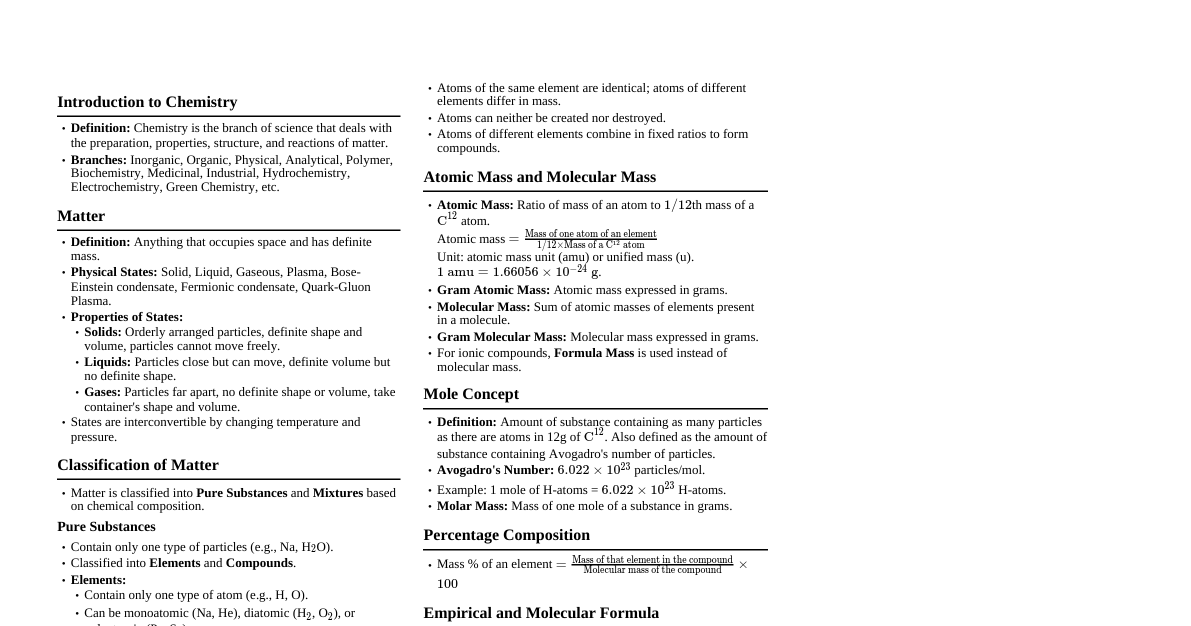
### Fundamental Laws of Chemistry The foundation of chemistry rests upon several key laws that describe how matter behaves and interacts. #### 1. Law of Conservation of Mass - **Statement:** In a closed system, the mass of the reactants before a chemical reaction must equal the mass of the products after the reaction. Matter cannot be created or destroyed. - **Example:** When 10g of hydrogen reacts completely with 80g of oxygen, 90g of water is formed. - **Formulation:** $\sum \text{mass}_{\text{reactants}} = \sum \text{mass}_{\text{products}}$ #### 2. Law of Definite Proportions (Proust's Law) - **Statement:** A given chemical compound always contains its component elements in fixed ratio by mass, regardless of the source or method of preparation. - **Example:** Water ($\text{H}_2\text{O}$) always consists of hydrogen and oxygen in a 1:8 mass ratio (approximately 11.1% hydrogen and 88.9% oxygen). - **Formulation:** For a compound AB, $\frac{\text{mass of A}}{\text{mass of B}} = \text{constant}$ #### 3. Law of Multiple Proportions (Dalton's Law) - **Statement:** If two elements form more than one compound between them, then the ratios of the masses of the second element which combine with a fixed mass of the first element will be ratios of small whole numbers. - **Example:** Carbon and oxygen form carbon monoxide ($\text{CO}$) and carbon dioxide ($\text{CO}_2$). - In $\text{CO}$, 12g of C combines with 16g of O (ratio 1:1.33). - In $\text{CO}_2$, 12g of C combines with 32g of O (ratio 1:2.66). - The ratio of oxygen masses (16g : 32g) is 1:2, a small whole number ratio. - **Formulation:** For compounds $\text{A}_x\text{B}_y$ and $\text{A}_m\text{B}_n$, if mass of A is fixed, then $\frac{\text{mass of B in 1st compound}}{\text{mass of B in 2nd compound}} = \text{small whole number ratio}$ #### 4. Gay-Lussac's Law of Gaseous Volumes - **Statement:** When gases react together, they do so in volumes that bear a simple whole-number ratio to one another, and to the volumes of the gaseous products, provided that all volumes are measured at the same temperature and pressure. - **Example:** 1 volume of hydrogen gas reacts with 1 volume of chlorine gas to produce 2 volumes of hydrogen chloride gas. $\text{H}_2(g) + \text{Cl}_2(g) \rightarrow 2\text{HCl}(g)$ (1 vol) + (1 vol) $\rightarrow$ (2 vol) #### 5. Avogadro's Law - **Statement:** Equal volumes of all gases, at the same temperature and pressure, have the same number of molecules. - **Implication:** This law directly leads to the mole concept and the idea that the volume of a gas is proportional to the number of moles. - **Formulation:** $V \propto n$ (at constant T and P) ### The Mole Concept The mole is a central unit in chemistry, providing a bridge between the macroscopic world (grams) and the microscopic world (atoms/molecules). #### 1. What is a Mole? - **Definition:** The mole (symbol: mol) is the SI base unit of amount of substance. It is defined as the amount of substance that contains as many elementary entities (atoms, molecules, ions, electrons, etc.) as there are atoms in 0.012 kilogram (or 12 grams) of carbon-12. - **Avogadro's Number ($N_A$):** The number of elementary entities in one mole. - $N_A = 6.022 \times 10^{23} \text{ entities/mol}$ - **Key Relationship:** 1 mole of any substance contains $6.022 \times 10^{23}$ particles of that substance. #### 2. Molar Mass ($M$) - **Definition:** The mass of one mole of a substance. It is numerically equal to the atomic mass (for elements) or molecular mass (for compounds) expressed in grams per mole ($\text{g/mol}$). - **Units:** $\text{g/mol}$ - **Calculation:** - For an element: Molar mass is the atomic mass from the periodic table (e.g., C = 12.01 $\text{g/mol}$). - For a compound: Sum of the atomic masses of all atoms in the chemical formula (e.g., $\text{H}_2\text{O}$ = 2(1.008) + 1(15.999) = 18.015 $\text{g/mol}$). #### 3. Calculations Involving Moles The mole acts as a central conversion factor. | Quantity | Formula | Units | |---|---|---| | **Number of moles (n)** | $n = \frac{\text{mass (g)}}{\text{Molar Mass (g/mol)}}$ | mol | | | $n = \frac{\text{Number of particles}}{\text{Avogadro's Number } (N_A)}$ | mol | | **Mass (m)** | $m = n \times M$ | g | | **Number of particles (N)** | $N = n \times N_A$ | entities | - **Example 1: Mass to Moles** - How many moles are in 45.0 g of water ($\text{H}_2\text{O}$)? - $M(\text{H}_2\text{O}) = 18.015 \text{ g/mol}$ - $n = \frac{45.0 \text{ g}}{18.015 \text{ g/mol}} = 2.50 \text{ mol}$ - **Example 2: Moles to Number of Molecules** - How many molecules are in 0.50 mol of $\text{CO}_2$? - $N = 0.50 \text{ mol} \times 6.022 \times 10^{23} \text{ molecules/mol} = 3.011 \times 10^{23} \text{ molecules}$ - **Example 3: Grams to Number of Atoms (multi-step)** - How many oxygen atoms are in 10.0 g of $\text{H}_2\text{O}$? 1. Moles of $\text{H}_2\text{O}$: $n = \frac{10.0 \text{ g}}{18.015 \text{ g/mol}} = 0.555 \text{ mol H}_2\text{O}$ 2. Molecules of $\text{H}_2\text{O}$: $N = 0.555 \text{ mol} \times 6.022 \times 10^{23} \text{ molecules/mol} = 3.34 \times 10^{23} \text{ molecules H}_2\text{O}$ 3. Atoms of Oxygen: Since each $\text{H}_2\text{O}$ molecule has 1 oxygen atom, Number of O atoms = $3.34 \times 10^{23} \text{ atoms}$ #### 4. Molar Volume of a Gas ($V_m$) - **Definition:** The volume occupied by one mole of any gas at a specific temperature and pressure. - **At Standard Temperature and Pressure (STP):** - STP Conditions: $0^\circ\text{C}$ (273.15 K) and 1 atm (101.325 kPa) - Molar Volume at STP: $V_m = 22.4 \text{ L/mol}$ - **At Standard Ambient Temperature and Pressure (SATP):** - SATP Conditions: $25^\circ\text{C}$ (298.15 K) and 1 bar (100 kPa) - Molar Volume at SATP: $V_m = 24.79 \text{ L/mol}$ - **Calculations:** - $n = \frac{\text{Volume of gas (L)}}{\text{Molar Volume (L/mol)}}$ - $\text{Volume of gas (L)} = n \times V_m$ ### Amount of Substance & Stoichiometry The "amount of substance" refers specifically to the number of moles. Stoichiometry uses the mole concept to predict quantities in chemical reactions. #### 1. Empirical and Molecular Formulas - **Empirical Formula:** The simplest whole-number ratio of atoms in a compound. - **Molecular Formula:** The actual number of atoms of each element in a molecule. It is always a whole-number multiple of the empirical formula. - **Steps to Determine Empirical Formula from Percent Composition:** 1. Assume 100 g sample (convert % to grams). 2. Convert grams of each element to moles using molar mass. 3. Divide all mole values by the smallest mole value to get a preliminary ratio. 4. If ratios are not whole numbers, multiply by a small integer to get whole numbers. - **Steps to Determine Molecular Formula:** 1. Calculate the empirical formula mass. 2. Determine the molar mass of the compound (usually given). 3. Find the whole-number multiple: $x = \frac{\text{Molar Mass}}{\text{Empirical Formula Mass}}$ 4. Multiply the subscripts in the empirical formula by $x$. - **Example: Empirical Formula** - A compound contains 40.0% C, 6.7% H, and 53.3% O. 1. Assume 100g: 40.0g C, 6.7g H, 53.3g O 2. Moles: - C: $40.0 \text{ g} / 12.01 \text{ g/mol} = 3.33 \text{ mol}$ - H: $6.7 \text{ g} / 1.008 \text{ g/mol} = 6.65 \text{ mol}$ - O: $53.3 \text{ g} / 16.00 \text{ g/mol} = 3.33 \text{ mol}$ 3. Divide by smallest (3.33): - C: $3.33 / 3.33 = 1$ - H: $6.65 / 3.33 \approx 2$ - O: $3.33 / 3.33 = 1$ 4. Empirical Formula: $\text{CH}_2\text{O}$ #### 2. Stoichiometric Calculations Stoichiometry uses balanced chemical equations and mole ratios to calculate amounts of reactants and products. - **Balanced Chemical Equation:** Ensures conservation of mass and atoms. Coefficients represent mole ratios. - Example: $2\text{H}_2(g) + \text{O}_2(g) \rightarrow 2\text{H}_2\text{O}(l)$ - This means 2 moles of $\text{H}_2$ react with 1 mole of $\text{O}_2$ to produce 2 moles of $\text{H}_2\text{O}$. - **Steps for Stoichiometric Problems:** 1. **Write and Balance** the chemical equation. 2. **Convert** the given quantity (mass, volume, particles) of known substance to moles. 3. **Use Mole Ratios** from the balanced equation to convert moles of known substance to moles of desired substance. 4. **Convert** moles of desired substance to the required quantity (mass, volume, particles). - **Example: Mole-to-Mass Calculation** - How many grams of water are produced from 4.0 moles of oxygen reacting with excess hydrogen? - Equation: $2\text{H}_2(g) + \text{O}_2(g) \rightarrow 2\text{H}_2\text{O}(l)$ 1. Given 4.0 mol $\text{O}_2$. 2. Mole ratio from equation: 1 mol $\text{O}_2$ : 2 mol $\text{H}_2\text{O}$ 3. Moles of $\text{H}_2\text{O}$: $4.0 \text{ mol O}_2 \times \frac{2 \text{ mol H}_2\text{O}}{1 \text{ mol O}_2} = 8.0 \text{ mol H}_2\text{O}$ 4. Mass of $\text{H}_2\text{O}$: $8.0 \text{ mol} \times 18.015 \text{ g/mol} = 144.12 \text{ g H}_2\text{O}$ #### 3. Limiting Reactants & Percent Yield - **Limiting Reactant:** The reactant that is completely consumed in a chemical reaction, thereby limiting the amount of product that can be formed. - **Excess Reactant:** The reactant(s) that are not completely consumed. - **Theoretical Yield:** The maximum amount of product that can be formed from the given amounts of reactants, calculated stoichiometrically. - **Actual Yield:** The amount of product actually obtained from a reaction, typically determined experimentally. - **Percent Yield:** A measure of the efficiency of a reaction. - $\text{Percent Yield} = \frac{\text{Actual Yield}}{\text{Theoretical Yield}} \times 100\%$ - **Steps to Identify Limiting Reactant:** 1. Calculate the moles of each reactant. 2. For each reactant, calculate the moles of product that could be formed (assuming it is the limiting reactant) using mole ratios. 3. The reactant that produces the *least* amount of product is the limiting reactant. - **Example: Limiting Reactant & Percent Yield** - If 10.0 g of $\text{H}_2$ reacts with 70.0 g of $\text{O}_2$ to produce 75.0 g of $\text{H}_2\text{O}$. - Equation: $2\text{H}_2(g) + \text{O}_2(g) \rightarrow 2\text{H}_2\text{O}(l)$ 1. Moles of reactants: - $\text{H}_2$: $10.0 \text{ g} / 2.016 \text{ g/mol} = 4.96 \text{ mol H}_2$ - $\text{O}_2$: $70.0 \text{ g} / 32.00 \text{ g/mol} = 2.19 \text{ mol O}_2$ 2. Moles of $\text{H}_2\text{O}$ produced from each reactant: - From $\text{H}_2$: $4.96 \text{ mol H}_2 \times \frac{2 \text{ mol H}_2\text{O}}{2 \text{ mol H}_2} = 4.96 \text{ mol H}_2\text{O}$ - From $\text{O}_2$: $2.19 \text{ mol O}_2 \times \frac{2 \text{ mol H}_2\text{O}}{1 \text{ mol O}_2} = 4.38 \text{ mol H}_2\text{O}$ 3. Limiting Reactant: $\text{O}_2$ (produces less $\text{H}_2\text{O}$) 4. Theoretical Yield of $\text{H}_2\text{O}$: $4.38 \text{ mol} \times 18.015 \text{ g/mol} = 78.9 \text{ g H}_2\text{O}$ 5. Percent Yield: $\frac{75.0 \text{ g}}{78.9 \text{ g}} \times 100\% = 95.1\%$