Respiration Summary
Cheatsheet Content
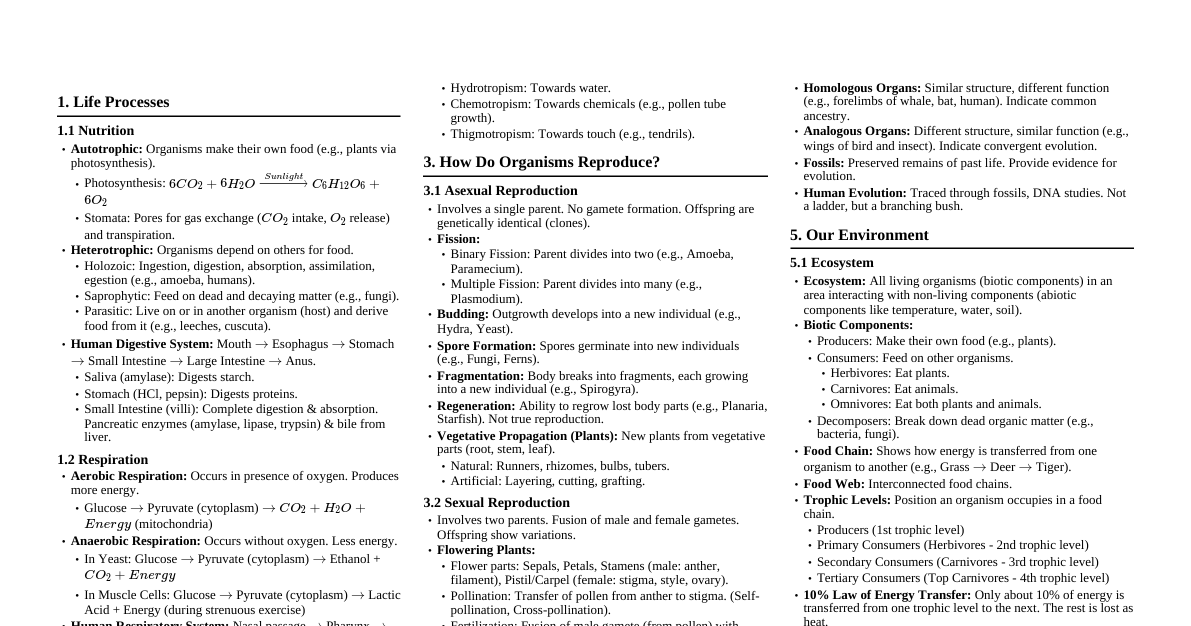
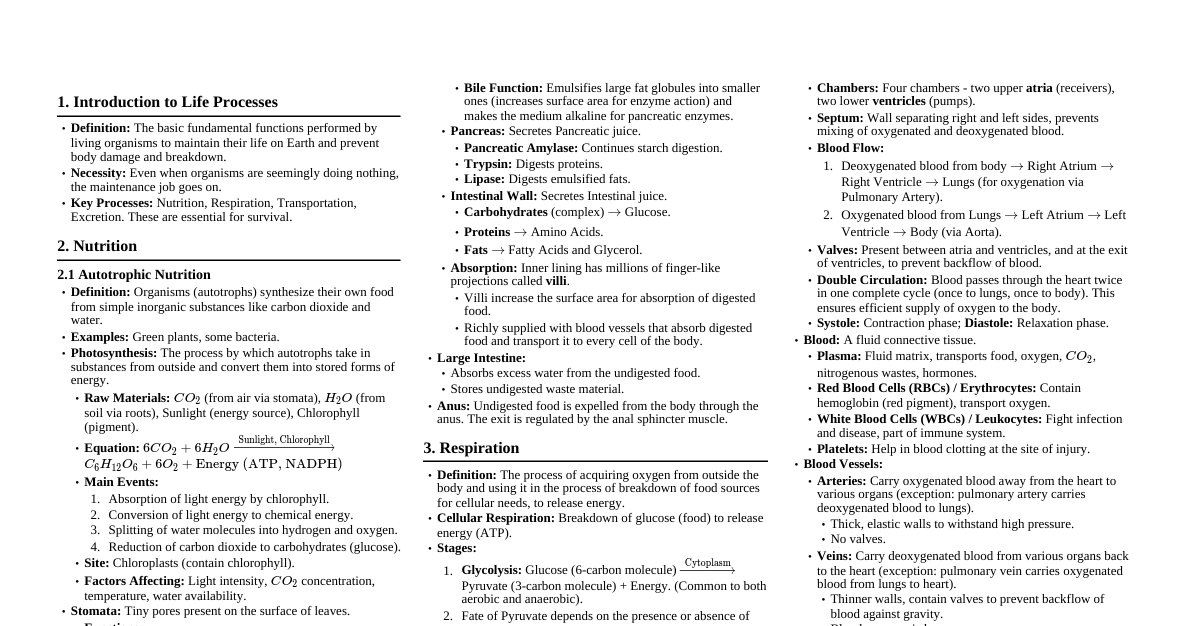
### Respiration Overview - **Definition:** Process where food material (e.g., glucose) is broken down in cells to provide energy for various life processes. - **First Step (Common to all):** Break-down of glucose (6-carbon molecule) into pyruvate (3-carbon molecule). - **Location of First Step:** Cytoplasm. ### Anaerobic Respiration - **Definition:** Respiration that occurs in the absence of oxygen. - **Process:** Pyruvate is converted into ethanol and carbon dioxide. - **Example:** Takes place in yeast during fermentation. - **Energy Release:** Less energy is released compared to aerobic respiration. - **In Muscles:** In muscle cells (during oxygen deficiency), pyruvate is converted into lactic acid (3-carbon molecule), leading to cramps. ### Aerobic Respiration - **Definition:** Respiration that occurs in the presence of oxygen. - **Process:** Pyruvate is broken down into three molecules of carbon dioxide and water. - **Location:** Mitochondria. - **Energy Release:** Significantly greater than anaerobic respiration. ### ATP: The Energy Currency - **Function:** Energy released during cellular respiration is used to synthesize ATP (Adenosine Triphosphate). - **Role:** ATP fuels all other activities in the cell (e.g., muscle contraction, protein synthesis, nervous impulses). - **Mechanism:** ATP is broken down, releasing a fixed amount of energy (30.5 kJ/mol) to drive endothermic reactions. - **Synthesis:** Made from ADP (Adenosine Diphosphate) and inorganic phosphate during respiration. ### Gas Exchange in Plants - **Mechanism:** Plants exchange gases (CO2 and O2) through stomata. - **Internal Structure:** Large inter-cellular spaces ensure all cells are in contact with air. - **Diffusion:** CO2 and O2 are exchanged by diffusion. - **Direction of Diffusion:** Depends on environmental conditions and plant requirements. - **Night:** CO2 elimination is the major activity (no photosynthesis). - **Day:** CO2 generated from respiration is used for photosynthesis; oxygen release is the major event. ### Gas Exchange in Animals #### General Adaptations - **Organs:** Animals have evolved different organs for oxygen uptake and CO2 removal. - **Surface Area:** Respiratory organs increase surface area for contact with oxygen-rich atmosphere. - **Protection:** Exchange surfaces are delicate and usually placed within the body, requiring passages to transport air. - **Movement:** Mechanisms exist to move air in and out of the exchange area. #### Aquatic vs. Terrestrial Animals - **Aquatic:** - Use dissolved oxygen in water. - Breathing rate is much faster due to low dissolved oxygen levels. - Example: Fish take water through mouth, force it past gills where oxygen is absorbed by blood. - **Terrestrial:** - Use oxygen from the atmosphere. - Example: Humans use the respiratory system. #### Human Respiratory System - **Pathway of Air:** 1. **Nostrils:** Air enters, filtered by fine hairs, lined with mucus. 2. **Throat:** Air passes through. 3. **Rings of Cartilage:** Prevent air-passage collapse in the throat. 4. **Lungs:** Air reaches the lungs. - **Within Lungs:** - **Bronchioles:** Passages divide into smaller tubes. - **Alveoli:** Terminate in balloon-like structures (singular: alveolus) which provide a surface for gas exchange. - **Blood Vessels:** Alveoli walls have an extensive network of blood vessels. - **Mechanism of Breathing:** - **Inhalation:** Ribs lift, diaphragm flattens, chest cavity enlarges, air is sucked into lungs and fills alveoli. - **Gas Exchange:** Blood brings CO2 from the body to alveoli for release. Oxygen from alveolar air is taken up by blood in alveolar blood vessels and transported to body cells. - **Residual Volume:** Lungs always contain a residual volume of air to allow sufficient time for O2 absorption and CO2 release. - **Respiratory Pigment (Humans):** - **Haemoglobin:** Present in red blood corpuscles, has a very high affinity for oxygen. Transports oxygen to tissues. - **Carbon Dioxide Transport:** More soluble in water, mostly transported in dissolved form in blood. ### Questions (Respiration) 1. What are the differences between autotrophic nutrition and heterotrophic nutrition? 2. Where do plants get each of the raw materials required for photosynthesis? 3. What is the role of the acid in our stomach? 4. What is the function of digestive enzymes? 5. How is the small intestine designed to absorb digested food?