Circle Cheatsheet
Cheatsheet Content
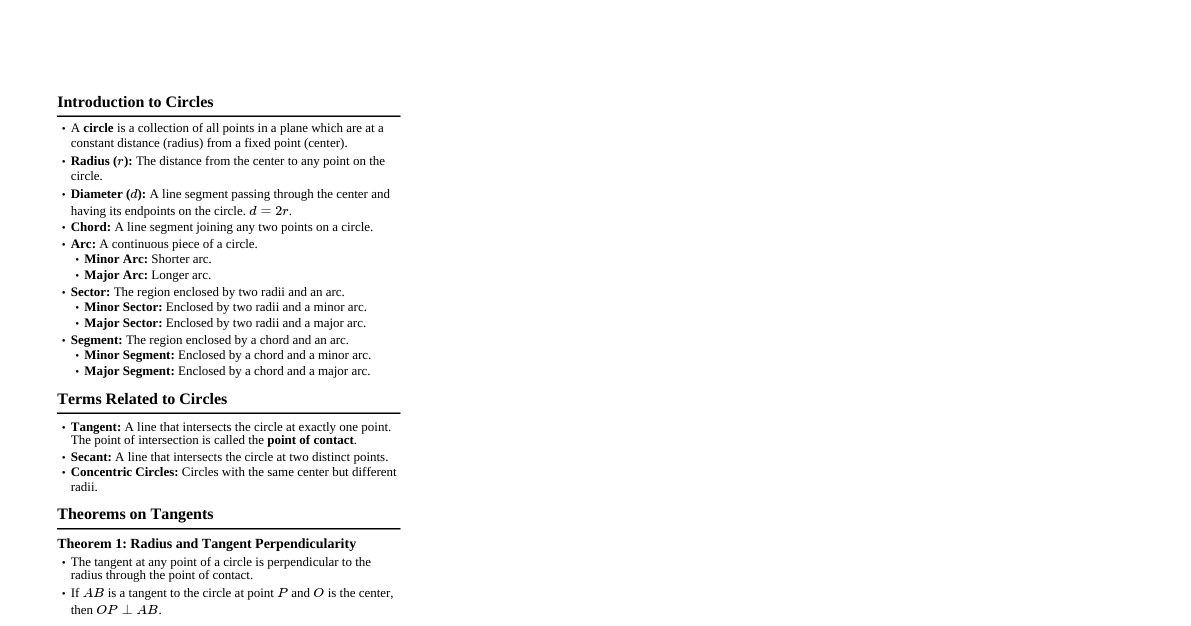
1. Equation of a Circle Standard Form: $(x-h)^2 + (y-k)^2 = r^2$ Center: $(h, k)$, Radius: $r$ General Form: $x^2 + y^2 + 2gx + 2fy + c = 0$ Center: $(-g, -f)$, Radius: $\sqrt{g^2 + f^2 - c}$ Condition for real circle: $g^2 + f^2 - c > 0$ Diameter Form: If $(x_1, y_1)$ and $(x_2, y_2)$ are endpoints of a diameter, $(x-x_1)(x-x_2) + (y-y_1)(y-y_2) = 0$ Parametric Form: $x = h + r\cos\theta$, $y = k + r\sin\theta$ 2. Position of a Point w.r.t Circle For $S \equiv x^2 + y^2 + 2gx + 2fy + c = 0$ and point $P(x_1, y_1)$: $S_1 = x_1^2 + y_1^2 + 2gx_1 + 2fy_1 + c$ If $S_1 > 0$: Point $P$ is outside the circle. If $S_1 = 0$: Point $P$ is on the circle. If $S_1 3. Tangents to a Circle Condition for Tangency: Distance from center to line = radius. Equation of Tangent: At $(x_1, y_1)$ on $x^2 + y^2 + 2gx + 2fy + c = 0$: $xx_1 + yy_1 + g(x+x_1) + f(y+y_1) + c = 0$ (denoted as $T=0$) Slope form $y = mx \pm r\sqrt{1+m^2}$ for $x^2+y^2=r^2$. Slope form $y-k = m(x-h) \pm r\sqrt{1+m^2}$ for $(x-h)^2+(y-k)^2=r^2$. Length of Tangent: From $P(x_1, y_1)$ to $S=0$, length $L = \sqrt{S_1}$. Pair of Tangents: From $P(x_1, y_1)$ to $S=0$, equation is $SS_1 = T^2$. 4. Normal to a Circle The normal to a circle always passes through its center. Equation of normal at $(x_1, y_1)$ on $x^2+y^2+2gx+2fy+c=0$: $(y-y_1)(x_1+g) = (x-x_1)(y_1+f)$ (line through $(x_1,y_1)$ and center $(-g,-f)$). 5. Chord of Contact From point $P(x_1, y_1)$ outside the circle $S=0$, the chord joining the points of contact of the two tangents is $T=0$. (Same equation as tangent at a point). 6. Pole and Polar The polar of point $P(x_1, y_1)$ w.r.t. circle $S=0$ is $T=0$. If $P$ is outside, polar is the chord of contact. If $P$ is on the circle, polar is the tangent at $P$. If $P$ is inside, polar is a line outside the circle. If the polar of $P(x_1, y_1)$ passes through $Q(x_2, y_2)$, then the polar of $Q$ passes through $P$. (Reciprocal property) The pole of a line $Lx+My+N=0$ w.r.t. $x^2+y^2=r^2$ is $\left(-\frac{Lr^2}{N}, -\frac{Mr^2}{N}\right)$. 7. Radical Axis of Two Circles For two circles $S_1 = 0$ and $S_2 = 0$, the radical axis is $S_1 - S_2 = 0$. Properties: Perpendicular to the line joining the centers. Locus of points from which tangents to both circles have equal length. If circles intersect, radical axis is their common chord. If circles touch, radical axis is their common tangent. 8. Radical Center For three circles $S_1=0, S_2=0, S_3=0$, the radical center is the point of intersection of the three radical axes ($S_1-S_2=0$, $S_2-S_3=0$, $S_3-S_1=0$). Tangents from the radical center to all three circles are equal in length. 9. Coaxial System of Circles A system of circles such that every pair has the same radical axis. Equation: $S + \lambda L = 0$, where $S=0$ is a circle, $L=0$ is the common radical axis, and $\lambda$ is a parameter. Also $S_1 + \lambda S_2 = 0$ (if $S_1, S_2$ are intersecting/touching circles). Limiting Points: For a non-intersecting coaxial system, there are two point circles called limiting points. 10. Common Tangents to Two Circles Let $C_1, C_2$ be centers and $r_1, r_2$ be radii. $d = C_1C_2$. Number of common tangents: $d > r_1 + r_2$: 4 common tangents (2 direct, 2 transverse) $d = r_1 + r_2$: 3 common tangents (2 direct, 1 transverse) - circles touch externally $|r_1 - r_2| $d = |r_1 - r_2|$: 1 common tangent (2 circles touch internally) $d Point of intersection of direct common tangents divides $C_1C_2$ externally in ratio $r_1:r_2$. Point of intersection of transverse common tangents divides $C_1C_2$ internally in ratio $r_1:r_2$. 11. Angle of Intersection of Two Circles If two circles $S_1=0$ and $S_2=0$ intersect at angle $\theta$: $d^2 = r_1^2 + r_2^2 - 2r_1r_2\cos\theta$ or $\cos\theta = \frac{r_1^2 + r_2^2 - d^2}{2r_1r_2}$ Orthogonal Circles: If $\theta = 90^\circ$, then $d^2 = r_1^2 + r_2^2$. For $x^2+y^2+2g_1x+2f_1y+c_1=0$ and $x^2+y^2+2g_2x+2f_2y+c_2=0$: $2g_1g_2 + 2f_1f_2 = c_1 + c_2$. 12. Family of Circles Through intersection of circle $S=0$ and line $L=0$: $S + \lambda L = 0$. Through intersection of two circles $S_1=0$ and $S_2=0$: $S_1 + \lambda S_2 = 0$. (This is a coaxial system of circles). Through two points $(x_1, y_1)$ and $(x_2, y_2)$: $(x-x_1)(x-x_2) + (y-y_1)(y-y_2) + \lambda \begin{vmatrix} x & y & 1 \\ x_1 & y_1 & 1 \\ x_2 & y_2 & 1 \end{vmatrix} = 0$. 13. Important Concepts & Theorems Image of a Point: Image of $(x_1,y_1)$ w.r.t. circle $x^2+y^2=r^2$ is the pole of the polar of $(x_1,y_1)$ with respect to the circle. If $P(x_1, y_1)$ and $Q(x_2, y_2)$ are inverse points w.r.t. $x^2+y^2=r^2$, then $x_1x_2+y_1y_2=r^2$. Power of a Point: For a point $P(x_1, y_1)$ and circle $S=0$, the power of the point is $S_1$. It's constant for any line through $P$ intersecting the circle. Director Circle: Locus of the point of intersection of two perpendicular tangents to a circle. For $x^2+y^2=r^2$, its equation is $x^2+y^2=2r^2$. (Radius $\sqrt{2}r$). Concyclic Points: Four points are concyclic if a circle passes through all of them. Condition for four points $(x_i, y_i)$ to be concyclic is that the determinant of the general circle equation matrix is zero.