JEE Alcohols, Phenols, Ethers
Cheatsheet Content
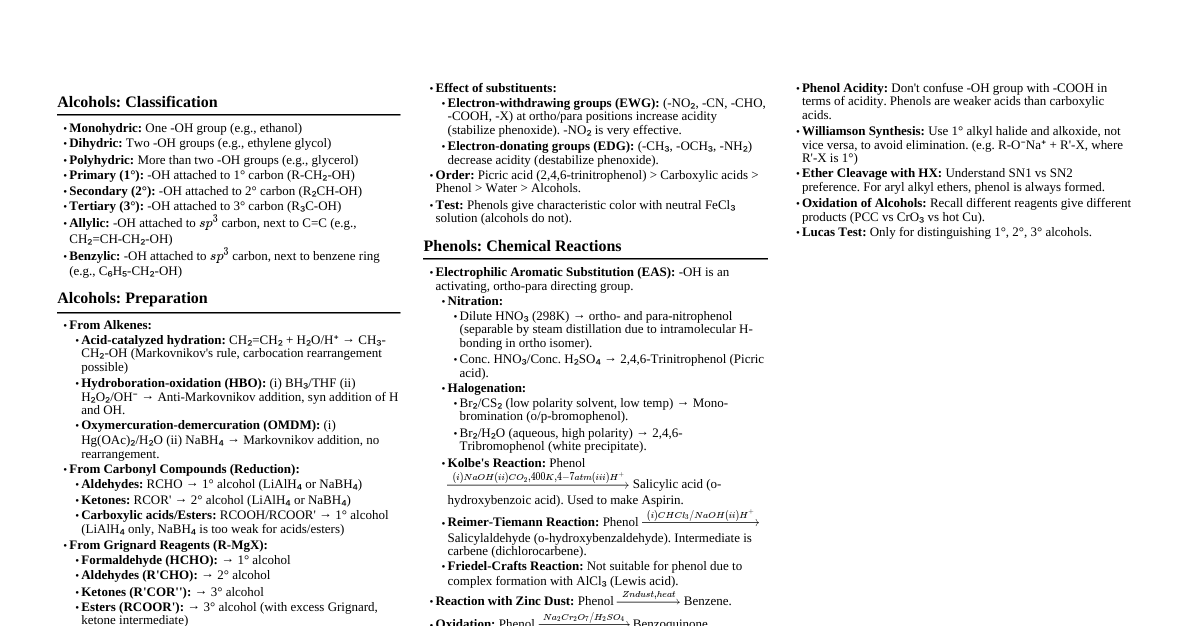
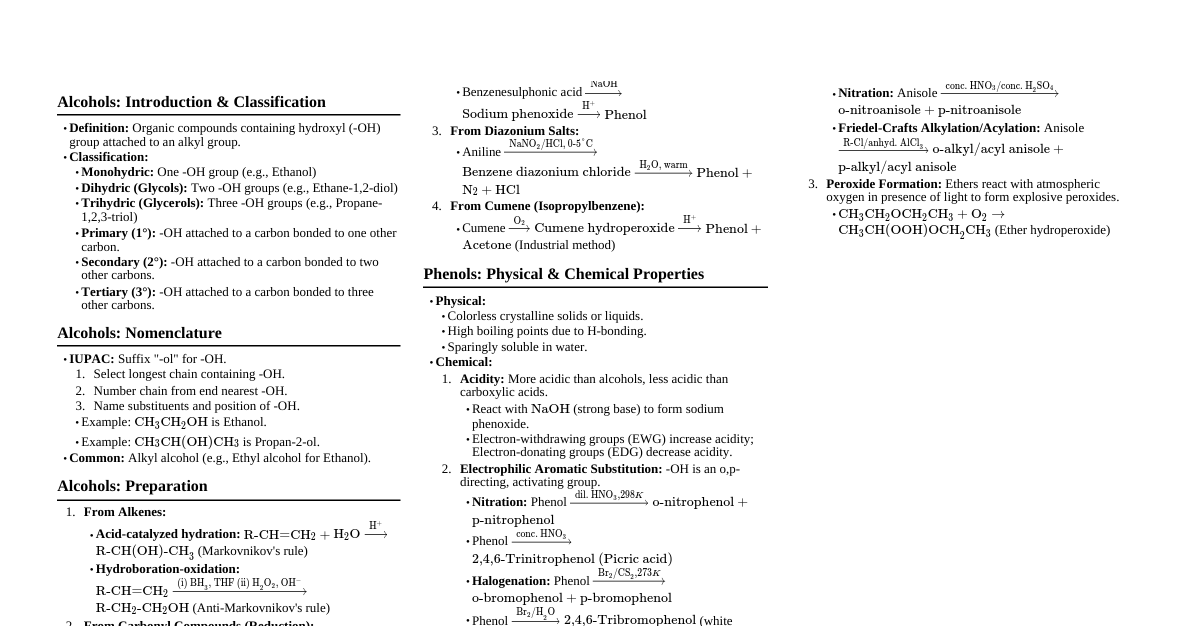
### Alcohols: Introduction & Nomenclature - **Definition:** Compounds with -OH group attached to an alkyl group. - **Classification:** - **Monohydric:** One -OH group. - **Polyhydric:** More than one -OH group (e.g., diols, triols). - **1°, 2°, 3° Alcohols:** Based on attachment of -OH to primary, secondary, or tertiary carbon. - **Nomenclature:** - IUPAC: Parent alkane name - 'e' + 'ol'. (e.g., Ethanol, Propan-2-ol). - Common: Alkyl group + alcohol (e.g., Ethyl alcohol, Isopropyl alcohol). ### Alcohols: Preparation Methods 1. **From Alkenes:** - **Acid-catalyzed hydration:** Markovnikov's rule. Rearrangements possible. $$R-CH=CH_2 \xrightarrow{H_2O/H^+} R-CH(OH)-CH_3$$ - **Hydroboration-oxidation (HBO):** Anti-Markovnikov's addition, syn-stereoselectivity. $$R-CH=CH_2 \xrightarrow{(i) BH_3, THF (ii) H_2O_2, OH^-} R-CH_2-CH_2-OH$$ - **Oxymercuration-demercuration (OMDM):** Markovnikov's addition, anti-addition, no rearrangement. $$R-CH=CH_2 \xrightarrow{(i) Hg(OAc)_2, H_2O (ii) NaBH_4} R-CH(OH)-CH_3$$ 2. **From Carbonyl Compounds (Aldehydes, Ketones, Carboxylic Acids, Esters):** - **Reduction:** - **LiAlH$_4$ (LAH):** Strong reducing agent, reduces aldehydes, ketones, esters, carboxylic acids to primary alcohols (except ketones to secondary). - **NaBH$_4$:** Milder, reduces aldehydes and ketones to alcohols. Does not reduce esters or carboxylic acids. - **Catalytic Hydrogenation (H$_2$/Ni, Pd, Pt):** Reduces aldehydes and ketones. 3. **From Grignard Reagents (RMgX):** - **Formaldehyde $\xrightarrow{RMgX}$ 1° Alcohol** - **Other Aldehydes $\xrightarrow{RMgX}$ 2° Alcohol** - **Ketones $\xrightarrow{RMgX}$ 3° Alcohol** - **Esters $\xrightarrow{2RMgX}$ 3° Alcohol** ### Alcohols: Important Reactions 1. **Acidity of Alcohols:** - Weaker acids than water. Acidity order: 1° > 2° > 3° (due to +I effect of alkyl groups). - React with active metals (Na, K, Al) to form alkoxides. $$2R-OH + 2Na \longrightarrow 2R-ONa + H_2$$ 2. **Reaction with HX (Lucas Test):** - **ZnCl$_2$ (anhydrous) + conc. HCl (Lucas Reagent).** - Reactivity order: 3° > 2° > 1°. - 3° alcohols react immediately (turbidity). 2° alcohols react within 5-10 min. 1° alcohols react only on heating. $$R-OH + HX \longrightarrow R-X + H_2O$$ 3. **Reaction with PCl$_3$, PCl$_5$, SOCl$_2$:** - Convert alcohols to alkyl halides. SOCl$_2$ is preferred due to gaseous byproducts (SO$_2$, HCl). $$R-OH + PCl_5 \longrightarrow R-Cl + POCl_3 + HCl$$ $$R-OH + SOCl_2 \xrightarrow{\text{Pyridine}} R-Cl + SO_2 \uparrow + HCl \uparrow$$ 4. **Dehydration (Elimination):** - **Reagents:** Conc. H$_2$SO$_4$, H$_3$PO$_4$, Al$_2$O$_3$ (at high temp.). - Follows Zaitsev's rule (most substituted alkene is major product). - Reactivity order for dehydration: 3° > 2° > 1°. E1 mechanism for 2°/3°, E2 for 1°. Carbocation rearrangements are possible. $$R-CH_2-CH_2-OH \xrightarrow{conc. H_2SO_4, 170^\circ C} R-CH=CH_2 + H_2O$$ 5. **Oxidation:** - **1° Alcohol:** - Mild (PCC, PDC): Aldehyde - Strong (KMnO$_4$, K$_2$Cr$_2$O$_7$/H$^+$): Carboxylic Acid - **2° Alcohol:** - Mild/Strong: Ketone - **3° Alcohol:** No oxidation under normal conditions (vigorous conditions cause C-C bond cleavage). 6. **Esterification:** Reaction with carboxylic acids/acid derivatives in presence of acid catalyst (reversible). $$R-OH + R'-COOH \xrightarrow{H_2SO_4} R'-COOR + H_2O$$ ### Phenols: Introduction & Nomenclature - **Definition:** -OH group directly attached to an aromatic ring. - **Nomenclature:** Parent name is phenol. Substituted phenols are named accordingly (e.g., Nitrophenol, Cresol). ### Phenols: Preparation Methods 1. **From Haloarenes (Dow's Process):** High temp. and pressure required. $$C_6H_5-Cl \xrightarrow{NaOH, 350^\circ C, 300 atm} C_6H_5-ONa \xrightarrow{H^+} C_6H_5-OH$$ 2. **From Benzenesulphonic Acid:** $$C_6H_5-SO_3H \xrightarrow{(i) NaOH (ii) H^+} C_6H_5-OH$$ 3. **From Diazonium Salts:** $$C_6H_5-N_2^+Cl^- \xrightarrow{H_2O, \text{warm}} C_6H_5-OH + N_2 + HCl$$ 4. **From Cumene (Isopropylbenzene):** Industrial method. $$C_6H_5-CH(CH_3)_2 \xrightarrow{(i) O_2 (ii) H_2O/H^+} C_6H_5-OH + CH_3COCH_3$$ ### Phenols: Important Reactions 1. **Acidity of Phenols:** - More acidic than alcohols due to resonance stabilization of phenoxide ion. - Acidity order depends on substituents: Electron-withdrawing groups (-NO$_2$, -CN) increase acidity. Electron-donating groups (-CH$_3$, -OCH$_3$) decrease acidity. - React with NaOH (strong base), but not with NaHCO$_3$ (weaker base than phenol except for some nitrophenols). $$C_6H_5-OH + NaOH \longrightarrow C_6H_5-ONa + H_2O$$ 2. **Electrophilic Aromatic Substitution (EAS):** - -OH group is activating and ortho/para directing. - **Halogenation (Bromination):** - With Br$_2$/CS$_2$ (low temp): Monosubstitution (o- and p-bromophenol). - With Br$_2$/H$_2$O (room temp): 2,4,6-tribromophenol (white precipitate). - **Nitration:** - Dilute HNO$_3$ (low temp): o- and p-nitrophenol. - Conc. HNO$_3$/H$_2$SO$_4$: 2,4,6-trinitrophenol (Picric Acid). - **Sulphonation:** With conc. H$_2$SO$_4$. - Low temp: o-HOC$_6$H$_4$SO$_3$H - High temp: p-HOC$_6$H$_4$SO$_3$H - **Friedel-Crafts Alkylation/Acylation:** Generally not good for phenols due to complex formation with AlCl$_3$. 3. **Reimer-Tiemann Reaction:** $$C_6H_5-OH \xrightarrow{(i) CHCl_3, NaOH (ii) H^+} \text{Salicylaldehyde (o-hydroxybenzaldehyde)}$$ 4. **Kolbe's Reaction (Kolbe-Schmidt Reaction):** $$C_6H_5-ONa \xrightarrow{(i) CO_2, 125^\circ C, 4-7 atm (ii) H^+} \text{Salicylic Acid (o-hydroxybenzoic acid)}$$ 5. **Reaction with Zinc Dust:** $$C_6H_5-OH \xrightarrow{Zn \text{ dust, heat}} C_6H_6 + ZnO$$ 6. **Oxidation:** - With Aerial Oxidation: Turns pink/brown due to formation of quinones. - With K$_2$Cr$_2$O$_7$/H$_2$SO$_4$: Benzoquinone formation. ### Ethers: Introduction & Nomenclature - **Definition:** Compounds with R-O-R' linkage. - **Classification:** - **Symmetrical:** R = R' (e.g., Diethyl ether). - **Unsymmetrical:** R $\neq$ R' (e.g., Ethyl methyl ether). - **Nomenclature:** - IUPAC: Alkoxyalkane (e.g., Methoxyethane). - Common: Alkyl alkyl ether (e.g., Diethyl ether, Ethyl methyl ether). ### Ethers: Preparation Methods 1. **Williamson Synthesis (Sn2):** - **SN2 reaction of an alkoxide with a primary alkyl halide.** Best for unsymmetrical ethers. - **Primary alkyl halide + Sodium alkoxide** - If secondary/tertiary alkyl halide is used, elimination (E2) predominates, forming alkenes. $$R-X (1^\circ) + R'-ONa \longrightarrow R-O-R' + NaX$$ 2. **Dehydration of Alcohols (Acid-catalyzed):** - **With conc. H$_2$SO$_4$ at 413 K (140°C).** Primarily forms symmetrical ethers. - **Intermolecular dehydration.** Intramolecular dehydration (at 443 K) forms alkenes. - Follows SN2 mechanism generally. $$2R-OH \xrightarrow{H_2SO_4, 413K} R-O-R + H_2O$$ ### Ethers: Important Reactions 1. **Cleavage by Halogen Acids (HX):** - Reactivity order: HI > HBr > HCl. - Forms alkyl halides and alcohol. On excess HX, the alcohol also reacts to form alkyl halide. - In unsymmetrical ethers, the halogen attaches to the smaller alkyl group via SN2 (if both are 1°/2°). - If one group is tertiary, a carbocation is formed, and the tertiary alkyl halide is the product (SN1). $$R-O-R' + HX \longrightarrow R-X + R'-OH$$ $$R-OH + HX \longrightarrow R-X + H_2O \text{ (on excess HX)}$$ 2. **Electrophilic Substitution in Aromatic Ethers (e.g., Anisole):** - -OR group is activating and ortho/para directing. - **Halogenation:** Br$_2$/CS$_2$ gives o- and p-bromoanisole. - **Nitration:** H$_2$SO$_4$/HNO$_3$ gives o- and p-nitroanisole. - **Friedel-Crafts Reaction:** (presence of AlCl$_3$ usually okay here) - Alkylation: R-Cl/AlCl$_3$ - Acylation: R-COCl/AlCl$_3$ 3. **Peroxide Formation:** - Ethers react with atmospheric oxygen in presence of light to form explosive peroxides (e.g., diethyl ether hydroperoxide). - Hence, ethers should never be evaporated to dryness. ### Distinguishing Tests 1. **Lucas Test:** (Alcohols) - 3° alcohol: Immediate turbidity. - 2° alcohol: Turbidity in 5-10 minutes. - 1° alcohol: No turbidity at room temperature. - Phenol/Ether: No reaction. 2. **Neutral Ferric Chloride Test (FeCl$_3$ Test):** (Phenols) - Phenols react with neutral FeCl$_3$ solution to give characteristic violet, green, or blue coloration. - Alcohols (except some enols), Ethers: No characteristic color. 3. **Litmus Test / NaOH / NaHCO$_3$:** (Acidity) - Phenol: Acidic, turns blue litmus red. Reacts with NaOH. Does NOT react with NaHCO$_3$ (except picric acid, 2,4-DNP). - Alcohol: Neutral to litmus. Does NOT react with NaOH or NaHCO$_3$. - Carboxylic acid (for comparison): Turns blue litmus red. Reacts with NaOH AND NaHCO$_3$ (with effervescence). 4. **Iodoform Test (CHI$_3$):** (Methyl ketones and alcohols producing methyl ketones upon oxidation) - CH$_3$CH(OH)R alcohols give yellow precipitate of iodoform (CHI$_3$) with I$_2$/NaOH. - E.g., Ethanol, Propan-2-ol will give iodoform test. ### Important Tips for JEE Chemistry 1. **Reaction Mechanisms:** Understand SN1, SN2, E1, E2, carbocation stability, resonance effects. This is key for predicting products and understanding selectivity (Markovnikov/Anti-Markovnikov, Zaitsev). 2. **Reagent Specificity:** Know what each reagent does. For example, LiAlH$_4$ is strong, NaBH$_4$ is mild. PCC/PDC for aldehydes, KMnO$_4$ for acids. 3. **Acidity & Basicity:** Compare acidity of alcohols, phenols, water, carboxylic acids. Electron-withdrawing groups increase acidity, electron-donating groups decrease it. 4. **Stereochemistry:** Pay attention to syn/anti addition for HBO and OMDM. SN2 reactions involve inversion. 5. **Rearrangements:** Watch out for carbocation rearrangements in reactions like acid-catalyzed hydration and dehydration of alcohols. 6. **Name Reactions:** Memorize Kolbe's, Reimer-Tiemann, Williamson Synthesis, Dow's Process, Cumene Process. These are frequently tested. 7. **Oxidation/Reduction Levels:** Understand how -OH group changes during oxidation (1° alcohol $\rightarrow$ aldehyde $\rightarrow$ carboxylic acid, 2° alcohol $\rightarrow$ ketone, 3° alcohol $\rightarrow$ no reaction). 8. **Distinguishing Tests:** Practice identifying compounds based on their reactions with specific reagents (Lucas, FeCl$_3$, Iodoform). 9. **Practice Problems:** Solve a variety of problems, especially multi-step syntheses and mechanism-based questions. 10. **Interconversion:** Be able to convert an alcohol to an ether, alcohol to phenol (not direct), alcohol to alkyl halide, etc. Think about the shortest pathway.