Alcohols, Phenols & Ethers
Shared 5/12/2026•1 views
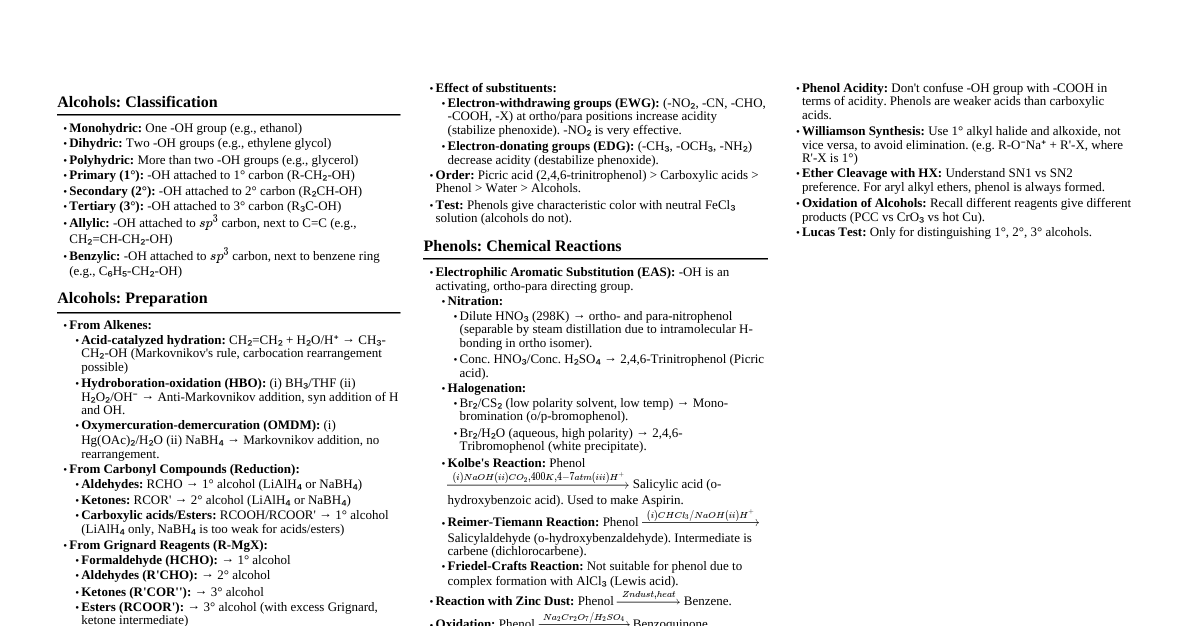
### Alcohols: Introduction & Classification - **Definition:** Organic compounds containing hydroxyl (-OH) group attached to an alkyl group. - **Classification:** - **Monohydric:** One -OH group (e.g., Ethanol) - **Dihydric (Glycols):** Two -OH groups (e.g., Ethane-1,2-diol) - **Trihydric (Glycerols):** Three -OH groups (e.g., Propane-1,2,3-triol) - **Primary (1°):** -OH attached to a carbon bonded to one other carbon. - **Secondary (2°):** -OH attached to a carbon bonded to two other carbons. - **Tertiary (3°):** -OH attached to a carbon bonded to three other carbons. ### Alcohols: Nomenclature - **IUPAC:** Suffix "-ol" for -OH. 1. Select longest chain containing -OH. 2. Number chain from end nearest -OH. 3. Name substituents and position of -OH. - Example: $\text{CH}_3\text{CH}_2\text{OH}$ is Ethanol. - Example: $\text{CH}_3\text{CH(OH)}\text{CH}_3$ is Propan-2-ol. - **Common:** Alkyl alcohol (e.g., Ethyl alcohol for Ethanol). ### Alcohols: Preparation 1. **From Alkenes:** - **Acid-catalyzed hydration:** $\text{R-CH=CH}_2 + \text{H}_2\text{O} \xrightarrow{\text{H}^+} \text{R-CH(OH)-CH}_3$ (Markovnikov's rule) - **Hydroboration-oxidation:** $\text{R-CH=CH}_2 \xrightarrow{\text{(i) BH}_3\text{, THF (ii) H}_2\text{O}_2\text{, OH}^-} \text{R-CH}_2\text{-CH}_2\text{OH}$ (Anti-Markovnikov's rule) 2. **From Carbonyl Compounds (Reduction):** - **Aldehydes:** $\text{R-CHO} \xrightarrow{\text{LiAlH}_4 \text{ or NaBH}_4} \text{R-CH}_2\text{OH}$ (Primary alcohol) - **Ketones:** $\text{R-CO-R'} \xrightarrow{\text{LiAlH}_4 \text{ or NaBH}_4} \text{R-CH(OH)-R'}$ (Secondary alcohol) - **Carboxylic Acids/Esters:** $\text{R-COOH} \xrightarrow{\text{LiAlH}_4} \text{R-CH}_2\text{OH}$ (Primary alcohol, not with $\text{NaBH}_4$) 3. **From Grignard Reagents ($\text{RMgX}$):** - **Formaldehyde ($\text{HCHO}$):** Primary alcohol - **Other Aldehydes ($\text{R'CHO}$):** Secondary alcohol - **Ketones ($\text{R'COR''}$):** Tertiary alcohol - **Esters:** Tertiary alcohol ### Alcohols: Physical & Chemical Properties - **Physical:** - Lower alcohols are liquids, higher are solids. - High boiling points due to intermolecular H-bonding. - Soluble in water (lower alcohols) due to H-bonding with water. - **Chemical (Reactions):** 1. **Acidity:** Weakly acidic, react with active metals ($\text{Na}$) to form alkoxides. - Acidity order: 1° > 2° > 3° (due to +I effect of alkyl groups). 2. **Esterification:** React with carboxylic acids/acid derivatives in presence of acid to form esters. - $\text{R-OH} + \text{R'-COOH} \xrightarrow{\text{H}^+} \text{R'-COOR} + \text{H}_2\text{O}$ 3. **Dehydration:** Elimination of water to form alkenes (high temp, $\text{H}_2\text{SO}_4$ or $\text{Al}_2\text{O}_3$). - Order of dehydration: 3° > 2° > 1°. 4. **Oxidation:** - **1° alcohols:** $\text{R-CH}_2\text{OH} \xrightarrow{\text{PCC}} \text{R-CHO}$ (aldehyde) $\xrightarrow{\text{KMnO}_4} \text{R-COOH}$ (carboxylic acid) - **2° alcohols:** $\text{R-CH(OH)-R'} \xrightarrow{\text{CrO}_3 \text{ or PCC}} \text{R-CO-R'}$ (ketone) - **3° alcohols:** Generally resistant to oxidation under mild conditions. Strong oxidation leads to C-C bond cleavage. 5. **Reaction with HX:** $\text{R-OH} + \text{HX} \xrightarrow{\text{ZnCl}_2} \text{R-X} + \text{H}_2\text{O}$ (Lucas test for 1°, 2°, 3° distinction) ### Phenols: Introduction & Classification - **Definition:** Compounds in which -OH group is directly attached to a benzene ring. - **Classification:** Monohydric, dihydric, trihydric based on number of -OH groups. - Example: Phenol, Catechol, Resorcinol, Hydroquinone. ### Phenols: Nomenclature - **IUPAC:** Benzene with "-ol" suffix or substituted phenol. - Example: Benzenol (common name Phenol). - Substituents are numbered relative to -OH group. - Ortho (o-), meta (m-), para (p-) are used for disubstituted benzenes. ### Phenols: Preparation 1. **From Haloarenes (Dow's Process):** - Chlorobenzene $\xrightarrow{\text{NaOH, 623K, 300 atm}} \text{Sodium phenoxide} \xrightarrow{\text{H}^+} \text{Phenol}$ 2. **From Benzenesulphonic Acid:** - Benzenesulphonic acid $\xrightarrow{\text{NaOH}} \text{Sodium phenoxide} \xrightarrow{\text{H}^+} \text{Phenol}$ 3. **From Diazonium Salts:** - Aniline $\xrightarrow{\text{NaNO}_2\text{/HCl, 0-5°C}} \text{Benzene diazonium chloride} \xrightarrow{\text{H}_2\text{O, warm}} \text{Phenol} + \text{N}_2 + \text{HCl}$ 4. **From Cumene (Isopropylbenzene):** - Cumene $\xrightarrow{\text{O}_2} \text{Cumene hydroperoxide} \xrightarrow{\text{H}^+} \text{Phenol} + \text{Acetone}$ (Industrial method) ### Phenols: Physical & Chemical Properties - **Physical:** - Colorless crystalline solids or liquids. - High boiling points due to H-bonding. - Sparingly soluble in water. - **Chemical:** 1. **Acidity:** More acidic than alcohols, less acidic than carboxylic acids. - React with $\text{NaOH}$ (strong base) to form sodium phenoxide. - Electron-withdrawing groups (EWG) increase acidity; Electron-donating groups (EDG) decrease acidity. 2. **Electrophilic Aromatic Substitution:** -OH is an o,p-directing, activating group. - **Nitration:** Phenol $\xrightarrow{\text{dil. HNO}_3, 298K} \text{o-nitrophenol} + \text{p-nitrophenol}$ - Phenol $\xrightarrow{\text{conc. HNO}_3} \text{2,4,6-Trinitrophenol (Picric acid)}$ - **Halogenation:** Phenol $\xrightarrow{\text{Br}_2\text{/CS}_2, 273K} \text{o-bromophenol} + \text{p-bromophenol}$ - Phenol $\xrightarrow{\text{Br}_2\text{/H}_2\text{O}} \text{2,4,6-Tribromophenol}$ (white precipitate) - **Sulphonation:** Phenol $\xrightarrow{\text{conc. H}_2\text{SO}_4, \text{low temp}} \text{o-Phenol sulphonic acid}$ - Phenol $\xrightarrow{\text{conc. H}_2\text{SO}_4, \text{high temp}} \text{p-Phenol sulphonic acid}$ 3. **Kolbe's Reaction:** Phenol $\xrightarrow{\text{(i) NaOH (ii) CO}_2\text{, 400K, 4-7 atm (iii) H}^+} \text{Salicylic acid}$ 4. **Reimer-Tiemann Reaction:** Phenol $\xrightarrow{\text{(i) CHCl}_3\text{/NaOH (ii) H}^+} \text{Salicylaldehyde}$ 5. **Reaction with Zinc Dust:** Phenol $\xrightarrow{\text{Zn dust, heat}} \text{Benzene}$ 6. **Oxidation:** Phenol $\xrightarrow{\text{Na}_2\text{Cr}_2\text{O}_7\text{/H}_2\text{SO}_4} \text{Benzoquinone}$ ### Ethers: Introduction & Classification - **Definition:** Organic compounds in which an oxygen atom is bonded to two alkyl or aryl groups ($\text{R-O-R'}$). - **Classification:** - **Simple/Symmetrical:** Both alkyl/aryl groups are identical (e.g., Diethyl ether, Dimethyl ether). - **Mixed/Unsymmetrical:** Alkyl/aryl groups are different (e.g., Ethyl methyl ether). ### Ethers: Nomenclature - **IUPAC:** Alkoxyalkane. The larger alkyl group is the parent alkane. - Example: $\text{CH}_3\text{OCH}_3$ is Methoxy methane. - Example: $\text{CH}_3\text{CH}_2\text{OCH}_3$ is Methoxy ethane. - **Common:** Alkyl alkyl ether (alphabetical order). - Example: Diethyl ether, Ethyl methyl ether. ### Ethers: Preparation 1. **Dehydration of Alcohols:** - 2 $\text{R-OH} \xrightarrow{\text{H}_2\text{SO}_4, 413K} \text{R-O-R} + \text{H}_2\text{O}$ (For symmetrical ethers, 1° alcohols only). - Intramolecular dehydration to alkene occurs at higher temp (443K). 2. **Williamson Synthesis:** - $\text{R-X} + \text{R'-ONa} \rightarrow \text{R-O-R'} + \text{NaX}$ - Best for preparing unsymmetrical ethers. - **Crucial:** Alkyl halide (R-X) must be primary (1°) to avoid elimination. Alkoxide (R'-ONa) can be 1°, 2°, or 3°. ### Ethers: Physical & Chemical Properties - **Physical:** - Lower ethers are gases, higher are liquids. - Lower boiling points than alcohols of comparable molar mass (no H-bonding). - Slightly soluble in water (can form H-bonds with water). - **Chemical:** 1. **Cleavage by Hot Concentrated HI/HBr:** - $\text{R-O-R'} + \text{HX (excess)} \xrightarrow{\text{heat}} \text{R-X} + \text{R'-X} + \text{H}_2\text{O}$ - If one group is primary/secondary, cleavage occurs via $\text{S}_{\text{N}}2$ pathway. - If one group is tertiary, cleavage occurs via $\text{S}_{\text{N}}1$ pathway (tertiary carbocation). - Phenol is formed if one group is aryl. 2. **Electrophilic Substitution (in aromatic ethers):** Alkoxy group (-OR) is o,p-directing and activating. - **Halogenation:** Anisole $\xrightarrow{\text{Br}_2\text{/Ethanoic acid}} \text{o-bromoanisole} + \text{p-bromoanisole}$ - **Nitration:** Anisole $\xrightarrow{\text{conc. HNO}_3\text{/conc. H}_2\text{SO}_4} \text{o-nitroanisole} + \text{p-nitroanisole}$ - **Friedel-Crafts Alkylation/Acylation:** Anisole $\xrightarrow{\text{R-Cl/anhyd. AlCl}_3} \text{o-alkyl/acyl anisole} + \text{p-alkyl/acyl anisole}$ 3. **Peroxide Formation:** Ethers react with atmospheric oxygen in presence of light to form explosive peroxides. - $\text{CH}_3\text{CH}_2\text{OCH}_2\text{CH}_3 + \text{O}_2 \rightarrow \text{CH}_3\text{CH(OOH)OCH}_2\text{CH}_3$ (Ether hydroperoxide)