Alcohols, Phenols & Ethers
Cheatsheet Content
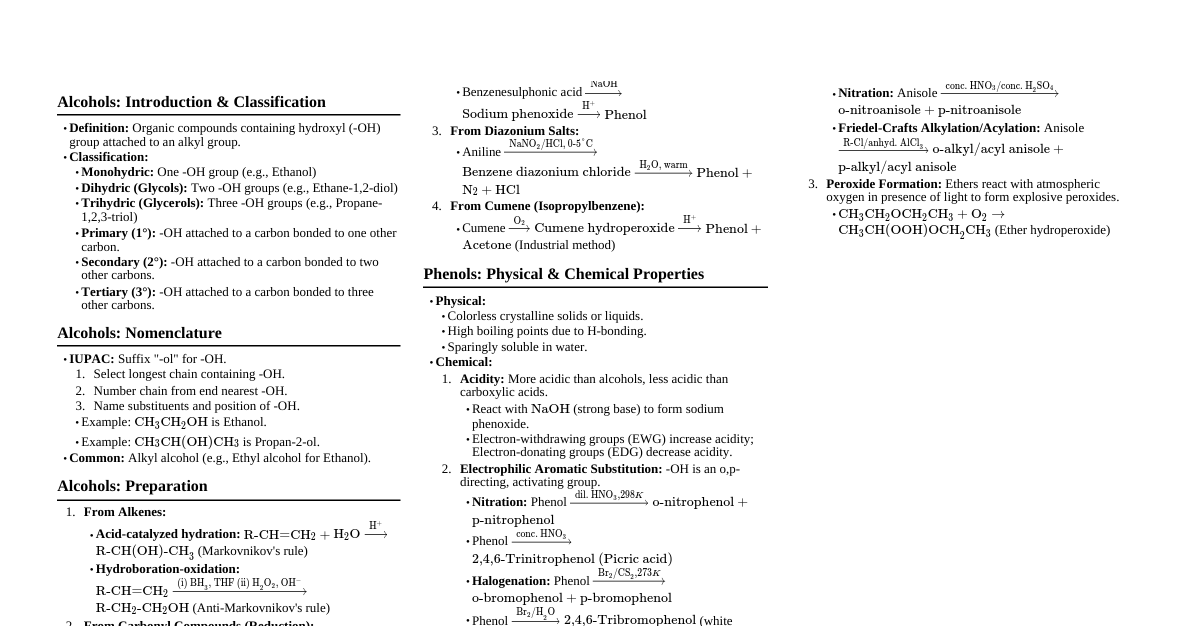
### Alcohols: Classification - **Monohydric:** One -OH group (e.g., ethanol) - **Dihydric:** Two -OH groups (e.g., ethylene glycol) - **Polyhydric:** More than two -OH groups (e.g., glycerol) - **Primary (1°):** -OH attached to 1° carbon (R-CH₂-OH) - **Secondary (2°):** -OH attached to 2° carbon (R₂CH-OH) - **Tertiary (3°):** -OH attached to 3° carbon (R₃C-OH) - **Allylic:** -OH attached to $sp^3$ carbon, next to C=C (e.g., CH₂=CH-CH₂-OH) - **Benzylic:** -OH attached to $sp^3$ carbon, next to benzene ring (e.g., C₆H₅-CH₂-OH) ### Alcohols: Preparation - **From Alkenes:** - **Acid-catalyzed hydration:** CH₂=CH₂ + H₂O/H⁺ → CH₃-CH₂-OH (Markovnikov's rule, carbocation rearrangement possible) - **Hydroboration-oxidation (HBO):** (i) BH₃/THF (ii) H₂O₂/OH⁻ → Anti-Markovnikov addition, syn addition of H and OH. - **Oxymercuration-demercuration (OMDM):** (i) Hg(OAc)₂/H₂O (ii) NaBH₄ → Markovnikov addition, no rearrangement. - **From Carbonyl Compounds (Reduction):** - **Aldehydes:** RCHO → 1° alcohol (LiAlH₄ or NaBH₄) - **Ketones:** RCOR' → 2° alcohol (LiAlH₄ or NaBH₄) - **Carboxylic acids/Esters:** RCOOH/RCOOR' → 1° alcohol (LiAlH₄ only, NaBH₄ is too weak for acids/esters) - **From Grignard Reagents (R-MgX):** - **Formaldehyde (HCHO):** → 1° alcohol - **Aldehydes (R'CHO):** → 2° alcohol - **Ketones (R'COR''):** → 3° alcohol - **Esters (RCOOR'):** → 3° alcohol (with excess Grignard, ketone intermediate) ### Alcohols: Physical Properties - **Boiling points:** Higher than hydrocarbons, ethers, haloalkanes of comparable molecular mass due to intermolecular H-bonding. - **Solubility:** Lower alcohols (up to C₃) are miscible with water due to H-bonding with water. Solubility decreases with increasing alkyl chain length. ### Alcohols: Chemical Reactions - **Acidity:** - Order: 1° > 2° > 3° (due to +I effect of alkyl groups stabilizing alkoxide ion) - React with active metals (Na, K, Al) to form alkoxides: 2ROH + 2Na → 2RONa + H₂ - Weaker acids than water. - **Esterification:** ROH + R'COOH $\xrightarrow{H^+}$ R'COOR + H₂O (Fischer esterification, reversible) - **Reaction with HX:** ROH + HX → RX + H₂O - Reactivity order: HI > HBr > HCl - Alcohol reactivity: 3° > 2° > 1° (SN1 mechanism for 2°, 3°; SN2 for 1°) - Lucas Test: Anhydrous ZnCl₂ + HCl. Turbidity: 3° (immediate), 2° (5-10 min), 1° (no turbidity at room temp). - **Dehydration:** R-CH₂-CH₂-OH $\xrightarrow{conc. H₂SO₄}$ Alkene - Order: 3° > 2° > 1° (follows Zaitsev's rule, carbocation intermediate, rearrangement possible) - Temp dependent: Low temp (413K) favors ether formation (intermolecular dehydration). High temp (443K) favors alkene formation (intramolecular dehydration). - **Oxidation:** - **1° alcohol:** RCH₂OH $\xrightarrow{PCC}$ RCHO (aldehyde) $\xrightarrow{CrO₃/H₂SO₄ (Jones Reagent)}$ RCOOH (carboxylic acid) - **2° alcohol:** R₂CHOH $\xrightarrow{PCC/CrO₃}$ R₂CO (ketone) - **3° alcohol:** Resistant to oxidation under mild conditions. Strong oxidizing agents (hot conc. HNO₃) cause C-C bond cleavage. - **Hot Cu (573K):** 1° → Aldehyde, 2° → Ketone, 3° → Alkene (dehydrogenation for 1°/2°, dehydration for 3°) ### Phenols: Preparation - **From Haloarenes (Dow's Process):** Chlorobenzene $\xrightarrow{NaOH, 623K, 300atm}$ Sodium phenoxide $\xrightarrow{H^+}$ Phenol - **From Benzenediazonium salt:** C₆H₅N₂⁺Cl⁻ $\xrightarrow{H₂O, warm}$ Phenol + N₂ + HCl - **From Cumene (Isopropylbenzene):** Cumene $\xrightarrow{O₂/air}$ Cumene hydroperoxide $\xrightarrow{H₂O/H⁺}$ Phenol + Acetone (major industrial method) - **From Benzenesulphonic acid:** C₆H₅SO₃H $\xrightarrow{NaOH, heat}$ Sodium phenoxide $\xrightarrow{H^+}$ Phenol ### Phenols: Physical Properties - **Boiling points:** Higher than hydrocarbons, haloarenes due to intermolecular H-bonding. - **Solubility:** Sparingly soluble in water, more soluble than alcohols of comparable molecular mass because of stronger H-bonding due to more polar O-H bond. ### Phenols: Acidity - **More acidic than alcohols and water.** - **Reason:** Resonance stabilization of phenoxide ion. - **Effect of substituents:** - **Electron-withdrawing groups (EWG):** (-NO₂, -CN, -CHO, -COOH, -X) at ortho/para positions increase acidity (stabilize phenoxide). -NO₂ is very effective. - **Electron-donating groups (EDG):** (-CH₃, -OCH₃, -NH₂) decrease acidity (destabilize phenoxide). - **Order:** Picric acid (2,4,6-trinitrophenol) > Carboxylic acids > Phenol > Water > Alcohols. - **Test:** Phenols give characteristic color with neutral FeCl₃ solution (alcohols do not). ### Phenols: Chemical Reactions - **Electrophilic Aromatic Substitution (EAS):** -OH is an activating, ortho-para directing group. - **Nitration:** - Dilute HNO₃ (298K) → ortho- and para-nitrophenol (separable by steam distillation due to intramolecular H-bonding in ortho isomer). - Conc. HNO₃/Conc. H₂SO₄ → 2,4,6-Trinitrophenol (Picric acid). - **Halogenation:** - Br₂/CS₂ (low polarity solvent, low temp) → Mono-bromination (o/p-bromophenol). - Br₂/H₂O (aqueous, high polarity) → 2,4,6-Tribromophenol (white precipitate). - **Kolbe's Reaction:** Phenol $\xrightarrow{(i) NaOH (ii) CO₂, 400K, 4-7 atm (iii) H^+}$ Salicylic acid (o-hydroxybenzoic acid). Used to make Aspirin. - **Reimer-Tiemann Reaction:** Phenol $\xrightarrow{(i) CHCl₃/NaOH (ii) H^+}$ Salicylaldehyde (o-hydroxybenzaldehyde). Intermediate is carbene (dichlorocarbene). - **Friedel-Crafts Reaction:** Not suitable for phenol due to complex formation with AlCl₃ (Lewis acid). - **Reaction with Zinc Dust:** Phenol $\xrightarrow{Zn dust, heat}$ Benzene. - **Oxidation:** Phenol $\xrightarrow{Na₂Cr₂O₇/H₂SO₄}$ Benzoquinone. - **Hydrogenation:** Phenol $\xrightarrow{Ni, heat}$ Cyclohexanol. ### Ethers: Classification - **Symmetrical:** Both alkyl/aryl groups are identical (e.g., CH₃-O-CH₃, C₆H₅-O-C₆H₅). - **Unsymmetrical:** Alkyl/aryl groups are different (e.g., CH₃-O-CH₂CH₃). ### Ethers: Preparation - **Dehydration of Alcohols:** 2ROH $\xrightarrow{conc. H₂SO₄, 413K}$ R-O-R + H₂O - Favors symmetrical ethers. - SN2 mechanism. - For unsymmetrical ethers, side products (alkenes) are formed. - Not suitable for 3° alcohols (dehydrate to alkenes). - **Williamson Synthesis:** R-X (1° alkyl halide) + R'-ONa (sodium alkoxide) → R-O-R' + NaX - Best for 1° alkyl halides. - If R-X is 2° or 3°, elimination (alkene formation) predominates over substitution, especially with strong bases. - Phenol can be used: C₆H₅-ONa + CH₃-X → C₆H₅-O-CH₃ (Anisole). Aryl halides cannot be used as R-X. ### Ethers: Physical Properties - **Boiling points:** Lower than alcohols of comparable molecular mass (no H-bonding between ether molecules). Comparable to hydrocarbons. - **Solubility:** Low molecular weight ethers are soluble in water due to H-bonding with water molecules. Solubility decreases with increasing alkyl chain length. ### Ethers: Chemical Reactions - **Cleavage by Hot Concentrated HX:** R-O-R' + HX $\xrightarrow{heat}$ R-X + R'-OH - Reactivity order: HI > HBr > HCl. - If one group is 1°/2° and other is 3°/aryl, the halide forms with 3°/aryl group if it's SN1. - For 1°/2° alkyl groups, SN2 mechanism: smaller alkyl group forms alkyl halide. - Example: CH₃-O-C₂H₅ + HI $\rightarrow$ CH₃-I + C₂H₅-OH (SN2, CH₃⁺ is more stable carbocation if it were SN1, but SN2 dominates for 1°). - **Aryl alkyl ethers:** C₆H₅-O-R + HX $\rightarrow$ C₆H₅-OH + R-X (Phenol is formed because C-O bond with benzene ring is stronger due to resonance, R-X is formed from alkyl group). - **Excess HX:** If excess HX, alcohol formed further reacts to form alkyl halide. R-O-R' + 2HX $\rightarrow$ R-X + R'-X + H₂O. - **Electrophilic Substitution (for aromatic ethers):** -OR is an activating, ortho-para directing group. - **Halogenation:** Anisole $\xrightarrow{Br₂/CH₃COOH}$ o/p-Bromoanisole. - **Friedel-Crafts Alkylation/Acylation:** Anisole $\xrightarrow{CH₃Cl/AlCl₃}$ o/p-Methylanisole. - **Nitration:** Anisole $\xrightarrow{conc. HNO₃/H₂SO₄}$ o/p-Nitroanisole. ### Common Mistakes & Traps - **Alcohol Dehydration:** Always check for carbocation rearrangements for 2°/3° alcohols. Zaitsev's rule for major product. - **Grignard Reactions:** Remember excess Grignard with esters gives 3° alcohol. - **Phenol Acidity:** Don't confuse -OH group with -COOH in terms of acidity. Phenols are weaker acids than carboxylic acids. - **Williamson Synthesis:** Use 1° alkyl halide and alkoxide, not vice versa, to avoid elimination. (e.g. R-O⁻Na⁺ + R'-X, where R'-X is 1°) - **Ether Cleavage with HX:** Understand SN1 vs SN2 preference. For aryl alkyl ethers, phenol is always formed. - **Oxidation of Alcohols:** Recall different reagents give different products (PCC vs CrO₃ vs hot Cu). - **Lucas Test:** Only for distinguishing 1°, 2°, 3° alcohols.