STEM Fundamentals
Cheatsheet Content
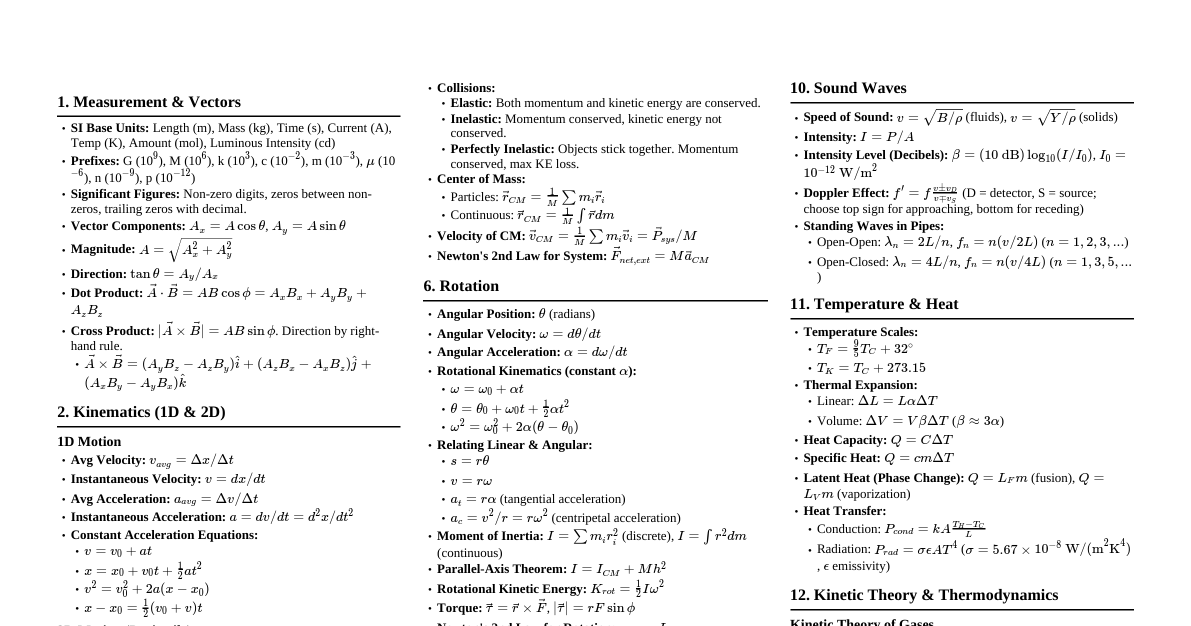
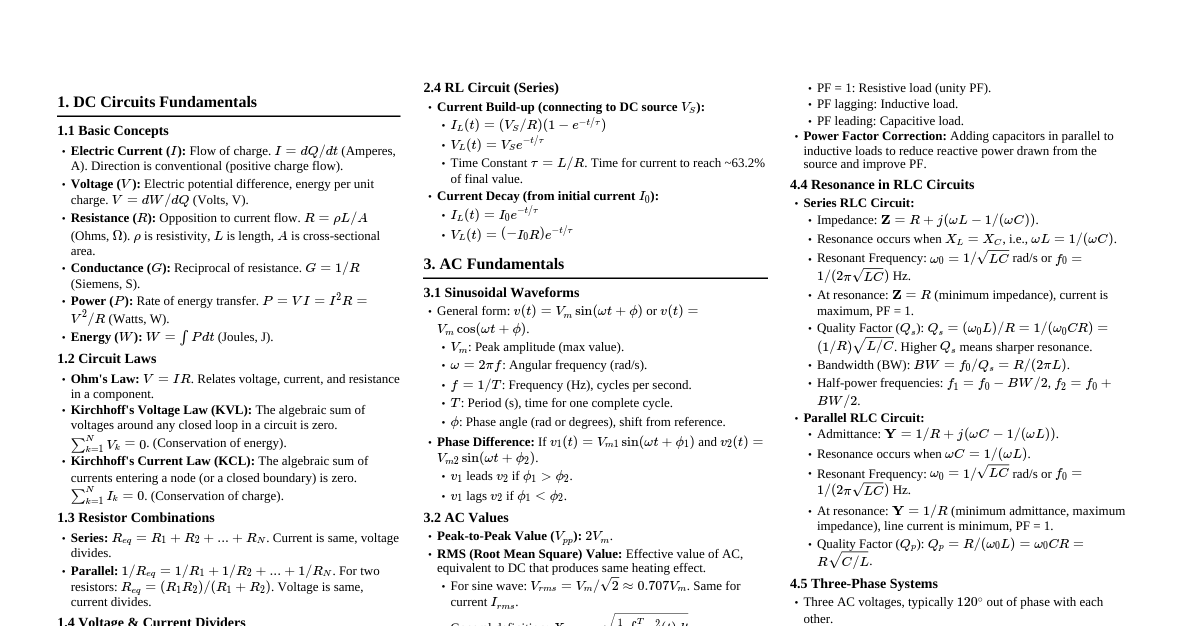
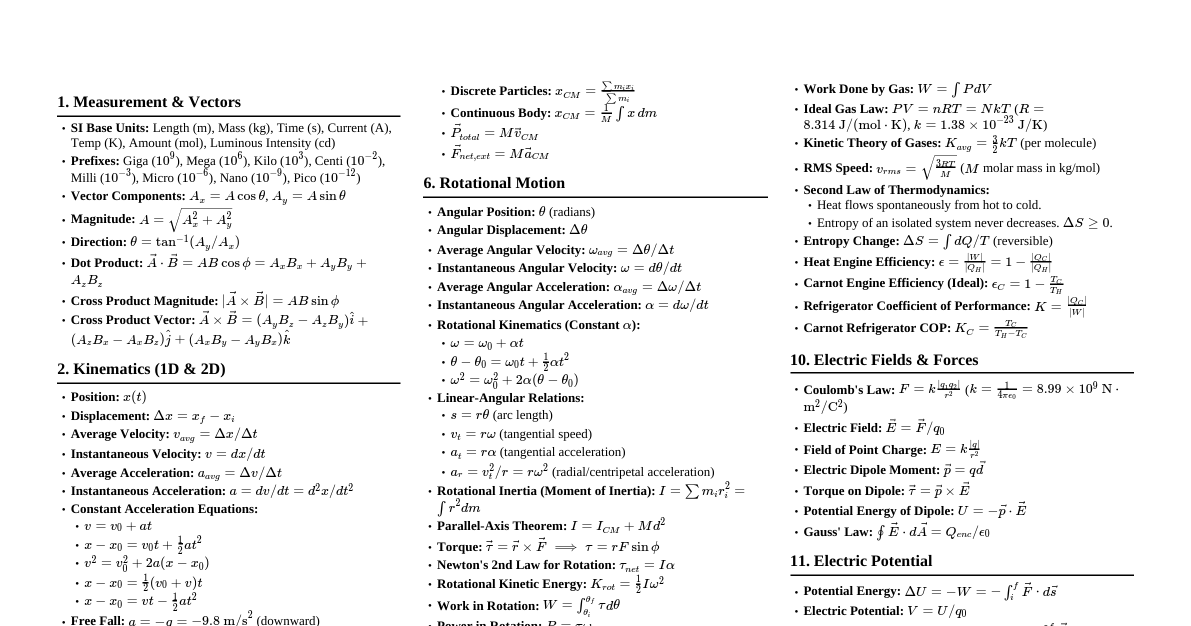
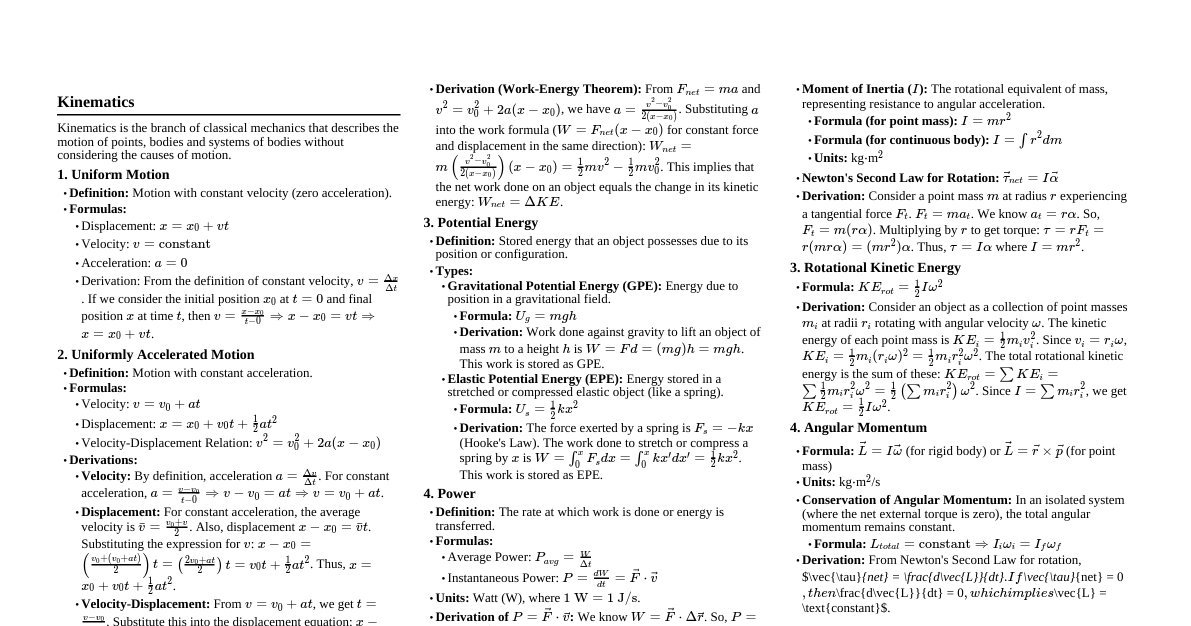
### Mathematics: Calculus #### Derivatives - **Power Rule:** $\frac{d}{dx}(x^n) = nx^{n-1}$ - **Product Rule:** $\frac{d}{dx}(uv) = u'v + uv'$ - **Quotient Rule:** $\frac{d}{dx}\left(\frac{u}{v}\right) = \frac{u'v - uv'}{v^2}$ - **Chain Rule:** $\frac{d}{dx}(f(g(x))) = f'(g(x))g'(x)$ - **Trigonometric:** - $\frac{d}{dx}(\sin x) = \cos x$ - $\frac{d}{dx}(\cos x) = -\sin x$ - $\frac{d}{dx}(\tan x) = \sec^2 x$ - **Exponential/Logarithmic:** - $\frac{d}{dx}(e^x) = e^x$ - $\frac{d}{dx}(a^x) = a^x \ln a$ - $\frac{d}{dx}(\ln x) = \frac{1}{x}$ - $\frac{d}{dx}(\log_a x) = \frac{1}{x \ln a}$ #### Integrals (Antiderivatives) - **Power Rule:** $\int x^n dx = \frac{x^{n+1}}{n+1} + C \quad (n \neq -1)$ - **Logarithmic:** $\int \frac{1}{x} dx = \ln|x| + C$ - **Trigonometric:** - $\int \cos x dx = \sin x + C$ - $\int \sin x dx = -\cos x + C$ - $\int \sec^2 x dx = \tan x + C$ - **Exponential:** - $\int e^x dx = e^x + C$ - $\int a^x dx = \frac{a^x}{\ln a} + C$ - **Integration by Parts:** $\int u dv = uv - \int v du$ #### Multivariable Calculus - **Gradient:** $\nabla f = \left\langle \frac{\partial f}{\partial x}, \frac{\partial f}{\partial y}, \frac{\partial f}{\partial z} \right\rangle$ - **Divergence:** $\nabla \cdot \mathbf{F} = \frac{\partial F_x}{\partial x} + \frac{\partial F_y}{\partial y} + \frac{\partial F_z}{\partial z}$ - **Curl:** $\nabla \times \mathbf{F} = \left\langle \frac{\partial F_z}{\partial y} - \frac{\partial F_y}{\partial z}, \frac{\partial F_x}{\partial z} - \frac{\partial F_z}{\partial x}, \frac{\partial F_y}{\partial x} - \frac{\partial F_x}{\partial y} \right\rangle$ ### Mathematics: Linear Algebra #### Vectors - **Vector Addition:** $\mathbf{a} + \mathbf{b} = (a_1+b_1, a_2+b_2, ..., a_n+b_n)$ - **Scalar Multiplication:** $c\mathbf{a} = (ca_1, ca_2, ..., ca_n)$ - **Dot Product:** $\mathbf{a} \cdot \mathbf{b} = \sum_{i=1}^n a_i b_i = |\mathbf{a}||\mathbf{b}|\cos\theta$ - **Cross Product (3D):** $\mathbf{a} \times \mathbf{b} = (a_2b_3 - a_3b_2, a_3b_1 - a_1b_3, a_1b_2 - a_2b_1)$ - **Magnitude:** $|\mathbf{a}| = \sqrt{a_1^2 + a_2^2 + ... + a_n^2}$ #### Matrices - **Matrix Multiplication:** $(AB)_{ij} = \sum_k A_{ik}B_{kj}$ - **Determinant (2x2):** $\det\begin{pmatrix} a & b \\ c & d \end{pmatrix} = ad - bc$ - **Determinant (3x3 Sarrus Rule):** $\det\begin{pmatrix} a & b & c \\ d & e & f \\ g & h & i \end{pmatrix} = a(ei-fh) - b(di-fg) + c(dh-eg)$ - **Inverse (2x2):** $A^{-1} = \frac{1}{\det(A)}\begin{pmatrix} d & -b \\ -c & a \end{pmatrix}$ - **Identity Matrix ($I$):** $AI = IA = A$ - **Transpose ($A^T$):** $(A^T)_{ij} = A_{ji}$ - **Eigenvalues and Eigenvectors:** $A\mathbf{v} = \lambda\mathbf{v}$, where $\det(A - \lambda I) = 0$ ### Mathematics: Probability & Statistics #### Basic Probability - **Probability of Event A:** $P(A) = \frac{\text{Number of favorable outcomes}}{\text{Total number of outcomes}}$ - **Complement Rule:** $P(A') = 1 - P(A)$ - **Addition Rule:** $P(A \cup B) = P(A) + P(B) - P(A \cap B)$ - **Conditional Probability:** $P(A|B) = \frac{P(A \cap B)}{P(B)}$ - **Multiplication Rule:** $P(A \cap B) = P(A|B)P(B) = P(B|A)P(A)$ - **Independent Events:** $P(A \cap B) = P(A)P(B)$ #### Descriptive Statistics - **Mean (Average):** $\bar{x} = \frac{\sum x_i}{n}$ - **Median:** Middle value when data is ordered. - **Mode:** Most frequent value. - **Variance:** $\sigma^2 = \frac{\sum (x_i - \bar{x})^2}{n-1}$ (sample) or $\frac{\sum (x_i - \mu)^2}{N}$ (population) - **Standard Deviation:** $\sigma = \sqrt{\sigma^2}$ - **Z-score:** $z = \frac{x - \mu}{\sigma}$ #### Distributions - **Binomial Distribution:** $P(X=k) = \binom{n}{k} p^k (1-p)^{n-k}$ - Mean: $np$ - Variance: $np(1-p)$ - **Normal Distribution:** Characterized by mean ($\mu$) and standard deviation ($\sigma$). - **Standard Normal:** $\mu=0, \sigma=1$ ### Physics: Mechanics #### Kinematics (Constant Acceleration) - $v = v_0 + at$ - $x = x_0 + v_0t + \frac{1}{2}at^2$ - $v^2 = v_0^2 + 2a(x - x_0)$ - $x = x_0 + \frac{1}{2}(v_0 + v)t$ #### Newton's Laws - **First Law:** An object remains at rest or in uniform motion unless acted upon by an external force. - **Second Law:** $\mathbf{F}_{net} = m\mathbf{a}$ - **Third Law:** For every action, there is an equal and opposite reaction. #### Work, Energy, Power - **Work:** $W = \mathbf{F} \cdot \mathbf{d} = Fd\cos\theta$ - **Kinetic Energy:** $K = \frac{1}{2}mv^2$ - **Gravitational Potential Energy:** $U_g = mgh$ (near Earth's surface) - **Spring Potential Energy:** $U_s = \frac{1}{2}kx^2$ - **Work-Energy Theorem:** $W_{net} = \Delta K$ - **Power:** $P = \frac{dW}{dt} = \mathbf{F} \cdot \mathbf{v}$ #### Momentum - **Momentum:** $\mathbf{p} = m\mathbf{v}$ - **Impulse:** $\mathbf{J} = \Delta \mathbf{p} = \int \mathbf{F} dt$ - **Conservation of Momentum:** If $\mathbf{F}_{net, ext} = 0$, then $\mathbf{P}_{total}$ is conserved. #### Rotational Motion - **Angular Velocity:** $\omega = \frac{d\theta}{dt}$ - **Angular Acceleration:** $\alpha = \frac{d\omega}{dt}$ - **Torque:** $\tau = rF\sin\theta = I\alpha$ - **Moment of Inertia:** $I = \sum mr^2$ (discrete), $I = \int r^2 dm$ (continuous) - **Rotational Kinetic Energy:** $K_{rot} = \frac{1}{2}I\omega^2$ - **Angular Momentum:** $L = I\omega = r p \sin\theta$ ### Physics: Electromagnetism #### Electrostatics - **Coulomb's Law:** $F = k \frac{|q_1 q_2|}{r^2}$, where $k = \frac{1}{4\pi\epsilon_0}$ - **Electric Field:** $\mathbf{E} = \frac{\mathbf{F}}{q_0}$ or $\mathbf{E} = k \frac{q}{r^2}\hat{r}$ - **Electric Potential:** $V = k \frac{q}{r}$ - **Potential Energy:** $U = qV$ - **Gauss's Law:** $\oint \mathbf{E} \cdot d\mathbf{A} = \frac{Q_{enc}}{\epsilon_0}$ #### Circuits - **Ohm's Law:** $V = IR$ - **Resistors in Series:** $R_{eq} = R_1 + R_2 + ...$ - **Resistors in Parallel:** $\frac{1}{R_{eq}} = \frac{1}{R_1} + \frac{1}{R_2} + ...$ - **Capacitance:** $C = \frac{Q}{V}$ - **Capacitors in Series:** $\frac{1}{C_{eq}} = \frac{1}{C_1} + \frac{1}{C_2} + ...$ - **Capacitors in Parallel:** $C_{eq} = C_1 + C_2 + ...$ - **Energy Stored in Capacitor:** $U = \frac{1}{2}CV^2 = \frac{Q^2}{2C}$ - **Power Dissipated:** $P = IV = I^2R = \frac{V^2}{R}$ #### Magnetism - **Magnetic Force on Charge:** $\mathbf{F}_B = q(\mathbf{v} \times \mathbf{B})$ - **Magnetic Force on Current:** $\mathbf{F}_B = I(\mathbf{L} \times \mathbf{B})$ - **Biot-Savart Law:** $d\mathbf{B} = \frac{\mu_0}{4\pi} \frac{I d\mathbf{l} \times \hat{\mathbf{r}}}{r^2}$ - **Ampere's Law:** $\oint \mathbf{B} \cdot d\mathbf{l} = \mu_0 I_{enc}$ - **Faraday's Law of Induction:** $\mathcal{E} = -\frac{d\Phi_B}{dt}$ - **Magnetic Flux:** $\Phi_B = \int \mathbf{B} \cdot d\mathbf{A}$ ### Physics: Thermodynamics #### Basic Concepts - **Temperature:** Measure of average kinetic energy of particles. - **Heat:** Transfer of thermal energy. - **Internal Energy ($U$):** Total energy contained within a system. #### Laws of Thermodynamics - **Zeroth Law:** If two systems are each in thermal equilibrium with a third system, they are in thermal equilibrium with each other. - **First Law:** $\Delta U = Q - W$ (where $Q$ is heat added to system, $W$ is work done BY system) - **Second Law:** Entropy of an isolated system never decreases; it always increases or remains constant. Heat cannot spontaneously flow from a colder body to a hotter body. - **Third Law:** As temperature approaches absolute zero, the entropy of a system approaches a constant minimum value. #### Ideal Gas Law - **Ideal Gas Law:** $PV = nRT = Nk_BT$ - $P$: pressure, $V$: volume, $n$: moles, $R$: ideal gas constant ($8.314 \text{ J/(mol·K)}$), $T$: temperature (Kelvin), $N$: number of molecules, $k_B$: Boltzmann constant ($1.38 \times 10^{-23} \text{ J/K}$) #### Heat Transfer - **Conduction:** $Q/t = kA\frac{\Delta T}{L}$ - **Convection:** Heat transfer via fluid movement. - **Radiation:** $P = \sigma A e T^4$ (Stefan-Boltzmann Law) - $\sigma$: Stefan-Boltzmann constant ($5.67 \times 10^{-8} \text{ W/(m}^2\text{K}^4)$), $e$: emissivity #### Entropy - **Change in Entropy:** $\Delta S = \int \frac{dQ_{rev}}{T}$ - **For reversible process:** $\Delta S = \frac{Q_{rev}}{T}$ ### Chemistry: Stoichiometry and States of Matter #### Stoichiometry - **Molar Mass:** Sum of atomic masses in a chemical formula. - **Moles:** $n = \frac{\text{mass (g)}}{\text{Molar Mass (g/mol)}}$ - **Avogadro's Number:** $N_A = 6.022 \times 10^{23} \text{ particles/mol}$ - **Molarity:** $M = \frac{\text{moles of solute}}{\text{liters of solution}}$ #### Gas Laws - **Boyle's Law:** $P_1V_1 = P_2V_2$ (Constant $T, n$) - **Charles's Law:** $\frac{V_1}{T_1} = \frac{V_2}{T_2}$ (Constant $P, n$) - **Gay-Lussac's Law:** $\frac{P_1}{T_1} = \frac{P_2}{T_2}$ (Constant $V, n$) - **Combined Gas Law:** $\frac{P_1V_1}{T_1} = \frac{P_2V_2}{T_2}$ (Constant $n$) - **Dalton's Law of Partial Pressures:** $P_{total} = P_1 + P_2 + ...$ - **Graham's Law of Effusion:** $\frac{Rate_1}{Rate_2} = \sqrt{\frac{M_2}{M_1}}$ #### Thermochemistry - **Heat Change:** $Q = mc\Delta T$ - $m$: mass, $c$: specific heat capacity, $\Delta T$: temperature change - **Enthalpy of Reaction:** $\Delta H_{rxn}^\circ = \sum \Delta H_f^\circ(\text{products}) - \sum \Delta H_f^\circ(\text{reactants})$ - **Gibbs Free Energy:** $\Delta G = \Delta H - T\Delta S$ - $\Delta G 0$: Non-spontaneous - $\Delta G = 0$: Equilibrium ### General: Constants and Units #### Fundamental Constants - **Speed of Light ($c$):** $3.00 \times 10^8 \text{ m/s}$ - **Planck's Constant ($h$):** $6.626 \times 10^{-34} \text{ J·s}$ - **Gravitational Constant ($G$):** $6.674 \times 10^{-11} \text{ N·m}^2/\text{kg}^2$ - **Elementary Charge ($e$):** $1.602 \times 10^{-19} \text{ C}$ - **Permittivity of Free Space ($\epsilon_0$):** $8.854 \times 10^{-12} \text{ F/m}$ - **Permeability of Free Space ($\mu_0$):** $4\pi \times 10^{-7} \text{ T·m/A}$ - **Boltzmann Constant ($k_B$):** $1.381 \times 10^{-23} \text{ J/K}$ - **Ideal Gas Constant ($R$):** $8.314 \text{ J/(mol·K)}$ or $0.0821 \text{ L·atm/(mol·K)}$ - **Avogadro's Number ($N_A$):** $6.022 \times 10^{23} \text{ mol}^{-1}$ - **Mass of Electron ($m_e$):** $9.109 \times 10^{-31} \text{ kg}$ - **Mass of Proton ($m_p$):** $1.672 \times 10^{-27} \text{ kg}$ - **Mass of Neutron ($m_n$):** $1.675 \times 10^{-27} \text{ kg}$ #### Common SI Units and Prefixes - **Length:** meter (m) - **Mass:** kilogram (kg) - **Time:** second (s) - **Electric Current:** ampere (A) - **Temperature:** Kelvin (K) - **Amount of Substance:** mole (mol) - **Luminous Intensity:** candela (cd) | Prefix | Symbol | Factor | |--------|--------|------------| | Giga | G | $10^9$ | | Mega | M | $10^6$ | | Kilo | k | $10^3$ | | Centi | c | $10^{-2}$ | | Milli | m | $10^{-3}$ | | Micro | $\mu$ | $10^{-6}$ | | Nano | n | $10^{-9}$ | | Pico | p | $10^{-12}$ |