Aptitude Fundamentals
Cheatsheet Content
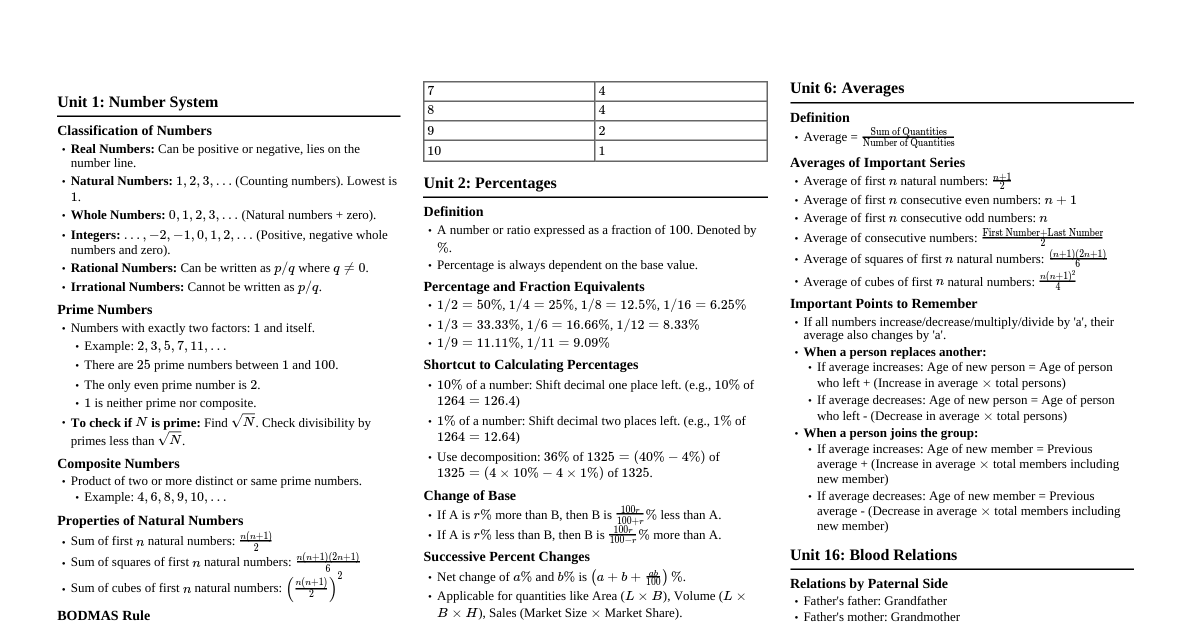
1. Basics of Number System Classification of Numbers Real Numbers: Set of all rational and irrational numbers. Irrational Numbers: Numbers that cannot be expressed as $p/q$. Examples: $\sqrt{2} = 1.4142...$, $\pi = 3.1415...$ Product/sum of a rational and an irrational number is always irrational. Rational Numbers: Numbers expressed as $p/q$ where $p, q$ are integers and $q \neq 0$. Examples: $-2/3, 3/7, -8$. Decimal representation is either finite (e.g., $3/4 = 0.75$) or recurring (e.g., $11/3 = 3.666...$). Conversion of recurring decimals: $0.x = x/10$, $0.xy = xy/100$ $0.\bar{x} = x/9$, $0.\overline{xy} = xy/99$ $0.x\bar{y} = (xy-x)/90$, $0.xy\bar{z} = (xyz-xy)/990$ Integers: Whole numbers including natural numbers with negative signs. Denoted by $\mathbb{I}$ or $\mathbb{Z}$. No fractions, no decimals. 0 is neither negative nor positive. Natural Numbers: Counting numbers $\{1, 2, 3, ...\}$. Denoted by $\mathbb{N}$. No fractions, no decimals, never negative, starts from 1. Whole Numbers: Natural numbers plus zero $\{0, 1, 2, 3, ...\}$. Denoted by $\mathbb{W}$. No fractions, no decimals, never negative. Operations on Integers Addition: Same sign: Add and keep the sign (e.g., $(+3) + (+2) = +5$, $(-2) + (-1) = -3$). Different signs: Subtract absolute values, keep sign of larger number (e.g., $(+4) + (-3) = +1$, $(-4) + (+3) = -1$). Subtraction: Same as adding the additive inverse. Multiplication: Positive $\times$ Negative = Negative (e.g., $-2 \times 7 = -14$). Negative $\times$ Negative = Positive (e.g., $-3 \times -8 = 24$). Division: Positive / Negative = Negative. Negative / Negative = Positive. Odd and Even Numbers Even Numbers: Natural numbers divisible by 2 (form $2n$). End in 0, 2, 4, 6, 8. Can be positive or negative. Odd Numbers: Natural numbers not divisible by 2 (form $2n+1$). End in 1, 3, 5, 7, 9. Can be positive or negative. Important Points on Odd/Even ODD + ODD = EVEN EVEN + EVEN = EVEN ODD + EVEN = ODD ODD × ODD = ODD EVEN × EVEN = EVEN ODD × EVEN = EVEN Prime and Composite Numbers Factors of a number: Numbers that divide another number exactly. Multiples of 12: 1, 2, 3, 4, 6, 12. Prime Numbers: Only 2 factors (1 and itself). Examples: 2, 3, 5, 7. 2 is the only even prime number. All other prime numbers are odd. 1 is neither composite nor prime. Any prime number can be expressed as $6n \pm 1$ (converse not always true). Composite Numbers: Numbers other than prime numbers. Power, Indices and Surds Rule 1: If $a$ is multiplied $n$ times, $a \times a \times ... \times a$ ($n$ times) = $a^n$. $n$: index, $a$: base. Rule 2: $a^m \times a^n = a^{m+n}$ (multiplying, same base $\rightarrow$ add powers). Rule 3: $a^m \times b^m = (ab)^m$ (multiplying, different bases, same power $\rightarrow$ multiply bases). Rule 4: $a^m / a^n = a^{m-n}$ (dividing, same base $\rightarrow$ subtract powers). Rule 5: Negative indices: $a^{-m} = 1/a^m$. Rule 6: Indices on indices: $(a^m)^n = a^{mn}$. Rule 7: Indices as fraction: $\sqrt[n]{a} = a^{1/n}$. Rule 8: If $a^x = a^y$ then $x=y$. If $x^n = y^n$ then $x=y$. Rule 9: $\sqrt[n]{ab} = \sqrt[n]{a} \times \sqrt[n]{b} = (a)^{1/n} \times (b)^{1/n}$. 2. Rules of Divisibility Basic Formulae of Divisibility Divisibility by 2: Last digit is 0 or an even number (e.g., 242, 540). Divisibility by 3: Sum of digits is divisible by 3 (e.g., 432 $\rightarrow 4+3+2=9$). Divisibility by 4: Last two digits are divisible by 4 (e.g., 48424 $\rightarrow 24$). Divisibility by 5: Last digit is 0 or 5 (e.g., 200, 225). Divisibility by 6: Divisible by both 2 and 3 (e.g., 216). Divisibility by 8: Last three digits are divisible by 8 (e.g., 56864 $\rightarrow 864$). Divisibility by 9: Sum of digits is divisible by 9 (e.g., 243243 $\rightarrow 2+4+3+2+4+3=18$). Divisibility by 10: Last digit is 0 (e.g., 10, 200). Divisibility by 11: Difference between sum of digits at even places and sum of digits at odd places is divisible by 11 (e.g., 9174 $\rightarrow (9+7)-(1+4)=11$). Divisibility by 12: Divisible by both 3 and 4. Divisibility by 7 and 13: Form groups of three digits from right, add alternate groups, difference must be divisible by 7 or 13. Divisibility by 14: Divisible by both 2 and 7. Divisibility by 15: Divisible by both 3 and 5. Divisibility by 16: Last 4 digits are divisible by 16. Few More Important Points A number $XYZ$ can be expressed as $100X + 10Y + Z$. A number of the form $ABCABC$ is always divisible by 7, 11, and 13. ($ABCABC = ABC \times 1001 = ABC \times 7 \times 11 \times 13$). A number of the form $AAAAAA$ (6 times) is exactly divisible by 3, 7, 11, 13, and 37. A number $ABCDEF$ is divisible by 7, 11, 13 if $(ABC + DEF)$ is divisible by 7, 11, and 13. Out of $n$ consecutive integers, one and only one number is divisible by $n$. The product of $n$ consecutive numbers is always divisible by $n!$. For any number $n$, $(n^P - n)$ is always divisible by $P$ where $P$ is a prime number. Divisibility Table for $a^n \pm b^n$ Form $N =$ odd $N =$ even $a^n + b^n$ Divisible by $(a+b)$ Not divisible by $(a+b)$ $a^n - b^n$ Divisible by $(a-b)$ Divisible by $(a-b)$ and $(a+b)$ 3. LCM and HCF Highest Common Factor (HCF) Also called Greatest Common Divisor (GCD). The greatest number that divides perfectly two or more given numbers. Example: HCF of 10, 20, 30 is 10. Least Common Multiple (LCM) The least number that is divisible by two or more given numbers. Example: LCM of 3, 5, 6 is 30. Factor and Multiple If $m$ divides $n$ perfectly, $m$ is a factor of $n$, and $n$ is a multiple of $m$. Rules for LCM and HCF Rule 1: $1^{st}$ number $\times 2^{nd}$ number = LCM $\times$ HCF. Rule 2: LCM of fractions = (LCM of numerators) / (HCF of denominators). Rule 3: HCF of fractions = (HCF of numerators) / (LCM of denominators). Rule 4: If there is no common factor between two numbers, then LCM is their product. Rule 5: When a number is divided by $a, b, c$ leaving same remainder $r$, the number is $k+r$ where $k = \text{LCM}(a, b, c)$. Rule 6: The largest number that divides $a, b, c$ leaving the same remainder is $\text{HCF}(a-b, b-c, c-a)$. 4. Summation/Counting of Digits Summation Rules Rule 1: Sum of first $n$ consecutive natural numbers = $n(n+1)/2$. Rule 2: Sum of squares of first $n$ consecutive natural numbers = $n(n+1)(2n+1)/6$. Rule 3: Sum of cubes of first $n$ consecutive natural numbers = $(n(n+1)/2)^2$. Rule 4: Sum of first $n$ consecutive even natural numbers = $n(n+1)$. Rule 5: Sum of first $n$ consecutive odd natural numbers = $n^2$. 5. Unit Digit / Cyclicity Unit Digit Rules Unit digit of $N^0$ is 0. Unit digit of $N^1$ is 1. For 4: $4^{\text{odd}} = 4$, $4^{\text{even}} = 6$. For 5: $5^N = 5$. For 6: $6^N = 6$. For 9: $9^{\text{odd}} = 9$, $9^{\text{even}} = 1$. Digits 2, 3, 7, 8 have a cyclicity of 4 (unit digit repeats every 4 powers). 6. Trailing Zeroes A trailing zero is produced by a pair of prime factors 2 and 5. The number of trailing zeroes in $n!$ is determined by the number of times 5 is a factor in $n!$. This can be calculated as $\lfloor n/5 \rfloor + \lfloor n/25 \rfloor + \lfloor n/125 \rfloor + \dots$ 7. Remainder Theorem Dividend = Quotient $\times$ Divisor + Remainder. Remainder is always less than the divisor. If remainder is 0, divisor is a factor. If dividend is less than divisor, remainder is the dividend itself. Negative Remainder Concept Can be used for easier calculation, but the final answer for remainder should be positive. 8. Factors of a Number If $N = a^p b^q c^r \dots$ (where $a, b, c$ are prime numbers), then: Number of factors of $N = (p+1)(q+1)(r+1)\dots$ Perfect square numbers have an odd number of factors. Perfect square of prime numbers has exactly three factors. 9. Reversing of Digits If $XY$ is a two-digit number, $XY = 10X + Y$. Its reverse $YX = 10Y + X$. Difference: $XY - YX = 9(X-Y)$. Sum: $XY + YX = 11(X+Y)$. For a three-digit number $XYZ$, $XYZ - ZYX = 99(X-Z)$. 10. Average Average Rules Rule 1: Average = (Sum of observations) / (Number of observations). Sum (S) = Average (A) $\times$ Number ($n$). Rule 2: Weighted Average: If quantities $x_1, x_2, \dots, x_n$ occur with frequencies $A_1, A_2, \dots, A_n$, then Average = $(A_1x_1 + A_2x_2 + \dots + A_nx_n) / (A_1 + A_2 + \dots + A_n)$. Rule 3: Average of first $n$ consecutive natural numbers (starting from 1) = $(n+1)/2$. Rule 4: Average of squares of first $n$ consecutive natural numbers (starting from 1) = $(n+1)(2n+1)/6$. Rule 5: Average of cubes of first $n$ consecutive natural numbers (starting from 1) = $[n(n+1)/2]^2 / n$. Rule 6: Average of first $n$ consecutive even natural numbers = $(n+1)$. Rule 7: Average of first $n$ consecutive odd natural numbers = $n$. Rule 8: Average of consecutive numbers $a, b, c, \dots, n$ = $(a+n)/2$. Rule 9: Average of $1^{st}$ $n$ multiples of a number $x$ = $x(1+n)/2$. Rule 10: If average of $n_1$ numbers is $a_1$ and average of $n_2$ numbers is $a_2$, then overall average = $(n_1a_1 + n_2a_2) / (n_1+n_2)$. 11. Algebra – Linear Equations General Concepts Linear equations involve variables raised to the power of 1. Solving simultaneous linear equations (e.g., two equations with two variables) to find unique values for variables. Word Problems Translate problem statements into mathematical equations. Common types: age-based problems, quantity distribution, work problems, distance/speed/time problems, mixture problems. Often requires setting up variables and forming equations based on given relationships. Ratio and Proportion Ratio Definition: Comparative relation between two quantities of the same type (e.g., $a:b$). Can be written as a fraction $a/b$. Always between same units (e.g., Rupees:Rupees, kg:kg). Dividing an amount $R$ into ratio $m:n$: Part of $A = (m/(m+n)) \times R$ Part of $B = (n/(m+n)) \times R$ If $A:B = m:n$ and $A$ is $R$, then $B = (n/m) \times R$. Ratio remains unchanged if both parts are multiplied or divided by the same non-zero number. Proportion Definition: Equality of two ratios (e.g., $a:b = c:d$). $a, d$ are extremes; $b, c$ are means. Product of extremes = Product of means ($ad = bc$). Rules for Proportion Rule 1 (Adding $x$): If $x$ is added to $a, b, c, d$ to make them proportional, then $(a+x)/(b+x) = (c+x)/(d+x)$. Rule 2 (Invertendo): If $a/b = c/d$, then $b/a = d/c$. Rule 3 (Alternendo): If $a/b = c/d$, then $a/c = b/d$. Rule 4 (Componendo): If $a/b = c/d$, then $(a+b)/b = (c+d)/d$. Rule 5 (Dividendo): If $a/b = c/d$, then $(a-b)/b = (c-d)/d$. Rule 6 (Componendo and Dividendo): If $a/b = c/d$, then $(a+b)/(a-b) = (c+d)/(c-d)$. Variation Direct Variation: $x \propto y$ or $x = ky$ ($k$ is a constant). Inverse Variation: $x \propto 1/y$ or $x = k/y$ ($k$ is a constant). Percentage Definition "Per hundred". $X\% = X/100$. To convert fraction/decimal to percentage, multiply by 100. Important Points If an amount is increased by $a\%$ and then reduced by $a\%$, the net change is a decrease of $(a^2/100)\%$. Profit and Loss - Partnership Basic Definitions Cost Price (CP): Purchasing price + repairing/maintenance cost. Selling Price (SP): Price at which an item is sold. Profit and Loss Rules Rule 1 (Profit): If SP > CP, Profit = SP - CP. Profit % = (Profit/CP) $\times 100$. Profit/loss is always calculated on CP. Rule 2 (Loss): If CP > SP, Loss = CP - SP. Loss % = (Loss/CP) $\times 100$. Rule 3 (SP/CP relations): If $r\%$ profit: SP = CP $\times (100+r)/100$, CP = SP $\times 100/(100+r)$. If $r\%$ loss: SP = CP $\times (100-r)/100$, CP = SP $\times 100/(100-r)$. Rule 4 (Discount): Calculated on Market Price (MP). Discount = MP - SP. Discount % = (Discount/MP) $\times 100$. Rule 5 (Selling two similar objects): If one is sold at $x\%$ loss and other at $x\%$ gain, there is always a loss of $(x/10)^2\%$. Rule 6 (Price change due to profit/loss): If an item is sold at $x\%$ profit/loss, and selling it for $R$ more/less would result in $y\%$ profit/loss, then CP = $R \times 100 / (y \pm x)$. (Use $+$ for one profit and one loss, $-$ for both profit or both loss). Rule 7 (Dishonest shopkeeper): If goods are sold at CP using false weight, then Profit % = (Error / (True value - Error)) $\times 100$. Mixture and Alligation Rule of Alligation Used to find the ratio in which two ingredients (cheap price $C$, dear price $D$) are mixed to get a mixture of mean price $M$. Quantity of cheaper / Quantity of dearer = $(D-M) / (M-C)$. Time and Work Basic Rules Rule 1 (Men, Days, Work): If $M_1$ men do $W_1$ work in $D_1$ days, and $M_2$ men do $W_2$ work in $D_2$ days: $M_1D_1/W_1 = M_2D_2/W_2$. If also $T_1$ and $T_2$ hours/day: $M_1D_1T_1/W_1 = M_2D_2T_2/W_2$. Rule 2 (Individual Work): If A does a work in $x$ days, and B in $y$ days: A's 1 day work = $1/x$, B's 1 day work = $1/y$. A and B together in 1 day = $1/x + 1/y = (x+y)/xy$. Total time for A and B together = $xy/(x+y)$. Rule 3 (Efficiency): Efficiency is inversely proportional to time taken. If efficiency $E \propto 1/D$, then $ED = k$ (constant). $E_1D_1 = E_2D_2$. Rule 4 (Wages): If A, B, C finish work in $m, n, p$ days respectively, and total wages are $R$, then wages are distributed in ratio of their 1-day work: $1/m : 1/n : 1/p$. Time, Speed and Distance Basic Relationships Rule 1: Distance = Speed $\times$ Time. Speed = Distance / Time. Time = Distance / Speed. Unit Conversion: $1 \text{ m/s} = 18/5 \text{ km/h}$, $1 \text{ km/h} = 5/18 \text{ m/s}$. Average Speed Rule 2: Average Speed = (Total Distance) / (Total Time). If distances $d_1, d_2, \dots$ are covered in times $t_1, t_2, \dots$: Average Speed = $(d_1+d_2+\dots) / (t_1+t_2+\dots)$. Relative Speed Opposite Direction: Relative Speed = Sum of individual speeds. Same Direction: Relative Speed = Difference of individual speeds. Problems Related to Trains Rule 1 (Crossing Platform/Bridge/Tunnel): Distance = Length of Train + Length of Platform/Bridge/Tunnel. Rule 2 (Crossing Pole/Man): Distance = Length of Train. Boats and Streams Rule 1 (Upstream): Speed against stream = Speed in still water - Speed of stream. Rule 2 (Downstream): Speed with stream = Speed in still water + Speed of stream. Circular Tracks Rule 1 (Meeting for first time): Time = (Length of track) / (Relative speed). Rule 2 (Meeting at starting point): Time = LCM of (Length/Speed A, Length/Speed B). Rule 3 (Faster person covers more rounds): When two people run on a circular track from the same point at the same time, every time they meet, the faster person covers one full round more than the slower person. Permutation and Combination Basic Formulae Factorial: $n! = n \times (n-1) \times \dots \times 1$. Permutation ($^nP_r$): Number of ways to select and arrange $r$ objects from $n$ distinct objects. $^nP_r = n! / (n-r)!$. Combination ($^nC_r$): Number of ways to select $r$ objects from $n$ distinct objects (order doesn't matter). $^nC_r = n! / (r! (n-r)!)$. Rules for Combinations and Permutations Rule 1: $^nC_r = ^nC_{n-r}$. Rule 2: Total selections from $n$ distinct items = $2^n$. Rule 3 (Frequently used results): $^nC_0 = 1$, $^nC_n = 1$, $^nC_1 = n$. Partitioning Rule 1 (Identical things into distinct slots): $n$ identical things into $r$ distinct slots = $^{n+r-1}C_{r-1}$. Rule 2 (Each slot gets at least 1): $n$ identical things into $r$ distinct slots, each getting at least 1 = $^{n-1}C_{r-1}$. Arrangement with Repetitions If $x$ items out of $n$ are repeated, total arrangements = $n! / x!$. Circular Arrangement $n$ things in a circle (distinct clockwise/anticlockwise) = $(n-1)!$. $n$ things in a circle (same clockwise/anticlockwise, e.g., beads in a necklace) = $(n-1)!/2$. Drawing Lines from Points Number of straight lines from $n$ non-collinear points = $^nC_2$. If $p$ points are collinear: $^nC_2 - ^pC_2 + 1$. Number of diagonals in a polygon with $n$ sides = $^nC_2 - n$. Drawing Triangles from Points Number of triangles from $n$ non-collinear points = $^nC_3$. If $p$ points are collinear: $^nC_3 - ^pC_3$. Mensuration Triangles Rule 1 (General Triangle): Area = $(1/2) \times \text{base} \times \text{height}$. Area (Heron's formula) = $\sqrt{S(S-a)(S-b)(S-c)}$, where $S = (a+b+c)/2$. Rule 2 (Equilateral Triangle): All sides equal, all angles $60^\circ$. Height = $(\sqrt{3}/2) \times a$. Area = $(\sqrt{3}/4) \times a^2$. In-radius (radius of inscribed circle) = $a/(2\sqrt{3})$. Circum-radius (radius of circumscribed circle) = $a/\sqrt{3}$. Area of in-circle = $\pi a^2 / 12$. Area of circum-circle = $\pi a^2 / 3$. Rectangle Opposite sides equal and parallel, all angles $90^\circ$. Area = length $\times$ breadth ($lb$). Perimeter = $2(l+b)$. Square All sides equal, all angles $90^\circ$. Area = side$^2 = (\text{diagonal})^2/2$. Perimeter = $4 \times \text{side}$. Parallelogram Opposite sides equal and parallel. Area = base $\times$ height. Perimeter = $2(\text{side}_1 + \text{side}_2)$. Rhombus All sides equal. Area = $(1/2) \times \text{diagonal}_1 \times \text{diagonal}_2$. Perimeter = $4 \times \text{side}$. Trapezium One pair of parallel sides. Area = $(1/2) \times (\text{sum of parallel sides}) \times \text{height}$. Perimeter = sum of all sides. Circle Radius ($r$): Distance from center to circumference. Diameter ($D$): $2r$. Area = $\pi r^2$. Perimeter (Circumference) = $2\pi r = \pi D$. Length of arc AB = $(\theta/360^\circ) \times 2\pi r$. Area of sector AOB = $(\theta/360^\circ) \times \pi r^2$. Inscribed Circle: Circle inside a polygon tangent to all its sides. Cyclic Quadrilateral: Vertices lie on the circumference of a circle. Sum of opposite angles = $180^\circ$. Solids Cuboid: Volume = $l \times b \times h$. Total Surface Area = $2(lb + bh + lh)$. Body diagonal = $\sqrt{l^2+b^2+h^2}$. Cube: Volume = side$^3$. Total Surface Area = $6 \times \text{side}^2$. Cylinder: Volume = $\pi r^2 h$. Curved Surface Area = $2\pi r h$. Area of base = $\pi r^2$. Sphere: Volume = $(4/3)\pi r^3$. Surface Area = $4\pi r^2$. Hemisphere: Volume = $(2/3)\pi r^3$. Curved Surface Area = $2\pi r^2$. Total Surface Area = $3\pi r^2$. Right Circular Cone: Volume = $(1/3)\pi r^2 h$. Curved Surface Area = $\pi r l$. Area of base = $\pi r^2$. Total Surface Area = $\pi r (l+r)$.