Physics Electromagnetism & Cir
Cheatsheet Content
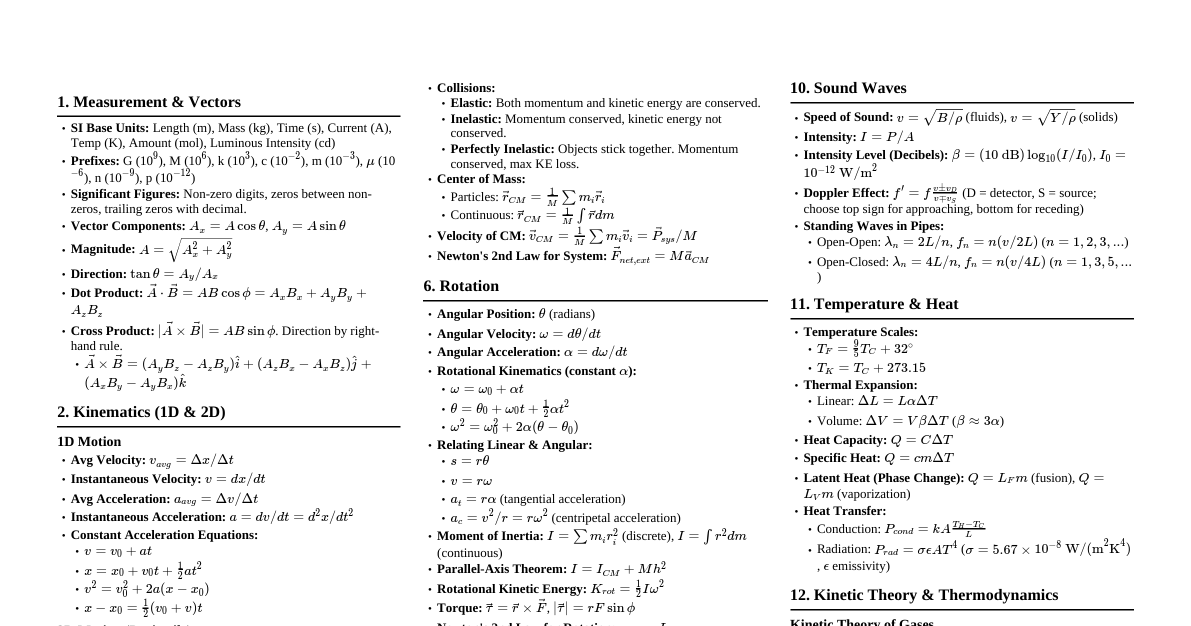
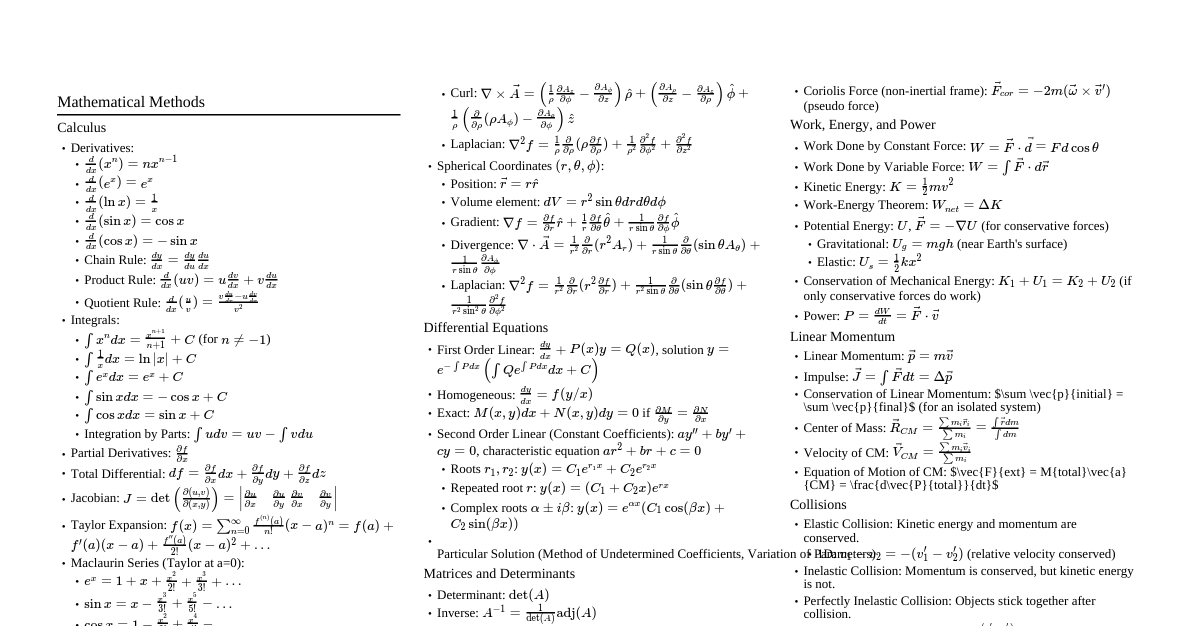
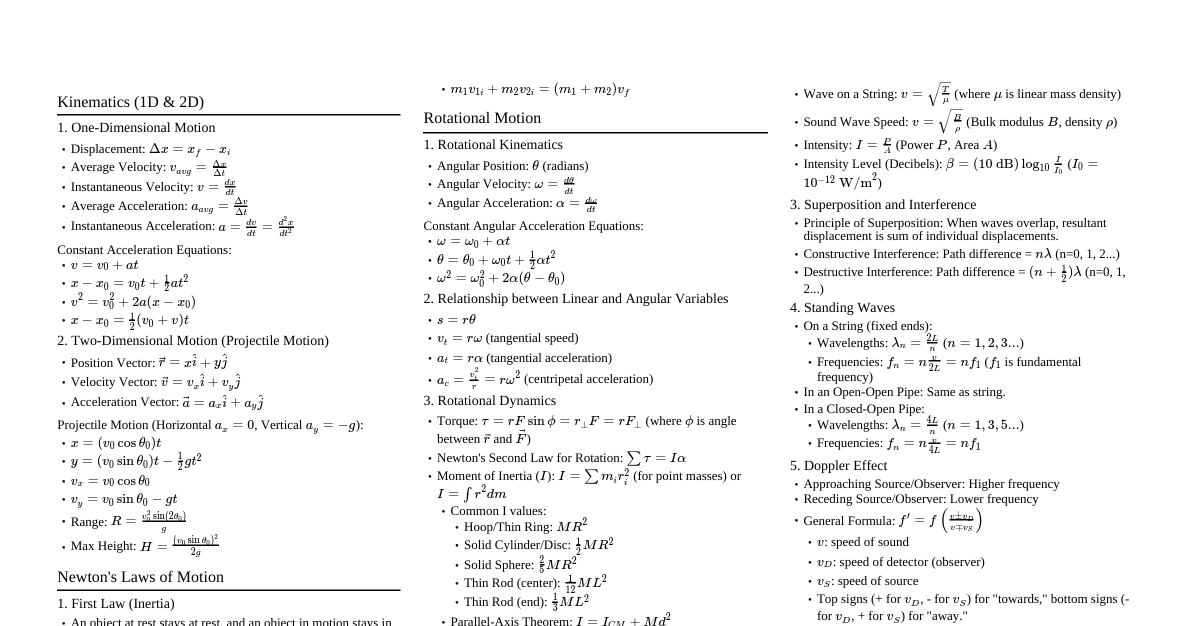
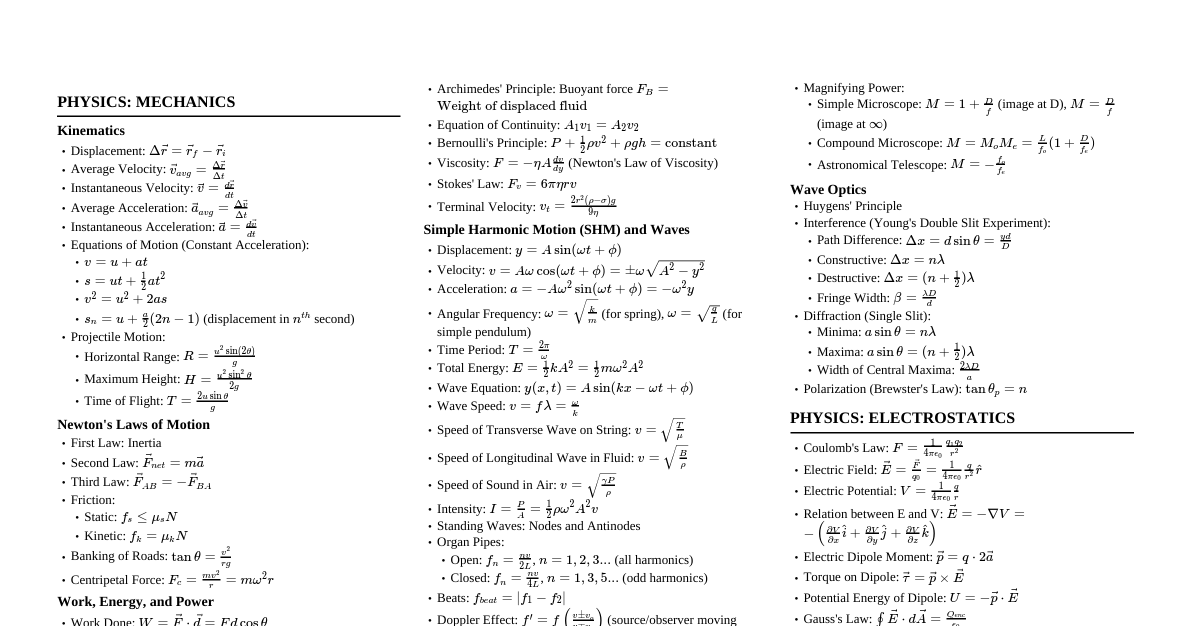
### Page 1: Concept & Formula Reference #### Simple Pendulum - **Key Equations:** - Period: $T = 2\pi\sqrt{\frac{L}{g}}$ - **Variables & Units:** - $T$: Period (s), scalar - $L$: Length of string (m), scalar - $g$: Acceleration due to gravity (m/s²), scalar - **Important Info & Assumptions:** - Valid for small angular displacements ($\theta \lesssim 15^\circ$). - Assumes massless string and no air resistance. - Describes Simple Harmonic Motion (SHM). - **Things Worth Memorizing:** - Period is independent of mass and amplitude (for small angles). - Period increases with length, decreases with gravity. #### Charging (RC Circuits) - **Key Equations:** - Charge on capacitor: $Q(t) = Q_{max}(1 - e^{-t/\tau})$ - Voltage across capacitor: $V_C(t) = \mathcal{E}(1 - e^{-t/\tau})$ - Current in circuit: $I(t) = I_{max} e^{-t/\tau}$ - Time constant: $\tau = RC$ - **Variables & Units:** - $Q(t)$: Charge (C), scalar; $Q_{max} = C\mathcal{E}$ - $V_C(t)$: Voltage (V), scalar; $\mathcal{E}$: EMF of battery (V) - $I(t)$: Current (A), scalar; $I_{max} = \mathcal{E}/R$ - $\tau$: Time constant (s), scalar - $R$: Resistance ($\Omega$), $C$: Capacitance (F) - **Important Info & Assumptions:** - Describes transient behavior of circuits with resistors and capacitors. - Assumes capacitor is initially uncharged ($Q(0)=0$). - $Q$ and $V_C$ approach $Q_{max}$ and $\mathcal{E}$ asymptotically. - **Things Worth Memorizing:** - After $1\tau$, $Q$ is 63.2% of max. After $5\tau$, charging is ~99% complete. - Discharging follows $Q(t) = Q_0 e^{-t/\tau}$. #### Coulomb’s Law - **Key Equations:** - Force between point charges: $\vec{F} = k\frac{q_1 q_2}{r^2}\hat{r}$ - **Variables & Units:** - $\vec{F}$: Electric force (N), vector - $q_1, q_2$: Point charges (C), scalar - $r$: Distance between charges (m), scalar - $\hat{r}$: Unit vector along line connecting charges, vector - $k = \frac{1}{4\pi\epsilon_0} \approx 8.99 \times 10^9 \text{ N}\cdot\text{m}^2/\text{C}^2$: Coulomb's constant - $\epsilon_0 \approx 8.85 \times 10^{-12} \text{ C}^2/(\text{N}\cdot\text{m}^2)$: Permittivity of free space - **Important Info & Assumptions:** - Describes electrostatic force between two point charges at rest. - Force is along the line connecting the charges. - Like charges repel, opposite charges attract. - **Things Worth Memorizing:** - Inverse square law. - $k$ and $\epsilon_0$ are fundamental constants. #### Electric Field - **Key Equations:** - Definition: $\vec{E} = \frac{\vec{F}}{q_0}$ - From a point charge $q$: $\vec{E} = k\frac{q}{r^2}\hat{r}$ - From continuous charge: $\vec{E} = \int d\vec{E} = \int k\frac{dq}{r^2}\hat{r}$ - **Variables & Units:** - $\vec{E}$: Electric field (N/C or V/m), vector - $\vec{F}$: Force on test charge $q_0$ (N) - $q_0$: Positive test charge (C) - $dq$: Differential charge element (C) - $\hat{r}$: Unit vector from source charge to field point - **Important Info & Assumptions:** - A field exists independently of a test charge, describing the space around charges. - Direction of $\vec{E}$ is direction a positive test charge would accelerate. - Superposition Principle: Net $\vec{E}$ is vector sum of fields from individual charges. - **Things Worth Memorizing:** - $\vec{E}$ points away from positive charges, towards negative charges. - Standard charge densities: $\lambda$ (line, C/m), $\sigma$ (surface, C/m²), $\rho$ (volume, C/m³). #### Electric Field Lines - **Important Info & Assumptions:** - Originate on positive charges, terminate on negative charges (or extend to infinity). - Never cross. - Density of lines indicates field strength (closer = stronger). - Tangent to a field line gives direction of $\vec{E}$ at that point. - **Things Worth Memorizing:** - Perpendicular to conductor surfaces in electrostatic equilibrium. #### Electric Flux - **Key Equations:** - Definition: $\Phi_E = \int \vec{E} \cdot d\vec{A}$ - For uniform E-field and flat surface: $\Phi_E = EA\cos\theta$ - **Variables & Units:** - $\Phi_E$: Electric flux (N$\cdot$m²/C or V$\cdot$m), scalar - $\vec{E}$: Electric field (N/C or V/m) - $d\vec{A}$: Differential area vector (m²), normal to surface - $\theta$: Angle between $\vec{E}$ and $d\vec{A}$ - **Important Info & Assumptions:** - Measure of "number of field lines" passing through a surface. - Positive flux: field lines leave the volume. Negative flux: field lines enter the volume. - **Things Worth Memorizing:** - Flux is maximum when $\vec{E}$ is perpendicular to the surface ($\theta=0^\circ$). - Flux is zero when $\vec{E}$ is parallel to the surface ($\theta=90^\circ$). #### Gauss’s Law - **Key Equations:** - $\oint \vec{E} \cdot d\vec{A} = \frac{Q_{enc}}{\epsilon_0}$ - **Variables & Units:** - $Q_{enc}$: Total charge enclosed by the Gaussian surface (C), scalar - **Important Info & Assumptions:** - Applies to *any* closed surface (Gaussian surface). - Most useful for calculating $\vec{E}$ for highly symmetric charge distributions (spherical, cylindrical, planar). - Requires $\vec{E}$ to be constant and perpendicular/parallel to $d\vec{A}$ over parts of the surface. - **Things Worth Memorizing:** - If $Q_{enc}=0$, then $\oint \vec{E} \cdot d\vec{A} = 0$. (Doesn't mean $\vec{E}=0$ everywhere, just net flux is zero). - E-field inside a conductor is zero in electrostatic equilibrium. #### Electric Potential - **Key Equations:** - Potential difference: $\Delta V = V_B - V_A = -\int_A^B \vec{E} \cdot d\vec{s}$ - For point charge $q$: $V = k\frac{q}{r}$ (relative to $V=0$ at $r=\infty$) - From continuous charge: $V = \int dV = \int k\frac{dq}{r}$ - Potential energy: $\Delta U = q_0 \Delta V$ - **Variables & Units:** - $V$: Electric potential (J/C or Volts, V), scalar - $\Delta U$: Change in electric potential energy (J), scalar - $q_0$: Charge (C) moved in the field - $\vec{s}$: Displacement vector - **Important Info & Assumptions:** - Scalar quantity, easier to work with than vector E-field. - Potential is a property of the field, potential energy is a property of a charge in the field. - Work done by $\vec{E}$ is $W = - \Delta U = -q_0 \Delta V$. - **Things Worth Memorizing:** - Positive charges move from high $V$ to low $V$ naturally. - Negative charges move from low $V$ to high $V$ naturally. - $V$ can be positive or negative depending on source charge and reference point. #### Determining Electric Field from Potentials - **Key Equations:** - General: $\vec{E} = -\nabla V = -(\frac{\partial V}{\partial x}\hat{i} + \frac{\partial V}{\partial y}\hat{j} + \frac{\partial V}{\partial z}\hat{k})$ - 1D: $E_x = -\frac{dV}{dx}$ - **Important Info & Assumptions:** - Useful when $V$ is known or easier to calculate. - $\vec{E}$ points in the direction of steepest *decrease* in potential. - **Things Worth Memorizing:** - If $V$ is constant, $\vec{E}=0$. #### Equipotential Surfaces - **Important Info & Assumptions:** - Surfaces where the electric potential $V$ is constant. - Electric field lines are always perpendicular to equipotential surfaces. - No work is done by the electric field when a charge moves along an equipotential surface. - **Things Worth Memorizing:** - The surface of a conductor in electrostatic equilibrium is an equipotential surface. #### Capacitance - **Key Equations:** - Definition: $C = \frac{Q}{V}$ - Parallel-plate capacitor: $C = \frac{\epsilon_0 A}{d}$ - With dielectric: $C = \kappa C_0 = \frac{\kappa \epsilon_0 A}{d}$ - **Variables & Units:** - $C$: Capacitance (Farads, F = C/V), scalar - $Q$: Magnitude of charge on one plate (C) - $V$: Potential difference between plates (V) - $A$: Area of plates (m²), $d$: Separation (m) - $\kappa$: Dielectric constant (unitless), $\kappa \ge 1$ - **Important Info & Assumptions:** - A measure of a device's ability to store electric charge. - $C$ depends only on geometry and dielectric material, not $Q$ or $V$. - **Things Worth Memorizing:** - Dielectrics increase capacitance. - $1 \text{ F}$ is a very large capacitance; typically $\mu\text{F}$ or $\text{pF}$. #### Series and Parallel Capacitors - **Key Equations:** - Parallel: $C_{eq} = C_1 + C_2 + C_3 + \dots$ - Series: $\frac{1}{C_{eq}} = \frac{1}{C_1} + \frac{1}{C_2} + \frac{1}{C_3} + \dots$ - **Important Info & Assumptions:** - **Parallel:** Same voltage across each capacitor ($V_{total} = V_1 = V_2 = \dots$). Total charge is sum of individual charges ($Q_{total} = Q_1 + Q_2 + \dots$). - **Series:** Same charge on each capacitor ($Q_{total} = Q_1 = Q_2 = \dots$). Total voltage is sum of individual voltages ($V_{total} = V_1 + V_2 + \dots$). - **Things Worth Memorizing:** - Equivalent capacitance for parallel is always larger than any individual capacitance. - Equivalent capacitance for series is always smaller than any individual capacitance. #### Energy and Capacitors - **Key Equations:** - Stored energy: $U = \frac{1}{2}CV^2 = \frac{1}{2}\frac{Q^2}{C} = \frac{1}{2}QV$ - Energy density (parallel plates): $u_E = \frac{1}{2}\epsilon_0 E^2$ - **Variables & Units:** - $U$: Stored potential energy (J), scalar - $u_E$: Energy per unit volume (J/m³), scalar - **Important Info & Assumptions:** - Energy is stored in the electric field between the plates. - **Things Worth Memorizing:** - Energy density formula is general for any electric field. #### Current - **Key Equations:** - Definition: $I = \frac{dQ}{dt}$ - Microscopic: $I = nq v_d A$ - **Variables & Units:** - $I$: Electric current (Amperes, A = C/s), scalar (direction specified by convention) - $n$: Charge carrier density (m⁻³), $q$: Charge per carrier (C) - $v_d$: Drift velocity (m/s), $A$: Cross-sectional area (m²) - **Important Info & Assumptions:** - Conventional current direction is the direction positive charges would flow. - **Things Worth Memorizing:** - Current is conserved at junctions (Kirchhoff's Junction Rule). #### Resistance - **Key Equations:** - Definition: $R = \frac{V}{I}$ - Resistivity: $R = \rho \frac{L}{A}$ - Temperature dependence of resistivity: $\rho(T) = \rho_0[1 + \alpha(T-T_0)]$ - **Variables & Units:** - $R$: Resistance (Ohms, $\Omega$ = V/A), scalar - $\rho$: Resistivity ($\Omega \cdot$m), scalar - $L$: Length of conductor (m), $A$: Cross-sectional area (m²) - $\alpha$: Temperature coefficient of resistivity ($\text{K}^{-1}$ or $^\circ\text{C}^{-1}$) - **Important Info & Assumptions:** - Resistance depends on material properties ($\rho$) and geometry. - Most materials' resistance increases with temperature. - **Things Worth Memorizing:** - Good conductors have low $\rho$, good insulators have high $\rho$. #### Ohm’s Law and Power - **Key Equations:** - Ohm’s Law: $V = IR$ - Electric Power: $P = IV = I^2R = \frac{V^2}{R}$ - **Variables & Units:** - $P$: Power (Watts, W = J/s), scalar - **Important Info & Assumptions:** - Ohm’s Law applies to ohmic materials (resistance is constant regardless of $V$ or $I$). - Power is the rate at which energy is converted (e.g., dissipated as heat in a resistor). - **Things Worth Memorizing:** - Power dissipated in a resistor is always positive. #### Electromotive Force (EMF) and Resistor Combinations - **Key Equations:** - Terminal voltage: $V_{terminal} = \mathcal{E} - Ir$ (for real battery with internal resistance $r$) - Series resistors: $R_{eq} = R_1 + R_2 + R_3 + \dots$ - Parallel resistors: $\frac{1}{R_{eq}} = \frac{1}{R_1} + \frac{1}{R_2} + \frac{1}{R_3} + \dots$ - **Variables & Units:** - $\mathcal{E}$: EMF (V), scalar - $r$: Internal resistance ($\Omega$), scalar - **Important Info & Assumptions:** - **EMF ($\mathcal{E}$):** The ideal voltage source, max potential difference when no current is drawn. - **Series:** Same current through each resistor. Total voltage drop is sum of individual drops. - **Parallel:** Same voltage drop across each resistor. Total current is sum of individual currents. - **Things Worth Memorizing:** - Resistors in series add, resistors in parallel sum reciprocally. This is opposite to capacitors. #### Kirchhoff’s Rules - **Key Equations:** - **Junction Rule:** $\sum I_{in} = \sum I_{out}$ (Conservation of Charge) - **Loop Rule:** $\sum \Delta V = 0$ (Conservation of Energy) - **Important Info & Assumptions:** - **Junction Rule:** Algebraic sum of currents entering a junction is zero. - **Loop Rule:** Algebraic sum of potential changes around any closed loop in a circuit is zero. - **Things Worth Memorizing:** - Essential for analyzing complex circuits that cannot be reduced by series/parallel combinations. - Be consistent with sign conventions for voltage changes (e.g., $-IR$ when traversing resistor with current, $+\mathcal{E}$ when traversing battery from - to +). #### Magnetism - **Key Equations:** - Force on moving charge: $\vec{F}_B = q\vec{v} \times \vec{B}$ - Force on current-carrying wire: $\vec{F}_B = I\vec{L} \times \vec{B}$ - Magnetic dipole moment: $\vec{\mu} = IA\hat{n}$ - Torque on a current loop: $\vec{\tau} = \vec{\mu} \times \vec{B}$ - Potential energy of a dipole: $U = -\vec{\mu} \cdot \vec{B}$ - **Variables & Units:** - $\vec{B}$: Magnetic field (Tesla, T), vector - $\vec{v}$: Velocity (m/s), $\vec{L}$: Length vector (m) - $\vec{\mu}$: Magnetic dipole moment (A$\cdot$m²), vector - $\vec{\tau}$: Torque (N$\cdot$m), vector - **Important Info & Assumptions:** - Magnetic force is always perpendicular to both $\vec{v}$ and $\vec{B}$. - Magnetic force does no work on a moving charge ($W = \int \vec{F} \cdot d\vec{s} = 0$ since $\vec{F} \perp d\vec{s}$). - Right-hand rule (RHR) for cross products. - **Things Worth Memorizing:** - $1 \text{ T}$ is a strong magnetic field. - Magnetic fields are produced by moving charges/currents. #### Biot-Savart Law - **Key Equations:** - Magnetic field from current element: $d\vec{B} = \frac{\mu_0}{4\pi} \frac{I d\vec{s} \times \hat{r}}{r^2}$ - **Variables & Units:** - $\mu_0 = 4\pi \times 10^{-7} \text{ T}\cdot\text{m/A}$: Permeability of free space - $I d\vec{s}$: Current element vector (A$\cdot$m) - $\hat{r}$: Unit vector from $d\vec{s}$ to field point - **Important Info & Assumptions:** - Fundamental law for calculating magnetic fields from current distributions. - Integration is required for extended current configurations. - **Things Worth Memorizing:** - Standard results for common geometries: - Long straight wire: $B = \frac{\mu_0 I}{2\pi r}$ - Center of current loop: $B = \frac{\mu_0 I}{2R}$ #### Parallel Currents and Current Loops - **Key Equations:** - Force between two parallel wires: $F/L = \frac{\mu_0 I_1 I_2}{2\pi d}$ - **Important Info & Assumptions:** - Force is attractive if currents are in the same direction. - Force is repulsive if currents are in opposite directions. - **Things Worth Memorizing:** - This force defines the Ampere. #### Ampere’s Law - **Key Equations:** - $\oint \vec{B} \cdot d\vec{s} = \mu_0 I_{enc}$ - **Variables & Units:** - $I_{enc}$: Net current enclosed by the Amperian loop (A), scalar - **Important Info & Assumptions:** - Applies to *any* closed loop (Amperian loop). - Most useful for calculating $\vec{B}$ for highly symmetric current distributions (long wires, solenoids, toroids). - Requires $\vec{B}$ to be constant and parallel/perpendicular to $d\vec{s}$ over parts of the loop. - **Things Worth Memorizing:** - Similar in form and application to Gauss's Law. - Direction of $I_{enc}$ is determined by RHR relative to loop direction. #### Solenoids - **Key Equations:** - Magnetic field inside ideal solenoid: $B = \mu_0 n I$ - **Variables & Units:** - $n = N/L$: Number of turns per unit length (m⁻¹) - **Important Info & Assumptions:** - Assumes an infinitely long solenoid. - Field is uniform inside, nearly zero outside. - **Things Worth Memorizing:** - Field strength depends on current and winding density, not radius. #### Faraday’s Law - **Key Equations:** - Induced EMF: $\mathcal{E} = -\frac{d\Phi_B}{dt}$ - Magnetic flux: $\Phi_B = \int \vec{B} \cdot d\vec{A}$ - **Variables & Units:** - $\mathcal{E}$: Induced EMF (Volts, V), scalar - $\Phi_B$: Magnetic flux (Weber, Wb = T$\cdot$m²), scalar - **Important Info & Assumptions:** - A changing magnetic flux through a loop induces an EMF. - The change in flux can be due to changing $\vec{B}$, changing area $A$, or changing angle between $\vec{B}$ and $d\vec{A}$. - **Lenz’s Law:** The negative sign indicates the induced current/EMF opposes the change in magnetic flux that produced it. - **Things Worth Memorizing:** - Basis for generators and transformers. #### Motional EMF - **Key Equations:** - $\mathcal{E} = BLv$ - **Variables & Units:** - $B$: Magnetic field (T), $L$: Length of conductor (m), $v$: Speed of conductor (m/s) - **Important Info & Assumptions:** - A specific case of Faraday's Law. - Applies when a conductor moves through a magnetic field. - Assumes $\vec{B}$, $\vec{L}$, and $\vec{v}$ are mutually perpendicular. - **Things Worth Memorizing:** - Due to magnetic force on charges within the moving conductor. #### Induced Electric Fields - **Key Equations:** - Non-conservative E-field: $\oint \vec{E} \cdot d\vec{s} = -\frac{d\Phi_B}{dt}$ - **Important Info & Assumptions:** - A changing magnetic field creates an electric field, even in empty space. - This induced E-field is non-conservative (work done depends on path). - This is a more general statement of Faraday's Law. - **Things Worth Memorizing:** - Unlike electrostatic E-fields, these E-field lines can form closed loops. ### Page 2: Problem-Solving & Intuition Guide #### Common Mistakes & Misconceptions - **Sign Errors:** - **Vector vs. Scalar:** For vector quantities ($\vec{F}, \vec{E}$), calculate magnitude ignoring charge signs, then determine direction by inspection (repel/attract). For scalar quantities ($V, U$), use charge signs directly. - **Lenz's Law:** The induced effect *opposes* the *change* in flux. Don't just oppose the existing flux. Use RHR to determine the direction of the opposing B-field, then the induced current. - **Kirchhoff's Loop Rule:** Be meticulous with potential changes ($\pm IR$, $\pm \mathcal{E}$). Pick a direction and stick with it. - **Vector Addition:** For multi-charge systems, $\vec{F}$ and $\vec{E}$ must be added vectorially (component-wise), not just magnitudes. - **Units:** Always check units! $1 \text{ cm} \ne 1 \text{ m}$, $1 \mu\text{F} \ne 1 \text{ F}$. - **Assumptions:** For formulas like $T = 2\pi\sqrt{L/g}$ (small angle) or $B = \mu_0 n I$ (infinite solenoid), remember their limits. - **Gaussian/Amperian Surfaces:** Choosing a surface/loop where symmetry conditions are not met. The integral becomes intractable without symmetry. - **RC/RL Circuits:** Confusing charging vs. discharging equations. Remember exponential growth vs. decay. #### "When to Use This" Cues & Decision Triggers - **High Symmetry (Spherical, Cylindrical, Planar):** - **Gauss's Law:** To find $\vec{E}$ when charge distribution is symmetric. - **Ampere's Law:** To find $\vec{B}$ when current distribution is symmetric. - **No Symmetry / Point Charges / Arbitrary Distributions:** - **Superposition:** For discrete charges/currents, sum individual contributions (vectorially for $\vec{F}, \vec{E}, \vec{B}$; scalarly for $V, U, \Phi$). - **Integration (Coulomb's Law, Biot-Savart, $V=\int k dq/r$):** For continuous charge/current distributions without high symmetry or when a standard result isn't applicable. - **Path Dependence:** - **Electric Potential (Electrostatics):** Potential difference is path-independent. - **Induced Electric Field:** Induced EMF (and thus work done by induced E-field) *is* path-dependent. - **Changing Magnetic Flux:** - **Faraday's Law:** Any time magnetic flux through a loop changes (varying $\vec{B}$, varying area $A$, varying orientation $\theta$). - **Motional EMF:** Specific case of Faraday's Law when a conductor moves in a $\vec{B}$-field. - **Steady Current / DC Circuits:** - **Ohm's Law, Kirchhoff's Rules:** For circuits with constant current and voltage sources. - **Time-Varying Circuits:** - **RC/RL Circuits:** When capacitors or inductors are charging or discharging. #### Common Problem Types & Approaches - **Finding Force/Field/Potential:** 1. **Point Charges:** Use Coulomb's Law/E-field/Potential formulas directly. Vector sum for $\vec{F}$, $\vec{E}$. Scalar sum (with signs) for $V$. 2. **Continuous Distributions:** - **Symmetric:** Use Gauss's Law (for $\vec{E}$) or Ampere's Law (for $\vec{B}$). - **Non-symmetric:** Set up integrals using $dq = \lambda dl, \sigma dA, \rho dV$ for $\vec{E}$ or $V$, or $Id\vec{s}$ for $\vec{B}$ (Biot-Savart). - **Circuit Analysis:** 1. **Simple:** Reduce series/parallel combinations of resistors/capacitors. 2. **Complex:** Apply Kirchhoff's Rules (Junction and Loop Rules) to set up a system of equations. - **Energy Problems:** - Use $U=qV$ for potential energy, $U=\frac{1}{2}CV^2$ for stored capacitor energy. - Apply conservation of energy if only electrostatic forces are doing work. - **E&M Induction:** - **Identify $\Phi_B$:** Determine how magnetic flux through a loop is changing. - **Apply Faraday's Law:** Calculate $\frac{d\Phi_B}{dt}$. - **Lenz's Law:** Determine direction of induced current/EMF to oppose the flux change. #### Rearranged / Specialized Equation Forms - **Energy of a system of point charges:** $U_{sys} = \sum_{i #### Sanity Checks, Limiting Cases, and Units - **Limiting Cases:** Does your answer make sense if a variable goes to zero or infinity? (e.g., $r \to \infty$, $E \to 0$ for a point charge). - **Units:** Always check that the final units are correct for the quantity you are calculating. This catches many algebraic errors. - **Direction (Vectors):** Does the direction of your calculated vector quantity ($\vec{E}, \vec{B}, \vec{F}$) align with physical intuition (e.g., $\vec{E}$ away from positive charge)? - **Magnitude (Scalars):** Is the magnitude reasonable? (e.g., $10^{20} \text{ V}$ is probably wrong for a typical circuit). - **Right-Hand Rules (RHR):** Crucial for vector products and directions in magnetism. Practice them! - **$\vec{A} \times \vec{B}$:** Fingers along $\vec{A}$, curl towards $\vec{B}$, thumb is $\vec{A} \times \vec{B}$. - **Current-produced $\vec{B}$:** Thumb in current direction, curled fingers show $\vec{B}$ direction. - **Lenz's Law:** Determine change in flux $\to$ determine opposing $\vec{B}_{induced}$ $\to$ use RHR to find $\vec{I}_{induced}$.