Chemistry & Biology Essentials
Cheatsheet Content
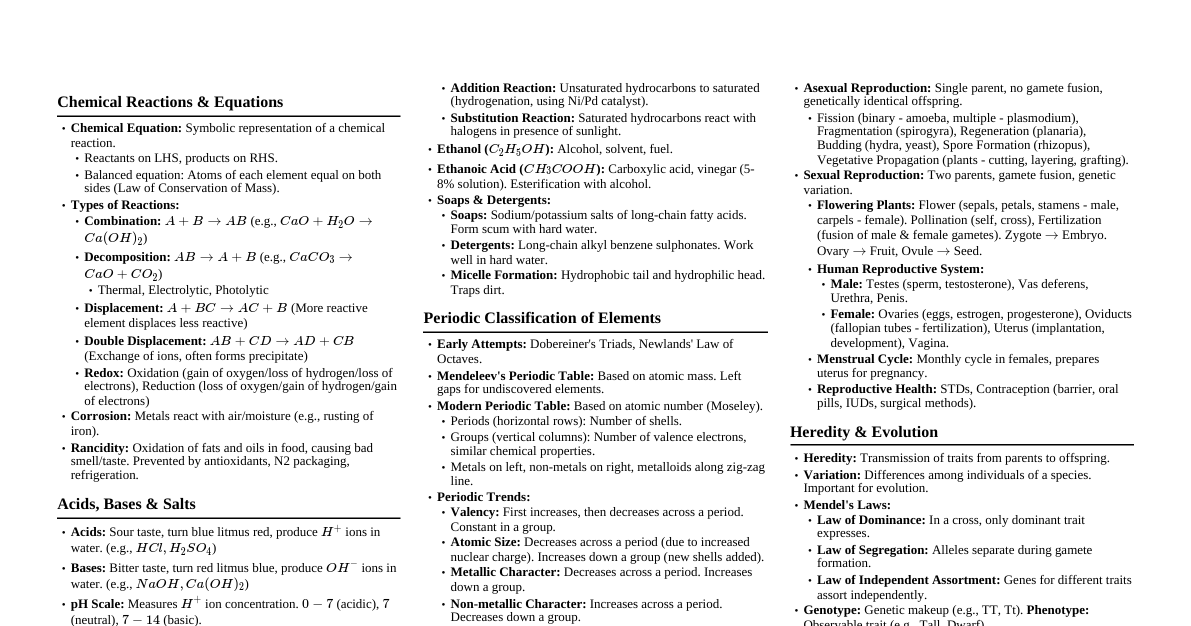
Chemical Reactions & Equations Definition: Chemical reactions are processes that involve the rearrangement of the atomic, ionic, or molecular structure of substances, resulting in the formation of new substances. Key Components: Reactants: The starting materials that undergo a chemical change. Products: The new substances formed as a result of the reaction. Chemical Equation: A symbolic representation of a chemical reaction using chemical formulas. Balancing Chemical Equations: Ensures the conservation of mass (Law of Conservation of Mass). The number of atoms of each element must be equal on both sides of the equation. Example: $2H_2(g) + O_2(g) \rightarrow 2H_2O(l)$ Common Types of Reactions: Combination (Synthesis): Two or more reactants combine to form a single product. $A + B \rightarrow AB$ (e.g., $2Mg + O_2 \rightarrow 2MgO$) Decomposition: A single reactant breaks down into two or more simpler products. $AB \rightarrow A + B$ (e.g., $CaCO_3 \rightarrow CaO + CO_2$) Displacement (Single Displacement): A more reactive element displaces a less reactive element from its compound. $A + BC \rightarrow AC + B$ (e.g., $Zn + CuSO_4 \rightarrow ZnSO_4 + Cu$) Double Displacement (Metathesis): Exchange of ions between two compounds. Often forms a precipitate or water. $AB + CD \rightarrow AD + CB$ (e.g., $AgNO_3 + NaCl \rightarrow AgCl(s) + NaNO_3$) Redox Reactions (Reduction-Oxidation): Involve the transfer of electrons. Oxidation: Loss of electrons, increase in oxidation state. Reduction: Gain of electrons, decrease in oxidation state. Reactants A + B Products AB Combination Example Acids, Bases, and Salts Acids: Typically sour in taste and corrosive. Turn blue litmus paper red. According to Arrhenius, substances that produce $H^+$ ions (or $H_3O^+$ hydronium ions) when dissolved in water. According to Brønsted-Lowry, proton ($H^+$) donors. Examples: Hydrochloric acid ($HCl$), Sulfuric acid ($H_2SO_4$), Acetic acid ($CH_3COOH$). Bases: Typically bitter in taste and feel slippery. Turn red litmus paper blue. According to Arrhenius, substances that produce $OH^-$ ions when dissolved in water. According to Brønsted-Lowry, proton ($H^+$) acceptors. Examples: Sodium hydroxide ($NaOH$), Calcium hydroxide ($Ca(OH)_2$), Ammonia ($NH_3$). Salts: Ionic compounds formed from the neutralization reaction between an acid and a base. Typically crystalline solids with high melting points. Examples: Sodium chloride ($NaCl$), Potassium nitrate ($KNO_3$), Calcium carbonate ($CaCO_3$). The pH Scale: A logarithmic scale from 0 to 14 used to specify the acidity or basicity of an aqueous solution. $pH = -\log[H^+]$ Acidic: $pH Neutral: $pH = 7$ (equal concentrations of $H^+$ and $OH^-$ ions, e.g., pure water). Basic (Alkaline): $pH > 7$ (higher concentration of $OH^-$ ions). Neutralization Reaction: Acid + Base $\rightarrow$ Salt + Water $HCl(aq) + NaOH(aq) \rightarrow NaCl(aq) + H_2O(l)$ 0 (Strong Acid) 7 (Neutral) 14 (Strong Base) Metals and Non-metals Metals: Physical Properties: Lustrous: Shiny appearance. Malleable: Can be hammered into thin sheets (e.g., aluminum foil). Ductile: Can be drawn into wires (e.g., copper wires). Sonorous: Produce a ringing sound when struck. Good conductors of heat and electricity. High melting and boiling points (generally). Solid at room temperature (except Mercury). Chemical Properties: Tend to lose electrons to form positive ions (cations). React with oxygen to form basic oxides (e.g., $Na_2O$). React with acids to produce hydrogen gas (e.g., $Zn + 2HCl \rightarrow ZnCl_2 + H_2$). Examples: Iron (Fe), Copper (Cu), Gold (Au), Aluminum (Al), Sodium (Na). Non-metals: Physical Properties: Generally dull in appearance. Brittle (solids), not malleable or ductile. Poor conductors of heat and electricity (except graphite, an allotrope of carbon). Lower melting and boiling points than metals. Exist as solids, liquids, or gases at room temperature. Chemical Properties: Tend to gain or share electrons to form negative ions (anions) or covalent bonds. React with oxygen to form acidic or neutral oxides (e.g., $CO_2$, $SO_2$). Examples: Oxygen (O), Carbon (C), Sulfur (S), Chlorine (Cl), Nitrogen (N). Metalloids: Elements that exhibit properties intermediate between metals and non-metals (e.g., Silicon (Si), Germanium (Ge), Arsenic (As)). Metal Conductive, Malleable Non-metal Insulator, Brittle Carbon and its Compounds Carbon: The Versatile Element Atomic Number: 6, Electronic Configuration: 2, 4. Forms covalent bonds by sharing electrons. Unique Properties of Carbon: Catenation: The ability of carbon atoms to link with other carbon atoms to form long chains, branched chains, and closed rings. This property gives rise to a vast number of carbon compounds. Tetravalency: Carbon has a valency of four, meaning it can form four covalent bonds with other atoms (carbon, hydrogen, oxygen, nitrogen, etc.). Hydrocarbons: Organic compounds containing only carbon and hydrogen. Saturated Hydrocarbons (Alkanes): Contain only single bonds between carbon atoms. General formula: $C_nH_{2n+2}$ Example: Methane ($CH_4$), Ethane ($C_2H_6$). Unsaturated Hydrocarbons: Contain double or triple bonds between carbon atoms. Alkenes: Contain at least one carbon-carbon double bond. General formula: $C_nH_{2n}$ (e.g., Ethene, $C_2H_4$). Alkynes: Contain at least one carbon-carbon triple bond. General formula: $C_nH_{2n-2}$ (e.g., Ethyne, $C_2H_2$). Functional Groups: Specific groups of atoms within molecules that are responsible for the characteristic chemical reactions of those molecules. -OH (Alcohol), -COOH (Carboxylic Acid), -CHO (Aldehyde), -CO- (Ketone), -X (Halogen). Allotropes of Carbon: Different structural forms of the same element. Diamond: Hardest known natural substance, insulator. Graphite: Soft, slippery, good conductor of electricity (used in pencils and lubricants). Fullerenes: Spherical or cylindrical cage-like structures (e.g., Buckminsterfullerene, $C_{60}$). Carbon Chain (Catenation) Tetravalency Example Life Processes Definition: The basic functions performed by living organisms to maintain their life on Earth. 1. Nutrition: The process of taking in food and utilizing it for energy, growth, and repair. Autotrophic Nutrition: Organisms synthesize their own food from simple inorganic substances (e.g., plants via photosynthesis). $6CO_2 + 6H_2O \xrightarrow{\text{Sunlight, Chlorophyll}} C_6H_{12}O_6 + 6O_2$ Heterotrophic Nutrition: Organisms obtain food by consuming other organisms or organic matter (e.g., animals, fungi). Holozoic (ingestion, digestion, absorption, assimilation, egestion). Saprophytic (feed on dead and decaying matter). Parasitic (live on or in another organism and derive nutrients). 2. Respiration: The process of breaking down complex organic molecules (food) to release energy for cellular activities. Aerobic Respiration: Occurs in the presence of oxygen, produces a large amount of energy. $C_6H_{12}O_6 + 6O_2 \rightarrow 6CO_2 + 6H_2O + \text{Energy (ATP)}$ Anaerobic Respiration: Occurs in the absence of oxygen, produces less energy. In Yeast: Glucose $\rightarrow$ Ethanol + Carbon Dioxide + Energy. In Muscles: Glucose $\rightarrow$ Lactic Acid + Energy. 3. Transportation (Circulation): The process of moving substances (nutrients, gases, hormones, waste products) within an organism. In Plants: Xylem: Transports water and minerals from roots to leaves. Phloem: Transports food (sugars) from leaves to other parts of the plant. In Animals (e.g., Humans): Blood: Carries oxygen, nutrients, hormones, and waste. Heart: Pumps blood throughout the body. Blood Vessels: Arteries, veins, capillaries. 4. Excretion: The removal of harmful metabolic waste products from the body. In Plants: Oxygen, water vapor, gums, resins. In Animals (e.g., Humans): Kidneys (urine), Lungs ($CO_2$), Skin (sweat). Plant Photosynthesis Animal Respiration Transport Excretion Control and Coordination Definition: The process through which various organ systems of an organism are regulated to work in harmony, allowing the organism to respond appropriately to stimuli. In Animals: Nervous System: Provides rapid, short-term control through nerve impulses. Central Nervous System (CNS): Brain and Spinal Cord (processing and command center). Peripheral Nervous System (PNS): Nerves extending from CNS to the rest of the body. Neurons: Basic structural and functional units, transmit electrical signals. Reflex Arc: An automatic, rapid, involuntary response to a stimulus (e.g., withdrawing hand from a hot object). Pathway: Receptor $\rightarrow$ Sensory Neuron $\rightarrow$ Spinal Cord (Relay Neuron) $\rightarrow$ Motor Neuron $\rightarrow$ Effector. Endocrine System: Provides slower, long-term control through chemical messengers called hormones. Glands: Specialized organs that secrete hormones directly into the bloodstream. Examples: Adrenaline: Secreted by adrenal glands, prepares body for 'fight or flight'. Insulin: Secreted by pancreas, regulates blood sugar levels. Thyroxine: Secreted by thyroid gland, regulates metabolism. In Plants: Plants lack a nervous system, coordination is primarily achieved by chemical means (plant hormones or phytohormones). Phytohormones: Auxins: Promote cell elongation, involved in phototropism (growth towards light) and geotropism (growth towards gravity). Gibberellins: Promote stem elongation, seed germination. Cytokinins: Promote cell division. Abscisic Acid: Inhibits growth, causes wilting of leaves. Ethylene: Promotes fruit ripening. Tropisms: Directional growth movements of plants in response to external stimuli. Phototropism: Growth towards light (shoots). Geotropism: Growth towards gravity (roots positive, shoots negative). Hydrotropism: Growth towards water (roots). Thigmotropism: Growth in response to touch (tendrils). Brain Nerve Muscle Hormone Gland How Do Organisms Reproduce? Reproduction: The biological process by which new individual organisms – "offspring" – are produced from their "parent" or parents. It ensures the continuation of species. Asexual Reproduction: Involves a single parent. Offspring are genetically identical to the parent (clones). Common in lower organisms and plants. Types: Fission: Parent cell divides into two or more daughter cells. Binary Fission: (e.g., Amoeba, Paramecium) Parent divides into two equal halves. Multiple Fission: (e.g., Plasmodium) Parent divides into many daughter cells simultaneously. Budding: A small outgrowth (bud) forms on the parent body, detaches, and develops into a new individual (e.g., Hydra, Yeast). Fragmentation: The body of the organism breaks into two or more pieces, each growing into a new individual (e.g., Spirogyra, Planaria). Spore Formation: Organisms produce spores, which are microscopic, tough, and resistant structures that can grow into new individuals under favorable conditions (e.g., Fungi, Ferns). Vegetative Propagation: Asexual reproduction in plants where new plants are grown from vegetative parts (roots, stems, leaves) of the parent plant. Natural (e.g., runners in grass, tubers in potato). Artificial (e.g., cutting, layering, grafting). Sexual Reproduction: Involves two parents (usually male and female). Offspring are genetically different from both parents, leading to variation. Involves the formation and fusion of specialized reproductive cells called gametes. Process: Gamete Formation: Male gamete (sperm/pollen) and female gamete (egg/ovule) are produced. Fertilization: Fusion of male and female gametes to form a zygote. Embryonic Development: Zygote develops into an embryo, then a new individual. In Flowering Plants: Pollination: Transfer of pollen grains from anther to stigma. Fertilization: Fusion of male gamete (from pollen) with female gamete (in ovule). Results in seed and fruit formation. In Humans: Male reproductive system produces sperm, female produces eggs. Internal fertilization, followed by embryonic and fetal development in the uterus. Parent Asexual (Clone) Offspring Male Parent Female Parent Sexual (Variation) Heredity Heredity: The passing of traits (characteristics) from parents to their offspring through generations. It is the basis of genetics. Variation: The differences in traits among individuals of the same species. Variation is crucial for evolution. Key Terms: Genes: The basic physical and functional units of heredity. They are specific sequences of DNA that code for particular traits. Alleles: Different forms of a gene (e.g., gene for height can have tall or dwarf alleles). Chromosomes: Thread-like structures located inside the nucleus of animal and plant cells. Each chromosome is made of protein and a single molecule of DNA. Genotype: The genetic makeup of an organism (the set of alleles it possesses). Phenotype: The observable characteristics or traits of an organism, resulting from the interaction of its genotype with the environment. Dominant Trait: A trait that is expressed even if only one copy of the allele is present. Recessive Trait: A trait that is only expressed if two copies of the allele are present. Mendel's Laws of Inheritance (Gregor Mendel, "Father of Genetics"): 1. Law of Dominance: In a cross between two pure parents differing in one or more pairs of contrasting characters, the characters that appear in the $F_1$ generation are called dominant characters, and those that do not appear are called recessive characters. 2. Law of Segregation: During gamete formation, the two alleles for a heritable character segregate (separate) from each other, so that each gamete carries only one allele for each character. 3. Law of Independent Assortment: When two pairs of traits are combined in a hybrid, segregation of one pair of characters is independent of the other pair of characters. (Applies to genes on different chromosomes or far apart on the same chromosome). Sex Determination: The process by which the sex of an offspring is determined. In humans, sex is determined by sex chromosomes: Females have two X chromosomes (XX), and males have one X and one Y chromosome (XY). The male parent determines the sex of the child as they contribute either an X or a Y chromosome to the offspring. Parent 1 Parent 2 Gamete Fusion Offspring (Mixed Traits) Human Eye and Colorful World The Human Eye: A natural optical instrument that enables us to see the world around us. Structure and Function: Cornea: The transparent, bulging front surface of the eye. It refracts most of the light entering the eye. Iris: A dark muscular diaphragm that controls the size of the pupil. It gives the eye its color. Pupil: The opening in the center of the iris through which light enters the eye. Its size adjusts to regulate the amount of light. Crystalline Lens: A transparent, biconvex lens that focuses light onto the retina. Its focal length can be adjusted by ciliary muscles (accommodation). Ciliary Muscles: Muscles that change the curvature (and thus focal length) of the eye lens. Retina: The light-sensitive screen at the back of the eye. Contains photoreceptor cells: Rods: Sensitive to dim light (night vision), detect intensity. Cones: Sensitive to bright light (day vision), detect color. Optic Nerve: Transmits electrical signals (visual information) from the retina to the brain. Blind Spot: The point where the optic nerve leaves the eye; it has no photoreceptor cells. Defects of Vision (Refractive Defects): Myopia (Nearsightedness): Distant objects appear blurred. Light focuses in front of the retina. Causes: Eyeball too long, or lens too curved. Correction: Concave lens (diverging lens). Hypermetropia (Farsightedness): Near objects appear blurred. Light focuses behind the retina. Causes: Eyeball too short, or lens too flat. Correction: Convex lens (converging lens). Presbyopia: Age-related difficulty in focusing on near objects. Caused by weakening of ciliary muscles and reduced flexibility of the eye lens. Correction: Bifocal lenses (convex for near, concave for far). Dispersion of Light: The phenomenon of splitting of white light into its constituent colors (Violet, Indigo, Blue, Green, Yellow, Orange, Red - VIBGYOR) when it passes through a transparent medium (like a prism). Caused by different refractive indices for different colors of light. Rainbow Formation: Natural phenomenon of dispersion and total internal reflection of sunlight by raindrops. Atmospheric Refraction: The bending of light as it passes through different layers of the Earth's atmosphere with varying refractive indices. Twinkling of Stars: Due to continuous change in refractive index of atmospheric layers. Advance Sunrise and Delayed Sunset: Sun appears two minutes earlier and two minutes later than actual due to atmospheric refraction. Scattering of Light: The phenomenon in which light rays are deflected from their path by small particles or irregularities in the medium. Tyndall Effect: Scattering of light by colloidal particles. Why Sky is Blue: Blue light (shorter wavelength) is scattered more effectively by atmospheric particles than red light (longer wavelength). Reddish Appearance of Sun at Sunrise/Sunset: At sunrise/sunset, light travels a longer distance through the atmosphere, scattering away most of the blue light, leaving behind predominantly red light. Cornea Pupil Retina Electricity Electric Charge ($Q$): Fundamental property of matter. Unit: Coulomb (C). Types: Positive and Negative. Like charges repel, unlike charges attract. Quantization of charge: $Q = ne$, where $n$ is an integer and $e$ is the elementary charge ($1.6 \times 10^{-19}$ C). Electric Current ($I$): The rate of flow of electric charge. Formula: $I = Q/t$ (where $t$ is time). Unit: Ampere (A). 1 A = 1 C/s. Conventionally, current flows from positive to negative terminal. Electrons flow from negative to positive. Electric Potential Difference ($V$) / Voltage: The work done per unit charge in moving a charge from one point to another in an electric field. Formula: $V = W/Q$ (where $W$ is work done). Unit: Volt (V). 1 V = 1 J/C. Measured by a Voltmeter (connected in parallel). Ohm's Law: States that the current ($I$) flowing through a conductor between two points is directly proportional to the voltage ($V$) across the two points, and inversely proportional to the resistance ($R$) between them, provided the temperature and other physical conditions remain constant. Formula: $V = IR$ Resistance ($R$): The opposition offered by a conductor to the flow of electric current. Unit: Ohm ($\Omega$). Factors affecting resistance: Length of the conductor ($R \propto L$). Area of cross-section ($R \propto 1/A$). Nature of the material (resistivity, $\rho$). Temperature. Formula: $R = \rho L/A$ (where $\rho$ is resistivity). Combination of Resistors: Series Combination: Resistors are connected end-to-end. Equivalent Resistance: $R_{eq} = R_1 + R_2 + R_3 + ...$ Current is same through all resistors. Voltage divides across resistors. Parallel Combination: Resistors are connected across the same two points. Equivalent Resistance: $1/R_{eq} = 1/R_1 + 1/R_2 + 1/R_3 + ...$ Voltage is same across all resistors. Current divides through resistors. Electric Power ($P$): The rate at which electrical energy is consumed or dissipated. Formulae: $P = VI = I^2R = V^2/R$ Unit: Watt (W). 1 W = 1 J/s. Commercial unit of electrical energy: Kilowatt-hour (kWh). 1 kWh = $3.6 \times 10^6$ J. Joule's Law of Heating: When current flows through a resistor, electrical energy is converted into heat energy. Heat produced ($H$) is directly proportional to the square of the current ($I^2$), resistance ($R$), and time ($t$). Formula: $H = I^2Rt$ Battery R I $V = IR$ Magnetic Effects of Electric Current Magnetic Field: The region around a magnet or a current-carrying conductor where its magnetic influence can be detected. Represented by magnetic field lines. Magnetic Field Lines (Properties): Are closed curves. Originate from the North pole and merge into the South pole outside the magnet; inside the magnet, they go from South to North. Never intersect each other. The degree of closeness of field lines indicates the strength of the magnetic field (closer lines = stronger field). The tangent at any point on a field line gives the direction of the magnetic field at that point. Magnetic Field Due to a Current-Carrying Conductor: Straight Conductor: Concentric circles around the wire. Direction given by Right-Hand Thumb Rule. Right-Hand Thumb Rule: If you hold a current-carrying straight conductor in your right hand such that your thumb points in the direction of the current, then your fingers wrapped around the conductor will give the direction of the magnetic field lines. Circular Loop: Magnetic field lines are concentric circles near the wire, becoming nearly straight and parallel at the center of the loop. Solenoid: A coil of many circular turns of insulated copper wire wrapped closely in the shape of a cylinder. Acts like a bar magnet when current flows through it. Force on a Current-Carrying Conductor in a Magnetic Field: A current-carrying conductor placed in a magnetic field experiences a force. Direction given by Fleming's Left-Hand Rule: Stretch the thumb, forefinger, and middle finger of your left hand such that they are mutually perpendicular. If the forefinger points in the direction of the magnetic field, and the middle finger points in the direction of the current, then the thumb will point in the direction of the force (motion) on the conductor. Principle of Electric Motor. Electromagnetic Induction: The phenomenon of producing an induced electric current in a conductor by changing the magnetic field lines linked with it. Discovered by Michael Faraday. Faraday's Law: The magnitude of the induced current (or EMF) is proportional to the rate of change of magnetic flux. Fleming's Right-Hand Rule: Used to find the direction of induced current. Stretch the thumb, forefinger, and middle finger of your right hand such that they are mutually perpendicular. If the forefinger points in the direction of the magnetic field, and the thumb points in the direction of motion of the conductor, then the middle finger will point in the direction of the induced current. Principle of Electric Generator. Electric Motor: Converts electrical energy into mechanical energy. Electric Generator: Converts mechanical energy into electrical energy. Domestic Electric Circuits: Use of live wire (red), neutral wire (black), and earth wire (green). Importance of fuses and earthing for safety. N S Magnetic Field