CBU CH110 Intro Chemistry
Cheatsheet Content
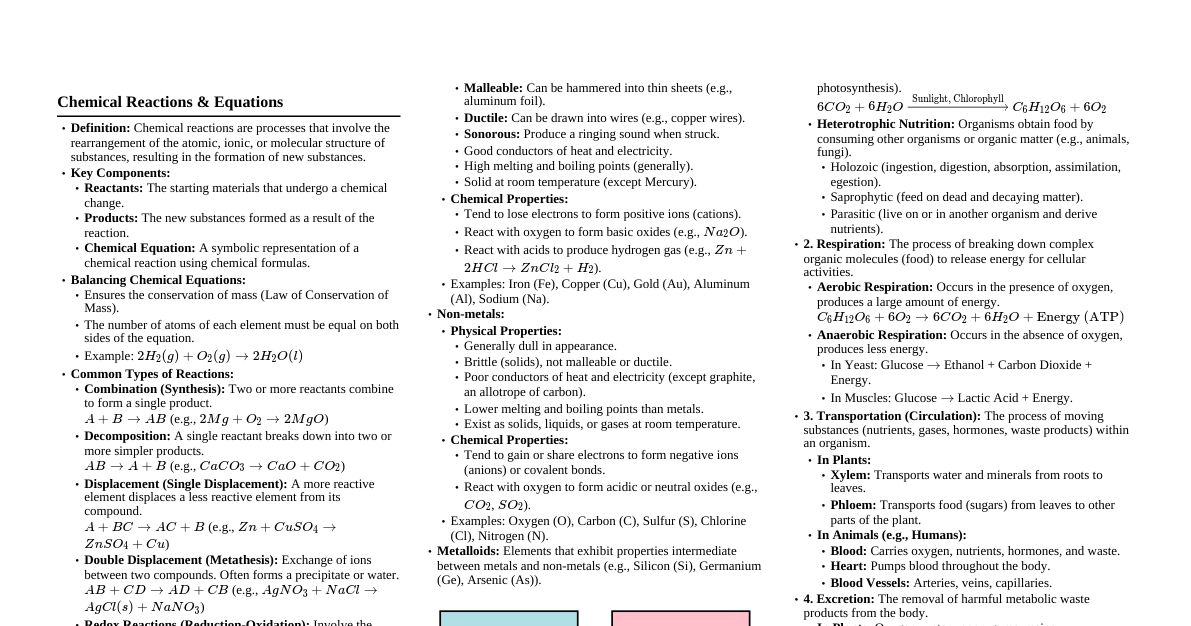
1. Matter and Measurement Matter: Anything that has mass and occupies space. States of Matter: Solid: Definite shape and volume. Particles close together, fixed positions. Liquid: Indefinite shape, definite volume. Particles close, but can move past each other. Gas: Indefinite shape and volume. Particles far apart, random motion. Classification of Matter: Pure Substances: Elements: Cannot be broken down further by chemical means (e.g., O, H, Fe). Compounds: Two or more elements chemically combined in fixed proportions (e.g., $H_2O$, $CO_2$). Mixtures: Two or more substances physically combined. Homogeneous: Uniform composition throughout (e.g., salt water, air). Heterogeneous: Non-uniform composition; components visible (e.g., sand and water, salad). Physical vs. Chemical Properties/Changes: Physical: Observed without changing composition (e.g., color, density, melting point, boiling point). Chemical: Observed when a substance undergoes a change in composition (e.g., flammability, reactivity). Physical Change: Alters appearance but not composition (e.g., melting ice, dissolving sugar). Chemical Change (Reaction): Forms new substances (e.g., burning wood, rusting iron). Measurements: Quantitative: Involves numbers and units. SI Units: Mass (kg), Length (m), Time (s), Temperature (K), Amount of substance (mol). Derived Units: Volume ($m^3$ or L), Density ($g/mL$ or $g/cm^3$). Density: $D = \frac{m}{V}$ (mass/volume). Scientific Notation: Expresses very large or small numbers (e.g., $6.022 \times 10^{23}$). Significant Figures: Indicate precision of a measurement. Non-zero digits are always significant. Zeros between non-zero digits are significant. Leading zeros (0.00x) are not significant. Trailing zeros are significant if a decimal point is present (e.g., 100. vs 100). Exact numbers (counting, definitions) have infinite sig figs. Addition/Subtraction: Result limited by fewest decimal places. Multiplication/Division: Result limited by fewest significant figures. Temperature Scales: Celsius ($^\circ C$), Fahrenheit ($^\circ F$), Kelvin (K). $K = ^\circ C + 273.15$ $^\circ C = \frac{(^\circ F - 32)}{1.8}$ 2. Atoms and Elements Atomic Theory (Dalton): Elements composed of indivisible particles (atoms). Atoms of same element are identical; different elements are different. Atoms combine in whole-number ratios to form compounds. Atoms are rearranged in chemical reactions, not created or destroyed. Subatomic Particles: Protons ($p^+$): Positive charge (+1), mass $\approx 1$ amu. In nucleus. Neutrons ($n^0$): No charge (0), mass $\approx 1$ amu. In nucleus. Electrons ($e^-$): Negative charge (-1), mass $\approx 0$ amu. Orbit nucleus. Atomic Number (Z): Number of protons. Defines the element. Mass Number (A): Protons + Neutrons. Isotopes: Atoms of the same element (same Z) but different number of neutrons (different A). Atomic Mass: Weighted average of naturally occurring isotopes of an element. Periodic Table: Arranges elements by increasing atomic number. Periods: Horizontal rows (7). Groups/Families: Vertical columns (18), elements in same group have similar chemical properties due to similar electron configurations. Main Group Elements: Groups 1, 2, 13-18. Transition Metals: Groups 3-12. Metals: Tend to lose electrons, good conductors, malleable, ductile. (Left side and middle). Nonmetals: Tend to gain electrons, poor conductors, brittle. (Right side). Metalloids: Properties intermediate between metals and nonmetals (e.g., Si, Ge, As). Common Groups: Group 1: Alkali Metals (except H) Group 2: Alkaline Earth Metals Group 17: Halogens Group 18: Noble Gases 3. Ions and Ionic Compounds Ions: Atoms that have gained or lost electrons, resulting in a net electrical charge. Cation: Positively charged ion (loses electrons, e.g., $Na^+$). Anion: Negatively charged ion (gains electrons, e.g., $Cl^-$). Ionic Bonds: Electrostatic attraction between oppositely charged ions. Formed between metals and nonmetals. Ionic Compounds: Neutral compounds formed by ionic bonds. Form crystal lattices. High melting points, conduct electricity when molten or dissolved. Forming Ionic Compounds: Ions combine to achieve charge neutrality. e.g., $Na^+$ and $Cl^-$ form $NaCl$. e.g., $Mg^{2+}$ and $Cl^-$ form $MgCl_2$. Polyatomic Ions: Ions composed of two or more atoms covalently bonded together, but carrying an overall charge (e.g., $SO_4^{2-}$, $NO_3^-$, $OH^-$). Naming Ionic Compounds: Metal (fixed charge) + Nonmetal: Metal name + (base name of nonmetal + -ide). E.g., $NaCl$ = Sodium Chloride. Metal (variable charge, transition metals) + Nonmetal: Metal name (Roman numeral for charge) + (base name of nonmetal + -ide). E.g., $FeCl_2$ = Iron(II) Chloride. Ionic Compounds with Polyatomic Ions: Metal name + Polyatomic ion name. E.g., $NaNO_3$ = Sodium Nitrate. 4. Covalent Compounds Covalent Bonds: Sharing of electrons between two nonmetal atoms. Molecules: Discrete groups of atoms held together by covalent bonds. Characteristics: Lower melting points, don't conduct electricity. Naming Binary Covalent Compounds (Nonmetal-Nonmetal): Prefix (for first element, if >1) + First element name + Prefix (for second element) + Base name of second element + -ide. Prefixes: mono- (1), di- (2), tri- (3), tetra- (4), penta- (5), hexa- (6), hepta- (7), octa- (8), nona- (9), deca- (10). Example: $CO_2$ = Carbon Dioxide, $N_2O_4$ = Dinitrogen Tetroxide. "Mono-" is often omitted for the first element. 5. Chemical Reactions and Equations Chemical Equation: Represents a chemical reaction. Reactants $\rightarrow$ Products e.g., $2H_2(g) + O_2(g) \rightarrow 2H_2O(l)$ Balancing Equations: Ensure the Law of Conservation of Mass is obeyed (same number of atoms of each element on both sides). Use coefficients. Types of Reactions: Combination (Synthesis): A + B $\rightarrow$ AB Decomposition: AB $\rightarrow$ A + B Single Displacement: A + BC $\rightarrow$ AC + B (or AB + C) Double Displacement (Metathesis): AB + CD $\rightarrow$ AD + CB Combustion: Reaction with oxygen, often producing $CO_2$ and $H_2O$. States of Matter in Equations: (s) solid, (l) liquid, (g) gas, (aq) aqueous (dissolved in water). 6. The Mole and Stoichiometry The Mole (mol): The amount of substance containing $6.022 \times 10^{23}$ particles (Avogadro's Number). Molar Mass: Mass of one mole of a substance in grams (numerically equal to atomic/molecular/formula weight in amu). Calculations: Moles to mass: mass = moles $\times$ molar mass Mass to moles: moles = mass / molar mass Moles to particles: particles = moles $\times$ Avogadro's Number Particles to moles: moles = particles / Avogadro's Number Stoichiometry: Quantitative relationships between reactants and products in a balanced chemical equation. Use mole ratios from balanced equation to convert between amounts of different substances. Steps: Balance the equation. Convert given mass to moles. Use mole ratio to find moles of desired substance. Convert moles of desired substance to mass (if needed). Limiting Reactant: Reactant that is completely consumed first, limiting the amount of product formed. Theoretical Yield: Maximum amount of product that can be formed from given amounts of reactants. Actual Yield: Amount of product actually obtained in an experiment. Percent Yield: $\frac{\text{Actual Yield}}{\text{Theoretical Yield}} \times 100\%$ 7. Solutions Solution: Homogeneous mixture. Solute: Substance being dissolved (smaller amount). Solvent: Substance doing the dissolving (larger amount). Concentration: Amount of solute in a given amount of solution. Molarity (M): Moles of solute per liter of solution. $M = \frac{\text{moles of solute}}{\text{liters of solution}}$ Dilution: Adding more solvent to a solution to decrease its concentration. $M_1V_1 = M_2V_2$ (initial molarity $\times$ initial volume = final molarity $\times$ final volume) Electrolytes: Substances that produce ions when dissolved in water, allowing the solution to conduct electricity. Strong Electrolytes: Dissociate completely (e.g., strong acids, strong bases, soluble ionic compounds). Weak Electrolytes: Dissociate partially (e.g., weak acids, weak bases). Non-electrolytes: Do not produce ions (e.g., sugar, alcohol). 8. Acids and Bases Arrhenius Definition: Acid: Produces $H^+$ ions in water (e.g., $HCl$). Base: Produces $OH^-$ ions in water (e.g., $NaOH$). Brønsted-Lowry Definition: Acid: Proton ($H^+$) donor. Base: Proton ($H^+$) acceptor. Conjugate Acid-Base Pair: Two species that differ by a single proton. pH Scale: Measures acidity/basicity. $pH = -\log[H^+]$ $pOH = -\log[OH^-]$ $pH + pOH = 14$ (at $25^\circ C$) $pH 7$: Basic Neutralization Reaction: Acid + Base $\rightarrow$ Salt + Water. 9. Oxidation-Reduction (Redox) Reactions Oxidation: Loss of electrons (LEO - Loss of Electrons is Oxidation). Oxidation number increases. Reduction: Gain of electrons (GER - Gain of Electrons is Reduction). Oxidation number decreases. Oxidizing Agent: Accepts electrons, causes oxidation (itself reduced). Reducing Agent: Donates electrons, causes reduction (itself oxidized). Assigning Oxidation Numbers: Elements in elemental form: 0. Monatomic ions: Equal to charge. Oxygen: Usually -2 (except in peroxides, -1). Hydrogen: Usually +1 (except in metal hydrides, -1). Halogens: Usually -1. Sum of oxidation numbers in a neutral compound = 0. Sum of oxidation numbers in a polyatomic ion = ion's charge.