Chemistry Cheatsheet
Cheatsheet Content
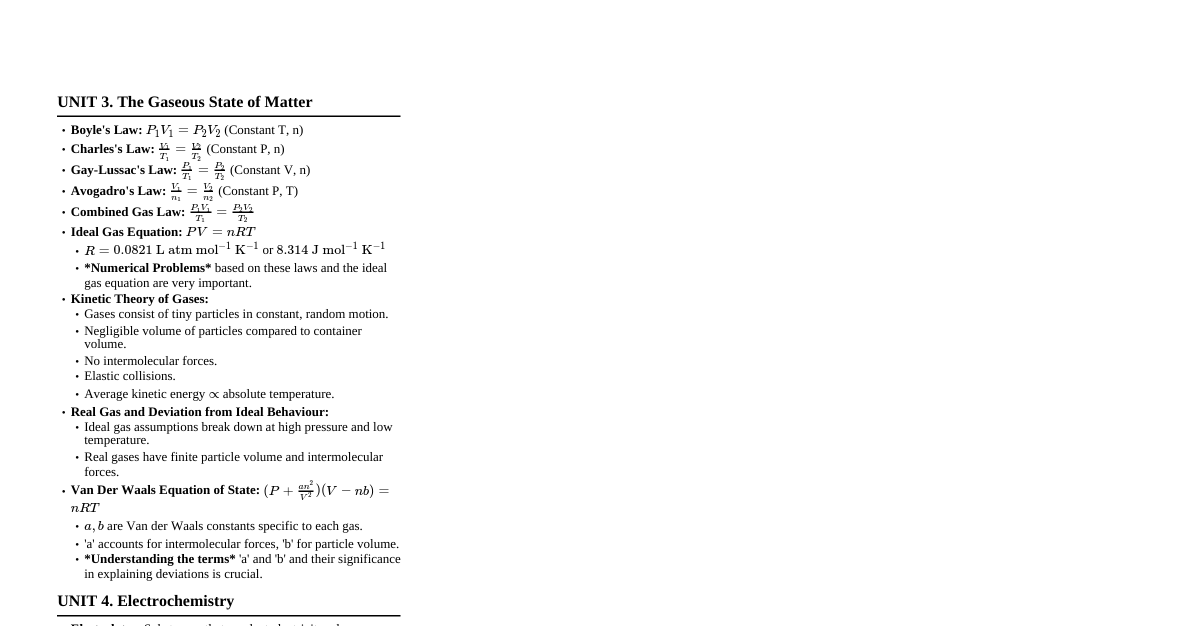
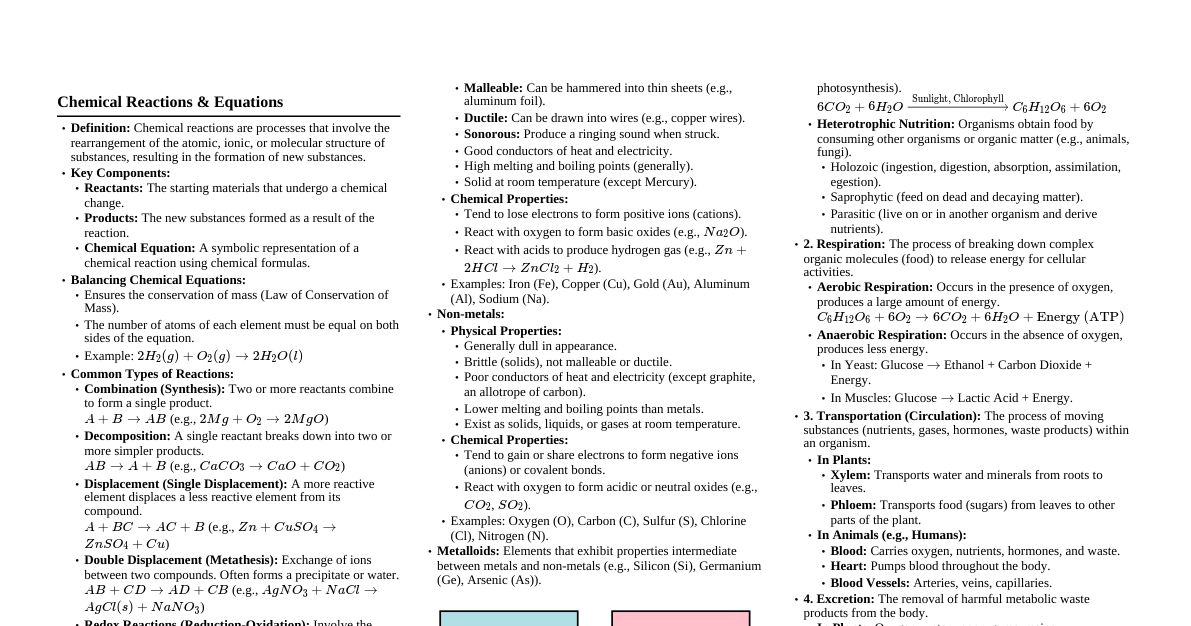
UNIT 1. Fundamentals of Chemistry Atom & Molecule: Basic building blocks. Mass: Atomic mass, Molecular mass (sum of atomic masses). Mole Concept: $1 \text{ mole} = 6.022 \times 10^{23}$ particles. Molar mass (g/mol). States of Matter: Solid, Liquid, Gas (brief properties). Elements, Compounds, Mixtures: Definitions and examples. Empirical & Molecular Formula: Empirical: Simplest whole number ratio of atoms. Molecular: Actual number of atoms in a molecule. ⭐ Laws of Chemical Combination: Law of Conservation of Mass: Mass is neither created nor destroyed. Law of Definite Proportion: A compound always contains elements in fixed proportion by mass. Law of Multiple Proportions: If two elements combine to form more than one compound, the masses of one element that combine with a fixed mass of the other are in simple whole number ratios. Law of Reciprocal Proportions: If two elements combine separately with a third element, the ratio of their masses in which they combine with the third element is either the same or some simple multiple of the ratio in which they combine with each other. Chemical Reactions: Combination, Decomposition, Displacement, Double Displacement, Neutralization, Redox. ⭐ Redox Reactions: Involve both oxidation (loss of electrons) and reduction (gain of electrons). Identify oxidizing and reducing agents. UNIT 2. Chemistry of Solutions Properties of Liquids: Vapour pressure, Boiling point, Density, Surface tension, Viscosity. Solutions: Homogeneous mixtures. Solute + Solvent. ⭐ Units of Concentration: Percentage: $m/m, v/v, m/v$. Molarity (M): Moles of solute / Litres of solution. Molality (m): Moles of solute / kg of solvent. Normality (N): Gram equivalents of solute / Litres of solution. Mole Fraction ($\chi$): Moles of component / Total moles. Colloids: Heterogeneous systems with particle size 1-1000 nm. (Definition and examples). Solubility: Max amount of solute that dissolves in a given amount of solvent. Factors affecting solubility: Temperature, Pressure. Saturated, Unsaturated, Supersaturated solutions. ⭐ Chemical Equilibrium: Dynamic state where rates of forward and reverse reactions are equal. Equilibrium Constant (K): Ratio of products to reactants at equilibrium. $K_c = \frac{[C]^c[D]^d}{[A]^a[B]^b}$ for $aA+bB \rightleftharpoons cC+dD$. Law of Mass Action: Relates reaction rates to concentrations. Le Chatelier's Principle: System adjusts to relieve stress (change in temp, pressure, conc.). Acids, Bases, Buffers: Arrhenius: Acid ($H^+$ producer), Base ($OH^-$ producer). Bronsted-Lowry: Acid ($H^+$ donor), Base ($H^+$ acceptor). Lewis: Acid (electron pair acceptor), Base (electron pair donor). Buffer Solutions: Resist pH change upon addition of small amounts of acid/base. (e.g., weak acid + its conjugate base). ⭐ pH Value: $pH = -\log[H^+]$. $pH + pOH = 14$. Calculate pH for strong/weak acids/bases. UNIT 3. The Gaseous State of Matter ⭐ Gas Laws: Boyle's Law: $P_1V_1 = P_2V_2$ (constant T, n). Charles's Law: $\frac{V_1}{T_1} = \frac{V_2}{T_2}$ (constant P, n). Gay-Lussac's Law: $\frac{P_1}{T_1} = \frac{P_2}{T_2}$ (constant V, n). Avogadro's Law: $\frac{V_1}{n_1} = \frac{V_2}{n_2}$ (constant P, T). ⭐ Ideal Gas Equation: $PV = nRT$. (R is the universal gas constant). Numerical problems involving P, V, n, T calculations. Kinetic Theory of Gases: Postulates (random motion, elastic collisions, negligible volume of particles). Ideal vs. Real Gases: Ideal gases follow $PV=nRT$ perfectly. Real gases deviate at high pressure and low temperature. ⭐ Van der Waals Equation of State (for real gases): $(P + \frac{an^2}{V^2})(V - nb) = nRT$. 'a' accounts for intermolecular forces, 'b' for finite volume of gas particles. Numerical problems comparing ideal vs. real gas behavior. UNIT 4. Electrochemistry Electrolytes: Substances that conduct electricity when dissolved or molten. Strong electrolytes (fully dissociate), Weak electrolytes (partially dissociate). ⭐ Electrolysis: Chemical decomposition by electric current. Electrolysis of aqueous copper sulphate solution: Identify products at anode and cathode. Electrolytic Cells: Convert electrical energy to chemical energy. Galvanic (Voltaic) Cells: Convert chemical energy to electrical energy. (Spontaneous reactions). ⭐ Electrode Potential: Potential difference between electrode and electrolyte. Standard Electrode Potential ($E^\circ$): Measured under standard conditions ($1M$, $298K$, $1 \text{ atm}$). Cell Potential ($E_{cell}$): $E_{cathode} - E_{anode}$. ⭐ EMF of the Cell: Electromotive force, maximum potential difference. ⭐ Cell Diagram/Representation: (e.g., $Zn(s) | Zn^{2+}(aq) || Cu^{2+}(aq) | Cu(s)$). Batteries: Primary Battery: Non-rechargeable (e.g., Dry cell). Secondary Battery: Rechargeable (e.g., Lead storage battery, Lithium metal battery). UNIT 5. Basic Organic Chemistry Hydrocarbons: Compounds of carbon and hydrogen. Classification: Alkanes, Alkenes, Alkynes, Benzene (aromatic). ⭐ Nomenclature: IUPAC naming of simple alkanes, alkenes, alkynes, and benzene derivatives. Physical Properties: Physical state (gas, liquid, solid based on C atoms). Melting & Boiling points (increase with chain length, branching lowers it). Solubility (non-polar, insoluble in water, soluble in organic solvents). ⭐ Chemical Properties of Alkanes (Mechanism excluded): Halogenation: Substitution reaction (e.g., $CH_4 + Cl_2 \xrightarrow{hv} CH_3Cl + HCl$). Combustion: Complete ($\text{CO}_2 + \text{H}_2\text{O}$) and incomplete ($\text{CO} + \text{H}_2\text{O}$). Aromatization: Conversion to aromatic compounds. Pyrolysis (Cracking): Thermal decomposition into smaller hydrocarbons. ⭐ Chemical Properties of Alkenes and Alkynes (Mechanism excluded): Addition of Hydrogen (Hydrogenation): $\text{C}=\text{C} + \text{H}_2 \xrightarrow{Ni/Pt/Pd} \text{C}-\text{C}$. Addition of Halogens: $\text{C}=\text{C} + \text{Br}_2 \rightarrow \text{C}(\text{Br})-\text{C}(\text{Br})$. Oxidation: (e.g., Baeyer's test for unsaturation with cold, dilute alkaline $\text{KMnO}_4$). Polymerization: Formation of long chains from monomers. ⭐ Chemical Properties of Benzene (Mechanism excluded): Halogenation: (e.g., Benzene + $\text{Cl}_2 \xrightarrow{FeCl_3}$ Chlorobenzene). Sulphonation: Benzene + conc. $\text{H}_2\text{SO}_4 \rightarrow$ Benzenesulfonic acid. Friedel-Crafts Alkylation: Benzene + Alkyl halide $\xrightarrow{AlCl_3}$ Alkylbenzene. Friedel-Crafts Acylation: Benzene + Acyl chloride $\xrightarrow{AlCl_3}$ Acylbenzene. Combustion: Burns with sooty flame due to high carbon content. Industrial Applications of Hydrocarbons: Fuels, plastics, solvents, raw materials for chemicals.