Proteins & Amino Acids
Shared 3/25/2026•75 views
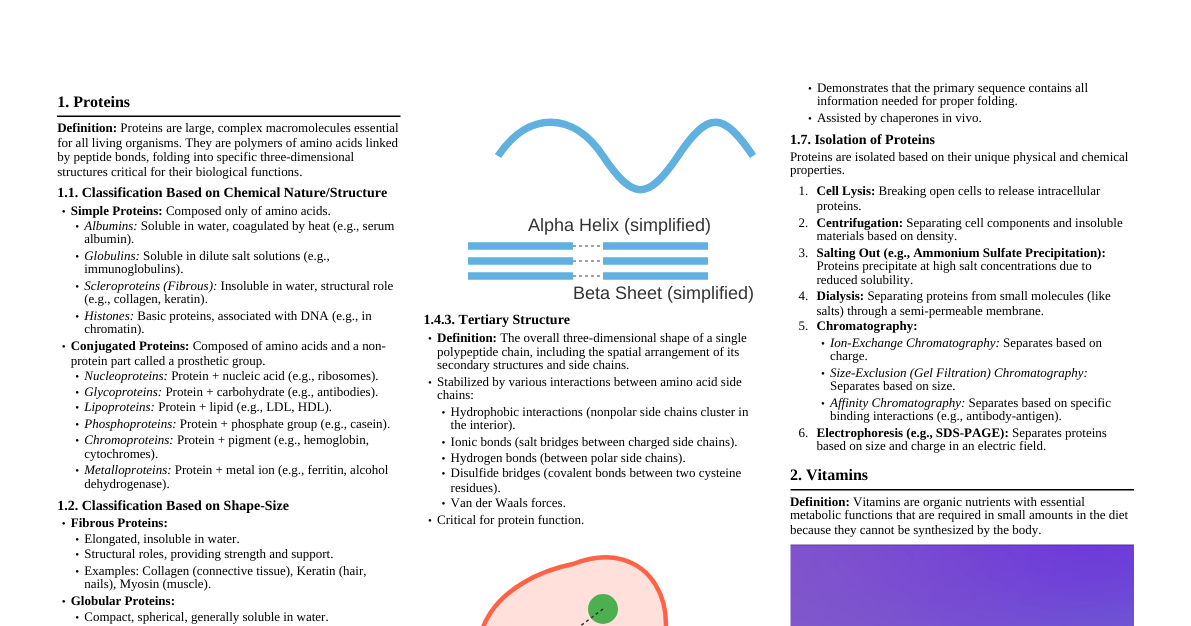
### Amino Acid Basics - **Definition:** Organic molecules containing both an amino group (-NH₂) and a carboxyl group (-COOH). - **General Structure:** ``` R | H₂N—C—COOH | H ``` where R is the side chain unique to each amino acid. - **Optical Isomerism:** All amino acids (except glycine, where R=H) are chiral at the $\alpha$-carbon, existing as L- and D-isomers. L-amino acids are predominantly found in proteins. - **Zwitterionic Form:** At physiological pH, amino acids exist as zwitterions (dipolar ions) with both amino and carboxyl groups ionized. ``` R | H₃N⁺—C—COO⁻ | H ``` - **UV Absorption:** Aromatic amino acids (Tryptophan, Tyrosine, Phenylalanine) absorb UV light, particularly at 280 nm, used for protein quantification. ### Amino Acid Classification Based on the properties of their R-groups: #### 1. Nonpolar, Aliphatic - Glycine (Gly, G) - Alanine (Ala, A) - Valine (Val, V) - Leucine (Leu, L) - Isoleucine (Ile, I) - Methionine (Met, M) - Proline (Pro, P) #### 2. Aromatic - Phenylalanine (Phe, F) - Tyrosine (Tyr, Y) - Tryptophan (Trp, W) #### 3. Polar, Uncharged - Serine (Ser, S) - Threonine (Thr, T) - Cysteine (Cys, C) - Asparagine (Asn, N) - Glutamine (Gln, Q) #### 4. Positively Charged (Basic) - Lysine (Lys, K) - Arginine (Arg, R) - Histidine (His, H) #### 5. Negatively Charged (Acidic) - Aspartate (Asp, D) - Glutamate (Glu, E) ### Amino Acid Reactions #### 1. Due to Amino Group (-NH₂) - **Peptide Bond Formation:** Condensation with carboxyl group. - **Acylation:** Reaction with acid chlorides/anhydrides. - **Ninhydrin Reaction:** Forms a purple product, used for detection. - **Oxidation:** Can be oxidized to imines. #### 2. Due to Carboxyl Group (-COOH) - **Peptide Bond Formation:** Condensation with amino group. - **Esterification:** Reaction with alcohols. - **Reduction:** Can be reduced to aldehydes or alcohols. #### 3. Ionization - **Titration Curves:** pH-dependent charge changes. - **Isoelectric Point (pI):** pH at which the net charge of the amino acid is zero. ### Peptides & Proteins Overview - **Peptides:** Short chains of amino acids linked by peptide bonds. - **Proteins:** Long, complex chains of amino acids (polypeptides) with specific biological functions. - **Peptide Bond:** Amide linkage formed between the carboxyl group of one amino acid and the amino group of another, with the elimination of water. ``` —CO—NH— ``` This bond has partial double-bond character, making it rigid and planar. ### Protein Structure #### 1. Primary Structure - **Definition:** The unique linear sequence of amino acids in a polypeptide chain. - **Determination:** Dictates all higher-order structures. Written from N-terminus (amino end) to C-terminus (carboxyl end). #### 2. Secondary Structure - **Definition:** Local folded structures formed by hydrogen bonding between backbone atoms (not R-groups). - **$\alpha$-Helix:** Coiled structure stabilized by H-bonds between every 4th amino acid. - **$\beta$-Sheet:** Extended, pleated structure stabilized by H-bonds between adjacent polypeptide strands (can be parallel or antiparallel). #### 3. Tertiary Structure - **Definition:** The overall three-dimensional shape of a single polypeptide chain, including side chain interactions. - **Stabilized by:** - Hydrophobic interactions - Ionic bonds (salt bridges) - Hydrogen bonds - Disulfide bonds (covalent, between Cys residues) - Van der Waals forces #### 4. Quaternary Structure - **Definition:** The arrangement of multiple polypeptide subunits (two or more tertiary structures) to form a functional protein complex. - **Examples:** Hemoglobin (4 subunits), antibodies. - **Stabilized by:** Same forces as tertiary structure, but between different subunits. ### Protein Classification #### 1. Based on Solubility & Shape - **Fibrous Proteins:** - **Structure:** Elongated, insoluble in water. - **Function:** Structural roles (e.g., collagen, keratin). - **Globular Proteins:** - **Structure:** Compact, spherical, generally soluble in water. - **Function:** Dynamic roles (e.g., enzymes, hormones, antibodies). #### 2. Based on Composition - **Simple Proteins:** Composed entirely of amino acids (e.g., albumin, insulin). - **Conjugated Proteins:** Composed of amino acids and a non-protein component (prosthetic group). - **Glycoproteins:** Protein + carbohydrate (e.g., antibodies). - **Lipoproteins:** Protein + lipid (e.g., HDL, LDL). - **Metalloproteins:** Protein + metal ion (e.g., hemoglobin, cytochromes). - **Phosphoproteins:** Protein + phosphate group (e.g., casein). - **Nucleoproteins:** Protein + nucleic acid (e.g., histones). ### C- and N-Terminal Determination - **N-Terminal Amino Acid:** The amino acid at the beginning of the polypeptide chain with a free amino group. - **Edman Degradation:** Sequentially removes N-terminal amino acids, identified by chromatography. - **Sanger's Reagent (FDNB):** Reacts with N-terminal amino group, followed by hydrolysis and identification. - **C-Terminal Amino Acid:** The amino acid at the end of the polypeptide chain with a free carboxyl group. - **Hydrazinolysis:** Splits all peptide bonds except C-terminal. - **Carboxypeptidases:** Enzymes that cleave C-terminal amino acids.