Chem EQM
Cheatsheet Content
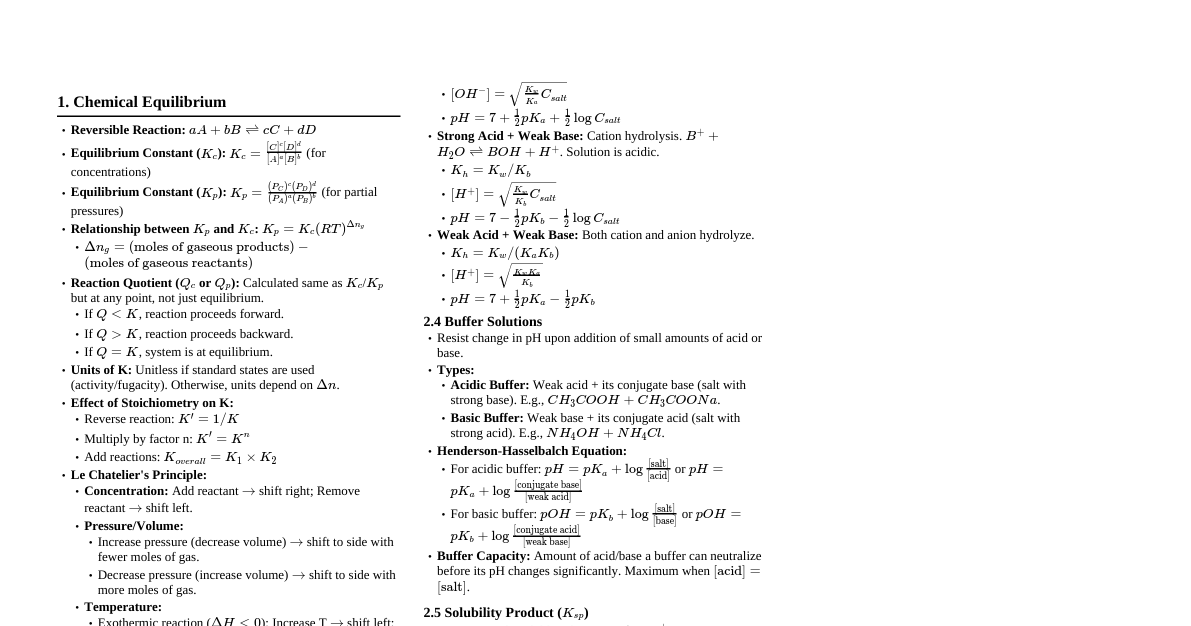
I understand you want the cheat sheet to be exactly one page, with an expanded content density to fill the space, while maintaining the current structure and clarity. I will refine the existing explanations, add more brief definitions, and include additional concise examples to reach the target length. Here is the expanded and refined cheat sheet: Chemical Equilibrium: Introduction A chemical reaction is a process transforming reactants to products. Chemical Equilibrium is a dynamic state where the rate of the forward reaction equals the rate of the reverse reaction, leading to constant macroscopic properties (concentrations, pressures, temperature) of the system. Types of Reactions & Equilibrium: Irreversible Reactions: Unidirectional; products cannot revert to reactants. Ex: $BaCl_2(aq) + H_2SO_4(aq) \longrightarrow BaSO_4(ppt) + 2HCl(aq)$. Reversible Reactions: Occur in both forward and backward directions, never go to completion; requires a closed system. Ex: $N_2(g) + 3H_2(g) \rightleftharpoons 2NH_3(g)$. Physical Equilibrium: Involves phase changes or dissolution processes of the same substance. Solid-liquid: $H_2O(s) \rightleftharpoons H_2O(l)$ (melting/freezing). Liquid-vapour: $H_2O(l) \rightleftharpoons H_2O(g)$ (vaporization/condensation). Gas-solution: Governed by Henry's Law ($P_{gas} = k_H C_{gas}$). Chemical Equilibrium: Involves a chemical transformation. At equilibrium, the net Gibbs Free Energy change ($\Delta G$) is zero. Characteristics of Equilibrium State: Dynamic nature: Reactions continue, but at equal rates ($Rate_f = Rate_b$). Attainable from either direction (starting with reactants or products). Concentrations of reactants and products are constant. Cannot be established if products can escape from the system. Law of Mass Action & Equilibrium Constant ($K$) The rate of a reaction is proportional to the product of the active masses (molar concentrations) of the reactants, each raised to the power of its stoichiometric coefficient. For a general reversible reaction: $aA + bB \rightleftharpoons cC + dD$ The Equilibrium Constant ($K$) expresses the ratio of products to reactants at equilibrium. It is constant at a given temperature, independent of initial concentrations or catalysts. For concentrations ($K_c$): $K_c = \frac{[C]^c [D]^d}{[A]^a [B]^b}$ (units: $(\text{mol/L})^{\Delta n}$) For partial pressures ($K_p$): $K_p = \frac{(P_C)^c (P_D)^d}{(P_A)^a (P_B)^b}$ (units: $(\text{atm})^{\Delta n_g}$ or $(\text{bar})^{\Delta n_g}$) Properties of Equilibrium Constant: Stoichiometry Changes: If reaction is reversed: $K'_{new} = 1/K_{old}$. If coefficients are multiplied by $n$: $K'_{new} = (K_{old})^n$. If reactions are added: $K_{overall} = K_1 \times K_2 \times \dots$. Temperature Dependence (Van't Hoff Equation): $$\log \frac{K_2}{K_1} = \frac{\Delta H^\circ}{2.303R} \left( \frac{T_2 - T_1}{T_1 T_2} \right)$$ Where $\Delta H^\circ$ is the standard enthalpy change of the reaction ($R$ is the ideal gas constant, $8.314 \text{ J/mol} \cdot \text{K}$). Exothermic ($\Delta H^\circ Endothermic ($\Delta H^\circ > 0$): Increasing $T$ increases $K$. Relationship between $K_p$ and $K_c$: $K_p = K_c (RT)^{\Delta n_g}$ Where $\Delta n_g = (\text{sum of stoichiometric coefficients of gaseous products}) - (\text{sum of stoichiometric coefficients of gaseous reactants})$. Heterogeneous Equilibria: Pure solids and pure liquids have active masses (concentrations) taken as unity (1) and are omitted from the $K$ expression. Ex: $CaCO_3(s) \rightleftharpoons CaO(s) + CO_2(g) \implies K_c = [CO_2]$; $K_p = P_{CO_2}$. Reaction Quotient ($Q$) and Predicting Reaction Direction The Reaction Quotient ($Q$) is calculated using non-equilibrium concentrations or partial pressures. Its form is identical to $K$. $Q = \frac{[C]^c [D]^d}{[A]^a [B]^b}$ (calculated at any point in time). If $Q forward direction to reach equilibrium. If $Q > K$: The reaction will proceed in the backward direction to reach equilibrium. If $Q = K$: The system is already at equilibrium . Le Chatelier's Principle If a system at equilibrium is subjected to a change in concentration, temperature, or pressure, it will adjust itself to counteract the effect of the change and establish a new equilibrium. Effects of Various Stresses: Concentration: Increasing reactant concentration or decreasing product concentration shifts equilibrium forward . Decreasing reactant concentration or increasing product concentration shifts equilibrium backward . Temperature: Increasing temperature shifts equilibrium in the endothermic direction (absorbs heat). Decreasing temperature shifts equilibrium in the exothermic direction (releases heat). Pressure (for gaseous reactions where $\Delta n_g \neq 0$): Increasing pressure shifts equilibrium towards the side with fewer moles of gas . Decreasing pressure shifts equilibrium towards the side with more moles of gas . If $\Delta n_g = 0$, pressure changes have no effect. Inert Gas Addition: At constant volume: No effect on equilibrium position (partial pressures remain unchanged). At constant pressure: The system expands, partial pressures of reactants/products decrease. Equilibrium shifts towards the side with more moles of gas (similar to decreasing pressure). Catalyst: A catalyst increases the rate of both forward and reverse reactions equally, allowing the system to reach equilibrium faster. It does not change the equilibrium position or the value of $K$ . Le Chatelier's & Physical Equilibria: Melting: Substances contracting on melting (e.g., ice) $\implies \uparrow P$ lowers MP. Boiling Point: $\uparrow P \implies \uparrow$ BP. Solubility: Gases in liquids: $\uparrow P \implies \uparrow$ solubility (Henry's Law); $\uparrow T \implies \downarrow$ solubility. Degree of Dissociation ($\alpha$) The fraction of total reactant moles that have dissociated at equilibrium. Useful for calculating equilibrium concentrations in gaseous dissociation reactions. For a reaction $A \rightleftharpoons nB$ (where 1 mole of A dissociates into n moles of B, e.g., $PCl_5 \rightleftharpoons PCl_3 + Cl_2$, so $n=2$): $\alpha = \frac{D - d}{d (n-1)}$ or $\alpha = \frac{M_{theoretical} - M_{observed}}{M_{observed} (n-1)}$ Where $D$ is initial vapor density, $d$ is equilibrium vapor density, $M_{theoretical}$ is theoretical molar mass, $M_{observed}$ is observed molar mass. Gibbs Free Energy and Equilibrium The relationship between standard Gibbs Free Energy change ($\Delta G^\circ$) and the equilibrium constant ($K_{eq}$) is fundamental: $\Delta G^\circ = -RT \ln K_{eq}$ or $\Delta G^\circ = -2.303 RT \log K_{eq}$ If $\Delta G^\circ 1$, indicating products are favored at equilibrium (spontaneous). If $\Delta G^\circ > 0$: $K_{eq} If $\Delta G^\circ = 0$: $K_{eq} = 1$, indicating reactants and products are equally favored. Calculation of $K_c$ and $K_p$ (Examples) General Steps: 1. Write balanced equation. 2. Define initial moles/pressures. 3. Define change (using $\alpha$ or $x$). 4. Calculate equilibrium moles/pressures/concentrations. 5. Substitute into $K$ expression. 1. Homogeneous Gaseous Phase ($\Delta n_g = 0$, e.g., $N_2(g) + O_2(g) \rightleftharpoons 2NO(g)$): Initial moles: $N_2=a$, $O_2=b$. Eq. moles: $N_2=(a-x)$, $O_2=(b-x)$, $NO=2x$. Total moles constant. $K_c = \frac{(2x/V)^2}{((a-x)/V)((b-x)/V)} = \frac{4x^2}{(a-x)(b-x)}$. $K_c$ is independent of $V$. As $\Delta n_g = 0$, $K_p = K_c$. 2. Homogeneous Gaseous Phase ($\Delta n_g > 0$, e.g., $PCl_5(g) \rightleftharpoons PCl_3(g) + Cl_2(g)$): Initial moles: $PCl_5=1$. Eq. moles: $PCl_5=(1-\alpha)$, $PCl_3=\alpha$, $Cl_2=\alpha$. Total moles = $(1+\alpha)$. $K_c = \frac{(\alpha/V)(\alpha/V)}{((1-\alpha)/V)} = \frac{\alpha^2}{(1-\alpha)V}$. $K_c$ depends on $V$. $K_p = \frac{P_{PCl_3} P_{Cl_2}}{P_{PCl_5}} = \frac{(\frac{\alpha}{1+\alpha}P_{total})(\frac{\alpha}{1+\alpha}P_{total})}{(\frac{1-\alpha}{1+\alpha}P_{total})} = \frac{\alpha^2 P_{total}}{1-\alpha^2}$. $K_p$ depends on $P_{total}$. 3. Homogeneous Gaseous Phase ($\Delta n_g Initial moles: $N_2=1$, $H_2=3$. Eq. moles: $N_2=(1-\alpha)$, $H_2=(3-3\alpha)$, $NH_3=2\alpha$. Total moles = $(4-2\alpha)$. $K_c = \frac{(2\alpha/V)^2}{((1-\alpha)/V)((3-3\alpha)/V)^3} = \frac{4\alpha^2 V^2}{27(1-\alpha)^4}$. $K_c$ depends on $V$. $K_p = \frac{P_{NH_3}^2}{P_{N_2} P_{H_2}^3} = \frac{16\alpha^2 (4-2\alpha)^2}{27(1-\alpha)^4 P_{total}^2}$. $K_p$ depends on $P_{total}$. 4. Homogeneous Solution Phase (e.g., Esterification: $CH_3COOH(l) + C_2H_5OH(l) \rightleftharpoons CH_3COOC_2H_5(l) + H_2O(l)$): Initial moles: Acid=1, Alcohol=1. Eq. moles: Acid=(1-x), Alcohol=(1-x), Ester=x, Water=x. $K_c = \frac{[Ester][Water]}{[Acid][Alcohol]} = \frac{(x/V)(x/V)}{((1-x)/V)((1-x)/V)} = \frac{x^2}{(1-x)^2}$. $K_c$ is independent of $V$ here as $\Delta n = 0$ for solution species.