Light - Class 8
Cheatsheet Content
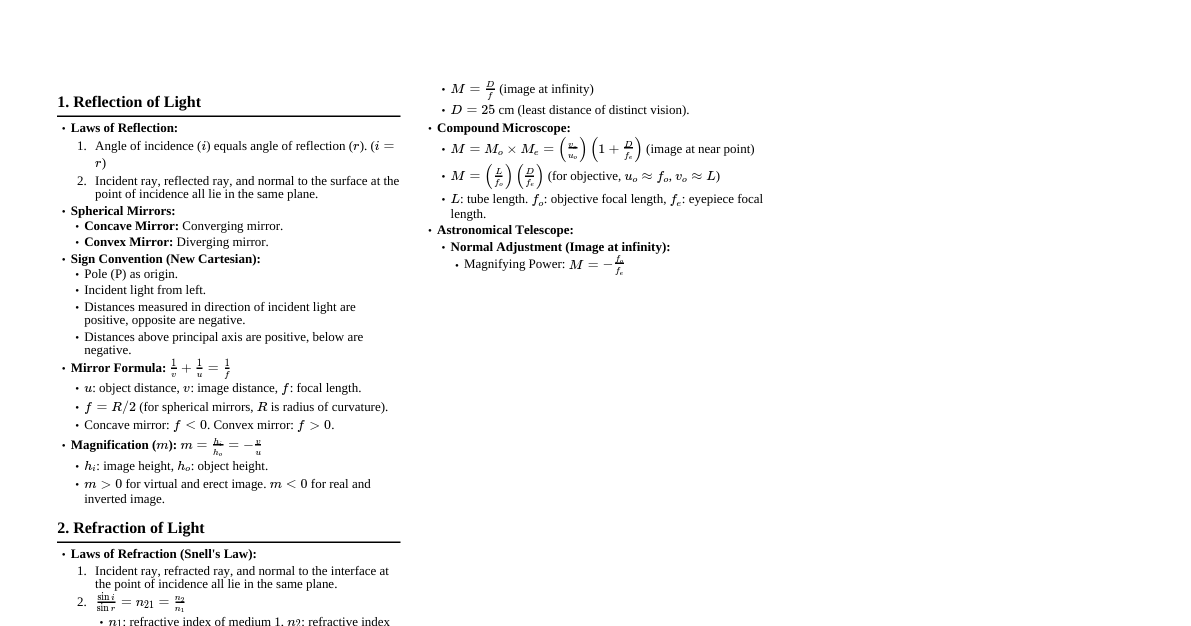
### Introduction to Light - **Light:** A form of energy that enables us to see objects. - **Luminous Objects:** Objects that emit their own light (e.g., sun, bulb, torch). - **Non-Luminous Objects:** Objects that do not emit their own light but reflect light from luminous objects (e.g., moon, chair, book). - **Propagation:** Light travels in a straight line. This is called the rectilinear propagation of light. ### Reflection of Light - **Reflection:** The phenomenon of bouncing back of light rays into the same medium after striking a surface. - **Incident Ray:** The light ray that strikes the surface. - **Reflected Ray:** The light ray that bounces back from the surface. - **Point of Incidence:** The point where the incident ray strikes the surface. - **Normal:** An imaginary line perpendicular to the surface at the point of incidence. - **Angle of Incidence ($\angle i$):** The angle between the incident ray and the normal. - **Angle of Reflection ($\angle r$):** The angle between the reflected ray and the normal. ### Laws of Reflection 1. The angle of incidence is equal to the angle of reflection ($\angle i = \angle r$). 2. The incident ray, the reflected ray, and the normal to the surface at the point of incidence all lie in the same plane. ### Types of Reflection #### Regular Reflection - Occurs when light reflects from a smooth, polished surface (e.g., mirror, calm water). - Parallel incident rays remain parallel after reflection. - Forms clear images. #### Diffused/Irregular Reflection - Occurs when light reflects from a rough or uneven surface (e.g., wall, paper). - Parallel incident rays reflect in different directions. - Does not form clear images, but allows us to see objects from different angles. ### Images Formed by a Plane Mirror - **Virtual:** The image cannot be obtained on a screen. - **Erect:** The image is upright (same orientation as the object). - **Same Size:** The image is the same size as the object. - **Same Distance:** The image is formed as far behind the mirror as the object is in front of it. - **Laterally Inverted:** The left side of the object appears as the right side in the image, and vice-versa. ### Multiple Images - When two plane mirrors are placed at an angle to each other, they can form multiple images. - Number of images ($N$) = $(360^\circ / \theta) - 1$, where $\theta$ is the angle between the mirrors. - Example: If $\theta = 90^\circ$, $N = (360/90) - 1 = 4 - 1 = 3$ images. - Example: If $\theta = 60^\circ$, $N = (360/60) - 1 = 6 - 1 = 5$ images. ### Dispersion of Light - **Dispersion:** The phenomenon of splitting of white light into its constituent seven colours (VIBGYOR - Violet, Indigo, Blue, Green, Yellow, Orange, Red) when it passes through a transparent medium (like a prism). - **Spectrum:** The band of seven colours formed due to dispersion. - **Cause:** Different colours of light travel at different speeds through a medium, causing them to bend at different angles. ### The Human Eye - **Cornea:** Transparent outer part, covers the front of the eye. - **Iris:** Coloured part, controls the size of the pupil. - **Pupil:** Opening in the centre of the iris, regulates light entering the eye. - **Lens:** Transparent, biconvex structure, focuses light onto the retina. - **Retina:** Light-sensitive layer at the back of the eye, contains rods and cones. - **Rods:** Sensitive to dim light, responsible for black and white vision. - **Cones:** Sensitive to bright light, responsible for colour vision. - **Optic Nerve:** Transmits visual information from the retina to the brain. - **Blind Spot:** Area on the retina where the optic nerve leaves the eye; no rods or cones, so no vision. ### Power of Accommodation - The ability of the eye lens to adjust its focal length to focus objects at varying distances on the retina. - Achieved by the action of ciliary muscles, which change the curvature of the lens. ### Persistence of Vision - The sensation of vision persists for about 1/16th of a second even after the removal of the stimulus. - This principle is used in motion pictures and animation. ### Care of Eyes - Do not read in very dim or very bright light. - Do not look directly at the sun or a powerful light source. - Wash eyes frequently with clean water. - Consult an eye specialist for any problems. - Maintain a proper reading distance (approx. 25 cm). ### Visually Challenged People - **Braille System:** A tactile writing system used by people who are visually impaired. - Developed by Louis Braille. - Uses raised dots in cells of two columns and three rows to represent letters, numbers, and punctuation. - Some visually impaired individuals can identify objects by touch and sound.