Electrostatics Cheatsheet
Cheatsheet Content
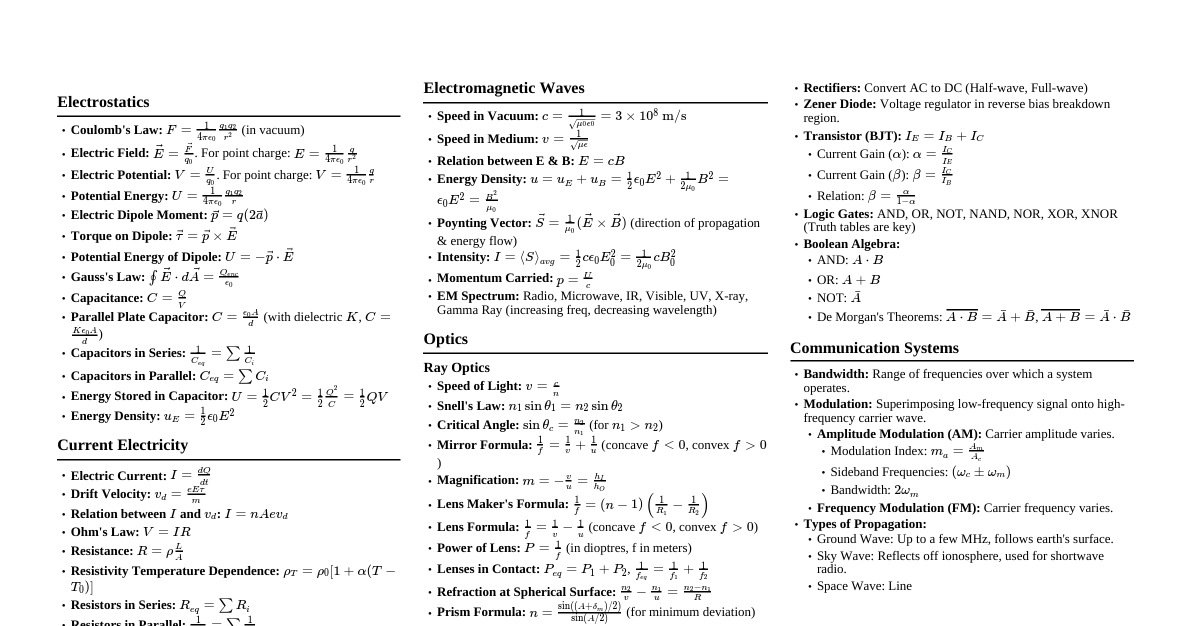
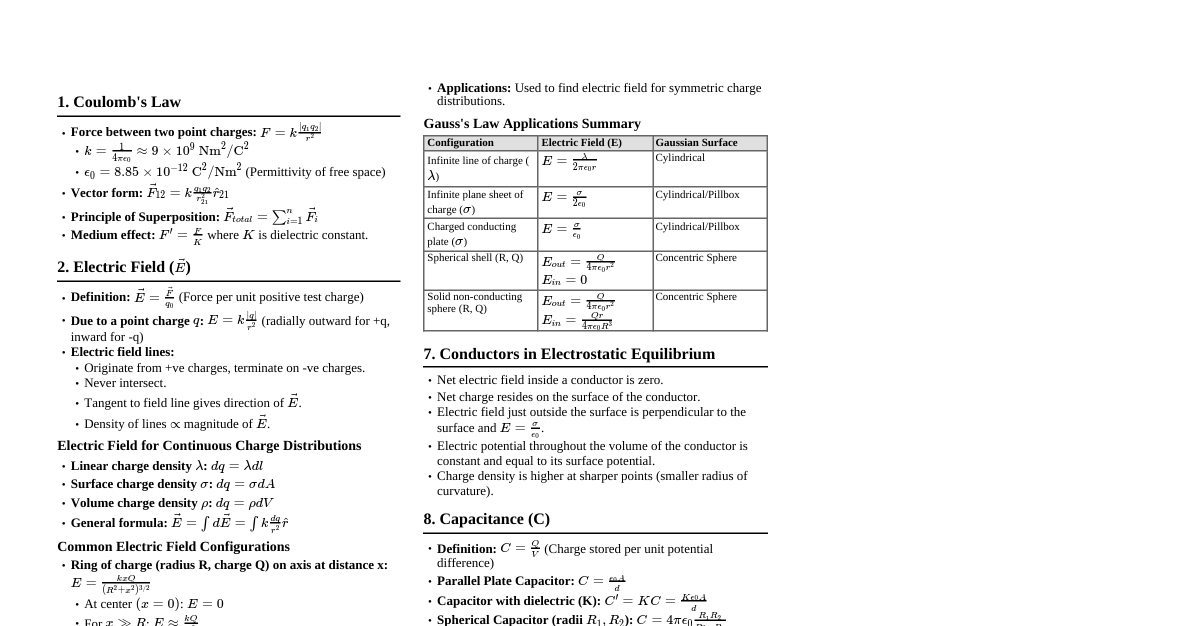
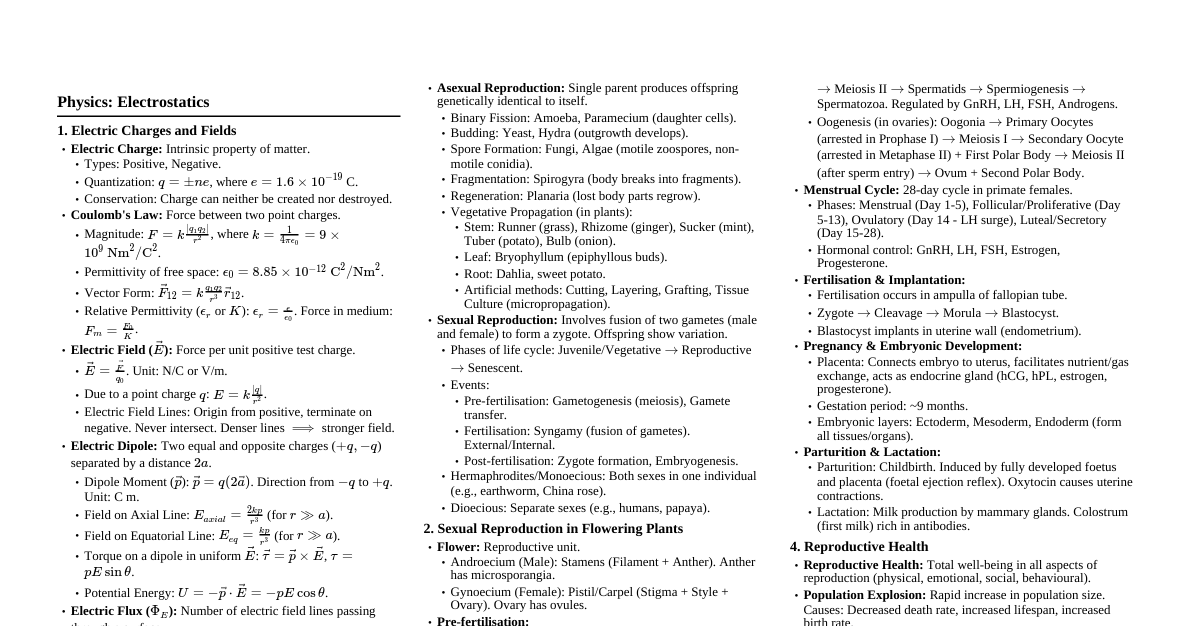
### Electric Charge - **Definition:** Intrinsic property of matter causing electrical and magnetic effects. - **Types:** - **Positive Charge:** Deficiency of electrons. - **Negative Charge:** Excess of electrons. - **SI Unit:** Coulomb (C) (ampere × second). - **Dimension:** $[AT]$ - **Practical Units:** Ampere-hour (3600 C), Faraday (96500 C). - **Quantization:** $q = ne$, where $n$ is an integer (positive or negative) and $e = 1.6 \times 10^{-19}$ C is the elementary charge. - **Conservation:** Total charge in an isolated system is constant. - **Invariance:** Charge is independent of reference frame (speed). - **Attraction/Repulsion:** Like charges repel, opposite charges attract. #### Accelerated Charge Radiation - **At rest ($v=0$):** Produces only Electric Field (E). - **Constant velocity ($v \neq 0$, constant):** Produces Electric (E) and Magnetic (B) fields, no radiation. - **Accelerated ($v \neq constant$):** Produces E, B, and radiates energy. ### Methods of Charging #### Friction - Electrons transfer between two bodies when rubbed. - Transfers from lower work function body to higher work function body. #### Electrostatic Induction - A charged body brought near a neutral metallic body induces opposite charge on the nearer side and similar charge on the farther side. - **Important Facts:** - Inducing body neither gains nor loses charge. - Induced charge is always opposite to that of inducing charge. - Occurs only in conducting or non-conducting bodies, not in particles. #### Conduction - Transfer of charge by direct contact between bodies. - The charged body loses some charge, and the uncharged body gains charge. - Charge flow depends on potential difference: - Positive charge: Higher potential to lower potential. - Negative charge: Lower potential to higher potential. ### Coulomb's Law - **Statement:** The electrostatic force between two static point charges is directly proportional to the product of their magnitudes and inversely proportional to the square of the distance between them. It acts along the line joining the charges. - **Formula:** $F = k \frac{q_1 q_2}{r^2}$ - Where $k = \frac{1}{4\pi\varepsilon_0} = 9 \times 10^9 \text{ Nm}^2/\text{C}^2$ is Coulomb's constant. - **Vector Form:** $\vec{F}_{12} = k \frac{q_1 q_2}{r^2} \hat{r}_{21}$ (force on $q_1$ due to $q_2$, $\hat{r}_{21}$ is unit vector from $q_1$ to $q_2$) - **Position Vector Form:** $\vec{F}_{12} = k q_1 q_2 \frac{(\vec{r}_1 - \vec{r}_2)}{|\vec{r}_1 - \vec{r}_2|^3}$ #### Principle of Superposition - The total force on a charge due to multiple interacting charges is the vector sum of the forces exerted by each individual charge. - $\vec{F} = \vec{F}_{12} + \vec{F}_{13} + \dots$ #### Important Points - Applies to point charges at rest. - Based on physical observations, universally valid. - Analogous to Newton's Law of Gravitation, but: - Electric force is much stronger than gravitational force. - Electric force can be attractive or repulsive; gravitational force is always attractive. - Electric force depends on the medium; gravitational force does not. - It is an action-reaction pair. - The force is conservative (work done in a closed path is zero). - **Dielectric Constant (K):** $K = \frac{F_{\text{free space}}}{F_{\text{medium}}}$ - Electric force between two charges does not depend on neighboring charges. ### Equilibrium of Charged Particles - Net electric force on every charged particle is zero. - Equilibrium of a charged particle under Colombian forces alone is never stable. #### Equilibrium of Three Point Charges - Two charges must be of like nature. - Third charge should be of unlike nature. #### Equilibrium of Symmetric Geometrical Point Charged System - For equilateral triangle: $Q = -\frac{q}{3}$ - For square: $Q = -\frac{q(2\sqrt{2}+1)}{4}$ #### Equilibrium of Suspended Point Charge System - For equilibrium position: $T \cos\theta = mg$ and $T \sin\theta = F_e = \frac{kQ^2}{x^2}$ - If $\theta$ is small, $\tan\theta \approx \sin\theta \approx \theta$. ### Electric Field - **Concept:** A region around a charge where its electrical effects are perceptible. - **Electric Field Intensity ($\vec{E}$):** Force per unit test charge. - **Formula:** $\vec{E} = \lim_{q_0 \to 0} \frac{\vec{F}}{q_0} = k \frac{q}{r^2} \hat{r}$ - **Units:** N/C or V/m. - **Dimension:** $[MLT^{-3}A^{-1}]$. #### Properties of Electric Field Intensity - Vector quantity. - Direction: Away from positive charge, towards negative charge. - Force on charge $q$: $\vec{F} = q\vec{E}$. - Obeys superposition principle. #### Electric Field Intensities Due to Various Charge Distributions ##### Discrete Distribution - $\vec{E}_p = \sum \vec{E}_i$ ##### Continuous Distribution - $\vec{E} = \int d\vec{E} = \int \frac{k dq}{r^2} \hat{r}$ ##### Uniformly Charged Rod - **At general point P:** - $E_x = \frac{kQ}{Lr}(\cos\theta_2 - \cos\theta_1)$ - $E_y = \frac{kQ}{Lr}(\sin\theta_1 - \sin\theta_2)$ #### Electric Field Due to a Uniformly Charged Ring ##### At its Centre - By symmetry, $\vec{E} = 0$. ##### At a Point on the Axis - $E_p = \frac{kQx}{(R^2 + x^2)^{3/2}}$ - Where $R$ is the radius of the ring and $x$ is the distance from the center along the axis. #### Electric Field Strength Due to a Charged Circular Arc at its Centre - $E_C = \frac{2kQ \sin(\phi/2)}{\phi R^2}$ - Where $\phi$ is the angle subtended by the arc at the center. #### Electric Field Strength Due to a Uniformly Surface Charged Disc - $dE = \frac{k \sigma 2\pi y dy \cdot x}{(x^2 + y^2)^{3/2}}$ - $E_p = \frac{\sigma}{2\varepsilon_0} \left(1 - \frac{x}{\sqrt{x^2 + R^2}}\right)$ - Where $\sigma$ is the surface charge density, $R$ is the radius of the disc, and $x$ is the distance from the center along the axis. - If $R \gg x$, then $E_p = \frac{\sigma}{2\varepsilon_0}$ (for an infinite sheet). ### Electric Flux - **Definition:** Measure of the flow of a vector field through an imaginary fixed element of surface. - **Formula:** $\Phi_E = \int \vec{E} \cdot d\vec{A}$ - **Units:** V-m or N-m$^2$/C. - **Dimension:** $[ML^3T^{-3}A^{-1}]$. - **Scalar quantity.** #### Electric Flux Through a Circular Disc - For a point charge $q$ placed at distance $l$ from a disc of radius $R$: - $\Phi = \frac{q}{2\varepsilon_0} \left(1 - \frac{l}{\sqrt{l^2 + R^2}}\right)$ #### Electric Flux Through the Lateral Surface of a Cylinder Due to a Point Charge - Total flux through the lateral surface of a cylinder due to a point charge $q$ at its center on the axis: - $\Phi = \frac{qR^2}{\varepsilon_0 l \sqrt{l^2 + 4R^2}}$ ### Gauss's Law - **Statement:** The total electric flux through any closed surface (Gaussian surface) is equal to $\frac{1}{\varepsilon_0}$ times the total electric charge enclosed by that surface. - **Formula:** $\Phi_E = \oint \vec{E} \cdot d\vec{A} = \frac{q_{\text{enclosed}}}{\varepsilon_0}$ #### Important Points Regarding Gauss's Law - Flux is independent of the shape and size of the Gaussian surface. - Flux depends only on charges inside the Gaussian surface. - Flux is independent of the position of charges inside the Gaussian surface. - Electric field intensity at the Gaussian surface is due to all charges (inside and outside). - Incoming flux is negative, outgoing flux is positive. - If $\Phi_E = 0$, it does not imply $\vec{E} = 0$. But if $\vec{E} = 0$ everywhere on the surface, then $\Phi_E = 0$. - Gauss's law and Coulomb's law are equivalent. - If a closed surface encloses a dipole, $q_{\text{enclosed}} = 0$, so $\Phi_E = 0$, but $\vec{E} \neq 0$. #### Electric Field Due to Solid Conducting or Hollow Sphere ##### Outside Point ($r > R$) - $E = \frac{kq}{r^2}$ - $V = \frac{kq}{r}$ ##### Surface Point ($r = R$) - $E_s = \frac{kq}{R^2}$ - $V_s = \frac{kq}{R}$ ##### Inside Point ($r R$) - $E = \frac{kq}{r^2}$ - $V = \frac{kq}{r}$ ##### Surface Point ($r = R$) - $E_s = \frac{kq}{R^2}$ - $V_s = \frac{kq}{R}$ ##### Inside Point ($r ### Electric Potential - **Definition:** Scalar property of every point in the region of an electric field. Potential $V = \frac{U}{q_0}$. - **Work Done:** Work done in bringing a unit positive charge from infinity to a point. - **Formula:** $V = -\int_{\infty}^r \vec{E} \cdot d\vec{r}$ #### Potential Difference - **Definition:** Work done in displacing a unit positive charge from point A to point B against electric forces. - $V_B - V_A = -\int_A^B \vec{E} \cdot d\vec{r}$ - If charge $q$ is shifted: $W = q(V_B - V_A)$. - Electric potential decreases in the direction of the electric field. #### Electric Potential Due to a Point Charge - $V = \frac{kq}{r}$ #### Electric Potential Due to a Charge Rod - $V = \frac{kQ}{L} \ln\left(\frac{r+L}{r}\right)$ #### Electric Potential Due to a Charged Ring ##### At its Centre - $V = \frac{kQ}{R}$ ##### At a Point on the Axis - $V_p = \frac{kQ}{\sqrt{R^2 + x^2}}$ #### Electric Potential Due to a Uniformly Charged Disc - $V = \frac{\sigma}{2\varepsilon_0} (\sqrt{x^2 + R^2} - x)$ - Where $\sigma$ is the surface charge density. #### Electric Potential Gradient - **Definition:** Maximum rate of change of potential at right angles to an equipotential surface. - $\vec{E} = -\nabla V = -\left(\frac{\partial V}{\partial x}\hat{i} + \frac{\partial V}{\partial y}\hat{j} + \frac{\partial V}{\partial z}\hat{k}\right)$ - Potential is a scalar, but its gradient is a vector. ### Equipotential Surfaces - **Definition:** Locus of all points having the same potential. - Never cross each other. - Always perpendicular to the electric field lines. - Work done moving a charge on an equipotential surface is zero. - **Shapes:** - **Uniform electric field:** Parallel planes. - **Point charge:** Concentric spheres. - **Line distribution:** Concentric cylinders. ### Electrostatic Potential Energy - **Definition:** Work done in assembling a system of charged particles from infinity to a given configuration. - **Interaction Energy of Two Charged Particles:** $U = \frac{kq_1 q_2}{r}$ - **Interaction Energy of a System of Charged Particles:** Sum of interaction energies for all pairs. - For three particles: $U = \frac{kq_1 q_2}{r_{12}} + \frac{kq_1 q_3}{r_{13}} + \frac{kq_2 q_3}{r_{23}}$ #### Self Energy of Charged Object - Work required to assemble the charge on the object from infinity. - **Uniformly Charged Hollow Sphere:** $U = \frac{kQ^2}{2R}$ - **Uniformly Charged Solid Sphere:** $U = \frac{3kQ^2}{5R}$ ### Electric Dipole - **Definition:** Two equal and opposite charges separated by a small distance ($2l$). - **Dipole Moment ($\vec{p}$):** Product of magnitude of either charge and separation distance. - **Formula:** $\vec{p} = q(2\vec{l})$ - **Direction:** From negative to positive charge. - **Units:** C-m. - **Dimension:** $[LTA]$. - **Practical Unit:** Debye (1 Debye = $3.3 \times 10^{-30}$ C-m). #### Dipole Placed in Uniform Electric Field - **Net Force:** $\vec{F}_{\text{net}} = 0$. - **Torque ($\vec{\tau}$):** $\vec{\tau} = \vec{p} \times \vec{E} = pE \sin\theta$. - **Work Done in Rotation:** $W = pE(\cos\theta_1 - \cos\theta_2)$. - **Potential Energy:** $U = -\vec{p} \cdot \vec{E} = -pE \cos\theta$. - Minimum potential energy when $\vec{p}$ is parallel to $\vec{E}$ ($\theta=0$, $U=-pE$). - Maximum potential energy when $\vec{p}$ is anti-parallel to $\vec{E}$ ($\theta=\pi$, $U=+pE$). #### Force on an Electric Dipole in Non-uniform Electric Field - $\vec{F} = -\nabla U = - \left(\frac{\partial U}{\partial x}\hat{i} + \frac{\partial U}{\partial y}\hat{j} + \frac{\partial U}{\partial z}\hat{k}\right)$ - If dipole is along E-field: $F = -p \frac{dE}{dx}$. #### Electric Potential Due to Dipole ##### At Axial Point - $V = \frac{kp}{r^2}$ (for $r \gg l$) ##### At Equatorial Point - $V = 0$ ##### At General Point - $V = \frac{kp \cos\theta}{r^2}$ #### Electric Field Due to an Electric Dipole ##### At Axial Point - $E = \frac{2kp}{r^3}$ (for $r \gg l$) ##### At Equatorial Point - $E = \frac{kp}{r^3}$ (for $r \gg l$) ##### At General Point - $E = \frac{kp}{r^3} \sqrt{1 + 3\cos^2\theta}$ ### Electrostatic Pressure - **Definition:** Force per unit area exerted on a charged surface. - **Formula:** $P = \frac{\sigma^2}{2\varepsilon_0}$ - **Direction:** Normally outwards to the surface. #### Equilibrium of Liquid Charged Surfaces (Soap Bubble) - Inward pressure due to surface tension ($P_T = \frac{4T}{r}$) and outward electrostatic pressure ($P_e = \frac{\sigma^2}{2\varepsilon_0}$). - For equilibrium: $P_T = P_e$ (if no external pressure difference). ### Conductor and its Properties - Contains free electrons. - Always equipotential surfaces in electrostatics. - Charge always resides on the surface. - If there is a cavity with no charge, charge resides only on the outer surface. - Electric field is always perpendicular to the conducting surface. - Electric field intensity near the conducting surface: $E = \frac{\sigma}{\varepsilon_0} \hat{n}$. - When grounded, potential becomes zero. - Charge flows until potentials become equal when connected. - Electric pressure at the surface: $P = \frac{\sigma^2}{2\varepsilon_0}$. #### Important Results for a Closed Conductor - If charge $q$ is kept in a cavity: $-q$ induced on inner surface, $+q$ induced on outer surface. - Resultant field due to $q$ and induced charge on $S_1$ is zero outside $S_1$. - Resultant field due to $q+Q$ on $S_2$ and other charges outside $S_2$ is zero inside $S_2$. - Resultant field in a charge-free cavity in a closed conductor is zero. ### Electric Lines of Force (ELF) - **Definition:** Imaginary lines tangent to which at any point give the direction of the electric field. #### Properties of ELF - Never intersect. - Originate from positive charges, terminate on negative charges. - Number of lines is proportional to the magnitude of charge. - End or start normally at the surface of a conductor. - Crowded lines indicate strong field, distant lines indicate weak field. ### Chapter at a Glance: Formulas and Concepts | Topic | Electric Field (E) | Electric Potential (V) | |---|---|---| | **Point Charge** | $E = \frac{kq}{r^2}$ | $V = \frac{kq}{r}$ | | **Uniformly Charged Straight Wire** | $E_x = \frac{k\lambda}{r}(\sin\theta_1 + \sin\theta_2)$, $E_y = \frac{k\lambda}{r}(\cos\theta_2 - \cos\theta_1)$ | $V_B - V_A = -2k\lambda \ln(\frac{r_B}{r_A})$ | | **Infinite Line of Charge** | $E = \frac{2k\lambda}{r}$ | $V_B - V_A = -2k\lambda \ln(\frac{r_B}{r_A})$ | | **Uniformly Charged Ring (Axis)** | $E = \frac{kQx}{(R^2 + x^2)^{3/2}}$ | $V = \frac{kQ}{\sqrt{R^2 + x^2}}$ | | **Uniformly Charged Circular Disc** | $E = \frac{\sigma}{2\varepsilon_0} \left(1 - \frac{x}{\sqrt{x^2 + R^2}}\right)$ | $V = \frac{\sigma}{2\varepsilon_0} (\sqrt{x^2 + R^2} - x)$ | | **Infinite Non-Conducting Sheet** | $E = \frac{\sigma}{2\varepsilon_0}$ | $V_B - V_A = -\frac{\sigma}{2\varepsilon_0}(r_B - r_A)$ | | **Spherical Shell / Conductor** | $E_{\text{out}} = \frac{kQ}{r^2}$, $E_{\text{in}} = 0$ | $V_{\text{out}} = \frac{kQ}{r}$, $V_{\text{in}} = \frac{kQ}{R}$ | | **Solid Non-Conductor** | $E_{\text{out}} = \frac{kQ}{r^2}$, $E_{\text{in}} = \frac{kQr}{R^3}$ | $V_{\text{out}} = \frac{kQ}{r}$, $V_{\text{in}} = \frac{kQ(3R^2 - r^2)}{2R^3}$ | | **Electric Dipole (Axial)** | $E = \frac{2kp}{r^3}$ | $V = \frac{kp}{r^2}$ | | **Electric Dipole (Equatorial)** | $E = \frac{kp}{r^3}$ | $V = 0$ | | **Electric Dipole (General)** | $E = \frac{kp}{r^3}\sqrt{1+3\cos^2\theta}$ | $V = \frac{kp\cos\theta}{r^2}$ | #### Key Concepts & Relations - **Energy Density of Electric Field:** $u = \frac{1}{2}\varepsilon_0 E^2$ - **Electric Pressure:** $P = \frac{\sigma^2}{2\varepsilon_0}$ - **Conductor Surface:** $\vec{E}$ is always perpendicular. Charge density is higher at sharp points. - **Dipole in Uniform Field:** $\vec{\tau} = \vec{p} \times \vec{E}$, $F=0$, $U = -\vec{p} \cdot \vec{E}$. - **Dipole in Non-uniform Field:** $\vec{F} = -\nabla U$.