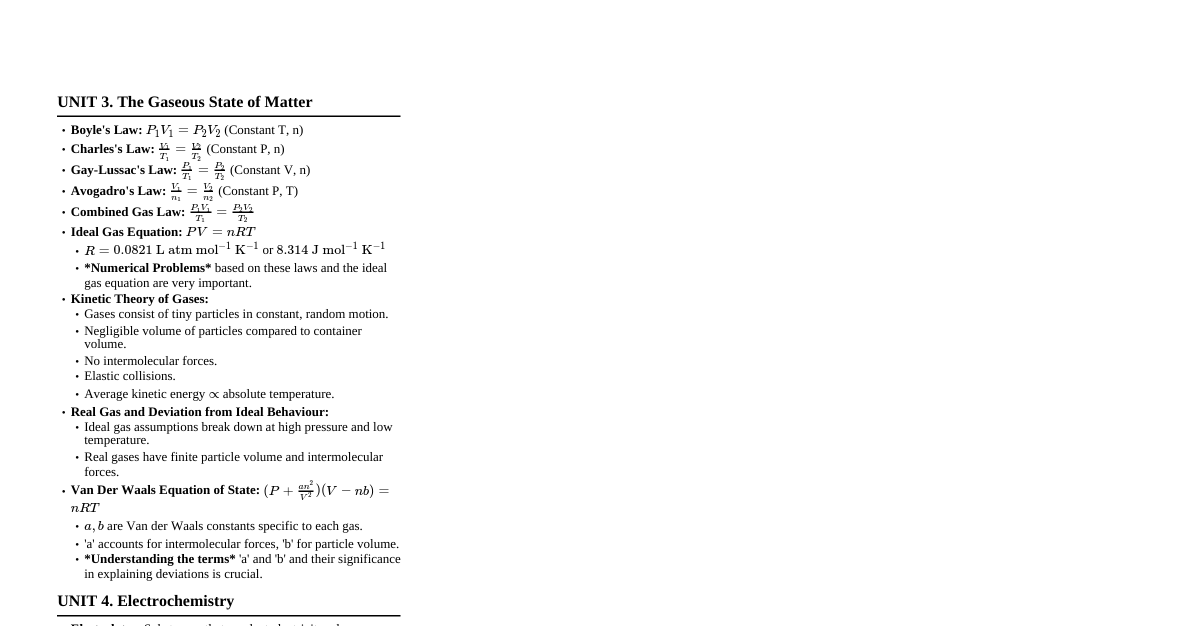
Class 12 Chemistry Formulas & Equations
Cheatsheet Content
1. Solutions Concentration Terms: Mole Fraction ($x$): $x_A = \frac{n_A}{n_A + n_B}$ (sum of mole fractions = 1) Molarity (M): $M = \frac{\text{moles of solute}}{\text{volume of solution (L)}}$ (temp. dependent) Molality (m): $m = \frac{\text{moles of solute}}{\text{mass of solvent (kg)}}$ (temp. independent) Mass Percentage: $\frac{\text{mass of component}}{\text{total mass of solution}} \times 100$ Volume Percentage: $\frac{\text{volume of component}}{\text{total volume of solution}} \times 100$ Mass by Volume Percentage: $\frac{\text{mass of solute (g)}}{\text{volume of solution (mL)}} \times 100$ Parts per Million (ppm): $\frac{\text{mass of component}}{\text{total mass of solution}} \times 10^6$ Henry's Law: $P = K_H x$ ($P$: partial pressure of gas, $K_H$: Henry's constant, $x$: mole fraction of gas in solution) Raoult's Law: For volatile components: $P_A = x_A P_A^\circ$; $P_B = x_B P_B^\circ$; $P_{\text{total}} = P_A + P_B = x_A P_A^\circ + x_B P_B^\circ$ For non-volatile solute: $\frac{P^\circ - P_s}{P^\circ} = x_{\text{solute}} = \frac{n_2}{n_1+n_2} \approx \frac{n_2}{n_1}$ (for dilute solutions) Colligative Properties: Depend only on the number of solute particles, not their identity. Relative Lowering of Vapor Pressure (RLVP): $\frac{P^\circ - P_s}{P^\circ} = \frac{n_2}{n_1+n_2}$ Elevation in Boiling Point ($\Delta T_b$): $\Delta T_b = T_b - T_b^\circ = K_b m$ $K_b$: Ebullioscopic constant (molal elevation constant) Depression in Freezing Point ($\Delta T_f$): $\Delta T_f = T_f^\circ - T_f = K_f m$ $K_f$: Cryoscopic constant (molal depression constant) Osmotic Pressure ($\Pi$): $\Pi = iCRT = i \frac{n_2}{V} RT$ $i$: van't Hoff factor, $C$: Molarity, $R$: Gas constant ($0.0821 \text{ L atm mol}^{-1} \text{ K}^{-1}$ or $8.314 \text{ J mol}^{-1} \text{ K}^{-1}$), $T$: Temperature (K) van't Hoff Factor ($i$): Accounts for dissociation or association of solute. $i = \frac{\text{Normal Molar Mass}}{\text{Observed Molar Mass}} = \frac{\text{Observed Colligative Property}}{\text{Calculated Colligative Property}}$ For dissociation: $i = 1 + (n-1)\alpha$ ($n$: number of ions produced, $\alpha$: degree of dissociation) For association: $i = 1 + (1/n - 1)\alpha$ ($n$: number of molecules associating, $\alpha$: degree of association) 2. Electrochemistry Electrochemical Cell Notation: Anode | Anode Ion || Cathode Ion | Cathode Standard Electrode Potential: $E^\circ_{\text{cell}} = E^\circ_{\text{reduction (cathode)}} - E^\circ_{\text{reduction (anode)}}$ Nernst Equation: For a general reaction $aA + bB \rightleftharpoons cC + dD$: $E_{\text{cell}} = E^\circ_{\text{cell}} - \frac{RT}{nF} \ln Q = E^\circ_{\text{cell}} - \frac{0.0591}{n} \log Q$ (at 298 K) where $Q = \frac{[C]^c[D]^d}{[A]^a[B]^b}$ (reaction quotient) Gibbs Free Energy & Cell Potential: $\Delta G = -nFE_{\text{cell}}$ $\Delta G^\circ = -nFE^\circ_{\text{cell}}$ Relationship between $E^\circ_{\text{cell}}$ and Equilibrium Constant ($K_c$): $\Delta G^\circ = -RT \ln K_c \implies -nFE^\circ_{\text{cell}} = -RT \ln K_c \implies E^\circ_{\text{cell}} = \frac{RT}{nF} \ln K_c = \frac{0.0591}{n} \log K_c$ (at 298 K) Faraday's Laws of Electrolysis: First Law: $W = ZIt$ ($W$: mass deposited, $Z$: electrochemical equivalent, $I$: current, $t$: time) Second Law: $\frac{W_1}{W_2} = \frac{E_1}{E_2}$ ($E$: equivalent weight) Number of Faradays ($F$) = $\frac{\text{Charge (Coulombs)}}{96487 \text{ C/mol e}^-}$ $1 \text{ Faraday} = 96487 \text{ C/mol e}^-$ Conductance ($G$): $G = \frac{1}{R}$ (Siemens, S) Conductivity ($\kappa$): $\kappa = G \cdot \frac{l}{A} = \frac{1}{R} \cdot G^*$ ($G^*$: cell constant, S cm$^{-1}$ or S m$^{-1}$) Molar Conductivity ($\Lambda_m$): $\Lambda_m = \frac{\kappa \times 1000}{M}$ (S cm$^2$ mol$^{-1}$) for $\kappa$ in S cm$^{-1}$ and M in mol L$^{-1}$. Kohlrausch's Law of Independent Migration of Ions: $\Lambda_m^\circ = \nu_+ \lambda_+^\circ + \nu_- \lambda_-^\circ$ $\nu_+, \nu_-$: number of cations/anions per formula unit $\lambda_+^\circ, \lambda_-^\circ$: limiting molar conductivities of cation/anion Degree of Dissociation ($\alpha$): $\alpha = \frac{\Lambda_m}{\Lambda_m^\circ}$ Fuel Cells: e.g., H$_2$-O$_2$ fuel cell: Anode: $H_2(g) + 2OH^-(aq) \to 2H_2O(l) + 2e^-$ Cathode: $O_2(g) + 2H_2O(l) + 4e^- \to 4OH^-(aq)$ Overall: $2H_2(g) + O_2(g) \to 2H_2O(l)$ 3. Chemical Kinetics Rate of Reaction: For $aA + bB \to cC + dD$: $\text{Rate} = -\frac{1}{a}\frac{d[A]}{dt} = -\frac{1}{b}\frac{d[B]}{dt} = \frac{1}{c}\frac{d[C]}{dt} = \frac{1}{d}\frac{d[D]}{dt}$ Rate Law: $\text{Rate} = k[A]^x[B]^y$ (where $x, y$ are orders with respect to A, B; $x+y$ is overall order) Integrated Rate Laws and Half-lives ($t_{1/2}$): Zero Order Reaction: $R \to P$ Rate: $-\frac{d[R]}{dt} = k[R]^0 = k$ Integrated Law: $[R]_t = -kt + [R]_0$ Half-life: $t_{1/2} = \frac{[R]_0}{2k}$ Units of $k$: mol L$^{-1}$ s$^{-1}$ First Order Reaction: $R \to P$ Rate: $-\frac{d[R]}{dt} = k[R]$ Integrated Law: $\ln[R]_t = -kt + \ln[R]_0$ or $k = \frac{2.303}{t} \log \frac{[R]_0}{[R]_t}$ Half-life: $t_{1/2} = \frac{0.693}{k}$ (independent of initial concentration) Units of $k$: s$^{-1}$ Second Order Reaction: Integrated Law: $\frac{1}{[R]_t} = kt + \frac{1}{[R]_0}$ Half-life: $t_{1/2} = \frac{1}{k[R]_0}$ Units of $k$: L mol$^{-1}$ s$^{-1}$ Activation Energy ($E_a$): Minimum energy required for a reaction to occur. Arrhenius Equation: $k = Ae^{-E_a/RT}$ $A$: Arrhenius factor (frequency factor) $\ln k = \ln A - \frac{E_a}{RT}$ Logarithmic form for two temperatures: $\ln \frac{k_2}{k_1} = \frac{E_a}{R} \left( \frac{1}{T_1} - \frac{1}{T_2} \right)$ 4. d- & f-Block Elements General Characteristics of Transition Elements (d-block): Variable oxidation states Formation of coloured ions Tendency to form complex compounds Paramagnetic behaviour (due to unpaired electrons) Catalytic properties Formation of interstitial compounds High melting and boiling points Magnetic Properties: Paramagnetic: Possess unpaired electrons, attracted by magnetic field. Diamagnetic: All electrons paired, repelled by magnetic field. Magnetic Moment ($\mu$): $\mu = \sqrt{n(n+2)}$ BM (Bohr Magnetons) $n$: number of unpaired electrons Lanthanoids (4f-series): Lanthanoid Contraction: Gradual decrease in atomic and ionic radii ($M^{3+}$) from La to Lu. Consequences: Similar radii of 4d and 5d series elements (e.g., Zr and Hf), difficulty in separation. Common oxidation state: +3 Actinoids (5f-series): Greater range of oxidation states than lanthanoids (e.g., +3, +4, +5, +6, +7). Mostly radioactive. Actinoid contraction is greater than lanthanoid contraction. 5. Coordination Compounds Definitions: Central Metal Atom/Ion: Lewis acid, accepts electron pairs. Ligands: Lewis base, donates electron pairs. (Monodentate, Bidentate, Polydentate) Coordination Number: Number of ligand donor atoms bonded to the central metal. Coordination Sphere: Central metal atom/ion and ligands enclosed in a square bracket. Nomenclature: IUPAC rules (e.g., Tetraamminecopper(II) sulfate) Isomerism: Structural Isomerism: Linkage: Ligand binds through different donor atoms (e.g., $-\text{NO}_2$ vs $-\text{ONO}$). Coordination: Exchange of ligands between cationic and anionic complexes. Ionization: Counter ion is a potential ligand and vice-versa. Solvate (Hydrate): Water molecule is ligand or solvent of crystallization. Stereoisomerism: Geometric (cis-trans): Different spatial arrangements around the central atom (e.g., $MA_2B_2$, $MA_4B_2$, $M(AA)_2B_2$). Also fac/mer for $MA_3B_3$. Optical: Non-superimposable mirror images (enantiomers), exhibit optical activity (e.g., $M(AA)_3$, $M(AA)_2B_2$). Bonding in Coordination Compounds: Werner's Theory: Primary (ionizable) and Secondary (non-ionizable, coordination number) valency. Valence Bond Theory (VBT): Explains bonding, geometry, and magnetic properties using hybridization (e.g., $sp^3, dsp^2, sp^3d^2, d^2sp^3$). Crystal Field Theory (CFT): Explains electronic structure, colour, and magnetic properties. Ligands cause splitting of degenerate d-orbitals. Octahedral Field: d-orbitals split into $t_{2g}$ (lower energy, $d_{xy}, d_{yz}, d_{zx}$) and $e_g$ (higher energy, $d_{x^2-y^2}, d_{z^2}$). $\Delta_o$ (crystal field splitting energy). Tetrahedral Field: d-orbitals split into $e$ (lower energy) and $t_2$ (higher energy). $\Delta_t = \frac{4}{9}\Delta_o$. Strong field ligands (e.g., CN$^-$, CO) cause large splitting, favour pairing. Weak field ligands (e.g., Cl$^-$, F$^-$) cause small splitting, favour high spin. EAN (Effective Atomic Number) Rule: $EAN = Z - \text{oxidation state} + 2 \times \text{coordination number}$ (for central metal) 6. Haloalkanes and Haloarenes Preparation Methods: From Alcohols: $R-OH + HX \xrightarrow{ZnCl_2} R-X + H_2O$; $R-OH + PCl_5 \to R-Cl + POCl_3 + HCl$; $R-OH + SOCl_2 \to R-Cl + SO_2 + HCl$ (Darzen's process) From Alkenes: $R-CH=CH_2 + HX \to R-CH(X)-CH_3$ (Markovnikov's rule); $R-CH=CH_2 + HBr \xrightarrow{\text{peroxide}} R-CH_2-CH_2Br$ (Anti-Markovnikov's rule) Halogen Exchange: Finkelstein Reaction: $R-X + NaI \xrightarrow{\text{acetone}} R-I + NaX$ Swarts Reaction: $CH_3Br + AgF \to CH_3F + AgBr$ Sandmeyer Reaction: Ar-N$_2^+$Cl$^-$ $\xrightarrow{Cu_2X_2 \text{ or } CuX} Ar-X + N_2$ ($X = Cl, Br$) Gatterman Reaction: Ar-N$_2^+$Cl$^-$ $\xrightarrow{Cu/HX} Ar-X + N_2$ Balz-Schiemann Reaction: Ar-N$_2^+$BF$_4^-$ $\xrightarrow{\Delta} Ar-F + BF_3 + N_2$ Nucleophilic Substitution Reactions: $S_N1$ (Unimolecular): Two steps, carbocation intermediate, rate = $k[RX]$, favored by $3^\circ > 2^\circ$, polar protic solvents, weaker nucleophiles. Leads to racemization. $S_N2$ (Bimolecular): One step (concerted), transition state, rate = $k[RX][Nu^-]$, favored by $1^\circ > 2^\circ$, polar aprotic solvents, stronger nucleophiles. Leads to inversion of configuration (Walden inversion). Elimination Reactions ($\beta$-elimination): Dehydrohalogenation ($HX$ removal) $R-CH_2-CH_2X \xrightarrow{\text{alc. KOH}} R-CH=CH_2$ Saytzeff's Rule: In dehydrohalogenation, the preferred product is the alkene that has the greater number of alkyl groups attached to the doubly bonded carbon atoms (more substituted alkene is major product). Reactions with Metals: Wurtz Reaction: $2RX + 2Na \xrightarrow{\text{dry ether}} R-R + 2NaX$ Fittig Reaction: $2ArX + 2Na \xrightarrow{\text{dry ether}} Ar-Ar + 2NaX$ Wurtz-Fittig Reaction: $RX + ArX + 2Na \xrightarrow{\text{dry ether}} R-Ar + 2NaX$ Grignard Reagent: $R-X + Mg \xrightarrow{\text{dry ether}} R-MgX$ Electrophilic Substitution in Haloarenes: Halogen is an ortho-para directing group but deactivating. 7. Alcohols, Phenols, and Ethers Preparation of Alcohols: From Alkenes: Acid-catalyzed hydration: $CH_2=CH_2 + H_2O \xrightarrow{H^+} CH_3CH_2OH$ (Markovnikov) Hydroboration-oxidation: $(BH_3)_2 \text{ then } H_2O_2/OH^-$ (Anti-Markovnikov) From Carbonyl Compounds: Reduction (Aldehydes $\to 1^\circ$, Ketones $\to 2^\circ$): $\xrightarrow{LiAlH_4 \text{ or } NaBH_4 \text{ or } H_2/Ni}$ Grignard Reagents: $RMgX + HCHO \to 1^\circ$; $RMgX + R'CHO \to 2^\circ$; $RMgX + R'COR'' \to 3^\circ$ Reactions of Alcohols: Dehydration to Alkenes: $R-CH_2-CH_2-OH \xrightarrow{\text{H}_2\text{SO}_4, \Delta} R-CH=CH_2$ (Saytzeff's rule) Oxidation: $1^\circ \to \text{aldehyde} \to \text{carboxylic acid}$; $2^\circ \to \text{ketone}$; $3^\circ$ not easily oxidized. Esterification: $R-OH + R'-COOH \rightleftharpoons R'-COOR + H_2O$ Lucas Test: $ROH + HCl \xrightarrow{ZnCl_2} RCl + H_2O$ (Turbidity: $3^\circ$ immediate, $2^\circ$ 5-10 min, $1^\circ$ on heating) Phenols: More acidic than alcohols due to resonance stabilization of phenoxide ion. Acidity: Electron-withdrawing groups increase acidity, electron-donating groups decrease acidity. Kolbe's Reaction: Phenol $\xrightarrow{\text{i) NaOH, ii) CO}_2, \text{iii) H}^+} \text{Salicylic acid}$ (ortho-substitution) Reimer-Tiemann Reaction: Phenol $\xrightarrow{\text{i) CHCl}_3/\text{NaOH, ii) H}^+} \text{Salicylaldehyde}$ (ortho-formylation) Bromination: Phenol $\xrightarrow{Br_2/\text{H}_2\text{O}} 2,4,6-\text{Tribromophenol}$ (white ppt) Nitration: Phenol $\xrightarrow{\text{dil. HNO}_3} \text{o- and p-Nitrophenol}$; Phenol $\xrightarrow{\text{conc. HNO}_3} \text{Picric acid (2,4,6-Trinitrophenol)}$ Ethers: Williamson Synthesis: $R-X + R'-ONa \to R-O-R' + NaX$ (Best for $1^\circ$ alkyl halides; $3^\circ$ alkyl halides undergo elimination) Reaction with HI: $R-O-R' + HI \to R-I + R'-OH$ (cleavage of C-O bond) 8. Aldehydes, Ketones, and Carboxylic Acids Preparation of Aldehydes and Ketones: Oxidation of Alcohols ($1^\circ \to \text{aldehyde}$, $2^\circ \to \text{ketone}$) using PCC, CrO$_3$. Ozonolysis of Alkenes. From Nitriles and Esters (reduction with DIBAL-H for aldehydes; Grignard for ketones). Rosenmund Reduction: $R-COCl + H_2 \xrightarrow{Pd/BaSO_4} R-CHO$ Stephen Reaction: $R-CN + SnCl_2/HCl \to R-CH=NH \xrightarrow{H_3O^+} R-CHO$ Etard Reaction: Toluene $\xrightarrow{CrO_2Cl_2} \text{Benzaldehyde}$ Gatterman-Koch Reaction: Benzene $\xrightarrow{CO, HCl, Anhy. AlCl_3/CuCl} \text{Benzaldehyde}$ Reactions of Aldehydes and Ketones (Nucleophilic Addition): Addition of HCN, NaHSO$_3$, Grignard Reagents, Alcohols (acetals/ketals), Ammonia derivatives. Reduction: To alcohols: $\xrightarrow{LiAlH_4 \text{ or } NaBH_4 \text{ or } H_2/Ni}$ To hydrocarbons: Clemmensen Reduction: $\xrightarrow{Zn-Hg/\text{conc. HCl}}$ Wolff-Kishner Reduction: $\xrightarrow{NH_2NH_2, KOH/\text{ethylene glycol}}$ Oxidation: Aldehydes easily oxidize to carboxylic acids; ketones resist oxidation. Tollen's Reagent (Silver mirror test): Aldehyde reduces $[Ag(NH_3)_2]^+$ to Ag. Fehling's Solution (Red ppt test): Aldehyde reduces $Cu^{2+}$ to $Cu_2O$. Aldol Condensation: Aldehydes/ketones with $\alpha$-hydrogens in presence of dilute base. Forms $\beta$-hydroxy aldehyde/ketone, which dehydrates to $\alpha,\beta$-unsaturated carbonyl compound. Cannizzaro Reaction: Aldehydes without $\alpha$-hydrogens in presence of strong base. Disproportionation (one molecule oxidized to carboxylic acid salt, another reduced to alcohol). Haloform Reaction: Compounds with $CH_3CO-$ group (or $CH_3CH(OH)-$) react with $X_2/NaOH$ to form haloform ($CHX_3$). Carboxylic Acids: More acidic than phenols. Acidity: Electron-withdrawing groups increase acidity, electron-donating groups decrease acidity. Preparation: Oxidation of $1^\circ$ alcohols/aldehydes; Nitriles/amides hydrolysis; Grignard reagent + CO$_2$. Reactions: Esterification: $R-COOH + R'-OH \rightleftharpoons R-COOR' + H_2O$ Reduction: $R-COOH \xrightarrow{LiAlH_4} R-CH_2OH$ Decarboxylation: $R-COOH \xrightarrow{NaOH/CaO, \Delta} R-H + Na_2CO_3$ Hell-Volhard-Zelinsky (HVZ) Reaction: $R-CH_2-COOH \xrightarrow{X_2/\text{Red P}} R-CH(X)-COOH$ ($\alpha$-halogenation) 9. Amines Classification: $1^\circ, 2^\circ, 3^\circ$ (based on number of alkyl/aryl groups attached to N). Preparation Methods: Reduction of Nitro compounds: $R-NO_2 \xrightarrow{Sn/HCl \text{ or } Fe/HCl \text{ or } H_2/Pd} R-NH_2$ Reduction of Nitriles: $R-C \equiv N \xrightarrow{LiAlH_4 \text{ or } H_2/Ni} R-CH_2-NH_2$ Reduction of Amides: $R-CONH_2 \xrightarrow{LiAlH_4} R-CH_2-NH_2$ Gabriel Phthalimide Synthesis: For preparation of pure primary amines. Hofmann Bromamide Degradation: $R-CONH_2 + Br_2 + 4NaOH \to R-NH_2 + Na_2CO_3 + 2NaBr + 2H_2O$ (product amine has one carbon less than amide). Basicity of Amines: Amines are basic due to lone pair on N. Order of Basicity (in aqueous phase): Aliphatic: $2^\circ > 1^\circ > 3^\circ > NH_3$ (due to inductive effect, solvation, steric hindrance) Aromatic: Aniline Order of Basicity (in gaseous phase): $3^\circ > 2^\circ > 1^\circ > NH_3$ (only inductive effect) Reactions of Amines: Acylation: $R-NH_2 + CH_3COCl \to R-NHCOCH_3$ (amide formation) Carbylamine Reaction (Isocyanide Test): $1^\circ \text{ amine} + CHCl_3 + 3KOH \xrightarrow{\Delta} R-NC + 3KCl + 3H_2O$ (foul smelling isocyanide) Reaction with Nitrous Acid ($HNO_2$, prepared from $NaNO_2 + HCl$): $1^\circ$ Aliphatic: $R-NH_2 \xrightarrow{HNO_2} R-OH + N_2 + H_2O$ (effervescence of $N_2$) $1^\circ$ Aromatic (Diazotisation): $Ar-NH_2 \xrightarrow{NaNO_2/HCl, 0-5^\circ C} Ar-N_2^+ Cl^- + 2H_2O$ (Diazonium salt) $2^\circ$ Amines: Forms N-nitrosoamines (yellow oily liquid). $3^\circ$ Amines: Forms trialkylammonium salts. Hinsberg's Test: For distinguishing $1^\circ, 2^\circ, 3^\circ$ amines using benzene sulphonyl chloride. Diazonium Salts Reactions: ($Ar-N_2^+ Cl^-$) Replacement of Nitrogen: Sandmeyer Reaction: $\xrightarrow{Cu_2Cl_2/HCl \text{ or } Cu_2Br_2/HBr \text{ or } CuCN/KCN}$ (forms Ar-Cl, Ar-Br, Ar-CN) Gatterman Reaction: $\xrightarrow{Cu/HX} Ar-X + N_2$ Balz-Schiemann Reaction: $\xrightarrow{HBF_4, \Delta}$ (forms Ar-F) $\xrightarrow{KI}$ (forms Ar-I) $\xrightarrow{H_2O, \Delta}$ (forms Phenol) $\xrightarrow{H_3PO_2 \text{ or } CH_3CH_2OH}$ (removes $N_2$, forms Arene) Coupling Reactions: Forms azo dyes (e.g., with Phenol or Aniline). 10. Biomolecules Carbohydrates: Polyhydroxy aldehydes or ketones, or compounds that produce them on hydrolysis. Classification: Monosaccharides (Glucose, Fructose, Ribose, Deoxyribose) Oligosaccharides (Sucrose, Lactose, Maltose) Polysaccharides (Starch, Cellulose, Glycogen) Glucose: $C_6H_{12}O_6$. Aldohexose. Exists in open chain and cyclic (pyranose) forms. ($\alpha$-D-Glucose, $\beta$-D-Glucose). Fructose: Ketohexose. Exists in open chain and cyclic (furanose) forms. Sucrose: Glucose + Fructose (glycosidic linkage). Non-reducing sugar. Starch: Polymer of $\alpha$-glucose (amylose and amylopectin). Cellulose: Polymer of $\beta$-glucose. Proteins: Polymers of $\alpha$-amino acids linked by peptide bonds. Amino Acids: Contain both amino ($-NH_2$) and carboxyl ($-COOH$) groups. Exist as Zwitterions at isoelectric point. Peptide Bond: $-CONH-$ linkage. Structure of Proteins: Primary: Sequence of amino acids. Secondary: $\alpha$-helix and $\beta$-pleated sheet (due to H-bonding). Tertiary: 3D folding of polypeptide chain (stabilized by H-bonds, disulfide linkages, ionic, hydrophobic interactions). Quaternary: Arrangement of multiple polypeptide subunits. Denaturation: Loss of biological activity due to disruption of $2^\circ, 3^\circ, 4^\circ$ structures (e.g., by heat, pH change). Primary structure remains intact. Enzymes: Biological catalysts, mostly proteins. Vitamins: Organic compounds required in small amounts for specific biological functions. Fat-soluble: A, D, E, K Water-soluble: B-complex, C Nucleic Acids: DNA (Deoxyribonucleic Acid) and RNA (Ribonucleic Acid). Polymers of nucleotides. Nucleotide: Base + Pentose Sugar + Phosphate group. Nucleoside: Base + Pentose Sugar. Bases: Purines: Adenine (A), Guanine (G) Pyrimidines: Cytosine (C), Thymine (T) (in DNA); Cytosine (C), Uracil (U) (in RNA) Sugars: Deoxyribose (in DNA), Ribose (in RNA). DNA: Double helix structure, A-T (2 H-bonds), G-C (3 H-bonds) pairing. Genetic material. RNA: Single stranded. Involved in protein synthesis. Hormones: Chemical messengers that regulate biological processes.