KTG & Thermodynamics
Cheatsheet Content
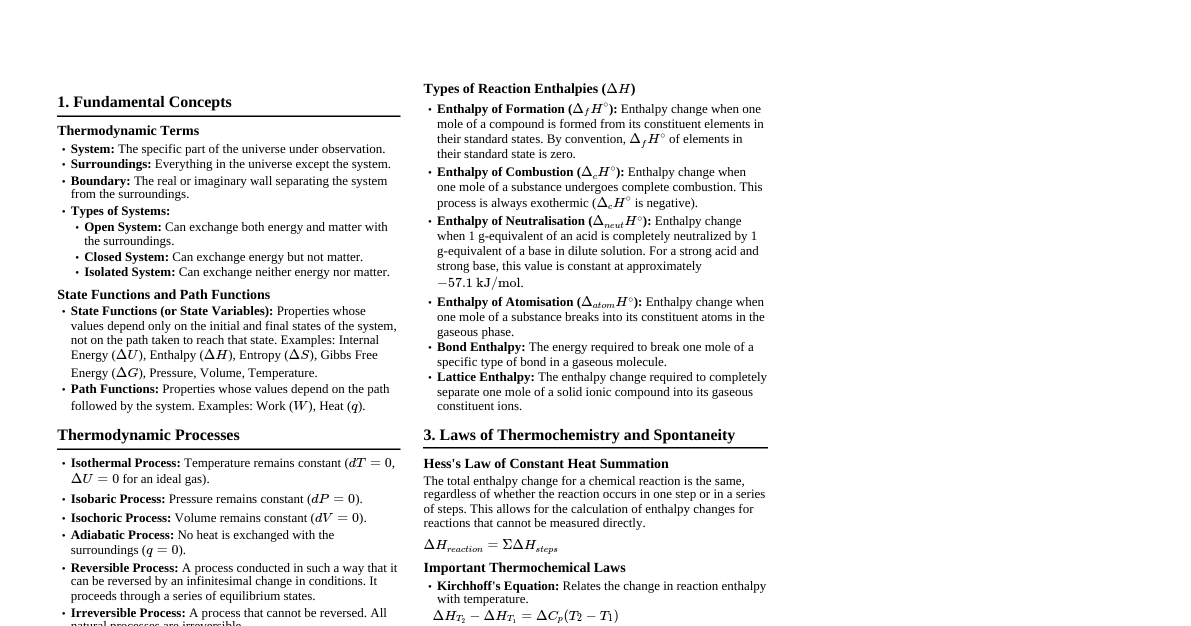
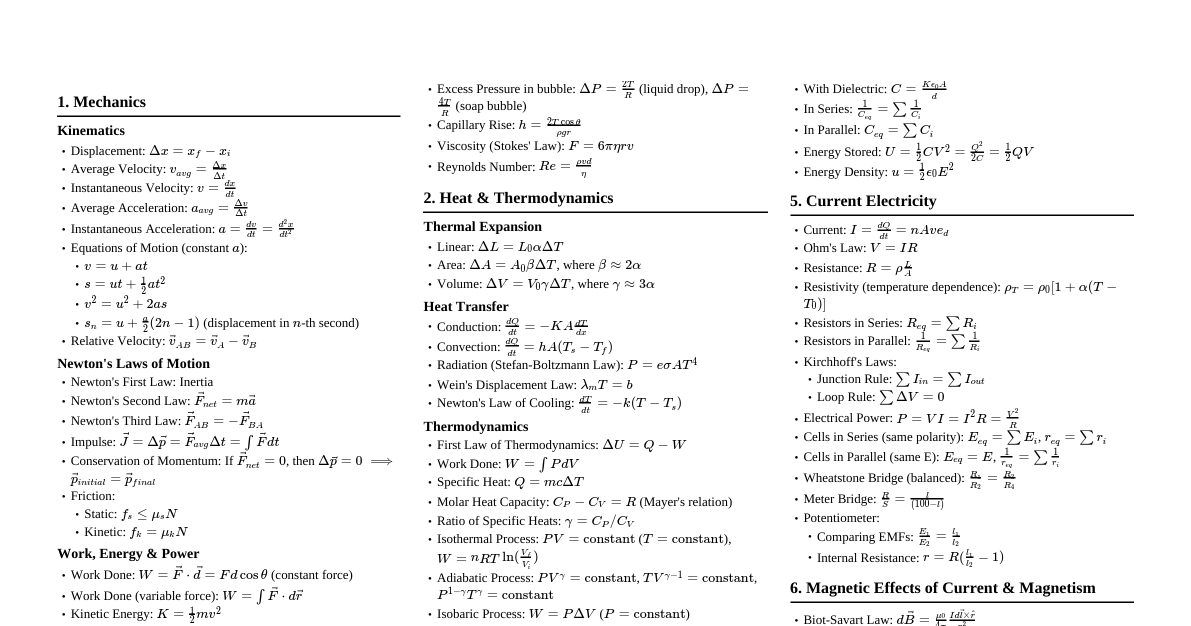
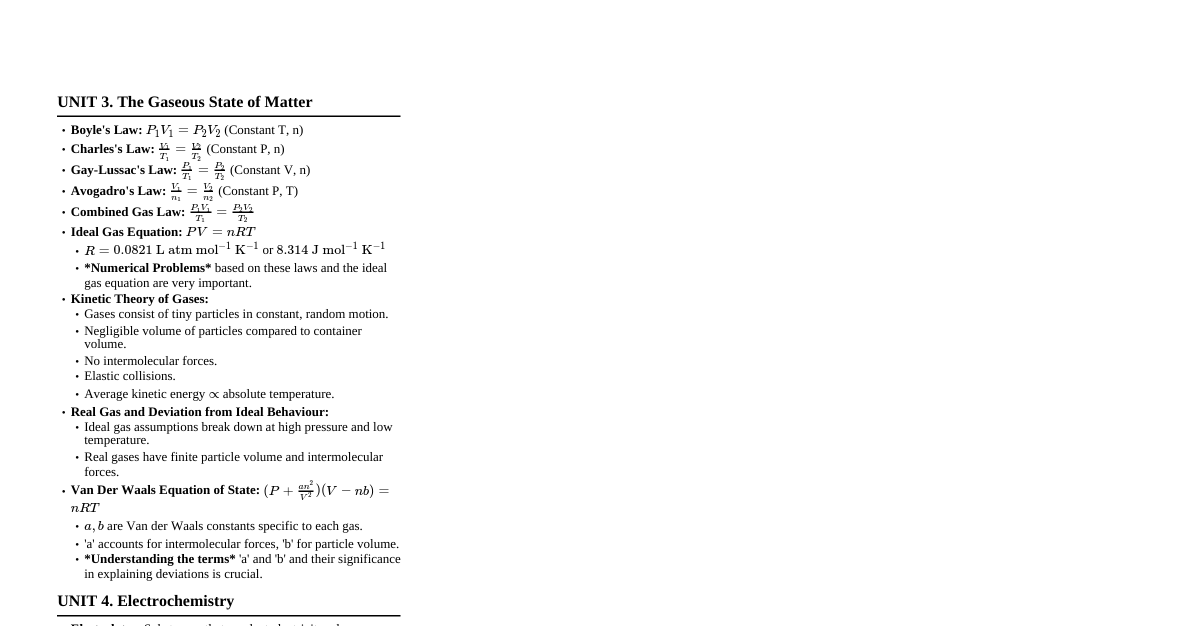
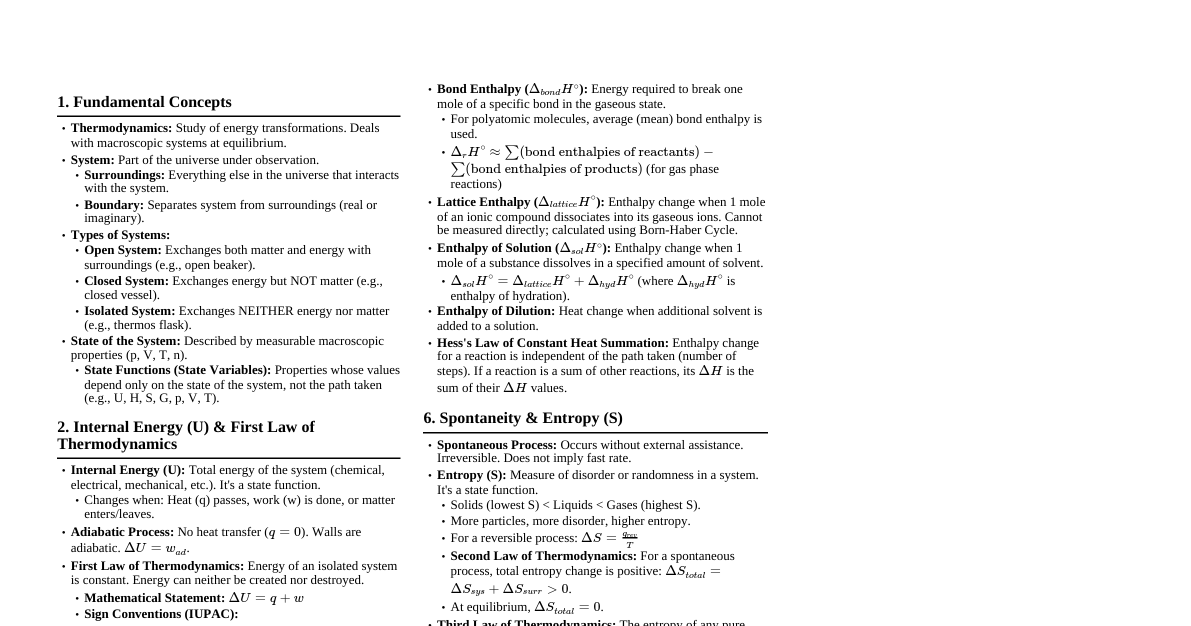
Kinetic Theory of Gases (KTG) Assumptions: Molecules are point masses. Random motion, elastic collisions. No intermolecular forces. Collision time negligible. Pressure of Gas: $P = \frac{1}{3} \frac{mN}{V} v_{rms}^2 = \frac{1}{3} \rho v_{rms}^2$ Kinetic Energy (KE) of Gas: Total KE: $KE = \frac{3}{2} nRT$ Average KE per molecule: $\bar{KE} = \frac{3}{2} kT$ Relation between P, V, T, KE: $PV = \frac{2}{3} KE$ Different Speeds: Root Mean Square (RMS) Speed: $v_{rms} = \sqrt{\frac{3RT}{M_0}} = \sqrt{\frac{3kT}{m}}$ Average Speed: $v_{avg} = \sqrt{\frac{8RT}{\pi M_0}} = \sqrt{\frac{8kT}{\pi m}}$ Most Probable Speed: $v_{mp} = \sqrt{\frac{2RT}{M_0}} = \sqrt{\frac{2kT}{m}}$ Order: $v_{mp} Speed (v) Fraction of molecules $v_{mp}$ $v_{avg}$ $v_{rms}$ Maxwell-Boltzmann Speed Distribution Curve Degrees of Freedom (f): Monoatomic (He, Ne): $f=3$ (translational) Diatomic (O$_2$, N$_2$): $f=5$ (3 trans. + 2 rot. at moderate T) Triatomic/Polyatomic (non-linear): $f=6$ (3 trans. + 3 rot.) Internal Energy: $U = \frac{f}{2} nRT$ Maxwell-Boltzmann Distribution: $dN_v = 4\pi N (\frac{m}{2\pi kT})^{3/2} v^2 e^{-mv^2/(2kT)} dv$ (Fraction of molecules with speed $v$ to $v+dv$) Thermodynamics Thermodynamic Processes First Law of Thermodynamics: $\Delta U = Q - W$ $Q$: Heat supplied to the system $W$: Work done by the system $\Delta U$: Change in internal energy Work Done by a Gas (W) General: $W = \int P dV$ (Area under P-V curve) Isobaric (P=const): $W = P(V_f - V_i)$ Isothermal (T=const): $W = nRT \ln(\frac{V_f}{V_i}) = nRT \ln(\frac{P_i}{P_f})$ Adiabatic ($PV^\gamma$=const): $W = \frac{P_iV_i - P_fV_f}{\gamma - 1} = \frac{nR(T_i - T_f)}{\gamma - 1}$ Isochoric (V=const): $W = 0$ Volume (V) Pressure (P) Isobaric Isochoric Isothermal Adiabatic P-V Diagram for Different Processes Specific Heats Molar Specific Heat at Constant Volume ($C_V$): $C_V = \frac{f}{2} R$ Molar Specific Heat at Constant Pressure ($C_P$): $C_P = C_V + R = (\frac{f}{2} + 1) R$ (Mayer's Relation) Ratio of Specific Heats ($\gamma$): $\gamma = \frac{C_P}{C_V} = 1 + \frac{2}{f}$ For Monoatomic: $C_V=\frac{3}{2}R$, $C_P=\frac{5}{2}R$, $\gamma=\frac{5}{3}$ For Diatomic: $C_V=\frac{5}{2}R$, $C_P=\frac{7}{2}R$, $\gamma=\frac{7}{5}$ For Polyatomic (non-linear): $C_V=3R$, $C_P=4R$, $\gamma=\frac{4}{3}$ Specific Processes & Their Equations Process Equation Work Done (W) Internal Energy ($\Delta U$) Heat (Q) Isobaric $P=$ const $P(V_f - V_i)$ $nC_V \Delta T$ $nC_P \Delta T$ Isochoric $V=$ const $0$ $nC_V \Delta T$ $nC_V \Delta T$ Isothermal $T=$ const, $PV=$ const $nRT \ln(\frac{V_f}{V_i})$ $0$ $W$ Adiabatic $PV^\gamma=$ const, $TV^{\gamma-1}=$ const, $P^{1-\gamma}T^\gamma=$ const $\frac{nR(T_i - T_f)}{\gamma-1}$ $-W$ $0$ Heat Engines & Refrigerators Heat Engine Efficiency ($\eta$): $\eta = \frac{W}{Q_H} = 1 - \frac{Q_C}{Q_H}$ $T_H$ (Source) $T_C$ (Sink) Engine $Q_H$ $Q_C$ $W$ Heat Engine Diagram Carnot Engine: $\eta_{Carnot} = 1 - \frac{T_C}{T_H}$ Refrigerator Coefficient of Performance (COP): $COP_{ref} = \frac{Q_C}{W} = \frac{Q_C}{Q_H - Q_C}$ $T_H$ (Hot Reservoir) $T_C$ (Cold Reservoir) Ref. $Q_H$ $Q_C$ $W$ Refrigerator Diagram Carnot Ref.: $COP_{Carnot, ref} = \frac{T_C}{T_H - T_C}$ Heat Pump Coefficient of Performance (COP): $COP_{HP} = \frac{Q_H}{W} = \frac{Q_H}{Q_H - Q_C}$ Carnot HP: $COP_{Carnot, HP} = \frac{T_H}{T_H - T_C}$ Relation: $COP_{HP} = 1 + COP_{ref}$ Entropy (S) Change in Entropy: $dS = \frac{dQ_{rev}}{T}$ For reversible process: $\Delta S = \int \frac{dQ_{rev}}{T}$ For irreversible process: $\Delta S_{total} = \Delta S_{system} + \Delta S_{surroundings} \ge 0$ Entropy change for ideal gas: $\Delta S = nC_V \ln(\frac{T_f}{T_i}) + nR \ln(\frac{V_f}{V_i}) = nC_P \ln(\frac{T_f}{T_i}) - nR \ln(\frac{P_f}{P_i})$ Entropy change during phase transition: $\Delta S = \frac{mL}{T}$ (L is latent heat, T is phase change temp) Important Constants Universal Gas Constant ($R$): $8.314 \, J mol^{-1} K^{-1}$ Boltzmann Constant ($k$): $1.38 \times 10^{-23} \, J K^{-1}$ Avogadro Number ($N_A$): $6.022 \times 10^{23} \, mol^{-1}$ Relation: $R = N_A k$