Matrices & Determinants JEE
Cheatsheet Content
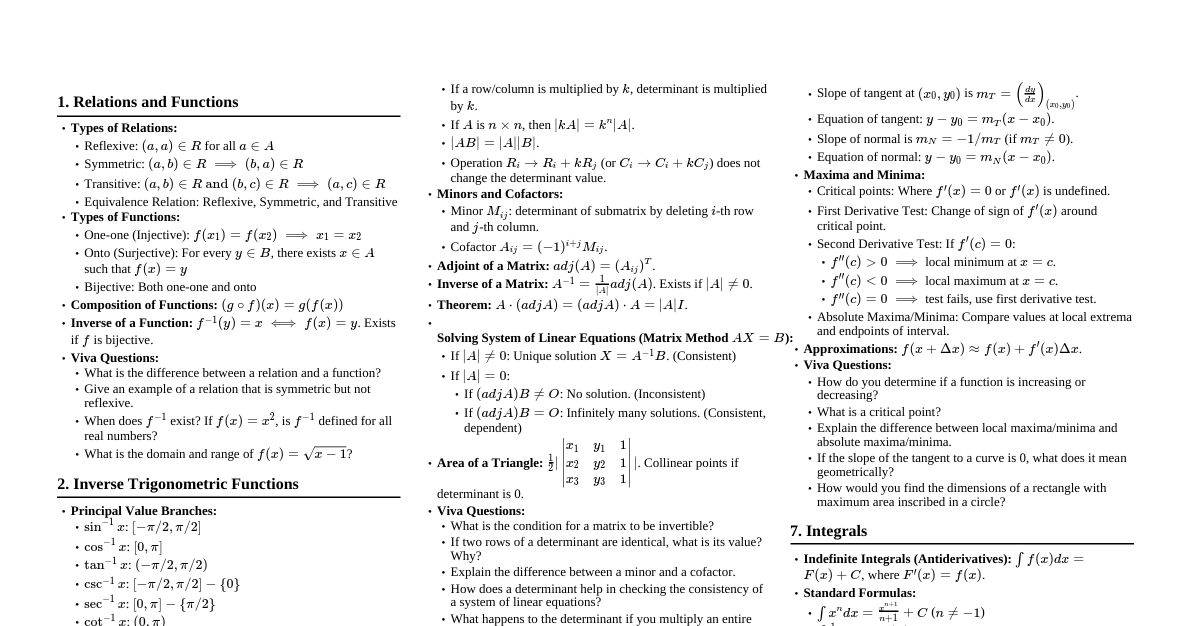
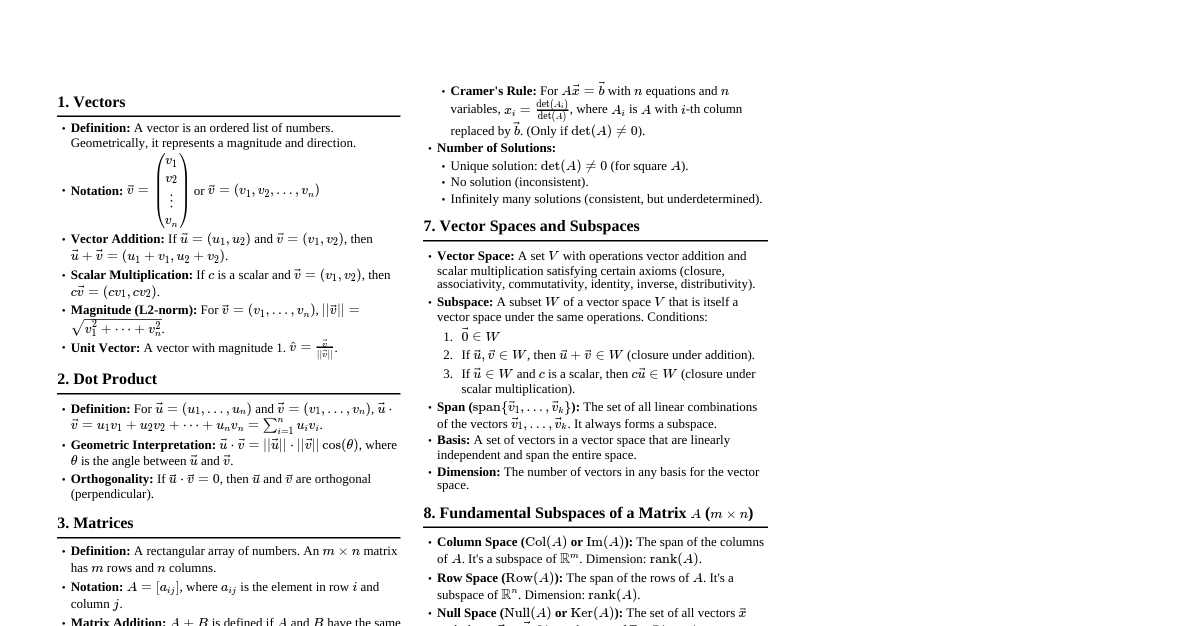
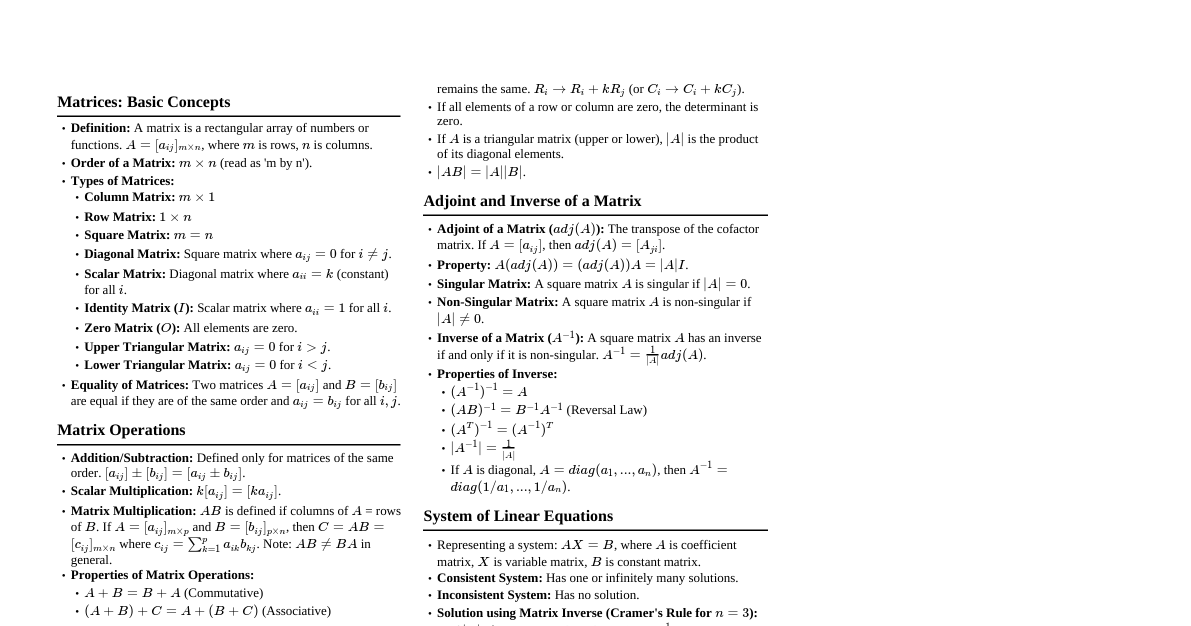
### Matrices Basics - **Definition:** A rectangular array of numbers (real or complex) arranged in rows and columns. - **Order:** $m \times n$ (m rows, n columns). - **Types of Matrices:** - **Row Matrix:** $1 \times n$ - **Column Matrix:** $m \times 1$ - **Zero Matrix (Null Matrix):** All elements are 0. - **Square Matrix:** $m=n$. - **Diagonal Matrix:** Square matrix where all non-diagonal elements are zero. $a_{ij}=0$ for $i \ne j$. - **Scalar Matrix:** Diagonal matrix where all diagonal elements are equal. - **Identity (Unit) Matrix:** Diagonal matrix where all diagonal elements are 1. Denoted by $I$. - **Upper Triangular Matrix:** $a_{ij}=0$ for $i > j$. - **Lower Triangular Matrix:** $a_{ij}=0$ for $i {"action": "edit", "target": {"section": "matrix-operations"}} ### Matrix Operations - **Addition/Subtraction:** $(A \pm B)_{ij} = a_{ij} \pm b_{ij}$ (same order). - **Scalar Multiplication:** $(kA)_{ij} = ka_{ij}$. - **Matrix Multiplication:** $(AB)_{ij} = \sum_{k=1}^n a_{ik}b_{kj}$ (for $A_{m \times n}$, $B_{n \times p}$). - **Properties:** $(AB)C = A(BC)$, $A(B+C) = AB+AC$. {"action": "edit", "target": {"section": "transpose-of-matrix"}} ### Transpose of a Matrix - **Definition:** $(A^T)_{ij} = a_{ji}$. - **Properties:** - $(A^T)^T = A$ - $(A \pm B)^T = A^T \pm B^T$ - $(kA)^T = kA^T$ - $(AB)^T = B^T A^T$ (Reversal Law) {"action": "edit", "target": {"section": "special-matrices"}} ### Special Matrices (Square Matrices) - **Symmetric Matrix:** $A^T = A$. - **Skew-Symmetric Matrix:** $A^T = -A$ ($a_{ii}=0$). - **Decomposition:** $A = \frac{1}{2}(A+A^T) + \frac{1}{2}(A-A^T)$. - **Orthogonal Matrix:** $AA^T = A^T A = I \implies A^{-1} = A^T$. - **Idempotent Matrix:** $A^2 = A$. - **Nilpotent Matrix:** $A^k = 0$ for some $k \in \mathbb{Z}^+$. - **Involutory Matrix:** $A^2 = I$. {"action": "edit", "target": {"section": "determinants"}} ### Determinants - **$2 \times 2$ matrix:** If $A = \begin{pmatrix} a & b \\ c & d \end{pmatrix}$, then $|A| = ad - bc$. - **Cofactor:** $C_{ij} = (-1)^{i+j} M_{ij}$. - **Expansion:** $|A| = \sum_{j=1}^n a_{ij}C_{ij}$ (along $i$-th row). {"action": "edit", "target": {"section": "properties-of-determinants"}} ### Properties of Determinants - $|A^T| = |A|$. - $|kA| = k^n |A|$ (for $n \times n$ matrix). - $|AB| = |A||B|$. - If two rows/columns are swapped, sign changes. - If two rows/columns are identical or proportional, $|A|=0$. - If a row/column is all zeros, $|A|=0$. {"action": "edit", "target": {"section": "adjoint-and-inverse"}} ### Adjoint and Inverse of a Matrix - **Adjoint:** $\text{adj}(A) = (C_{ij})^T$. - **Inverse:** $A^{-1} = \frac{1}{|A|} (\text{adj} A)$ (if $|A| \ne 0$). - **Properties:** - $A (\text{adj} A) = (\text{adj} A) A = |A| I$. - $|\text{adj} A| = |A|^{n-1}$. - $\text{adj}(AB) = (\text{adj} B)(\text{adj} A)$. - $\text{adj}(\text{adj} A) = |A|^{n-2} A$. - $(A^{-1})^{-1} = A$. - $(AB)^{-1} = B^{-1}A^{-1}$. - $(A^T)^{-1} = (A^{-1})^T$. {"action": "edit", "target": {"section": "system-of-linear-equations"}} ### System of Linear Equations (Cramer's Rule) For $D = \begin{vmatrix} a_1 & b_1 & c_1 \\ a_2 & b_2 & c_2 \\ a_3 & b_3 & c_3 \end{vmatrix}$, $D_x$, $D_y$, $D_z$ defined by replacing a column with constants. - **Unique solution:** If $D \ne 0$, then $x = \frac{D_x}{D}$, $y = \frac{D_y}{D}$, $z = \frac{D_z}{D}$. - **No solution:** If $D = 0$ and at least one of $D_x, D_y, D_z$ is non-zero. - **Infinite solutions:** If $D = 0$ and $D_x = D_y = D_z = 0$. {"action": "edit", "target": {"section": "homogenous-equations"}} ### Homogenous System of Linear Equations ($d_i=0$) - **Trivial solution ($x=y=z=0$):** If $D \ne 0$. - **Non-trivial solutions:** If $D = 0$. {"action": "edit", "target": {"section": "rank-of-matrix"}} ### Rank of a Matrix - Max number of linearly independent rows/columns. - Order of largest non-singular submatrix. - $\text{rank}(A) \le \min(m, n)$. - $\text{rank}(A^T) = \text{rank}(A)$. - $\text{rank}(AB) \le \min(\text{rank}(A), \text{rank}(B))$. {"action": "edit", "target": {"section": "jee-formulas"}} ### JEE Essential Formulas - **Matrix Addition:** $(A \pm B)_{ij} = a_{ij} \pm b_{ij}$ - **Scalar Mult:** $(kA)_{ij} = ka_{ij}$ - **Matrix Mult:** $(AB)_{ij} = \sum a_{ik}b_{kj}$ - **Transpose Properties:** $(A^T)^T=A$, $(AB)^T=B^T A^T$ - **Determinant $2 \times 2$:** $|A| = ad-bc$ for $A=\begin{pmatrix} a & b \\ c & d \end{pmatrix}$ - **Cofactor:** $C_{ij} = (-1)^{i+j} M_{ij}$ - **Adjoint:** $\text{adj}(A) = (C_{ij})^T$ - **Inverse:** $A^{-1} = \frac{1}{|A|} \text{adj}(A)$ (if $|A| \ne 0$) - **Determinant Properties:** - $|A^T| = |A|$ - $|kA| = k^n |A|$ - $|AB| = |A||B|$ - **Adjoint Properties:** - $A \cdot (\text{adj} A) = (\text{adj} A) \cdot A = |A| I$ - $|\text{adj} A| = |A|^{n-1}$ - $\text{adj}(\text{adj} A) = |A|^{n-2} A$ - $|\text{adj}(\text{adj} A)| = |A|^{(n-1)^2}$ - **Orthogonal Matrix:** $A^{-1} = A^T \iff AA^T = I$ - **Idempotent Matrix:** $A^2 = A$ - **Nilpotent Matrix:** $A^k = 0$ - **Involutory Matrix:** $A^2 = I$ - **System of Equations (Cramer's Rule):** - $x = D_x/D, y = D_y/D, z = D_z/D$ (unique solution if $D \ne 0$) - No solution if $D=0$ and any $D_x, D_y, D_z \ne 0$ - Infinite solutions if $D=0$ and $D_x=D_y=D_z=0$ - **Homogenous System:** - Trivial solution ($x=y=z=0$) if $D \ne 0$ - Non-trivial solutions if $D = 0$ ### Matrix Operations - **Addition/Subtraction:** Defined only for matrices of the same order. $(A \pm B)_{ij} = a_{ij} \pm b_{ij}$. - **Scalar Multiplication:** $kA = (ka_{ij})$. - **Matrix Multiplication:** - Defined for $A_{m \times n}$ and $B_{n \times p}$, resulting in $AB_{m \times p}$. - $(AB)_{ij} = \sum_{k=1}^n a_{ik}b_{kj}$. - **Properties:** - Not commutative: $AB \ne BA$ in general. - Associative: $(AB)C = A(BC)$. - Distributive: $A(B+C) = AB+AC$. - $IA = AI = A$. - If $AB=0$, it doesn't necessarily mean $A=0$ or $B=0$. ### Transpose of a Matrix - **Definition:** $A^T$ (or $A'$) is obtained by interchanging rows and columns of $A$. If $A = (a_{ij})$, then $A^T = (a_{ji})$. - **Properties:** - $(A^T)^T = A$ - $(A \pm B)^T = A^T \pm B^T$ - $(kA)^T = kA^T$ - $(AB)^T = B^T A^T$ (Reversal Law) ### Special Matrices (Square Matrices) - **Symmetric Matrix:** $A^T = A \implies a_{ij} = a_{ji}$. - **Skew-Symmetric Matrix:** $A^T = -A \implies a_{ij} = -a_{ji}$. - Diagonal elements of a skew-symmetric matrix are always zero ($a_{ii} = -a_{ii} \implies 2a_{ii} = 0 \implies a_{ii} = 0$). - **Any square matrix A can be expressed as a sum of a symmetric and a skew-symmetric matrix:** $A = \frac{1}{2}(A+A^T) + \frac{1}{2}(A-A^T)$. - **Orthogonal Matrix:** $A A^T = A^T A = I$. Implies $A^{-1} = A^T$. - **Idempotent Matrix:** $A^2 = A$. - **Nilpotent Matrix:** $A^k = 0$ for some positive integer $k$. (Index of nilpotency is $k$). - **Involutory Matrix:** $A^2 = I$. ### Determinants - **Definition:** A scalar value associated with a square matrix. Denoted by $|A|$ or $\det(A)$. - **For $2 \times 2$ matrix:** If $A = \begin{pmatrix} a & b \\ c & d \end{pmatrix}$, then $|A| = ad - bc$. - **For $3 \times 3$ matrix:** If $A = \begin{pmatrix} a_{11} & a_{12} & a_{13} \\ a_{21} & a_{22} & a_{23} \\ a_{31} & a_{32} & a_{33} \end{pmatrix}$, then $|A| = a_{11}(a_{22}a_{33} - a_{23}a_{32}) - a_{12}(a_{21}a_{33} - a_{23}a_{31}) + a_{13}(a_{21}a_{32} - a_{22}a_{31})$. This is expansion along the first row. Can be expanded along any row or column. - **Minors ($M_{ij}$):** Determinant of the submatrix obtained by deleting the $i$-th row and $j$-th column. - **Cofactors ($C_{ij}$):** $C_{ij} = (-1)^{i+j} M_{ij}$. - **Determinant using cofactors:** $|A| = \sum_{j=1}^n a_{ij}C_{ij}$ (expansion along $i$-th row) or $\sum_{i=1}^n a_{ij}C_{ij}$ (expansion along $j$-th column). ### Properties of Determinants - **P1:** $|A^T| = |A|$. - **P2:** If any two rows (or columns) are interchanged, the sign of the determinant changes. - **P3:** If any two rows (or columns) are identical, the determinant is 0. - **P4:** If all elements of a row (or column) are multiplied by a scalar $k$, the determinant is multiplied by $k$. - $|kA| = k^n |A|$ where $n$ is the order of the matrix. - **P5:** If a row (or column) consists of sum of two terms, the determinant can be expressed as sum of two determinants. Example: $\begin{vmatrix} a+x & b+y \\ c & d \end{vmatrix} = \begin{vmatrix} a & b \\ c & d \end{vmatrix} + \begin{vmatrix} x & y \\ c & d \end{vmatrix}$. - **P6:** If to any row (or column) is added $k$ times another row (or column), the value of the determinant remains unchanged. This is used in Row/Column Operations. - **P7:** If all elements of a row (or column) are zero, the determinant is 0. - **P8:** For square matrices $A, B$ of the same order, $|AB| = |A||B|$. - **P9:** The sum of the products of the elements of any row (or column) with the cofactors of another row (or column) is zero. $\sum_{j=1}^n a_{ik}C_{jk} = 0$ for $i \ne j$. ### Adjoint and Inverse of a Matrix - **Adjoint of a Matrix (adj A):** The transpose of the cofactor matrix. - If $A = (a_{ij})$, then $\text{adj}(A) = (C_{ij})^T$. - **Properties of Adjoint:** - $A (\text{adj} A) = (\text{adj} A) A = |A| I$. - $|\text{adj} A| = |A|^{n-1}$ (where $n$ is the order of A). - $\text{adj}(AB) = (\text{adj} B)(\text{adj} A)$. - $\text{adj}(A^T) = (\text{adj} A)^T$. - $\text{adj}(kA) = k^{n-1} \text{adj}(A)$. - $\text{adj}(\text{adj} A) = |A|^{n-2} A$. - $|\text{adj}(\text{adj} A)| = |A|^{(n-1)^2}$. - **Inverse of a Matrix ($A^{-1}$):** A square matrix $A$ is invertible if and only if $|A| \ne 0$. - $A^{-1} = \frac{1}{|A|} (\text{adj} A)$. - **Properties of Inverse:** - $(A^{-1})^{-1} = A$. - $(AB)^{-1} = B^{-1}A^{-1}$ (Reversal Law). - $(kA)^{-1} = \frac{1}{k} A^{-1}$. - $(A^T)^{-1} = (A^{-1})^T$. - If $A$ is an orthogonal matrix, $A^{-1} = A^T$. - **Singular Matrix:** A square matrix $A$ is singular if $|A|=0$. It does not have an inverse. - **Non-Singular Matrix:** A square matrix $A$ is non-singular if $|A| \ne 0$. It has an inverse. ### System of Linear Equations (Cramer's Rule) For a system of linear equations: $a_1x + b_1y + c_1z = d_1$ $a_2x + b_2y + c_2z = d_2$ $a_3x + b_3y + c_3z = d_3$ Let $D = \begin{vmatrix} a_1 & b_1 & c_1 \\ a_2 & b_2 & c_2 \\ a_3 & b_3 & c_3 \end{vmatrix}$ (Determinant of coefficients) Let $D_x = \begin{vmatrix} d_1 & b_1 & c_1 \\ d_2 & b_2 & c_2 \\ d_3 & b_3 & c_3 \end{vmatrix}$ (Replace x-coefficients with constants) Let $D_y = \begin{vmatrix} a_1 & d_1 & c_1 \\ a_2 & d_2 & c_2 \\ a_3 & d_3 & c_3 \end{vmatrix}$ (Replace y-coefficients with constants) Let $D_z = \begin{vmatrix} a_1 & b_1 & d_1 \\ a_2 & b_2 & d_2 \\ a_3 & b_3 & d_3 \end{vmatrix}$ (Replace z-coefficients with constants) - **Case 1: $D \ne 0$** - Unique solution: $x = \frac{D_x}{D}$, $y = \frac{D_y}{D}$, $z = \frac{D_z}{D}$. (Consistent system) - **Case 2: $D = 0$** - **Subcase 2a: At least one of $D_x, D_y, D_z$ is non-zero.** - No solution (Inconsistent system). Lines/planes are parallel or do not intersect at a single point. - **Subcase 2b: $D_x = D_y = D_z = 0$.** - Infinitely many solutions (Consistent system). Lines/planes are coincident. - To find solutions, reduce the system using row operations or express variables in terms of a parameter. ### Homogenous System of Linear Equations For a system: $a_1x + b_1y + c_1z = 0$ $a_2x + b_2y + c_2z = 0$ $a_3x + b_3y + c_3z = 0$ (Here $d_1=d_2=d_3=0$, so $D_x=D_y=D_z=0$) - **Case 1: $D \ne 0$** - Unique solution: $x=0, y=0, z=0$ (Trivial solution). - **Case 2: $D = 0$** - Infinitely many solutions (Non-trivial solutions). ### Rank of a Matrix - **Definition:** The maximum number of linearly independent rows (or columns) in a matrix. - Also, the order of the largest non-singular square submatrix (whose determinant is non-zero). - **Properties:** - For an $m \times n$ matrix $A$, $\text{rank}(A) \le \min(m, n)$. - $\text{rank}(A) = 0$ if and only if $A$ is a null matrix. - $\text{rank}(A^T) = \text{rank}(A)$. - $\text{rank}(AB) \le \min(\text{rank}(A), \text{rank}(B))$. - **Elementary Row/Column Operations:** Do not change the rank of a matrix.