d- and f-Block Elements
Shared 3/25/2026•48 views
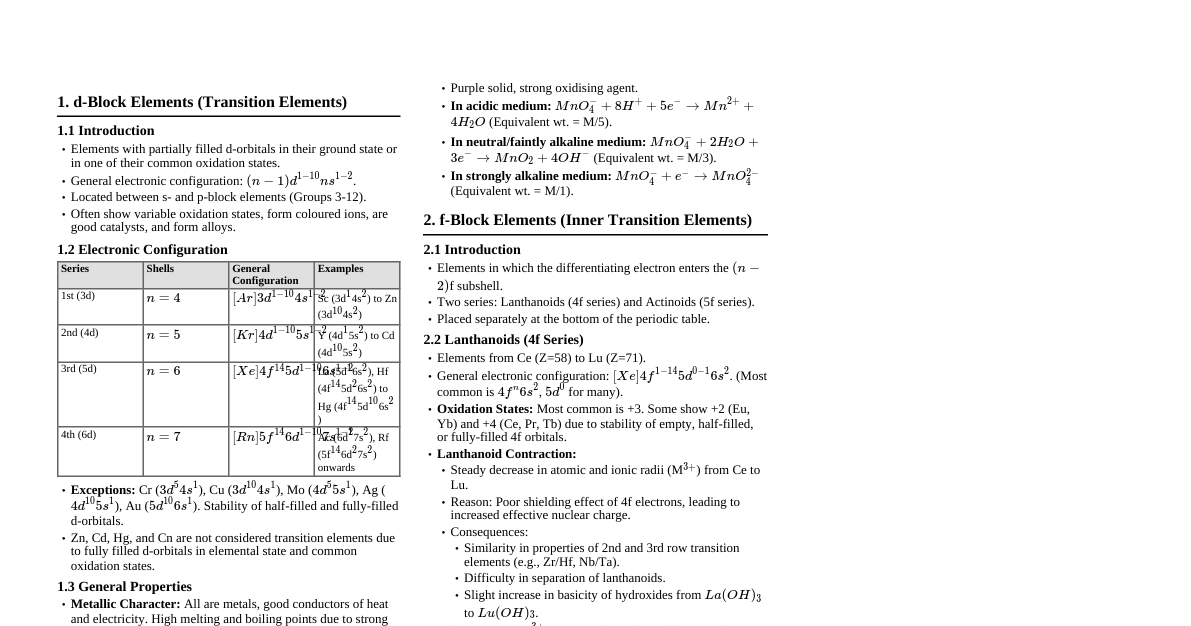
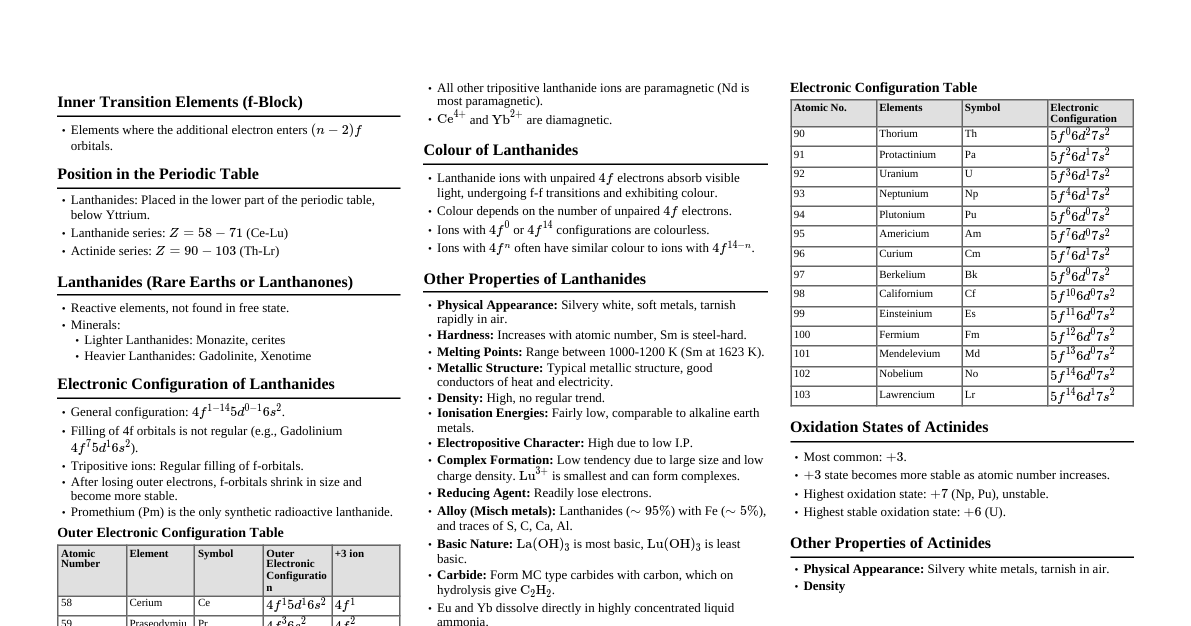
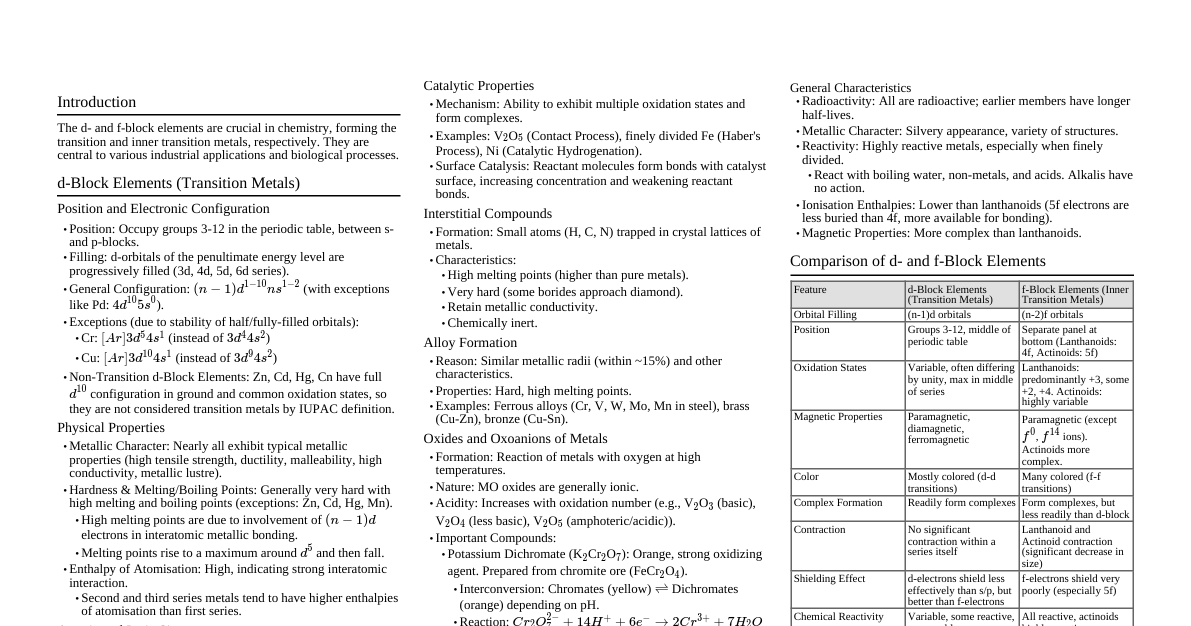
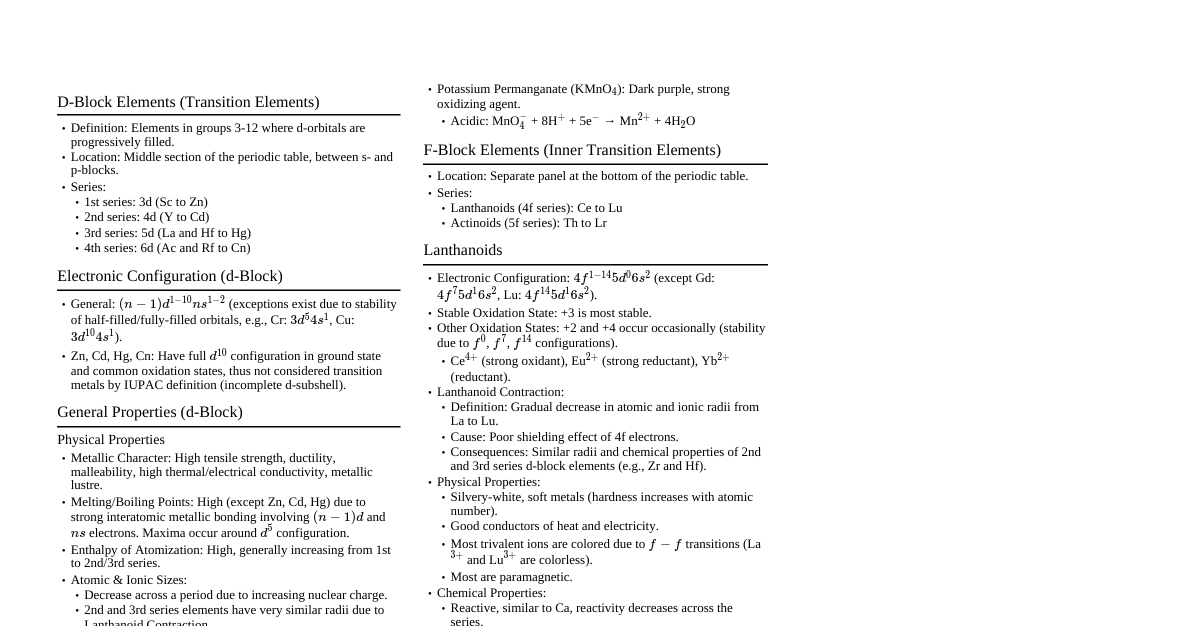
### d-Block Elements: Transition Metals Fundamentals - **Definition:** Elements with partially filled d-orbitals in their elemental or most common oxidation states. Excludes Group 12 ($Zn, Cd, Hg$) which have completely filled d-orbitals in +2 state. - **General Electronic Configuration:** $(n-1)d^{1-10}ns^{1-2}$. - **Exceptions:** $Cr ([Ar]3d^54s^1)$, $Cu ([Ar]3d^{10}4s^1)$. This is due to the extra stability of half-filled and completely filled d-orbitals. - **Position:** Groups 3-12 (Periods 4-7). - **Key Series (with Hindi song mnemonics):** - **1st Transition Series (3d series):** $Sc (Z=21)$ to $Zn (Z=30)$ - **Song:** "Science, Teacher, Vimal, Cricket, Man, Fe, Co, Ni, Cu, Zinc" - (Sc, Ti, V, Cr, Mn, Fe, Co, Ni, Cu, Zn) - **2nd Transition Series (4d series):** $Y (Z=39)$ to $Cd (Z=48)$ - **Song:** "Yeh Zindagi Nahi, Mohabbat Tumhari, Roke, Raahon Mein, Pade, Aag, Chandni" - (Y, Zr, Nb, Mo, Tc, Ru, Rh, Pd, Ag, Cd) - **3rd Transition Series (5d series):** $La (Z=57), Hf (Z=72)$ to $Hg (Z=80)$ - **Song:** "La Hf Ta W Re Os Ir Pt Au Hg" (Simplified for elements after Lanthanum) - (La, Hf, Ta, W, Re, Os, Ir, Pt, Au, Hg) ### Trends in d-Block Elements #### 1. Atomic and Ionic Radii - **Trend:** Generally decrease across a period until the middle, then slightly increase towards the end. - **Explanation:** Initial decrease due to increasing nuclear charge. Later increase is due to electron-electron repulsion becoming significant in filled d-orbitals. - **Comparison Down a Group:** - $3d \to 4d$: Radii increase (as expected). - $4d \to 5d$: Radii are very similar. - **Reason:** **Lanthanoid Contraction** (poor shielding by 4f electrons in 5d series elements, leading to increased effective nuclear charge). - **Consequence:** Similar properties (e.g., Zr and Hf are almost identical in size and chemical properties, making separation difficult). - **Smallest 3d element:** Ni (due to maximum effective nuclear charge before repulsion effects dominate). - **Largest 3d element:** Sc. #### 2. Ionization Enthalpy - **Trend Across a Period:** Generally increases, but not as steeply as s- and p-block elements. - **Explanation:** Increasing nuclear charge and poor shielding of d-electrons. - **Comparison Down a Group:** - $3d \to 4d$: Decreases (as expected, due to larger size). - $4d \to 5d$: Increases. - **Reason:** Lanthanoid Contraction causes 5d elements to have smaller atomic radii and higher effective nuclear charge than expected, leading to higher ionization enthalpies. #### 3. Metallic Character & Bonding - All are metals, typically hard, strong, and good conductors of heat and electricity. - **Metallic Bonding:** Strong metallic bonding due to involvement of both ns and (n-1)d electrons in forming a large number of covalent bonds within the metallic lattice. - **Melting and Boiling Points:** Generally high. Maxima around the middle of each series. - **Explanation:** Strong metallic bonding. - **Exceptions:** $Mn$ and $Tc$ have anomalously low melting points due to more stable half-filled d-orbitals, reducing the number of unpaired electrons available for strong metallic bonding. - $Zn, Cd, Hg$ have low melting points (and $Hg$ is liquid at room temp) because their d-orbitals are completely filled ($d^{10}$), limiting metallic bonding to only s-electrons, resulting in weaker bonding. - **Density:** Generally high. Increases across a period. - **Highest Density:** Osmium ($Os$) and Iridium ($Ir$) in the 3rd transition series. - **Lowest Density (3d series):** Scandium ($Sc$). #### 4. Oxidation States - **Origin:** Small energy difference between $(n-1)d$ and $ns$ orbitals allows both to participate in bonding. - **Common:** +2 and +3 are very common. - **Highest Oxidation States:** Generally shown by elements in the middle of each series (e.g., $Mn$ shows +7 in $MnO_4^-$). - **Stability Trends:** - Higher oxidation states are more stable with F and O ($V_2O_5, CrO_4^{2-}, MnO_4^-$) due to their high electronegativity and small size. - Lower oxidation states are more stable in complexes with $\pi$-acceptor ligands (e.g., $Ni(CO)_4$). - Across a period, the stability of higher oxidation states decreases after $Mn$. - **Note:** $Sc$ shows only +3. $Zn$ shows only +2. $Cu$ shows +1 and +2 (predominantly +2 in aqueous solutions due to higher hydration enthalpy). - **Oxides Acidity:** - Lower oxidation states: Basic oxides (e.g., $CrO, MnO$). - Intermediate oxidation states: Amphoteric oxides (e.g., $Cr_2O_3, V_2O_5$). - Higher oxidation states: Acidic oxides (e.g., $CrO_3, Mn_2O_7$). #### 5. Standard Electrode Potentials ($E^\circ$) - **Trend:** Generally negative, indicating tendency to act as reducing agents. - **Anomalies in $E^\circ_{M^{2+}/M}$ (3d series):** - **Copper ($Cu$):** Positive $E^\circ$ value (+0.34 V). - **Reason:** High enthalpy of atomisation and high ionization enthalpy (sum of $IE_1 + IE_2$) are not compensated by hydration enthalpy for $Cu^{2+}$ ions. Hence, $Cu$ does not liberate $H_2$ from acids. - **Manganese ($Mn$) and Zinc ($Zn$):** More negative $E^\circ$ values. - **Reason:** Stability of half-filled ($d^5$) for $Mn^{2+}$ and fully-filled ($d^{10}$) for $Zn^{2+}$ d-orbitals. This makes it easier to form these ions. - **Nickel ($Ni$):** Less negative $E^\circ$ value. - **Reason:** High negative hydration enthalpy of $Ni^{2+}$ ions. - **Anomalies in $E^\circ_{M^{3+}/M^{2+}}$ (3d series):** - **Scandium ($Sc$):** Not applicable, only +3 stable. - **Titanium ($Ti$), Vanadium ($V$), Chromium ($Cr$):** Low values, indicating $M^{2+}$ is a strong reducing agent (oxidized to $M^{3+}$). - **Manganese ($Mn$):** High positive value (+1.57 V). - **Reason:** High stability of $Mn^{2+}$ ($d^5$ configuration), making $Mn^{3+}$ a strong oxidizing agent. - **Iron ($Fe$):** Moderate positive value (+0.77 V). - **Cobalt ($Co$):** High positive value (+1.97 V). - **Reason:** High stability of $Co^{3+}$ in complex formation (e.g., $Co(NH_3)_6^{3+}$). #### 6. Magnetic Properties - **Paramagnetism:** Arises from unpaired electrons. Most transition metal ions are paramagnetic. - **Diamagnetism:** All electrons are paired. Ions like $Sc^{3+}(d^0), Ti^{4+}(d^0), Cu^+(d^{10}), Zn^{2+}(d^{10})$ are diamagnetic. - **Spin-Only Magnetic Moment:** $\mu = \sqrt{n(n+2)}$ BM (Bohr Magnetons), where n is the number of unpaired electrons. - **Calculation Steps:** 1. Determine the oxidation state of the metal ion. 2. Write the electronic configuration. 3. Find the number of unpaired d-electrons (n). 4. Calculate $\mu$. - **Important Note:** Spin-only formula is generally accurate for 1st transition series. For 2nd and 3rd series, orbital angular momentum also contributes, making calculations more complex. #### 7. Colour of Ions: d-d Transitions and Charge Transfer - **Origin of Colour (d-d Transitions):** When white light falls on a transition metal ion with partially filled d-orbitals, d-electrons absorb specific wavelengths from the visible region and are promoted to higher energy d-orbitals (within the same d-subshell, due to crystal field splitting). The complementary colour is observed. - **Crystal Field Splitting:** In complexes, the five degenerate d-orbitals split into two sets: $t_{2g}$ (lower energy, $d_{xy}, d_{yz}, d_{zx}$) and $e_g$ (higher energy, $d_{x^2-y^2}, d_{z^2}$) in an octahedral field. The energy gap is $\Delta_o$. - **Prerequisites for Colour:** Presence of partially filled d-orbitals (i.e., unpaired d-electrons). - **Colourless Ions:** Ions with $d^0$ (e.g., $Sc^{3+}, Ti^{4+}$) or $d^{10}$ (e.g., $Cu^+, Zn^{2+}$) configurations are colourless as d-d transitions are not possible. - **Origin of Colour (Charge Transfer Phenomenon):** Some compounds (e.g., $MnO_4^-, Cr_2O_7^{2-}$), despite having $d^0$ configurations, are intensely coloured. This is due to **charge transfer** from ligand orbitals to metal d-orbitals (Ligand to Metal Charge Transfer, LMCT) or vice versa. This transition requires less energy and absorbs strongly in the visible region. #### 8. Catalytic Properties - Many transition metals and their compounds act as catalysts. - **Reasons:** 1. **Variable Oxidation States:** Can form unstable intermediate compounds, providing a new reaction path with lower activation energy. 2. **Large Surface Area:** Finely divided metals provide a large surface for adsorption of reactants. 3. **Ability to form Complexes:** Can activate substrates by coordinating with them. - **Examples:** - $Fe$ in Haber process ($N_2 + 3H_2 \rightleftharpoons 2NH_3$). - $V_2O_5$ in Contact process ($2SO_2 + O_2 \rightleftharpoons 2SO_3$). - $Ni$ or $Pd$ in hydrogenation of oils. - $TiCl_4$ (Ziegler-Natta catalyst) in polymerization of ethene. #### 9. Interstitial Compound Formation - **Definition:** Non-stoichiometric compounds formed when small atoms (H, C, N, B) are trapped in the interstitial voids (holes) of the transition metal lattice. - **Properties:** - High melting points (higher than pure metals). - Very hard (e.g., borides are as hard as diamond). - Retain metallic conductivity. - Chemically inert. - **Example:** $TiC, Fe_3H, Mn_4N$. #### 10. Alloy Formation - **Reason:** Transition metals have similar atomic sizes (atomic radii difference ### Important Compound: Potassium Dichromate ($K_2Cr_2O_7$) - **Preparation:** 1. **Chromite ore ($FeCr_2O_4$) to Sodium Chromate:** Fusion with $Na_2CO_3$ and excess air. $4FeCr_2O_4 + 8Na_2CO_3 + 7O_2 \xrightarrow{\text{Fusion, 1000-1200°C}} 8Na_2CrO_4 + 2Fe_2O_3 + 8CO_2$ 2. **Sodium Chromate to Sodium Dichromate:** Acidification converts yellow chromate to orange dichromate. $2Na_2CrO_4 + 2H^+ \to Na_2Cr_2O_7 + 2Na^+ + H_2O$ 3. **Sodium Dichromate to Potassium Dichromate:** $K_2Cr_2O_7$ crystallizes due to lower solubility. $Na_2Cr_2O_7 + 2KCl \to K_2Cr_2O_7 + 2NaCl$ - **Structure:** Two $CrO_4$ tetrahedra sharing one corner. $Cr-O-Cr$ bond. - **Oxidizing Properties:** Strong oxidizing agent in acidic medium. $Cr_2O_7^{2-}$ is reduced to $Cr^{3+}$. $Cr_2O_7^{2-} + 14H^+ + 6e^- \to 2Cr^{3+} + 7H_2O$ - **Reactions:** - With $Fe^{2+}$: $Cr_2O_7^{2-} + 14H^+ + 6Fe^{2+} \to 2Cr^{3+} + 6Fe^{3+} + 7H_2O$ - With $I^-$: $Cr_2O_7^{2-} + 14H^+ + 6I^- \to 2Cr^{3+} + 3I_2 + 7H_2O$ - With $H_2S$: $Cr_2O_7^{2-} + 8H^+ + 3H_2S \to 2Cr^{3+} + 3S + 7H_2O$ - **Interconversion:** - Acidic medium: $CrO_4^{2-}$ (yellow) $\xrightarrow{H^+} Cr_2O_7^{2-}$ (orange) - Alkaline medium: $Cr_2O_7^{2-}$ (orange) $\xrightarrow{OH^-} CrO_4^{2-}$ (yellow) $2CrO_4^{2-} + 2H^+ \rightleftharpoons Cr_2O_7^{2-} + H_2O$ (This equilibrium is pH dependent). ### Important Compound: Potassium Permanganate ($KMnO_4$) - **Preparation:** 1. **Pyrolusite ore ($MnO_2$) to Potassium Manganate:** Fusion with $KOH$ and oxidizing agent ($KNO_3$ or air). $2MnO_2 + 4KOH + O_2 \xrightarrow{\text{Fusion}} 2K_2MnO_4 + 2H_2O$ (Green) 2. **Potassium Manganate to Potassium Permanganate:** - **Disproportionation (Acidic/Neutral):** $3MnO_4^{2-} + 4H^+ \to 2MnO_4^- + MnO_2 + 2H_2O$ (Green to Purple + Brown ppt) - **Electrolytic Oxidation:** $MnO_4^{2-} \xrightarrow{\text{electrolytic oxidation}} MnO_4^-$ - **Structure:** Tetrahedral $MnO_4^-$. - **Oxidizing Properties:** Powerful oxidizing agent. - **Acidic medium:** $MnO_4^- + 8H^+ + 5e^- \to Mn^{2+} + 4H_2O$ (purple to colourless) - **Reactions:** - With $Fe^{2+}$: $MnO_4^- + 8H^+ + 5Fe^{2+} \to Mn^{2+} + 5Fe^{3+} + 4H_2O$ - With Oxalate ($C_2O_4^{2-}$): $2MnO_4^- + 16H^+ + 5C_2O_4^{2-} \to 2Mn^{2+} + 10CO_2 + 8H_2O$ - With $I^-$: $2MnO_4^- + 16H^+ + 10I^- \to 2Mn^{2+} + 5I_2 + 8H_2O$ - With $H_2S$: $2MnO_4^- + 6H^+ + 5H_2S \to 2Mn^{2+} + 5S + 8H_2O$ - **Neutral/Weakly alkaline medium:** $MnO_4^- + 2H_2O + 3e^- \to MnO_2 + 4OH^-$ (purple to brown ppt) - **Reactions:** - With $S_2O_3^{2-}$ (thiosulphate): $2MnO_4^- + H_2O + 3S_2O_3^{2-} \to 2MnO_2 + 3SO_4^{2-} + 2OH^-$ - **Strongly alkaline medium:** $MnO_4^- + e^- \to MnO_4^{2-}$ (purple to green) ### f-Block Elements: Inner Transition Metals Fundamentals - **Definition:** Elements where the differentiating electron enters the $(n-2)f$ subshell. - **General Electronic Configuration:** $(n-2)f^{1-14}(n-1)d^{0-1}ns^2$. - **Series:** - **Lanthanoids (4f series):** $Ce (Z=58)$ to $Lu (Z=71)$. Placed after $La (Z=57)$. - **Actinoids (5f series):** $Th (Z=90)$ to $Lr (Z=103)$. Placed after $Ac (Z=89)$. ### Lanthanoids (4f Series) - **Electronic Configuration:** $[Xe]4f^{1-14}5d^{0-1}6s^2$. Most common is $4f^{1-14}6s^2$ (with $5d^0$ for many). - **Exceptions (for $5d^1$):** $Ce (4f^15d^16s^2)$, $Gd (4f^75d^16s^2)$, $Lu (4f^{14}5d^16s^2)$. - **Oxidation States:** - Most common and stable: +3. - Some show +2 (e.g., $Eu^{2+}(4f^7), Yb^{2+}(4f^{14})$) and +4 (e.g., $Ce^{4+}(4f^0), Pr^{4+}, Tb^{4+}$) for stability of empty, half-filled, or full f-orbitals. - **Stability:** +3 is most stable. +2 and +4 states tend to revert to +3. For example, $Ce^{4+}$ is a strong oxidizing agent (forms $Ce^{3+}$). $Eu^{2+}$ is a strong reducing agent (forms $Eu^{3+}$). - **Lanthanoid Contraction:** - **Definition:** The steady decrease in atomic and ionic radii (specifically $Ln^{3+}$ ions) with increasing atomic number across the lanthanoid series. - **Cause:** Poor shielding effect of 4f electrons. The 4f orbitals are deeply buried and do not shield the outer electrons effectively from the increasing nuclear charge. - **Consequences:** 1. **Similarity of 2nd and 3rd Transition Series elements:** (e.g., Zr/Hf, Nb/Ta, Mo/W have almost identical radii and chemical properties). 2. **Difficulty in Separation:** Due to similar ionic radii, chemical separation of lanthanoids is challenging (requires ion-exchange methods). 3. **Basic Strength of Hydroxides:** $Ln(OH)_3$ become less basic from $La(OH)_3$ to $Lu(OH)_3$ as ionic size decreases ($La(OH)_3$ is most basic, $Lu(OH)_3$ is least basic). - **Magnetic Properties:** - $La^{3+}(4f^0), Lu^{3+}(4f^{14}), Ce^{4+}(4f^0), Yb^{2+}(4f^{14})$ are diamagnetic. - Most other $Ln^{3+}$ ions are paramagnetic due to unpaired 4f electrons. - Magnetic moments are calculated with both spin and orbital contributions. - **Colour:** Many $Ln^{3+}$ ions are coloured in solid state and aqueous solution due to f-f transitions. - Ions with $4f^0$ or $4f^{14}$ configurations are colourless. - **Chemical Reactivity:** Generally reactive metals. Reactivity increases across the series. - React with $H_2O$ to form $Ln(OH)_3$. - Form binary compounds with non-metals (carbides, nitrides, hydrides, halides). - **Uses:** Used in alloys (Mischmetal: ~95% Ln, 5% Fe, traces of S, C, Ca, Al - used in lighter flints). $CeO_2$ in gas mantles. ### Actinoids (5f Series) - **Electronic Configuration:** $[Rn]5f^{1-14}6d^{0-1}7s^2$. - **Irregularities:** More irregularities due to comparable energies of 5f, 6d, and 7s orbitals. - **Oxidation States:** - Show a wider range of oxidation states than lanthanoids (e.g., +3, +4, +5, +6, +7). - +3 is most common and stable. - Higher oxidation states are more stable for initial members (e.g., $Th^{4+}, Pa^{5+}, U^{6+}$). - **Stability:** Early actinoids (Th, Pa, U, Np, Pu, Am) show higher oxidation states up to +6 or +7, while later actinoids primarily show +3. - **Actinoid Contraction:** - Gradual decrease in atomic and ionic radii, but less pronounced and more irregular than lanthanoid contraction. - **Cause:** Poor shielding effect of 5f electrons. - **Magnetic Properties:** Generally paramagnetic, but spin-only formula is not accurate due to significant orbital contribution, and magnetic moments are difficult to interpret. - **Colour:** Ions are generally coloured. - **Radioactivity:** All actinoids are radioactive. Those beyond Uranium are synthetic (transuranic elements). - **Chemical Reactivity:** Highly reactive metals, especially finely divided ones. React vigorously with non-metals. - **Complex Formation:** Greater tendency to form complexes than lanthanoids due to higher charge and smaller size of ions, and availability of 5f, 6d, 7s orbitals for bonding. - **Comparison of 4f and 5f orbitals:** 5f orbitals are less buried than 4f, making them more involved in bonding and leading to a wider range of oxidation states and greater complexing ability for actinoids. ### Key Differences: Lanthanoids vs. Actinoids | Property | Lanthanoids (4f Series) | Actinoids (5f Series) | |------------------------|------------------------------------------------------|-----------------------------------------------------| | **Electronic Conf.** | Filling of 4f orbitals. | Filling of 5f orbitals. | | **Oxidation States** | Mainly +3; also +2, +4 (less common, less stable). | Mainly +3; also +4, +5, +6, +7 (more common, more stable for early members). | | **Radioactivity** | Only Promethium ($^{147}Pm$) is radioactive. All others are non-radioactive. | All are radioactive. | | **Magnetic Prop.** | Magnetic moments are calculated by spin-only formula (approx). | Magnetic moments are more complex (orbital contribution is significant and difficult to interpret). | | **Complex Formation** | Less tendency due to larger size and lower charge density. | Greater tendency due to smaller size, higher charge, and more accessible orbitals. | | **Chemical Reactivity**| Less reactive (except initial members). | More reactive (especially when finely divided). | | **Contraction** | Lanthanoid contraction is more significant and regular. | Actinoid contraction is less regular and pronounced. | | **Shielding** | 4f electrons have better shielding than 5f. | 5f electrons have poorer shielding than 4f. | ### Important Questions & Concepts 1. **Why do transition metals exhibit variable oxidation states?** - Small energy difference between $(n-1)d$ and $ns$ orbitals allows both to participate in bonding. 2. **Why are most transition metal compounds coloured?** - Presence of unpaired d-electrons allows d-d transitions by absorbing light from the visible region. The complementary colour is observed. 3. **Why are $Sc^{3+}$ and $Zn^{2+}$ diamagnetic and colourless?** - $Sc^{3+}$ has $3d^0$ configuration (no d-electrons). $Zn^{2+}$ has $3d^{10}$ configuration (all d-electrons paired). No unpaired electrons, no d-d transitions possible. 4. **Explain Lanthanoid Contraction and its consequences.** - **Explanation:** Poor shielding of 4f electrons causes effective nuclear charge to increase, pulling the outer electrons closer to the nucleus. - **Consequences:** Similar radii and properties of 4d and 5d elements (e.g., Zr and Hf), difficulty in separating lanthanoids, decrease in basicity of hydroxides. 5. **Why is $Cu$ a transition element but $Zn$ is not (despite being in d-block)?** - $Cu$ has partially filled d-orbitals in its ground state ($3d^{10}4s^1$) and in its +2 oxidation state ($3d^9$). - $Zn$ has completely filled d-orbitals in its ground state ($3d^{10}4s^2$) and in its common +2 oxidation state ($3d^{10}$). By definition, transition elements must have incompletely filled d-orbitals. 6. **Why do transition metals form alloys readily?** - Similar atomic sizes (atomic radii difference