Heat and Temperature
Cheatsheet Content
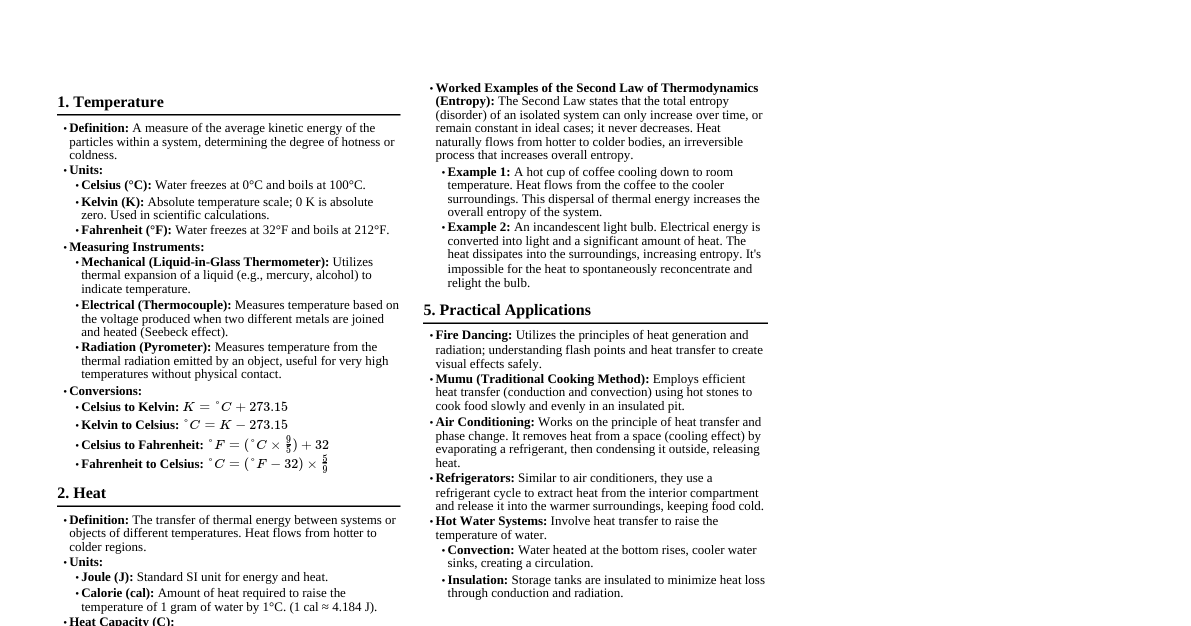
### Temperature: Definition and Scales - **Definition:** A measure of the average kinetic energy of the particles within a substance. It indicates the "hotness" or "coldness" of an object. - **Microscopic View:** Higher temperature means particles are moving faster (translational, vibrational, rotational). - **Scales:** - **Celsius (°C):** Water freezes at 0°C, boils at 100°C (at standard atmospheric pressure). - **Fahrenheit (°F):** Water freezes at 32°F, boils at 212°F. - **Kelvin (K):** Absolute temperature scale. 0 K (absolute zero) is the theoretical point where all particle motion ceases. No degree symbol is used. - **Conversions:** - $T_C = (T_F - 32) \times \frac{5}{9}$ - $T_F = T_C \times \frac{9}{5} + 32$ - $T_K = T_C + 273.15$ - $\Delta T_C = \Delta T_K$ ### Heat: Definition and Transfer - **Definition:** The transfer of thermal energy between objects due to a temperature difference. Heat is energy in transit, not a property an object "has." - **Units:** Joules (J), calories (cal). 1 cal = 4.184 J. - **Direction of Flow:** Heat always flows spontaneously from a region of higher temperature to a region of lower temperature. - **Heat Capacity (C):** The amount of heat required to raise the temperature of an entire object by 1°C (or 1 K). - $Q = C \Delta T$ - Units: J/°C or J/K - **Specific Heat Capacity (c):** The amount of heat required to raise the temperature of 1 kg of a substance by 1°C (or 1 K). - $Q = mc \Delta T$ - Units: J/(kg·°C) or J/(kg·K) - **Water:** $c_{water} \approx 4186 \text{ J/(kg}\cdot\text{°C)}$ ### Modes of Heat Transfer - **1. Conduction:** - **Mechanism:** Transfer of thermal energy through direct contact, primarily by molecular collisions. Common in solids. - **Equation (Fourier's Law):** $$ \frac{dQ}{dt} = -kA \frac{dT}{dx} $$ Where: - $\frac{dQ}{dt}$ is the rate of heat transfer (Power, Watts) - $k$ is the thermal conductivity of the material (W/(m·K)) - $A$ is the cross-sectional area (m²) - $\frac{dT}{dx}$ is the temperature gradient (K/m) - **2. Convection:** - **Mechanism:** Transfer of thermal energy through the movement of fluids (liquids or gases). - **Types:** - **Natural (Free) Convection:** Driven by buoyancy forces due to density differences from temperature variations. - **Forced Convection:** Fluid movement is caused by external means (e.g., fan, pump). - **Example:** Boiling water, ocean currents, weather patterns. - **3. Radiation:** - **Mechanism:** Transfer of thermal energy via electromagnetic waves (infrared, visible light, etc.). Does not require a medium. - **Equation (Stefan-Boltzmann Law):** $$ P = \epsilon \sigma A T^4 $$ Where: - $P$ is the net radiated power (Watts) - $\epsilon$ is the emissivity of the object (0 to 1, 1 for a perfect blackbody) - $\sigma$ is the Stefan-Boltzmann constant ($5.67 \times 10^{-8} \text{ W/(m}^2\cdot\text{K}^4)$) - $A$ is the radiating surface area (m²) - $T$ is the absolute temperature of the surface (Kelvin) - **Net Radiation:** For an object at $T_s$ in surroundings at $T_{surr}$: $$ P_{net} = \epsilon \sigma A (T_s^4 - T_{surr}^4) $$ ### Phase Changes and Latent Heat - **Phase Change:** A physical process where a substance changes from one state of matter (solid, liquid, gas) to another. Temperature remains constant during a phase change. - **Latent Heat (L):** The amount of energy absorbed or released per unit mass during a phase change. - $Q = mL$ - Units: J/kg - **Types of Latent Heat:** - **Latent Heat of Fusion ($L_f$):** Energy required to change from solid to liquid (melting) or liquid to solid (freezing). - For water: $L_f \approx 334 \times 10^3 \text{ J/kg}$ - **Latent Heat of Vaporization ($L_v$):** Energy required to change from liquid to gas (boiling/evaporation) or gas to liquid (condensation). - For water: $L_v \approx 2260 \times 10^3 \text{ J/kg}$ - **Heating Curve:** A graph showing temperature vs. heat added. It features plateaus where phase changes occur (temperature is constant).