Calculus Formulas
Cheatsheet Content
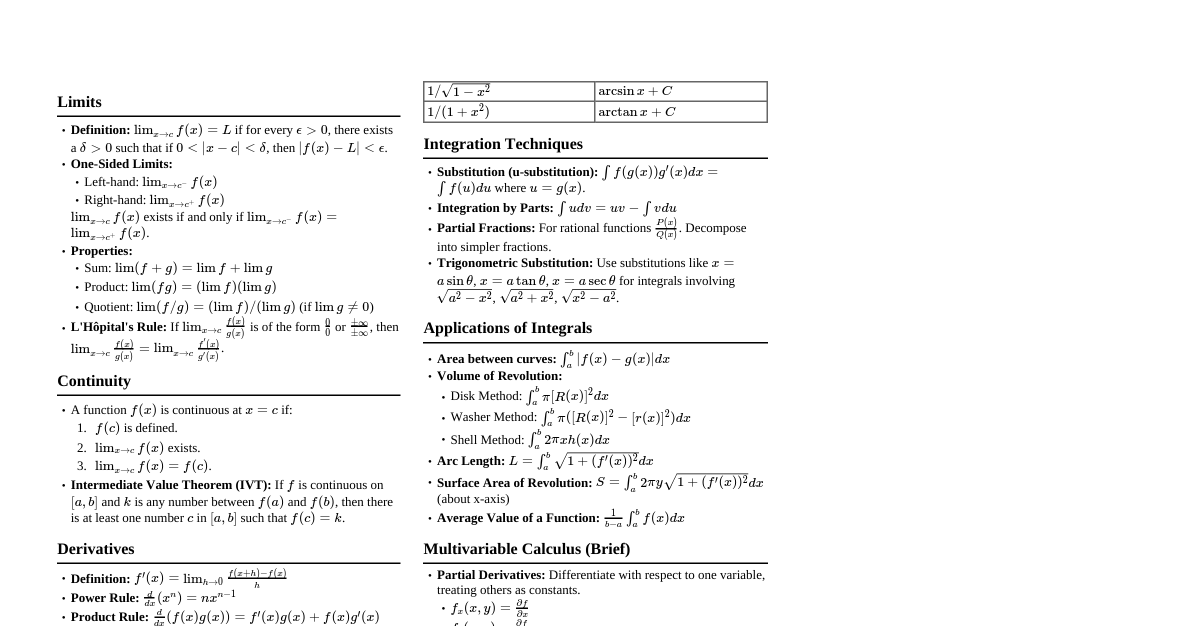
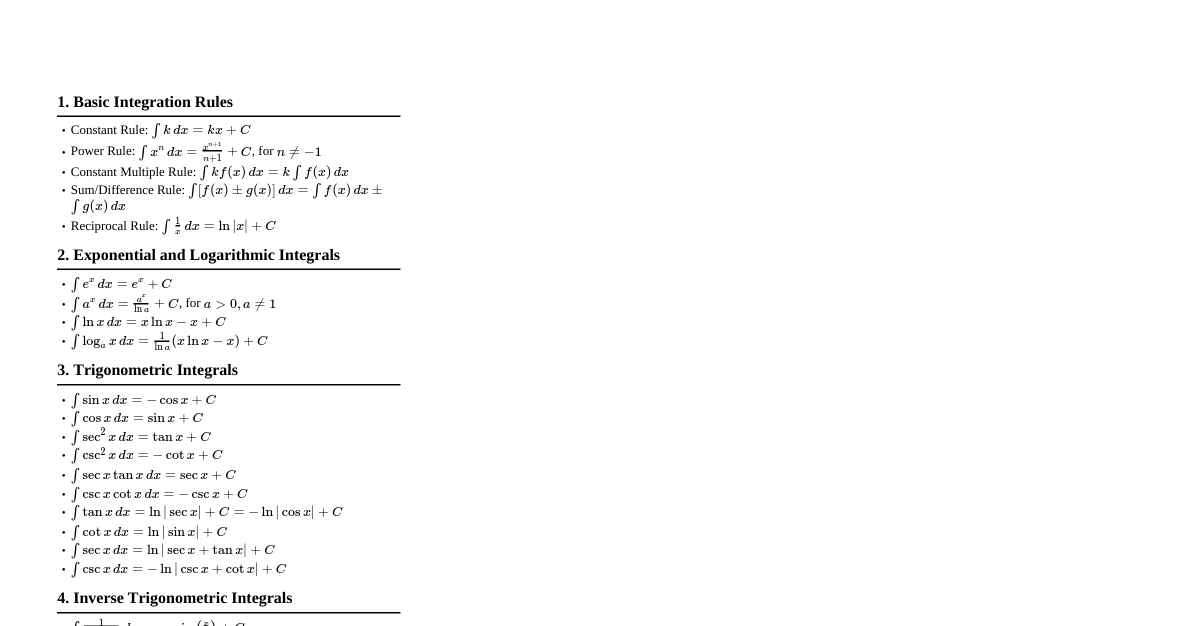
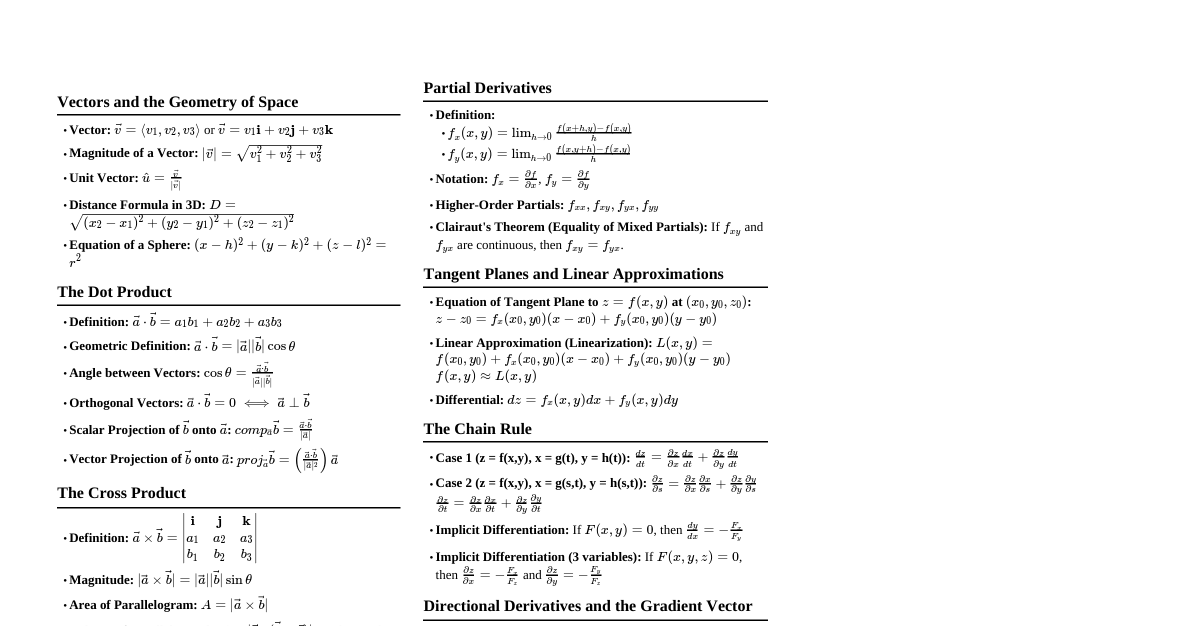
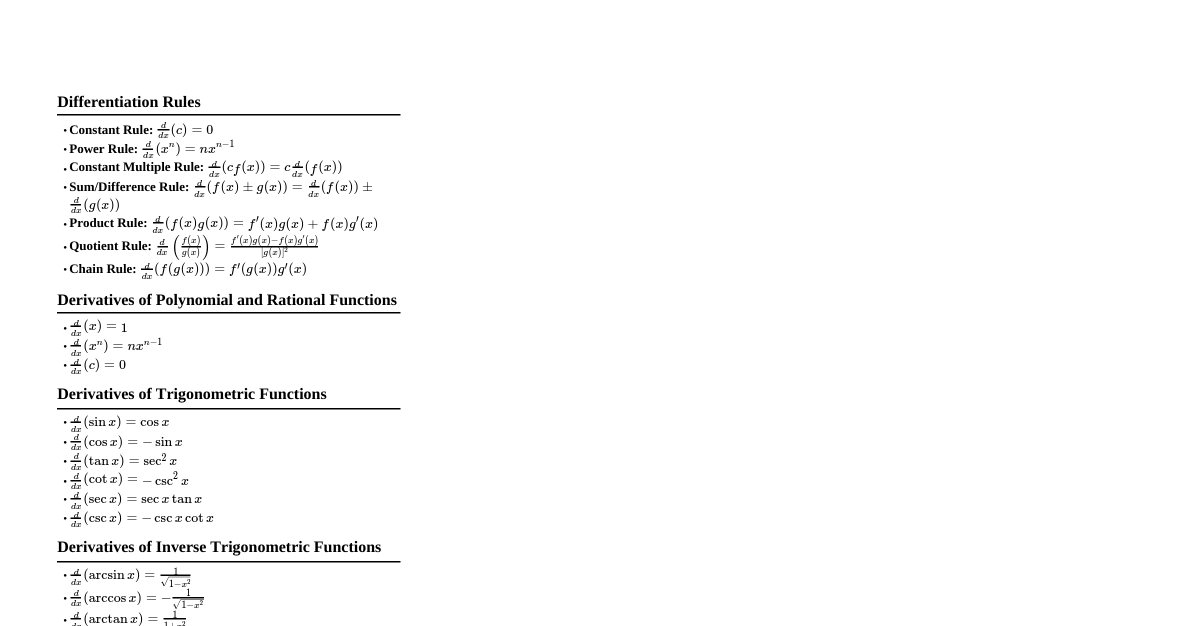
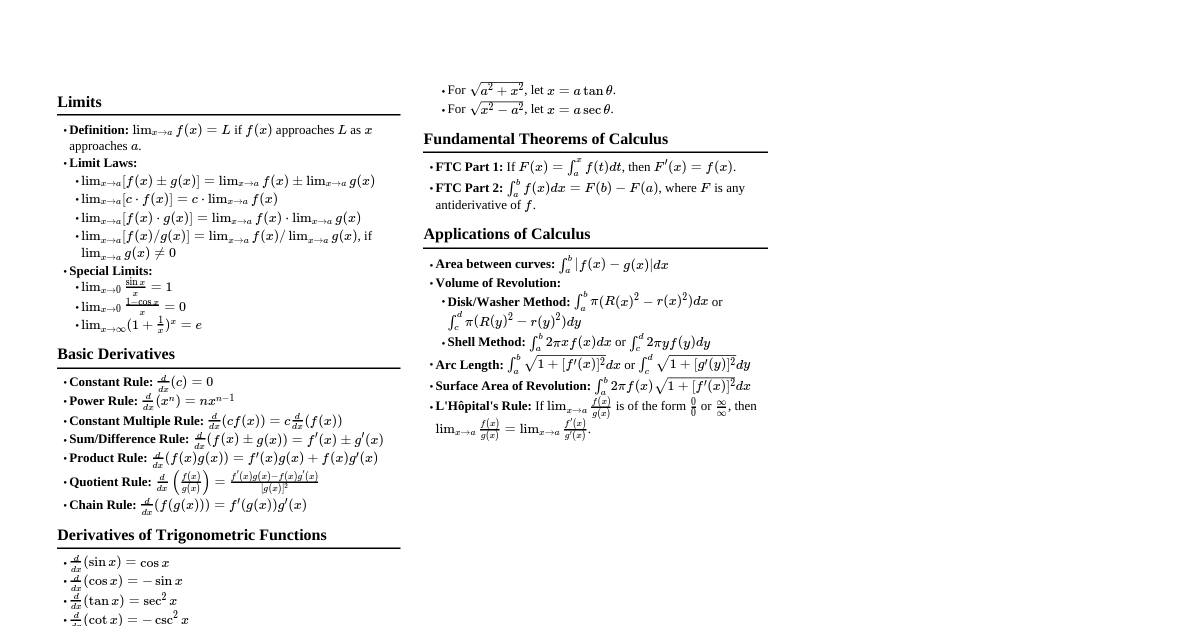
1. Derivatives Definition: $f'(x) = \lim_{h \to 0} \frac{f(x+h) - f(x)}{h}$ Power Rule: $\frac{d}{dx}(x^n) = nx^{n-1}$ Constant Multiple Rule: $\frac{d}{dx}(cf(x)) = c f'(x)$ Sum/Difference Rule: $\frac{d}{dx}(f(x) \pm g(x)) = f'(x) \pm g'(x)$ Product Rule: $\frac{d}{dx}(f(x)g(x)) = f'(x)g(x) + f(x)g'(x)$ Quotient Rule: $\frac{d}{dx}\left(\frac{f(x)}{g(x)}\right) = \frac{f'(x)g(x) - f(x)g'(x)}{(g(x))^2}$ Chain Rule: $\frac{d}{dx}(f(g(x))) = f'(g(x))g'(x)$ Common Derivatives Function Derivative $c$ $0$ $x$ $1$ $e^x$ $e^x$ $a^x$ $a^x \ln a$ $\ln x$ $\frac{1}{x}$ $\log_a x$ $\frac{1}{x \ln a}$ $\sin x$ $\cos x$ $\cos x$ $-\sin x$ $\tan x$ $\sec^2 x$ $\cot x$ $-\csc^2 x$ $\sec x$ $\sec x \tan x$ $\csc x$ $-\csc x \cot x$ $\arcsin x$ $\frac{1}{\sqrt{1-x^2}}$ $\arccos x$ $-\frac{1}{\sqrt{1-x^2}}$ $\arctan x$ $\frac{1}{1+x^2}$ 2. Integrals (Antiderivatives) Definition: If $F'(x) = f(x)$, then $\int f(x) dx = F(x) + C$ Power Rule: $\int x^n dx = \frac{x^{n+1}}{n+1} + C$ for $n \ne -1$ Constant Multiple Rule: $\int cf(x) dx = c \int f(x) dx$ Sum/Difference Rule: $\int (f(x) \pm g(x)) dx = \int f(x) dx \pm \int g(x) dx$ Substitution Rule: $\int f(g(x))g'(x) dx = \int f(u) du$ where $u=g(x)$ Integration by Parts: $\int u \, dv = uv - \int v \, du$ Common Integrals Function Integral $0$ $C$ $1$ $x+C$ $x^n$ ($n \ne -1$) $\frac{x^{n+1}}{n+1} + C$ $\frac{1}{x}$ $\ln|x| + C$ $e^x$ $e^x + C$ $a^x$ $\frac{a^x}{\ln a} + C$ $\sin x$ $-\cos x + C$ $\cos x$ $\sin x + C$ $\sec^2 x$ $\tan x + C$ $\csc^2 x$ $-\cot x + C$ $\sec x \tan x$ $\sec x + C$ $\csc x \cot x$ $-\csc x + C$ $\frac{1}{\sqrt{1-x^2}}$ $\arcsin x + C$ $\frac{1}{1+x^2}$ $\arctan x + C$ 3. Definite Integrals Fundamental Theorem of Calculus (Part 1): If $F(x) = \int_a^x f(t) dt$, then $F'(x) = f(x)$ Fundamental Theorem of Calculus (Part 2): $\int_a^b f(x) dx = F(b) - F(a)$, where $F'(x) = f(x)$ Properties: $\int_a^b f(x) dx = -\int_b^a f(x) dx$ $\int_a^a f(x) dx = 0$ $\int_a^b c f(x) dx = c \int_a^b f(x) dx$ $\int_a^b (f(x) \pm g(x)) dx = \int_a^b f(x) dx \pm \int_a^b g(x) dx$ $\int_a^b f(x) dx = \int_a^c f(x) dx + \int_c^b f(x) dx$ 4. Applications of Derivatives Slope of Tangent Line: $m = f'(x_0)$ at $(x_0, f(x_0))$ Critical Points: $f'(x)=0$ or $f'(x)$ is undefined Increasing/Decreasing: $f'(x) > 0 \implies$ increasing; $f'(x) Local Extrema (First Derivative Test): $f'$ changes from $+$ to $-$ at $c \implies$ local max $f'$ changes from $-$ to $+$ at $c \implies$ local min Concavity: $f''(x) > 0 \implies$ concave up; $f''(x) Inflection Points: $f''(x)=0$ or $f''(x)$ is undefined and $f''$ changes sign Optimization: Find absolute max/min by evaluating $f(x)$ at critical points and endpoints. Related Rates: Use chain rule to relate rates of change of interdependent variables. Linear Approximation: $L(x) = f(a) + f'(a)(x-a)$ Newton's Method: $x_{n+1} = x_n - \frac{f(x_n)}{f'(x_n)}$ (for approximating roots) 5. Applications of Integrals Area between Curves: $\int_a^b (f(x) - g(x)) dx$ (where $f(x) \ge g(x)$) Volume of Revolution (Disk/Washer Method): About x-axis: $V = \pi \int_a^b [R(x)^2 - r(x)^2] dx$ About y-axis: $V = \pi \int_c^d [R(y)^2 - r(y)^2] dy$ Volume of Revolution (Shell Method): About y-axis: $V = 2\pi \int_a^b x f(x) dx$ About x-axis: $V = 2\pi \int_c^d y f(y) dy$ Arc Length: $L = \int_a^b \sqrt{1 + (f'(x))^2} dx$ or $L = \int_c^d \sqrt{1 + (g'(y))^2} dy$ Average Value of a Function: $f_{avg} = \frac{1}{b-a} \int_a^b f(x) dx$ 6. Taylor and Maclaurin Series Taylor Series: $f(x) = \sum_{n=0}^{\infty} \frac{f^{(n)}(a)}{n!}(x-a)^n$ Maclaurin Series: $f(x) = \sum_{n=0}^{\infty} \frac{f^{(n)}(0)}{n!}x^n$ (Taylor series with $a=0$) Common Maclaurin Series Function Series Interval of Convergence $e^x$ $\sum_{n=0}^{\infty} \frac{x^n}{n!} = 1 + x + \frac{x^2}{2!} + \dots$ $(-\infty, \infty)$ $\sin x$ $\sum_{n=0}^{\infty} (-1)^n \frac{x^{2n+1}}{(2n+1)!} = x - \frac{x^3}{3!} + \frac{x^5}{5!} - \dots$ $(-\infty, \infty)$ $\cos x$ $\sum_{n=0}^{\infty} (-1)^n \frac{x^{2n}}{(2n)!} = 1 - \frac{x^2}{2!} + \frac{x^4}{4!} - \dots$ $(-\infty, \infty)$ $\frac{1}{1-x}$ $\sum_{n=0}^{\infty} x^n = 1 + x + x^2 + \dots$ $(-1, 1)$ $\ln(1+x)$ $\sum_{n=1}^{\infty} (-1)^{n-1} \frac{x^n}{n} = x - \frac{x^2}{2} + \frac{x^3}{3} - \dots$ $(-1, 1]$ $\arctan x$ $\sum_{n=0}^{\infty} (-1)^n \frac{x^{2n+1}}{2n+1} = x - \frac{x^3}{3} + \frac{x^5}{5} - \dots$ $[-1, 1]$ 7. Multivariable Calculus (Brief) Partial Derivatives: $\frac{\partial f}{\partial x}$, $\frac{\partial f}{\partial y}$ Gradient Vector: $\nabla f(x,y) = \left\langle \frac{\partial f}{\partial x}, \frac{\partial f}{\partial y} \right\rangle$ Directional Derivative: $D_{\mathbf{u}}f(x,y) = \nabla f(x,y) \cdot \mathbf{u}$ Double Integral (Area): $\iint_R dA$ Double Integral (Volume): $\iint_R f(x,y) dA$