Physics from Zero to Advanced
Cheatsheet Content
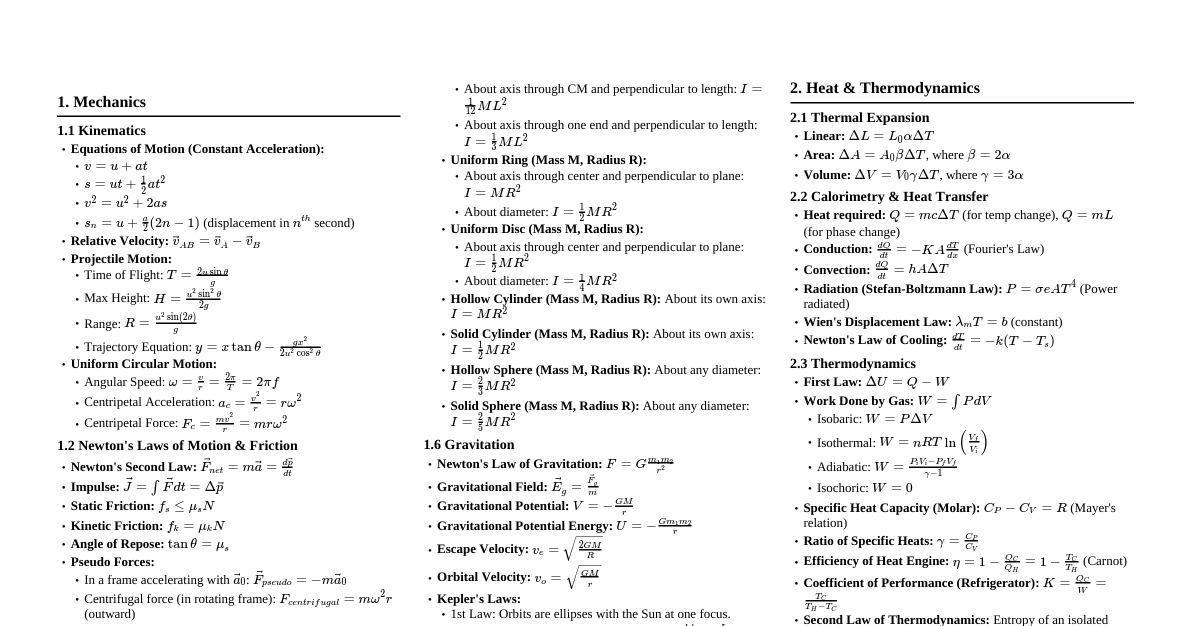
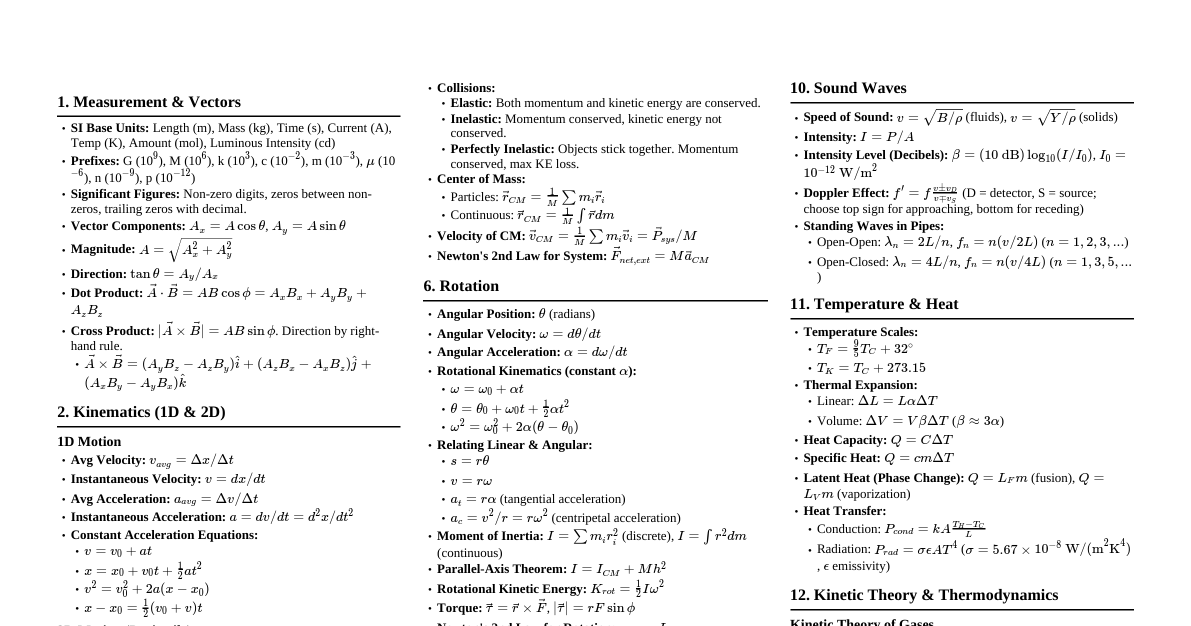
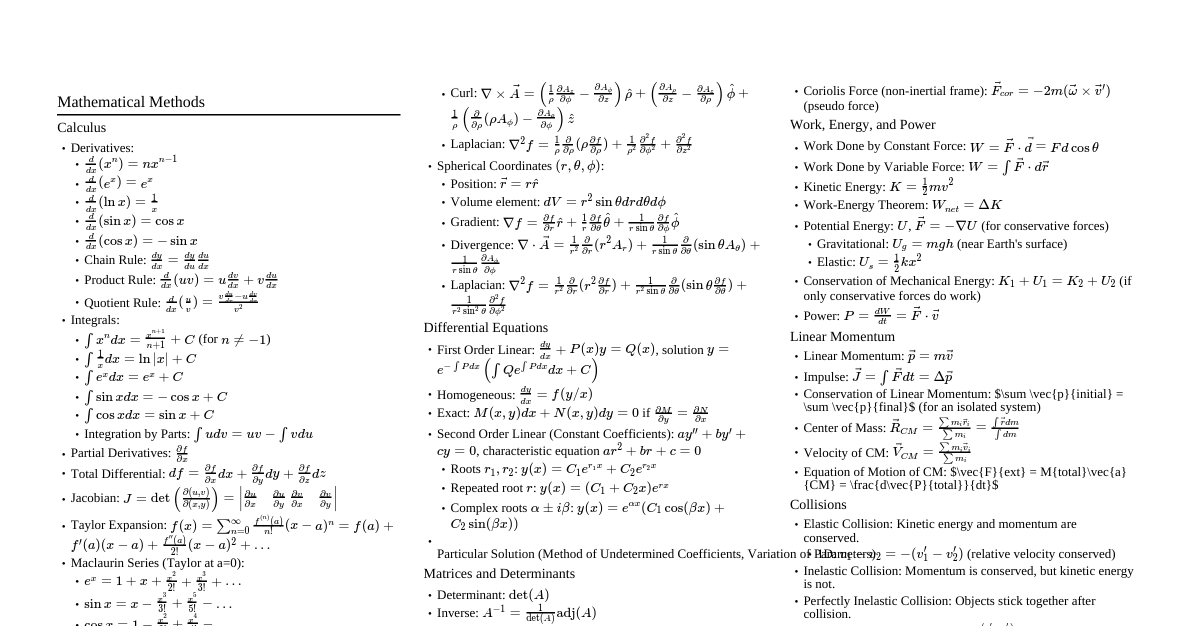
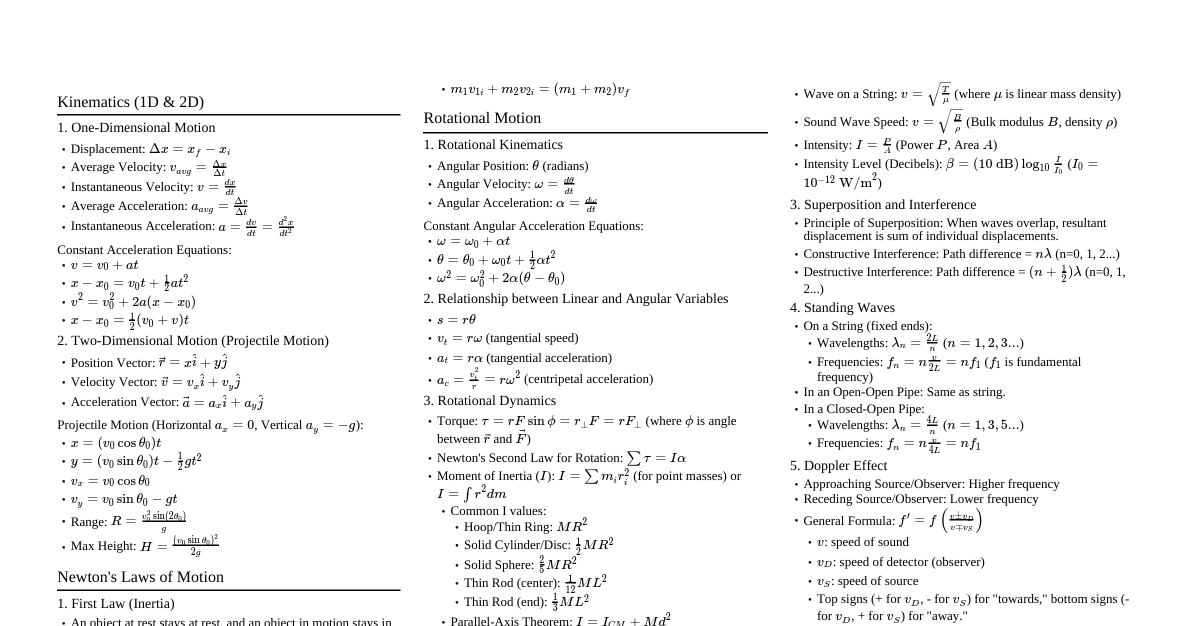
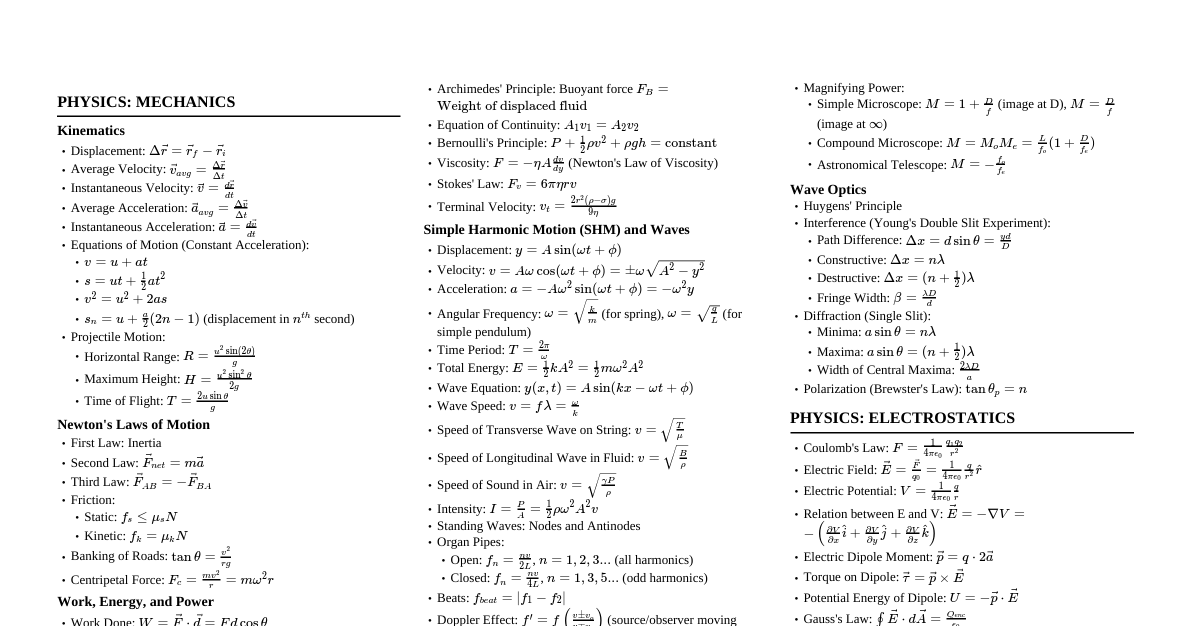
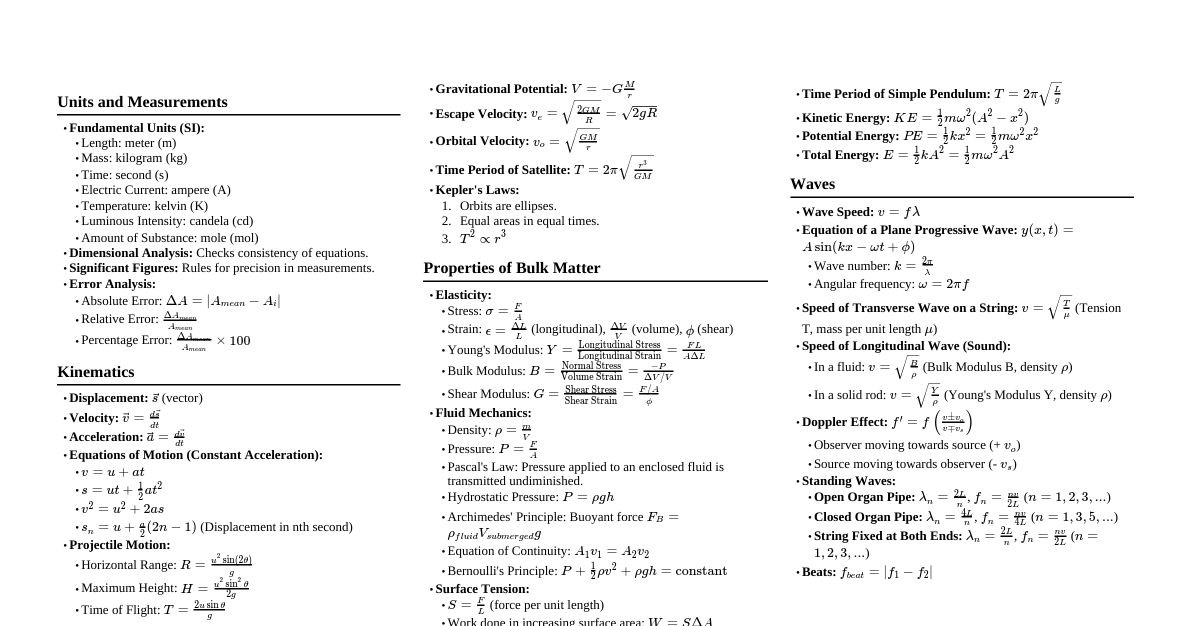
### Introduction to Physics Physics is the natural science that studies matter, its fundamental constituents, its motion and behavior through space and time, and the related entities of energy and force. It is one of the most fundamental scientific disciplines, and its main goal is to understand how the universe behaves. #### Branches of Physics - **Classical Mechanics:** Study of motion of macroscopic objects. - **Thermodynamics:** Study of heat and its relation to other forms of energy and work. - **Electromagnetism:** Study of electricity, magnetism, and light. - **Optics:** Study of light and its behavior. - **Quantum Mechanics:** Study of physics at the atomic and subatomic levels. - **Relativity:** Study of space and time. ### Classical Mechanics The foundation of classical physics, describing motion. #### Kinematics - **Position:** $x$ (m) - **Displacement:** $\Delta x = x_f - x_i$ (m) - **Velocity:** $v = \frac{\Delta x}{\Delta t}$ (m/s) - **Acceleration:** $a = \frac{\Delta v}{\Delta t}$ (m/s$^2$) #### Equations of Motion (Constant Acceleration) - $v = v_0 + at$ - $x = x_0 + v_0 t + \frac{1}{2}at^2$ - $v^2 = v_0^2 + 2a(x - x_0)$ #### Newton's Laws of Motion 1. **Inertia:** An object at rest stays at rest and an object in motion stays in motion with the same speed and in the same direction unless acted upon by an unbalanced force. 2. **Force:** $F = ma$ (N) 3. **Action-Reaction:** For every action, there is an equal and opposite reaction. #### Work, Energy, and Power - **Work:** $W = F \cdot d \cos\theta$ (J) - **Kinetic Energy:** $KE = \frac{1}{2}mv^2$ (J) - **Potential Energy (Gravitational):** $PE_g = mgh$ (J) - **Potential Energy (Spring):** $PE_s = \frac{1}{2}kx^2$ (J) - **Conservation of Energy:** $KE_i + PE_i = KE_f + PE_f$ (if no non-conservative forces) - **Power:** $P = \frac{W}{\Delta t} = F \cdot v$ (W) #### Momentum and Collisions - **Momentum:** $p = mv$ (kg m/s) - **Impulse:** $J = F \Delta t = \Delta p$ (N s) - **Conservation of Momentum:** $p_{total, i} = p_{total, f}$ (in a closed system) ### Thermodynamics Study of heat and energy transfer. #### Key Concepts - **Temperature:** Measure of average kinetic energy of particles. - **Heat:** Energy transferred due to temperature difference. - **Internal Energy:** Sum of kinetic and potential energies of particles in a system. #### Laws of Thermodynamics 1. **First Law (Conservation of Energy):** $\Delta U = Q - W$ (Change in internal energy = Heat added - Work done by system) 2. **Second Law (Entropy):** The total entropy of an isolated system can only increase over time. It can remain constant in ideal cases where the system is in a steady state or undergoing a reversible process. 3. **Third Law:** As temperature approaches absolute zero, the entropy of a system approaches a constant minimum value. #### Heat Transfer Mechanisms - **Conduction:** Transfer through direct contact. - **Convection:** Transfer through fluid movement. - **Radiation:** Transfer via electromagnetic waves. ### Electromagnetism Interactions between electric charges and magnetic fields. #### Electrostatics - **Coulomb's Law:** $F = k \frac{|q_1 q_2|}{r^2}$ (N) where $k = 8.99 \times 10^9 \text{ N m}^2/\text{C}^2$ - **Electric Field:** $E = \frac{F}{q_0}$ (N/C) or $E = k \frac{q}{r^2}$ - **Electric Potential:** $V = \frac{PE}{q_0}$ (V) - **Capacitance:** $C = \frac{Q}{V}$ (F) #### Current and Circuits - **Current:** $I = \frac{\Delta Q}{\Delta t}$ (A) - **Ohm's Law:** $V = IR$ (V) - **Resistance:** $R = \rho \frac{L}{A}$ ($\Omega$) - **Power (Electrical):** $P = IV = I^2R = \frac{V^2}{R}$ (W) #### Magnetism - **Magnetic Force on a Charge:** $F_B = qvB\sin\theta$ (N) - **Magnetic Force on a Current:** $F_B = ILB\sin\theta$ (N) - **Magnetic Field by a Wire:** $B = \frac{\mu_0 I}{2\pi r}$ (T) where $\mu_0 = 4\pi \times 10^{-7} \text{ T m/A}$ - **Faraday's Law of Induction:** $\mathcal{E} = -N \frac{\Delta \Phi_B}{\Delta t}$ (V) ### Optics Study of light and its properties. #### Wave Nature of Light - **Wave Speed:** $c = \lambda f$ (m/s), where $c \approx 3 \times 10^8 \text{ m/s}$ in vacuum. - **Refraction (Snell's Law):** $n_1 \sin\theta_1 = n_2 \sin\theta_2$ - **Diffraction:** Bending of waves around obstacles. - **Interference:** Superposition of waves. #### Geometric Optics (Lenses and Mirrors) - **Mirror/Lens Equation:** $\frac{1}{f} = \frac{1}{d_o} + \frac{1}{d_i}$ - **Magnification:** $M = -\frac{d_i}{d_o} = \frac{h_i}{h_o}$ ### Quantum Mechanics Physics at the atomic and subatomic level. #### Key Concepts - **Quantization of Energy:** Energy exists in discrete packets (quanta). - **Photon Energy:** $E = hf = \frac{hc}{\lambda}$ (J), where $h \approx 6.626 \times 10^{-34} \text{ J s}$ (Planck's constant) - **Wave-Particle Duality:** Particles can exhibit wave-like properties, and waves can exhibit particle-like properties. - **De Broglie Wavelength:** $\lambda = \frac{h}{p}$ - **Heisenberg Uncertainty Principle:** $\Delta x \Delta p \ge \frac{\hbar}{2}$ and $\Delta E \Delta t \ge \frac{\hbar}{2}$ #### Atomic Structure - **Bohr Model:** Quantized electron orbits in atoms. - **Quantum Numbers:** Describe the state of an electron in an atom ($n, l, m_l, m_s$). ### Relativity Theory of space and time. #### Special Relativity (Einstein) - **Postulates:** 1. The laws of physics are the same for all observers in uniform motion. 2. The speed of light in vacuum is the same for all inertial observers. - **Time Dilation:** $\Delta t' = \gamma \Delta t_0$, where $\gamma = \frac{1}{\sqrt{1 - v^2/c^2}}$ - **Length Contraction:** $L' = \frac{L_0}{\gamma}$ - **Relativistic Mass-Energy Equivalence:** $E = mc^2$ ### Modern Physics Topics Brief overview of advanced areas. #### Nuclear Physics - **Radioactivity:** Spontaneous decay of unstable atomic nuclei. - **Nuclear Fission:** Splitting of heavy nuclei. - **Nuclear Fusion:** Combining of light nuclei. #### Particle Physics - **Standard Model:** Describes fundamental particles and forces. - **Fermions:** Matter particles (quarks, leptons). - **Bosons:** Force-carrying particles (photons, gluons, W/Z bosons, Higgs boson). #### Cosmology - **Big Bang Theory:** Origin of the universe. - **Dark Matter & Dark Energy:** Hypothetical components of the universe.