Diffraction Cheatsheet
Cheatsheet Content
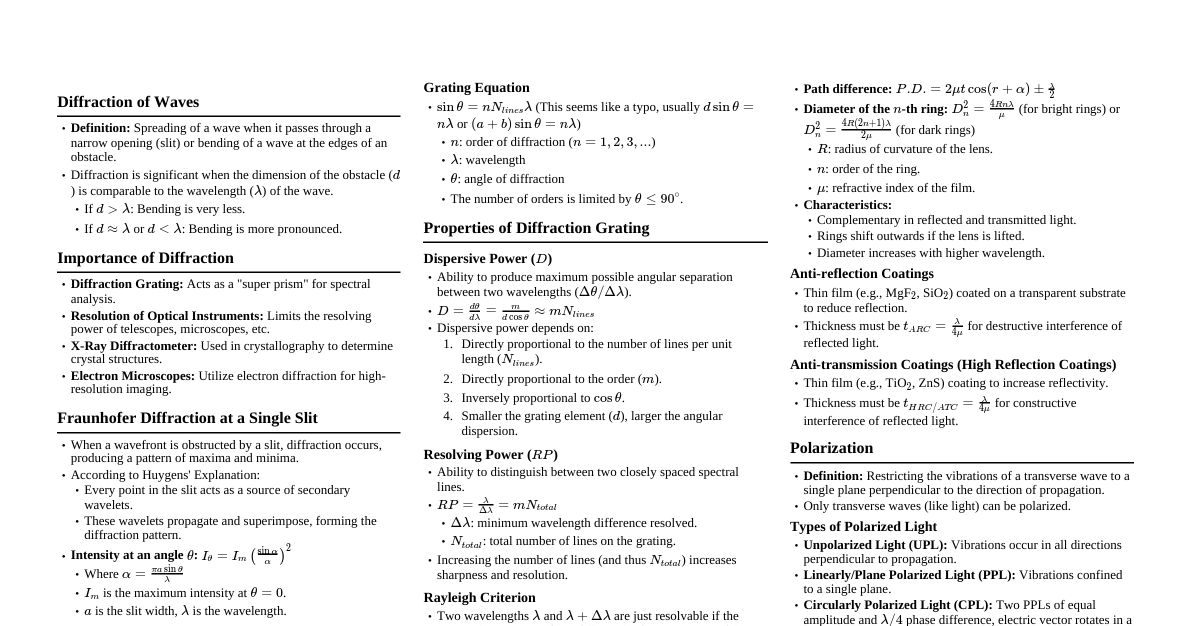
What is Diffraction? (Bending of Waves) Imagine waves (like light or sound) hitting a small gap or an object. Instead of just going straight, the waves bend around the edges. This bending is called Diffraction. It happens best when the gap or object is about the same size as the wave's wavelength (distance between two wave peaks). Think of it: Sound bends around corners, light makes patterns when it goes through a tiny hole. Why is Diffraction Important? (Real-World Uses) Making Colors from Light: Diffraction Gratings: These are like super-prisms. They have many tiny lines that split white light into all its rainbow colors better than a simple prism. Used in labs to study light. Seeing Tiny Things (Resolution): Microscopes & Telescopes: Diffraction affects how clear images are. It puts a limit on how small or far away something can be before it looks blurry. Electron Microscopes: Use electrons (which act like waves with very tiny wavelengths) to see incredibly small details, even atoms! Studying Materials: X-Ray Diffraction: Scientists shoot X-rays at crystals. The way the X-rays diffract (bend) tells them how the atoms are arranged inside the crystal. Super important for chemistry and material science. Radar: Larger radar dishes can use diffraction ideas to get a clearer picture of distant objects. Diffraction from a Single Slit (One Small Opening) When light goes through just one narrow gap, it doesn't just make one bright line. It makes a bright center, and then dimmer bright lines with dark spaces in between. Where are the Dark and Bright Spots? (Single Slit) Let $a$ be the width of the slit (the gap), $\lambda$ be the wavelength of light, and $\theta$ be the angle where you see the light. Brightest Spot (Central Maximum): Happens right in the middle, at an angle of $0^\circ$. This is the strongest light. Dark Spots (Minima): These are the places where there's no light. They happen when $a \sin\theta = m\lambda$, where $m = \pm 1, \pm 2, \ldots$ (meaning the 1st dark spot, 2nd dark spot, etc., on either side). Dimmer Bright Spots (Secondary Maxima): These are the smaller bright areas between the dark spots. They are much less bright than the central one. Diffraction Grating (Many Small Openings) This is like having hundreds or thousands of very thin, parallel slits (gaps) very close together. It's super good at splitting light into its individual colors (wavelengths). Imagine a CD or DVD surface – it acts a bit like a diffraction grating, showing rainbow colors. Grating Equation (Where the Bright Colors Appear) For a diffraction grating, the bright lines (called "principal maxima") appear at angles $\theta$ that follow this rule: $$d \sin\theta = n\lambda$$ $d$: This is the distance from the center of one slit to the center of the next slit. (It's usually very tiny!) $n$: This is the "order" of the bright line. $n=0$ is the central bright line, $n=1$ is the first bright line on either side, $n=2$ is the second, and so on. $\lambda$: This is the wavelength (color) of the light. $\theta$: This is the angle from the center where you see that specific bright color. How Good is Your Grating? (Important Measures) Dispersive Power (How well it spreads colors) This tells you how much a grating can spread out different colors (wavelengths). A grating with high dispersive power will separate red light from blue light by a larger angle. It's better if: You look at higher "orders" ($n=2$ spreads colors more than $n=1$). The slits are closer together (smaller $d$). There are more lines per centimeter on the grating. Resolving Power (How well it tells similar colors apart) This tells you if the grating can tell the difference between two very, very similar colors (wavelengths). For example, can it tell apart yellow-orange from pure orange? Formula for a grating: $RP = nN$ $n$: The order of the spectrum (e.g., 1st order, 2nd order). $N$: The total number of lines on the grating (not just lines per cm, but the total number across its width). It's better if: You use a higher order ($n$). The grating has more total lines ($N$). So, a wider grating with more lines does better. Rayleigh Criterion (When can you see two things separately?) This is a rule to decide if two nearby images or colors are "resolved" (meaning you can see them as two separate things, not one blurry blob). It says you can tell them apart when the brightest part of one image falls exactly on the first dark part of the other image. This applies to microscopes, telescopes, and gratings, setting the fundamental limit on what can be clearly seen.