Class 10 CBSE Electricity
Cheatsheet Content
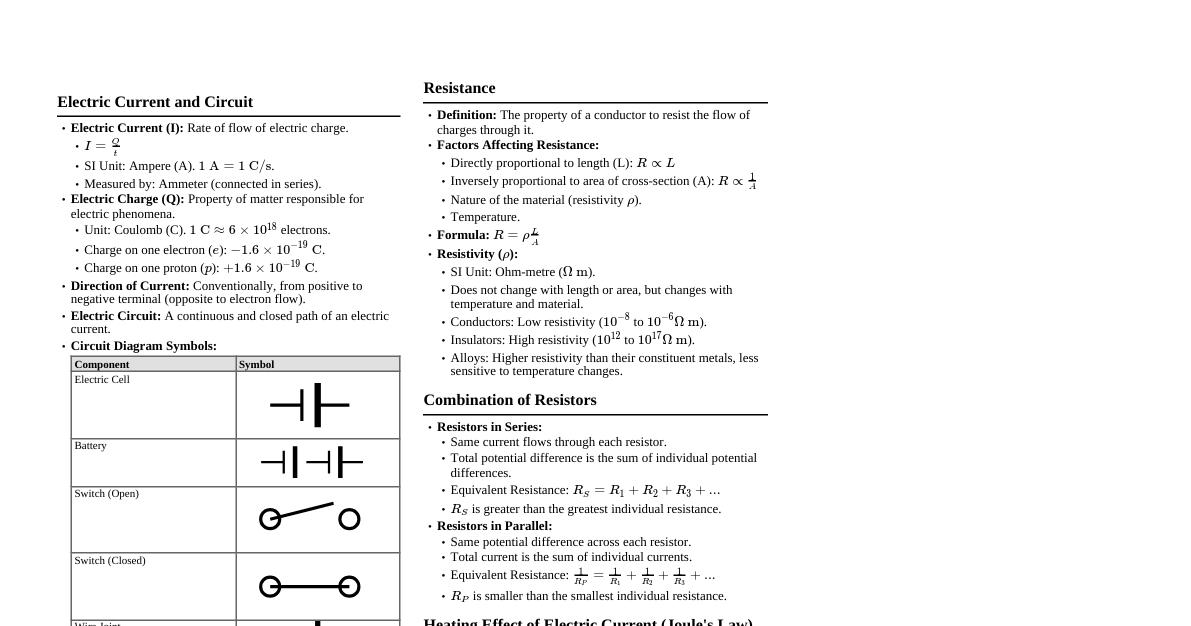
### Electric Current - **Definition:** The rate of flow of electric charge. - **Formula:** $I = \frac{Q}{t}$ - $I$: Electric current (Amperes, A) - $Q$: Electric charge (Coulombs, C) - $t$: Time (seconds, s) - **Direction:** Conventionally, from positive terminal to negative terminal (opposite to electron flow). - **Unit:** Ampere (A). 1 A = 1 C/s. - **Ammeter:** Device used to measure current, always connected in series. ### Electric Potential & Potential Difference - **Electric Potential (V):** Work done per unit charge to bring a charge from infinity to a point. - **Potential Difference (V):** Work done per unit charge in moving a charge from one point to another. - **Formula:** $V = \frac{W}{Q}$ - $V$: Potential Difference (Volts, V) - $W$: Work done (Joules, J) - $Q$: Electric charge (Coulombs, C) - **Unit:** Volt (V). 1 V = 1 J/C. - **Voltmeter:** Device used to measure potential difference, always connected in parallel. - **Cell/Battery:** A source of potential difference. ### Ohm's Law - **Statement:** The current flowing through a conductor is directly proportional to the potential difference across its ends, provided its temperature and other physical conditions remain unchanged. - **Formula:** $V = IR$ - $V$: Potential difference (Volts, V) - $I$: Current (Amperes, A) - $R$: Resistance (Ohms, $\Omega$) - **Graphical Representation:** V-I graph is a straight line passing through the origin. - **Ohmic Conductors:** Materials that obey Ohm's Law (e.g., metals). - **Non-Ohmic Conductors:** Materials that do not obey Ohm's Law (e.g., semiconductors, diodes). ### Resistance - **Definition:** The opposition offered by a conductor to the flow of electric current. - **Unit:** Ohm ($\Omega$). - **Factors Affecting Resistance:** 1. **Length (L):** $R \propto L$ 2. **Area of Cross-section (A):** $R \propto \frac{1}{A}$ 3. **Nature of Material:** Different materials have different resistivity. 4. **Temperature:** Resistance generally increases with temperature for metals. - **Formula:** $R = \rho \frac{L}{A}$ - $\rho$ (rho): Resistivity of the material ($\Omega \cdot m$) - **Resistivity ($\rho$):** The resistance of a wire of unit length and unit cross-sectional area. It is a characteristic property of the material. - **Conductors:** Low resistivity (e.g., Copper, Aluminium). - **Insulators:** High resistivity (e.g., Glass, Rubber). - **Alloys:** Resistivity is higher than their constituent metals, and less sensitive to temperature changes (e.g., Nichrome, Manganin). ### Resistors in Series - **Arrangement:** Components connected end-to-end, so the same current flows through each. - **Total Resistance ($R_S$):** Sum of individual resistances. - $R_S = R_1 + R_2 + R_3 + ...$ - **Current:** Same through each resistor ($I = I_1 = I_2 = I_3$). - **Potential Difference:** Divides across resistors ($V = V_1 + V_2 + V_3$). - **Advantages:** Easy to connect, current is the same. - **Disadvantages:** If one component fails, the circuit breaks; total resistance increases. ### Resistors in Parallel - **Arrangement:** Components connected across the same two points, so the potential difference across each is the same. - **Total Resistance ($R_P$):** Reciprocal of total resistance is the sum of reciprocals of individual resistances. - $\frac{1}{R_P} = \frac{1}{R_1} + \frac{1}{R_2} + \frac{1}{R_3} + ...$ - **Current:** Divides among parallel branches ($I = I_1 + I_2 + I_3$). - **Potential Difference:** Same across each resistor ($V = V_1 = V_2 = V_3$). - **Advantages:** If one component fails, others continue to work; total resistance decreases. - **Disadvantages:** Different currents flow through different branches. ### Heating Effect of Electric Current (Joule's Law) - **Statement:** When an electric current passes through a conductor, the conductor gets heated. - **Cause:** Collisions between moving electrons and atoms/ions of the conductor, transferring kinetic energy to heat. - **Joule's Law of Heating:** The heat produced (H) in a resistor is directly proportional to: 1. Square of the current ($I^2$). 2. Resistance of the conductor ($R$). 3. Time for which current flows ($t$). - **Formula:** $H = I^2 R t$ - $H$: Heat produced (Joules, J) - $I$: Current (Amperes, A) - $R$: Resistance (Ohms, $\Omega$) - $t$: Time (seconds, s) - **Other forms:** - $H = V I t$ (since $I R = V$) - $H = \frac{V^2}{R} t$ (since $I = \frac{V}{R}$) - **Applications:** Electric heater, electric iron, electric kettle, electric fuse, incandescent light bulb. ### Electric Power - **Definition:** The rate at which electrical energy is consumed or dissipated. - **Formula:** $P = \frac{W}{t} = V I$ - $P$: Power (Watts, W) - $W$: Electrical energy (Joules, J) - $t$: Time (seconds, s) - **Other forms:** - $P = I^2 R$ (since $V = I R$) - $P = \frac{V^2}{R}$ (since $I = \frac{V}{R}$) - **Unit:** Watt (W). 1 W = 1 J/s. - **Commercial Unit of Electrical Energy:** Kilowatt-hour (kWh). - 1 kWh = $3.6 \times 10^6$ Joules. - It represents the energy consumed by a 1 kW appliance operating for 1 hour. - **Power Rating:** Appliances are rated with power (W) and voltage (V). - Example: A 100 W, 220 V bulb means it consumes 100 Joules of energy per second when connected to a 220 V supply. #### Relationship between Power, Voltage, and Current | Quantity | Formula | Unit | | :------- | :------ | :--- | | Power | $P = VI$ | Watt | | Energy | $E = P \cdot t$ | Joule / kWh | ### Electric Energy - **Definition:** The total work done by the current in an electric circuit for a given time. - **Formula:** $E = P \times t = V I t = I^2 R t = \frac{V^2}{R} t$ - **Unit:** Joule (J). - **Commercial Unit:** Kilowatt-hour (kWh). - **Cost of Electricity:** Calculated based on the number of kWh consumed. - Cost = (Number of units in kWh) $\times$ (Cost per unit) ### Household Electric Circuits - **Series vs. Parallel:** Household circuits use parallel arrangement for appliances. - **Reason:** Each appliance gets the full supply voltage, and if one appliance fails, others continue to work. - **Wiring:** Consists of three types of wires: 1. **Live Wire (Red):** Carries current at high potential (e.g., 220 V). 2. **Neutral Wire (Black):** At zero potential. 3. **Earth Wire (Green):** Connected to a metal plate deep in the earth, used for safety. - **Safety Devices:** - **Electric Fuse:** A safety device that protects circuits and appliances by preventing the flow of excessively high current. It has a low melting point and high resistance. Connected in series with the live wire. - **Earthing:** Connects the metal body of an appliance to the earth wire to prevent electric shock in case of insulation failure. - **MCB (Miniature Circuit Breaker):** An electromagnetic switch that automatically opens the circuit when current exceeds a safe limit. More advanced than fuses. - **Overloading:** Occurs when too many appliances are connected to a single socket, drawing excessive current from the main supply. This can lead to overheating of wires and fire. - **Short-circuiting:** Occurs when the live wire and the neutral wire come into direct contact (e.g., due to damaged insulation). This results in a very low resistance path for current, causing a very large current to flow and producing excessive heat, potentially leading to fires. ### Circuit Symbols | Component | Symbol | | :--------------- | :---------- | | Electric Cell |  | | Battery |  | | Connecting Wire |  | | Switch (Open) |  | | Switch (Closed) |  | | Resistor |  | | Variable Resistor (Rheostat) |  | | Ammeter |  | | Voltmeter |  | | Galvanometer |  | | Electric Bulb |  | | Joint Wire |  | | Wire Crossing (No Join) |  |