Class 11 Chemistry PCB
Shared 3/20/2026•82 views
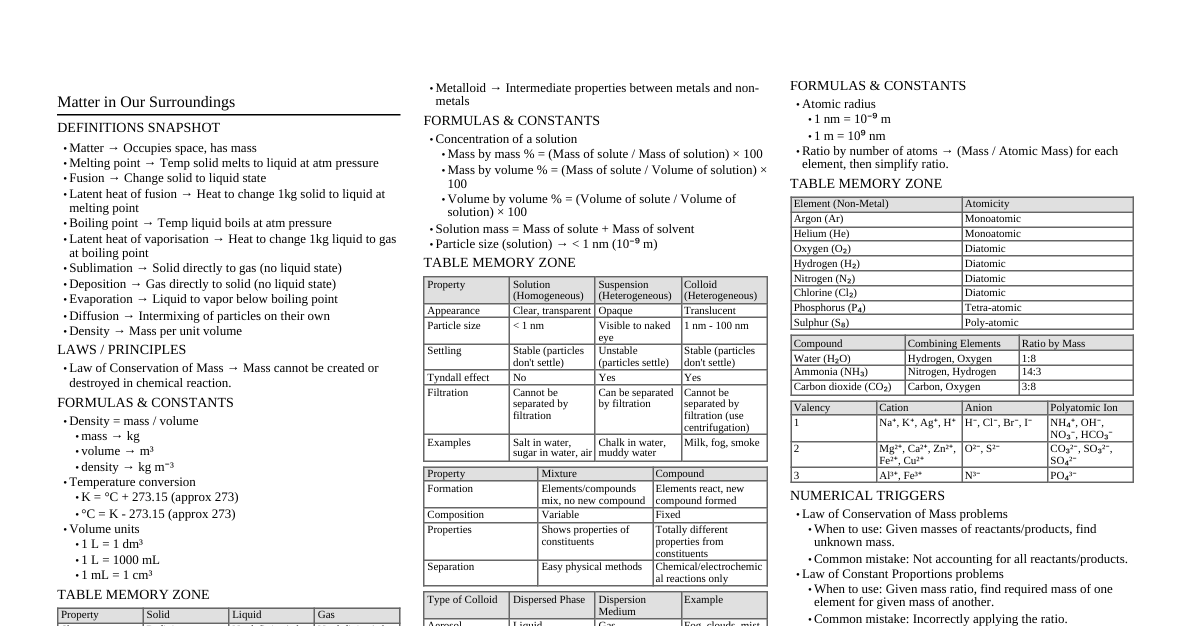
### Some Basic Concepts of Chemistry - **Matter:** Anything that has mass and occupies space. - **Classification:** - **Physical:** Solid, Liquid, Gas - **Chemical:** - **Pure Substances:** Elements (metals, non-metals, metalloids), Compounds (organic, inorganic) - **Mixtures:** Homogeneous (uniform composition), Heterogeneous (non-uniform composition) - **Laws of Chemical Combination:** - **Law of Conservation of Mass (Lavoisier):** Mass is neither created nor destroyed. - **Law of Definite Proportions (Proust):** A given compound always contains exactly the same proportion of elements by weight. - **Law of Multiple Proportions (Dalton):** If two elements combine to form more than one compound, the masses of one element that combine with a fixed mass of the other element are in ratios of small whole numbers. - **Gay-Lussac's Law of Gaseous Volumes:** When gases combine or are produced in a chemical reaction, they do so in a simple ratio by volume, provided all gases are at the same temperature and pressure. - **Avogadro's Law:** Equal volumes of all gases at the same temperature and pressure contain equal numbers of molecules. - **Dalton's Atomic Theory:** - Matter consists of indivisible atoms. - All atoms of a given element have identical properties. - Compounds formed when atoms of different elements combine in a fixed ratio. - Chemical reactions involve reorganization of atoms. - **Atomic and Molecular Masses:** - **Atomic Mass Unit (amu):** 1/12th the mass of a carbon-12 atom. - **Average Atomic Mass:** Weighted average of isotopic masses. - **Molecular Mass:** Sum of atomic masses of all atoms in a molecule. - **Formula Mass:** Sum of atomic masses of all atoms in a formula unit (for ionic compounds). - **Mole Concept:** - **Mole:** Amount of substance containing as many elementary entities (atoms, molecules, ions) as there are atoms in 12g of carbon-12. - **Avogadro's Number ($N_A$):** $6.022 \times 10^{23}$ entities/mol. - **Molar Mass:** Mass of one mole of a substance in grams. - **Molar Volume:** Volume occupied by one mole of any gas at STP ($22.4 \text{ L}$ at $0^\circ \text{C}$ and $1 \text{ atm}$). - **Stoichiometry:** - **Limiting Reactant:** Reactant completely consumed, determining the amount of product formed. - **Excess Reactant:** Reactant not completely consumed. - **Percentage Yield:** $(\text{Actual Yield} / \text{Theoretical Yield}) \times 100$. - **Concentration Terms:** - **Mass Percent:** $(\text{Mass of solute} / \text{Mass of solution}) \times 100$. - **Mole Fraction ($X$):** $(\text{Moles of component} / \text{Total moles of all components})$. - **Molarity ($M$):** $(\text{Moles of solute} / \text{Volume of solution in L})$. - **Molality ($m$):** $(\text{Moles of solute} / \text{Mass of solvent in kg})$. - **Parts Per Million (ppm):** $(\text{Mass of solute} / \text{Mass of solution}) \times 10^6$. ### Structure of Atom - **Discovery of Subatomic Particles:** - **Electrons (J.J. Thomson):** Cathode ray experiments. Charge-to-mass ratio ($e/m$) determined. Millikan's oil drop experiment determined charge ($e$). - **Protons (Goldstein/Rutherford):** Anode ray (canal ray) experiments. - **Neutrons (Chadwick):** Bombardment of beryllium with $\alpha$-particles. - **Atomic Models:** - **Thomson's Plum Pudding Model:** Positive sphere with embedded electrons. Failed to explain $\alpha$-scattering. - **Rutherford's Nuclear Model:** - Most of the mass and positive charge concentrated in a small, dense nucleus. - Electrons revolve around the nucleus. - Most of atom is empty space. - Drawbacks: Could not explain stability of atom (electron would spiral into nucleus) and line spectra. - **Bohr's Model for Hydrogen Atom:** - Electrons revolve in fixed circular orbits (stationary states) with definite energy. - Electrons do not radiate energy in stationary states. - Energy is absorbed/emitted when electron jumps between orbits ($E_2 - E_1 = h\nu$). - Angular momentum is quantized: $mvr = nh/(2\pi)$. - Drawbacks: Only applicable to one-electron species, failed to explain fine spectrum, Zeeman and Stark effects. - **Quantum Mechanical Model of Atom:** - **Dual Nature of Matter (de Broglie):** $\lambda = h/(mv)$. - **Heisenberg's Uncertainty Principle:** It is impossible to simultaneously determine with certainty both the position and momentum of a microscopic particle: $\Delta x \cdot \Delta p \ge h/(4\pi)$. - **Schrödinger Wave Equation:** $H\psi = E\psi$. Describes the wave nature of electrons. $\psi^2$ represents probability density of finding electron. - **Quantum Numbers:** Describe the state of an electron. - **Principal Quantum Number ($n$):** $1, 2, 3, ...$. Determines size and main energy level (shell). - **Azimuthal/Angular Momentum Quantum Number ($l$):** $0, 1, ..., (n-1)$. Determines shape of orbital (subshell: $s, p, d, f$). - **Magnetic Quantum Number ($m_l$):** $-l, ..., 0, ..., +l$. Determines orientation of orbital in space. - **Spin Quantum Number ($m_s$):** $+1/2, -1/2$. Describes electron spin. - **Shapes of Orbitals:** - **s-orbital:** Spherical. - **p-orbitals:** Dumbbell shaped ($p_x, p_y, p_z$). - **d-orbitals:** Double dumbbell ($d_{xy}, d_{yz}, d_{zx}, d_{x^2-y^2}$) and one doughnut ($d_{z^2}$). - **Electronic Configuration:** - **Aufbau Principle:** Orbitals are filled in order of increasing energy (determined by $n+l$ rule). - **Pauli's Exclusion Principle:** No two electrons in an atom can have all four quantum numbers identical. Max 2 electrons per orbital with opposite spins. - **Hund's Rule of Maximum Multiplicity:** Pairing of electrons in degenerate orbitals (same energy) does not occur until each orbital is singly occupied. - **Stability of Half-filled and Fully-filled Orbitals:** Extra stability due to symmetry and exchange energy. (e.g., Cr: $[Ar] 3d^5 4s^1$, Cu: $[Ar] 3d^{10} 4s^1$). ### Classification of Elements and Periodicity in Properties - **Need for Classification:** To organize and understand the vast number of elements. - **Early Attempts:** - **Dobereiner's Triads:** Groups of three elements with similar properties, where atomic weight of middle element was average of other two. - **Newlands' Law of Octaves:** Elements arranged by increasing atomic weight, every eighth element had similar properties (like musical octaves). Failed after Calcium. - **Mendeleev's Periodic Table:** - **Periodic Law:** Properties of elements are a periodic function of their atomic weights. - **Merits:** Predicted existence and properties of undiscovered elements (e.g., Eka-Aluminium/Gallium, Eka-Silicon/Germanium). Left gaps. - **Demerits:** Position of hydrogen, anomalous pairs (Ar/K, Co/Ni), isotopes, no explanation for cause of periodicity. - **Modern Periodic Table (Moseley):** - **Modern Periodic Law:** Properties of elements are a periodic function of their atomic numbers. - **Structure:** - **Periods (7 horizontal rows):** Number of shell. - **Groups (18 vertical columns):** Same number of valence electrons, similar chemical properties. - **Blocks:** - **s-block (Groups 1 & 2):** Alkali metals, Alkaline earth metals. Soft metals, low ionization enthalpy, highly reactive. - **p-block (Groups 13-18):** Metals, non-metals, metalloids. Variable properties. Halogens (Gr 17), Noble gases (Gr 18). - **d-block (Groups 3-12):** Transition elements. Metals, high melting/boiling points, variable oxidation states, coloured ions. - **f-block (Lanthanoids & Actinoids):** Inner transition elements. - **Periodic Trends in Properties:** - **Atomic Radius:** - **Across a period (L to R):** Decreases (increased nuclear charge, same shell). - **Down a group (Top to Bottom):** Increases (new shells added). - **Ionic Radius:** - Cations are smaller than parent atoms (loss of electron, higher Zeff). - Anions are larger than parent atoms (gain of electron, lower Zeff). - Isoelectronic species: Smaller the positive charge, larger the size (e.g., $N^{3-} > O^{2-} > F^- > Na^+ > Mg^{2+} > Al^{3+}$). - **Ionization Enthalpy ($\Delta_i H$):** Energy required to remove an electron from an isolated gaseous atom. - **Across a period:** Increases (increased Zeff, smaller size). - **Down a group:** Decreases (increased size, shielding effect). - **Exceptions:** - Gr 13 Gr 16 > Gr 17 > Gr 18 (e.g., $N > O$). - Due to half-filled/fully-filled orbitals and penetration effect. - **Electron Gain Enthalpy ($\Delta_{eg} H$):** Energy change when an electron is added to an isolated gaseous atom. - **Across a period:** Generally more negative (increases, easier to gain electron). - **Down a group:** Generally less negative (decreases, harder to gain electron). - **Exceptions:** - Halogens have high negative $\Delta_{eg} H$. - Noble gases have positive $\Delta_{eg} H$. - Second period elements (O, F) have less negative $\Delta_{eg} H$ than third period (S, Cl) due to small size and inter-electronic repulsion. - **Electronegativity:** Tendency of an atom in a chemical compound to attract shared pair of electrons towards itself. (No units). - **Across a period:** Increases. - **Down a group:** Decreases. - **Pauling scale:** F (4.0) is most electronegative. - **Valency:** Combining capacity of an element. - For s & p-block: Usually equal to number of valence electrons or (8 - number of valence electrons). - **Metallic Character:** Tendency to lose electrons. - **Across a period:** Decreases. - **Down a group:** Increases. - **Anomalous Properties of Second Period Elements:** Li, Be, B, C, N, O, F differ from rest of their groups due to small size, high electronegativity, and absence of d-orbitals. - **Diagonal Relationship:** Similarity in properties between certain diagonally adjacent elements (e.g., Li & Mg, Be & Al, B & Si). ### Chemical Bonding and Molecular Structure - **Kossel-Lewis Approach to Chemical Bonding:** - **Lewis Symbols:** Valence electrons shown as dots around element symbol. - **Octet Rule:** Atoms combine to achieve a stable octet (8 electrons) in their valence shell. (Exceptions: H, Li, Be, B, PCl5, SF6, etc.) - **Ionic Bond:** Transfer of electrons between atoms (metal + non-metal) to form ions. - **Factors affecting:** Low ionization enthalpy for metal, high electron gain enthalpy for non-metal, high lattice enthalpy for ionic compound. - **Covalent Bond:** Sharing of electrons between atoms (non-metals). - **Lewis Structures:** Representation of molecules showing bonding and non-bonding electron pairs. - **Formal Charge:** (Total valence e- in free atom) - (Non-bonding e-) - (1/2 Bonding e-). - **Bond Parameters:** - **Bond Length:** Equilibrium distance between nuclei of two bonded atoms. - **Bond Angle:** Angle between the orbitals containing bonding electron pairs around the central atom. - **Bond Enthalpy:** Energy required to break one mole of bonds of a particular type. - **Bond Order:** Number of bonds between two atoms (e.g., 1 for single, 2 for double, 3 for triple). - **Resonance:** When a single Lewis structure cannot describe a molecule accurately, multiple contributing structures (resonance structures) are used. Actual structure is a resonance hybrid. - **Polarity of Bonds:** - **Non-polar Covalent:** Equal sharing (electronegativity difference = 0). - **Polar Covalent:** Unequal sharing (electronegativity difference > 0 but 1.7). - **Dipole Moment ($\mu$):** (Charge, Q) $\times$ (Distance, r). Vector quantity. Indicates overall polarity of a molecule. - Symmetric molecules (e.g., $CO_2, CCl_4$) have zero dipole moment even if bonds are polar. - **VSEPR Theory (Valence Shell Electron Pair Repulsion Theory):** - Electron pairs around central atom repel each other and arrange themselves to minimize repulsion. - Order of repulsion: Lone pair-lone pair > Lone pair-bond pair > Bond pair-bond pair. - Predicts molecular geometry. (e.g., $CH_4$ - tetrahedral, $NH_3$ - pyramidal, $H_2O$ - bent/angular). - **Valence Bond Theory (VBT):** - Covalent bond formed by overlapping of atomic orbitals. - **Types of Overlap:** - **Axial/Head-on (sigma, $\sigma$ bond):** Stronger, occurs by s-s, s-p, p-p (head-on) overlap. - **Lateral/Sideways (pi, $\pi$ bond):** Weaker, occurs by p-p (sideways) overlap. - **Hybridization:** Mixing of atomic orbitals of slightly different energies to form new hybrid orbitals of equivalent energy and shape. - **sp:** Linear ($BeCl_2, C_2H_2$) - **sp$^2$:** Trigonal Planar ($BF_3, C_2H_4$) - **sp$^3$:** Tetrahedral ($CH_4, NH_3, H_2O$) - **sp$^3$d:** Trigonal Bipyramidal ($PCl_5$) - **sp$^3$d$^2$:** Octahedral ($SF_6$) - **Molecular Orbital Theory (MOT):** - Atomic orbitals combine to form molecular orbitals (MOs). - **LCAO (Linear Combination of Atomic Orbitals):** Bonding MOs (lower energy, constructive interference) and Anti-bonding MOs (higher energy, destructive interference). - **Filling of MOs:** According to Aufbau, Pauli, Hund's rules. - **Order of MOs (up to $N_2$):** $\sigma 1s, \sigma^* 1s, \sigma 2s, \sigma^* 2s, \pi 2p_x = \pi 2p_y, \sigma 2p_z, \pi^* 2p_x = \pi^* 2p_y, \sigma^* 2p_z$. - **Order of MOs (for $O_2, F_2$ and beyond):** $\sigma 1s, \sigma^* 1s, \sigma 2s, \sigma^* 2s, \sigma 2p_z, \pi 2p_x = \pi 2p_y, \pi^* 2p_x = \pi^* 2p_y, \sigma^* 2p_z$. - **Bond Order (BO):** $1/2 (N_b - N_a)$, where $N_b$ = electrons in bonding MOs, $N_a$ = electrons in anti-bonding MOs. - BO > 0 implies stable molecule. - Higher BO means higher bond strength, shorter bond length. - **Magnetic Properties:** - **Paramagnetic:** Unpaired electrons (attracted by magnetic field). - **Diamagnetic:** All electrons paired (repelled by magnetic field). - **Hydrogen Bonding:** - Special type of dipole-dipole interaction between H atom (bonded to highly electronegative atom like F, O, N) and another electronegative atom. - **Intermolecular H-bonding:** Between molecules (e.g., $H_2O, NH_3, HF$). Increases boiling point, solubility. - **Intramolecular H-bonding:** Within the same molecule (e.g., o-nitrophenol). Reduces boiling point, solubility. ### States of Matter: Gases and Liquids - **Intermolecular Forces:** Attractive forces between molecules. - **Dispersion/London Forces:** Present in all molecules, especially non-polar. Temporary dipoles. Weakest. - **Dipole-Dipole Forces:** Between polar molecules. - **Dipole-Induced Dipole Forces:** Between polar and non-polar molecules. - **Hydrogen Bonding:** Strongest (covered in Chemical Bonding). - **Ion-Dipole Forces:** Between ions and polar molecules. - **Gaseous State:** - Highly compressible, no fixed volume/shape, low density, exert pressure. - **Gas Laws:** - **Boyle's Law:** At constant T and n, $P \propto 1/V$ or $P_1V_1 = P_2V_2$. - **Charles's Law:** At constant P and n, $V \propto T$ or $V_1/T_1 = V_2/T_2$. ($T$ in Kelvin). - **Gay-Lussac's Law:** At constant V and n, $P \propto T$ or $P_1/T_1 = P_2/T_2$. - **Avogadro's Law:** At constant T and P, $V \propto n$ or $V_1/n_1 = V_2/n_2$. - **Ideal Gas Equation:** $PV = nRT$. - $R$ (Gas Constant): $0.0821 \text{ L atm mol}^{-1} K^{-1}$, $8.314 \text{ J mol}^{-1} K^{-1}$. - **Dalton's Law of Partial Pressures:** Total pressure of a mixture of non-reacting gases is the sum of their partial pressures: $P_{total} = p_1 + p_2 + ...$. - $p_i = X_i P_{total}$ (where $X_i$ is mole fraction). - **Kinetic Molecular Theory of Gases:** - Gases consist of large number of identical particles (atoms/molecules) in constant, random motion. - Volume of individual particles is negligible compared to total volume of gas. - No intermolecular forces between particles. - Collisions are perfectly elastic. - Average kinetic energy of gas particles is directly proportional to absolute temperature. - **Deviation from Ideal Behaviour:** - Real gases deviate at high pressure and low temperature. - **Reasons:** Volume of molecules is not negligible, intermolecular forces are present. - **Van der Waals Equation:** $(P + an^2/V^2)(V-nb) = nRT$. - 'a': accounts for intermolecular forces. - 'b': accounts for finite volume of molecules (excluded volume). - **Compressibility Factor (Z):** $Z = PV/(nRT)$. - For ideal gas, $Z=1$. - For real gases: $Z 1$ (repulsive forces dominate due to volume of molecules). - **Liquid State:** - Fixed volume, no fixed shape, low compressibility. - **Vapour Pressure:** Pressure exerted by vapour in equilibrium with its liquid at a given temperature. - Increases with temperature. - **Boiling Point:** Temperature at which vapour pressure of liquid equals external pressure. - **Surface Tension ($\gamma$):** Force acting per unit length perpendicular to an imaginary line on the liquid surface. - Due to net inward pull of molecules on the surface. - Minimizes surface area. - Increases with decreasing temperature. - **Viscosity ($\eta$):** Resistance to flow. - Due to strong intermolecular forces. - Decreases with increasing temperature. ### Thermodynamics - **Terms:** - **System:** Part of universe under investigation. - **Open:** Exchanges matter and energy. - **Closed:** Exchanges energy, not matter. - **Isolated:** Exchanges neither matter nor energy. - **Surroundings:** Rest of the universe. - **Boundary:** Separates system from surroundings. - **State Functions:** Properties depending only on initial and final states (P, V, T, U, H, S, G). Path independent. - **Path Functions:** Properties depending on the path taken (q, w). - **Extensive Properties:** Depend on amount of matter (V, n, U, H, S, G). - **Intensive Properties:** Independent of amount of matter (P, T, density, molarity). - **First Law of Thermodynamics (Law of Conservation of Energy):** - Energy can neither be created nor destroyed. - $\Delta U = q + w$. - $\Delta U$: Change in internal energy. - $q$: Heat absorbed by system (+), released by system (-). - $w$: Work done on system (+), work done by system (-). - **Work done:** $w = -P_{ext} \Delta V$ (for expansion against constant external pressure). - **Internal Energy (U):** Sum of all forms of energy of a system. - **Enthalpy (H):** $H = U + PV$. - **Change in Enthalpy ($\Delta H$):** Heat change at constant pressure. - $\Delta H = q_p$. - $\Delta H = \Delta U + P\Delta V$. - For chemical reactions: $\Delta H = \Delta U + \Delta n_g RT$. - **Standard Enthalpy of Formation ($\Delta_f H^\circ$):** Enthalpy change when 1 mole of a compound is formed from its elements in their most stable states at standard conditions ($298 \text{ K}, 1 \text{ atm}$). - **Standard Enthalpy of Reaction ($\Delta_r H^\circ$):** - $\Delta_r H^\circ = \sum \Delta_f H^\circ (\text{products}) - \sum \Delta_f H^\circ (\text{reactants})$. - **Hess's Law of Constant Heat Summation:** Total enthalpy change for a reaction is the same whether it occurs in one step or in several steps. - **Second Law of Thermodynamics:** - For a spontaneous process, the total entropy of the universe increases ($\Delta S_{total} > 0$). - **Entropy (S):** Measure of randomness or disorder. - $\Delta S = q_{rev}/T$. - **Across a reaction:** $\Delta_r S^\circ = \sum S^\circ (\text{products}) - \sum S^\circ (\text{reactants})$. - Entropy increases with temperature, volume, and number of particles. - **Gibbs Free Energy (G):** $G = H - TS$. - **Gibbs-Helmholtz Equation:** $\Delta G = \Delta H - T\Delta S$. - **Spontaneity Criteria (at constant T, P):** - $\Delta G 0$: Non-spontaneous. - $\Delta G = 0$: Equilibrium. - **Relationship with Equilibrium Constant:** $\Delta G^\circ = -RT \ln K$. - **Third Law of Thermodynamics:** - Entropy of a perfectly crystalline substance at absolute zero (0 K) is zero. ### Equilibrium - **Dynamic Equilibrium:** State where forward and reverse reaction rates are equal, and concentrations of reactants and products remain constant. - **Types of Equilibrium:** - **Physical Equilibrium:** (e.g., solid $\leftrightarrow$ liquid, liquid $\leftrightarrow$ gas, dissolution of solids/gases). - **Chemical Equilibrium:** Between reactants and products in a reversible reaction. - **Law of Chemical Equilibrium and Equilibrium Constant:** - For a general reaction: $aA + bB \leftrightarrow cC + dD$. - **Equilibrium Constant ($K_c$):** $K_c = ([C]^c [D]^d) / ([A]^a [B]^b)$. (Concentrations in mol/L). - **Equilibrium Constant ($K_p$):** For gaseous reactions, $K_p = (P_C^c P_D^d) / (P_A^a P_B^b)$. (Partial pressures). - **Relationship between $K_p$ and $K_c$:** $K_p = K_c (RT)^{\Delta n_g}$. - $\Delta n_g = (\text{moles of gaseous products}) - (\text{moles of gaseous reactants})$. - **Characteristics of $K$:** - Independent of initial concentrations. - Dependent on temperature. - If $K > 10^3$: Products favored. - If $K K$: Reaction proceeds backward. - If $Q = K$: Reaction is at equilibrium. - **Le Chatelier's Principle:** If a change of condition (temperature, pressure, concentration) is applied to a system in equilibrium, the system will shift in a direction that counteracts the change. - **Effect of Concentration:** Increasing reactant concentration shifts equilibrium forward; increasing product concentration shifts backward. - **Effect of Pressure (for gaseous reactions):** - Increasing pressure shifts to side with fewer moles of gas. - Decreasing pressure shifts to side with more moles of gas. - No effect if $\Delta n_g = 0$. - **Effect of Temperature:** - **Endothermic ($\Delta H > 0$):** Increasing T shifts forward. - **Exothermic ($\Delta H 7$). - **Weak Acid + Weak Base:** pH depends on $K_a$ and $K_b$. - **Buffer Solutions:** Resist change in pH upon addition of small amounts of acid or base. - **Acidic Buffer:** Weak acid + its conjugate base (salt). (e.g., $CH_3COOH/CH_3COONa$). - **Basic Buffer:** Weak base + its conjugate acid (salt). (e.g., $NH_4OH/NH_4Cl$). - **Henderson-Hasselbalch Equation:** - $pH = pK_a + \log([\text{Salt}]/[\text{Acid}])$. - $pOH = pK_b + \log([\text{Salt}]/[\text{Base}])$. - **Solubility Product ($K_{sp}$):** For sparingly soluble ionic compounds, it's the product of the molar concentrations of its ions, each raised to the power of its stoichiometric coefficient. - For $A_x B_y (s) \leftrightarrow xA^{y+} (aq) + yB^{x-} (aq)$, $K_{sp} = [A^{y+}]^x [B^{x-}]^y$. - **Common Ion Effect:** Solubility of a sparingly soluble salt decreases in the presence of a common ion. ### Redox Reactions - **Oxidation and Reduction:** - **Classical Concept:** - **Oxidation:** Addition of oxygen, removal of hydrogen, loss of electrons. - **Reduction:** Removal of oxygen, addition of hydrogen, gain of electrons. - **Electronic Concept:** - **Oxidation:** Loss of electrons. - **Reduction:** Gain of electrons. - **Oxidizing Agent (Oxidant):** Accepts electrons, gets reduced. - **Reducing Agent (Reductant):** Donates electrons, gets oxidized. - **Oxidation Number/State:** - The charge an atom would have if all bonds were ionic. - **Rules:** 1. Elements in free state: 0. 2. Monoatomic ions: Equal to charge. 3. Fluorine: Always -1. 4. Oxygen: -2 (except peroxides (-1), superoxides (-1/2), $OF_2$ (+2)). 5. Hydrogen: +1 (except metal hydrides (-1)). 6. Alkali metals: +1. Alkaline earth metals: +2. 7. Sum of oxidation numbers in a neutral compound = 0. 8. Sum of oxidation numbers in a polyatomic ion = charge on the ion. - **Types of Redox Reactions:** - **Combination Reactions:** $A + B \rightarrow C$. - **Decomposition Reactions:** $A \rightarrow B + C$. - **Displacement Reactions:** - **Metal displacement:** More reactive metal displaces less reactive metal. - **Non-metal displacement:** More reactive non-metal displaces less reactive non-metal (e.g., halogens). - **Disproportionation Reactions:** An element in one oxidation state is simultaneously oxidized and reduced (e.g., $H_2O_2 \rightarrow H_2O + O_2$). - **Balancing Redox Reactions:** - **Oxidation Number Method:** 1. Assign oxidation numbers. 2. Identify atoms undergoing change and calculate change in ON. 3. Multiply species to equalize total increase and decrease in ON. 4. Balance other atoms, then H and O. 5. Add $H^+/H_2O$ (acidic) or $OH^-/H_2O$ (basic) to balance H and O. - **Half-Reaction Method (Ion-Electron Method):** 1. Separate into oxidation and reduction half-reactions. 2. Balance atoms other than O and H. 3. Balance O atoms by adding $H_2O$. 4. Balance H atoms by adding $H^+$ (acidic) or $H_2O$ and $OH^-$ (basic). 5. Balance charge by adding electrons. 6. Multiply half-reactions to equalize electrons. 7. Add half-reactions and cancel common terms. ### Hydrogen - **Position in Periodic Table:** Resembles both alkali metals (loses $e^-$, forms $H^+$) and halogens (gains $e^-$, forms $H^-$). Occupies a unique position. - **Isotopes:** - **Protium ($^1_1 H$):** No neutron. Most abundant. - **Deuterium ($^2_1 H$ or D):** 1 neutron. Heavy water ($D_2O$). - **Tritium ($^3_1 H$ or T):** 2 neutrons. Radioactive. - **Preparation of Dihydrogen ($H_2$):** - **Laboratory:** - $Zn + H_2SO_4 \rightarrow ZnSO_4 + H_2$ - $Zn + 2NaOH \rightarrow Na_2ZnO_2 + H_2$ - **Commercial:** - **Electrolysis of acidified water:** $2H_2O(l) \xrightarrow{electrolysis} 2H_2(g) + O_2(g)$. - **Bosch Process:** Reaction of steam with coke ($C + H_2O \rightarrow CO + H_2$, water gas). - **From hydrocarbons:** $CH_4(g) + H_2O(g) \xrightarrow{Ni, 1270K} CO(g) + 3H_2(g)$. (Syngas or synthesis gas). - **Water Gas Shift Reaction:** $CO(g) + H_2O(g) \xrightarrow{catalyst} CO_2(g) + H_2(g)$ (to increase $H_2$ yield). - **Properties:** - Colourless, odourless, tasteless gas. - Combustible. - Non-polar, very high bond dissociation enthalpy. - **Reactions:** - **With Metals:** Forms ionic hydrides (e.g., $NaH, CaH_2$). - **With Non-metals:** Forms covalent hydrides (e.g., $H_2O, NH_3, HX$). - **Reducing Agent:** Reduces metal oxides, organic compounds. - **Hydrogenation:** Addition of $H_2$ to unsaturated hydrocarbons (e.g., vegetable oil to ghee). - **Hydrides:** - **Ionic/Saline Hydrides:** Formed by s-block elements. White crystalline solids, good reducing agents. - **Covalent/Molecular Hydrides:** Formed by p-block elements. - Electron-deficient ($B_2H_6$). - Electron-precise ($CH_4$). - Electron-rich ($NH_3, H_2O, HF$). - **Metallic/Interstitial Hydrides:** Formed by d and f-block elements. Non-stoichiometric. Act as catalysts. - **Water ($H_2O$):** - Bent structure, polar molecule, extensive H-bonding. - High boiling point, specific heat, heat of vaporization. - **Hard Water:** Contains dissolved salts of Ca and Mg. - **Temporary Hardness:** Due to bicarbonates. Removed by boiling, Clark's method ($Ca(OH)_2$). - **Permanent Hardness:** Due to chlorides and sulfates. Removed by washing soda, Calgon method, ion-exchange resins (Zeolite/Permutit process). - **Hydrogen Peroxide ($H_2O_2$):** - **Preparation:** - **From Barium Peroxide:** $BaO_2 \cdot 8H_2O + H_2SO_4 \rightarrow BaSO_4 \downarrow + H_2O_2 + 8H_2O$. - **Electrolytic Process:** Electrolysis of 50% $H_2SO_4$. - **Auto-oxidation of 2-ethylanthraquinol.** - **Structure:** Non-planar, open book structure. - **Properties:** - Colourless liquid. - **Oxidizing Agent:** (e.g., $PbS + 4H_2O_2 \rightarrow PbSO_4 + 4H_2O$). - **Reducing Agent:** (e.g., $Cl_2 + H_2O_2 \rightarrow 2HCl + O_2$). - **Bleaching Agent:** Due to nascent oxygen. - **Uses:** Antiseptic (Perhydrol), bleaching, rocket fuel. - **Heavy Water ($D_2O$):** Used as moderator in nuclear reactors. ### The s-Block Elements - **General Characteristics:** - Groups 1 (Alkali Metals) and 2 (Alkaline Earth Metals). - Low ionization enthalpy, highly electropositive, form ionic compounds. - Strong reducing agents. - Exhibit characteristic flame colours. - **Group 1: Alkali Metals (Li, Na, K, Rb, Cs, Fr)** - **Electronic Configuration:** $[Noble Gas] ns^1$. - **Atomic & Ionic Radii:** Increase down the group. - **Ionization Enthalpy:** Decreases down the group. - **Hydration Enthalpy:** Decreases down the group ($Li^+ > Na^+ > K^+ > ...$). - **Physical Properties:** Soft, low melting points, low densities. - **Chemical Properties:** - **Reactivity:** Increases down the group. - **Reaction with Air:** Form oxides ($Li_2O$), peroxides ($Na_2O_2$), superoxides ($KO_2, RbO_2, CsO_2$). - **Reaction with Water:** Form hydroxides and $H_2$. ($2Na + 2H_2O \rightarrow 2NaOH + H_2$). - **Reaction with Halogens:** Form halides ($MX$). - **Reducing Nature:** Strong reducing agents. - **Solution in Liquid Ammonia:** Form deep blue solutions which are conducting and paramagnetic. - **Important Compounds of Sodium:** - **Sodium Carbonate ($Na_2CO_3 \cdot 10H_2O$, Washing Soda):** - **Solvay Process:** $NH_3 + H_2O + CO_2 \rightarrow NH_4HCO_3$. Then $NaCl + NH_4HCO_3 \rightarrow NaHCO_3 \downarrow + NH_4Cl$. Then $2NaHCO_3 \xrightarrow{heat} Na_2CO_3 + H_2O + CO_2$. - Uses: Laundry, glass, paper industries. - **Sodium Chloride ($NaCl$, Common Salt):** From seawater. - **Sodium Hydroxide ($NaOH$, Caustic Soda):** - **Castner-Kellner Cell:** Electrolysis of brine solution. - Uses: Soap, paper, artificial silk. - **Sodium Bicarbonate ($NaHCO_3$, Baking Soda):** - Uses: Baking powder, antacid, fire extinguisher. - **Group 2: Alkaline Earth Metals (Be, Mg, Ca, Sr, Ba, Ra)** - **Electronic Configuration:** $[Noble Gas] ns^2$. - **Atomic & Ionic Radii:** Increase down the group, but smaller than corresponding alkali metals. - **Ionization Enthalpy:** Decreases down the group, but higher than alkali metals. - **Hydration Enthalpy:** Decreases down the group ($Be^{2+} > Mg^{2+} > ...$). - **Physical Properties:** Harder, higher melting points, denser than alkali metals. - **Chemical Properties:** - **Reactivity:** Increases down the group, but less reactive than alkali metals. - **Reaction with Air:** Form oxides (MO) and nitrides ($M_3N_2$). - **Reaction with Water:** Form hydroxides and $H_2$. ($Ca + 2H_2O \rightarrow Ca(OH)_2 + H_2$). Be doesn't react. - **Reaction with Halogens:** Form halides ($MX_2$). - **Reducing Nature:** Strong reducing agents. - **Anomalous Behaviour of Beryllium:** Smallest size, high electronegativity, high polarizing power. Forms covalent compounds. Diagonal relationship with Aluminium. - **Important Compounds of Calcium:** - **Calcium Oxide ($CaO$, Quicklime):** - **Preparation:** $CaCO_3 \xrightarrow{heat} CaO + CO_2$. - Uses: Cement, metallurgy. - **Calcium Hydroxide ($Ca(OH)_2$, Slaked Lime):** - **Preparation:** $CaO + H_2O \rightarrow Ca(OH)_2$. - Uses: Building material, whitewash. - **Calcium Carbonate ($CaCO_3$, Limestone, Marble):** - Uses: Building material, antacid. - **Calcium Sulfate Hemihydrate ($CaSO_4 \cdot 1/2 H_2O$, Plaster of Paris):** - **Preparation:** $CaSO_4 \cdot 2H_2O \xrightarrow{393K} CaSO_4 \cdot 1/2 H_2O + 3/2 H_2O$. - Uses: Casts, statues, dentistry. ### The p-Block Elements - **General Characteristics:** - Groups 13 to 18. - Last electron enters p-orbital. - Show wide variation in properties (metals, non-metals, metalloids). - Exhibit variable oxidation states. - **Group 13 Elements (Boron Family):** - **Electronic Configuration:** $[Noble Gas] ns^2 np^1$. - **Oxidation State:** +3 (most common), +1 (down the group due to inert pair effect: stability of $ns^2$ electrons). - **Boron:** Non-metal, forms covalent compounds. - **Al, Ga, In, Tl:** Metals. - **Anomalous Behaviour of Boron:** Small size, high ionization enthalpy, forms only covalent compounds, lacks d-orbitals. - **Important Compounds:** - **Borax ($Na_2B_4O_7 \cdot 10H_2O$):** - **Borax Bead Test:** Used to identify coloured metal ions. - $Na_2B_4O_7 \cdot 10H_2O \xrightarrow{heat} Na_2B_4O_7 \xrightarrow{heat} 2NaBO_2 (\text{sodium metaborate}) + B_2O_3 (\text{boric anhydride})$. - **Boric Acid ($H_3BO_3$):** Weak monobasic acid, acts as Lewis acid ($B(OH)_3 + H_2O \rightarrow [B(OH)_4]^- + H^+$). - **Diborane ($B_2H_6$):** Electron deficient compound, forms 3-centre-2-electron bonds (banana bonds). - **Aluminium:** Amphoteric (reacts with acids and bases). - $2Al + 6HCl \rightarrow 2AlCl_3 + 3H_2$. - $2Al + 2NaOH + 6H_2O \rightarrow 2Na[Al(OH)_4] + 3H_2$. - **Group 14 Elements (Carbon Family):** - **Electronic Configuration:** $[Noble Gas] ns^2 np^2$. - **Oxidation States:** +4 (most common), +2 (down the group due to inert pair effect). - **C, Si:** Non-metals. - **Ge:** Metalloid. - **Sn, Pb:** Metals. - **Catenation:** Self-linking property of atoms to form long chains/rings (strongest in Carbon). - **Allotropes of Carbon:** - **Crystalline:** Diamond (hardest natural substance, insulator), Graphite (soft, conductor, lubricant), Fullerene ($C_{60}$, buckyball). - **Amorphous:** Coal, charcoal, lampblack. - **Important Compounds:** - **Carbon Monoxide (CO):** Colourless, odourless, toxic gas. Reducing agent. Ligand. - **Carbon Dioxide ($CO_2$):** Colourless, odourless gas. Acidic oxide. Greenhouse gas. - **Silicon Dioxide ($SiO_2$, Silica):** Covalent network solid. Quartz, cristobalite, tridymite. - **Silicones:** Organosilicon polymers containing $R_2SiO$ repeating units. Water repellent, heat resistant. - **Silicates:** Basic structural unit is $SiO_4^{4-}$ tetrahedron. (e.g., feldspar, mica, asbestos). - **Zeolites:** Aluminosilicates with 3D network, used as catalysts (e.g., ZSM-5 converts alcohol to gasoline). ### Organic Chemistry - Some Basic Principles and Techniques - **Introduction:** Chemistry of carbon compounds. - **Tetravalency of Carbon:** Forms four bonds. - **Catenation:** Ability to form long chains, branches, rings. - **Multiple Bond Formation:** Forms double and triple bonds with C, O, N. - **Classification of Organic Compounds:** - **Acyclic/Open Chain/Aliphatic:** Straight or branched chains. - **Cyclic/Closed Chain/Ring:** - **Alicyclic:** Aliphatic properties (e.g., cyclopropane). - **Aromatic:** Contain benzene ring or similar (e.g., benzene, naphthalene). - **Heterocyclic:** Contain heteroatom (O, N, S) in ring (e.g., furan, pyridine). - **Nomenclature of Organic Compounds (IUPAC):** - **Word Root:** Number of carbon atoms in longest continuous chain. (Meth-, Eth-, Prop-, But-, Pent-, Hex-...). - **Primary Suffix:** Nature of C-C bond (ane, ene, yne). - **Secondary Suffix:** Functional group (e.g., -ol for alcohol, -al for aldehyde, -oic acid for carboxylic acid). - **Prefix:** Substituents (e.g., methyl, ethyl, chloro). - **Priority Order of Functional Groups:** Carboxylic acid > Sulfonic acid > Ester > Acid chloride > Amide > Nitrile > Aldehyde > Ketone > Alcohol > Amine > Alkene > Alkyne > Alkyl/Halogen. - **Isomerism:** Compounds with same molecular formula but different structural or spatial arrangements. - **Structural Isomerism:** - **Chain Isomerism:** Different carbon skeleton (e.g., n-butane, isobutane). - **Position Isomerism:** Different position of functional group or substituent (e.g., 1-butanol, 2-butanol). - **Functional Isomerism:** Different functional groups (e.g., ethanol, dimethylether). - **Metamerism:** Different alkyl groups attached to the same functional group (e.g., methyl propyl ether, diethyl ether). - **Tautomerism:** Dynamic equilibrium between two functional isomers (e.g., keto-enol tautomerism). - **Stereoisomerism:** Different arrangement of atoms in space. - **Geometrical Isomerism (cis-trans):** Restricted rotation around double bond or ring. Requires two different groups on each double bonded carbon. - **Optical Isomerism:** Non-superimposable mirror images (enantiomers) due to chiral carbon. - **Fundamental Concepts in Organic Reaction Mechanism:** - **Fission of Covalent Bonds:** - **Homolytic Fission:** Each atom gets one electron. Forms free radicals. (e.g., $Cl-Cl \rightarrow Cl^\bullet + Cl^\bullet$). Occurs in presence of light, heat, peroxides. - **Heterolytic Fission:** One atom takes both electrons. Forms carbocations ($C^+$) or carbanions ($C^-$). - **Types of Reagents:** - **Electrophiles:** Electron-deficient species, Lewis acids (e.g., $H^+, NO_2^+, BF_3$). Attack electron-rich centers. - **Nucleophiles:** Electron-rich species, Lewis bases (e.g., $OH^-, NH_3, H_2O$). Attack electron-deficient centers. - **Electron Displacement Effects:** - **Inductive Effect (+I/-I):** Permanent displacement of $\sigma$-electrons along a carbon chain towards more electronegative atom. - **+I groups:** Electron donating (e.g., alkyl groups). - **-I groups:** Electron withdrawing (e.g., $-NO_2, -COOH, -Cl$). - Affects acidity/basicity. - **Resonance Effect (Mesomeric Effect, +R/-R):** Delocalization of $\pi$-electrons or lone pairs through conjugation. - **+R groups:** Donate electrons to conjugated system (e.g., $-OH, -NH_2, -Cl$). Ortho/para directing. - **-R groups:** Withdraw electrons from conjugated system (e.g., $-NO_2, -CHO, -COOH$). Meta directing. - **Hyperconjugation (No-bond Resonance):** Delocalization of $\sigma$-electrons of C-H bond with adjacent empty p-orbital or $\pi$-bond. Stabilizes carbocations, free radicals, alkenes. - **Electromeric Effect (E-effect):** Temporary and complete transfer of $\pi$-electrons to one of the bonded atoms in presence of an attacking reagent. - **Types of Organic Reactions:** - **Substitution:** One atom/group replaced by another. - **Addition:** Across multiple bonds (alkenes, alkynes). - **Elimination:** Removal of atoms/groups to form multiple bonds. - **Rearrangement:** Atoms/groups migrate within a molecule. - **Purification of Organic Compounds:** - **Sublimation:** For solids that sublime (e.g., naphthalene). - **Crystallization:** Based on difference in solubility in a suitable solvent. - **Distillation:** For liquids with different boiling points. - **Simple Distillation:** Large difference in BP. - **Fractional Distillation:** Small difference in BP. - **Distillation under Reduced Pressure:** For high BP liquids that decompose at atmospheric pressure. - **Steam Distillation:** For steam volatile, water immiscible compounds. - **Differential Extraction:** Using immiscible solvent. - **Chromatography:** Based on differential adsorption/partition. - **Column Chromatography, Thin Layer Chromatography (TLC), Paper Chromatography, Gas Chromatography.** - **Qualitative Analysis of Organic Compounds:** - **Detection of C and H:** Heating with $CuO$. $CO_2$ (turns limewater milky), $H_2O$ (turns anhydrous $CuSO_4$ blue). - **Detection of N, S, Halogens, P (Lassaigne's Test):** Fusing organic compound with Na metal. Extract with water. - **N:** Prussian blue color with $FeSO_4$ (forms $Na_4[Fe(CN)_6]$). - **S:** Blood red color with $FeCl_3$ (forms $Fe(CNS)_3$). Sodium nitroprusside test (violet color). - **Halogens:** White ppt ($AgCl$), yellow ppt ($AgBr$), dark yellow ppt ($AgI$) with $AgNO_3$. - **Detection of Phosphorus:** Fusion with $Na_2O_2$, then reaction with nitric acid and ammonium molybdate (yellow ppt). - **Quantitative Analysis:** - **Carbon and Hydrogen (Liebig's Method):** Masses of $CO_2$ and $H_2O$ formed used to calculate %C and %H. - **Nitrogen:** - **Dumas Method:** Volume of $N_2$ gas collected. - **Kjeldahl's Method:** Ammonia produced titrated with acid. - **Halogens (Carius Method):** Precipitate $AgX$. Mass of $AgX$ used. - **Sulphur (Carius Method):** Precipitate $BaSO_4$. Mass of $BaSO_4$ used. - **Phosphorus (Carius Method):** Precipitate $MgNH_4PO_4$ then $Mg_2P_2O_7$. Mass of $Mg_2P_2O_7$ used. - **Oxygen:** By difference or specific methods. ### Hydrocarbons - **Alkanes:** Saturated hydrocarbons (C-C single bonds). - **General Formula:** $C_nH_{2n+2}$. - **Nomenclature:** -ane suffix. - **Preparation:** - **Hydrogenation of Alkenes/Alkynes:** $R-CH=CH_2 + H_2 \xrightarrow{Ni, Pt, Pd}$ $R-CH_2-CH_3$. - **Wurtz Reaction:** $2RX + 2Na \xrightarrow{dry \ ether} R-R + 2NaX$. (For symmetric alkanes). - **Decarboxylation of Carboxylic Acids:** $RCOOH + NaOH \xrightarrow{CaO, \Delta} RH + Na_2CO_3$. - **Kolbe's Electrolytic Method:** $2RCOONa + 2H_2O \xrightarrow{electrolysis} R-R + 2CO_2 + H_2 + 2NaOH$. - **Properties:** - **Physical:** Non-polar, insoluble in water, BP increases with chain length, decreases with branching. - **Chemical:** Relatively unreactive (paraffins). - **Halogenation (Free Radical Substitution):** $CH_4 + Cl_2 \xrightarrow{h\nu} CH_3Cl + HCl$. (Multiple substitutions possible). - **Combustion:** $C_nH_{2n+2} + (3n+1)/2 O_2 \rightarrow nCO_2 + (n+1)H_2O$. - **Pyrolysis/Cracking:** Decomposition at high temperature. - **Isomerization:** $n$-alkane $\xrightarrow{AlCl_3/HCl}$ branched alkane. - **Aromatization:** $n$-hexane $\xrightarrow{Cr_2O_3/Al_2O_3, \Delta}$ benzene. - **Alkenes:** Unsaturated hydrocarbons (C=C double bond). - **General Formula:** $C_nH_{2n}$. - **Nomenclature:** -ene suffix. - **Preparation:** - **Dehydration of Alcohols:** $R-CH_2-CH_2-OH \xrightarrow{conc. H_2SO_4, \Delta}$ $R-CH=CH_2$. - **Dehydrohalogenation of Alkyl Halides:** $R-CH_2-CH_2-X \xrightarrow{alc. KOH, \Delta}$ $R-CH=CH_2$. (Saytzeff's Rule: more substituted alkene is major product). - **Dehalogenation of Vicinal Dihalides:** $R-CHBr-CH_2Br + Zn \rightarrow R-CH=CH_2 + ZnBr_2$. - **Properties:** - **Physical:** Non-polar, insoluble in water. - **Chemical (Electrophilic Addition Reactions):** Due to $\pi$-electron cloud. - **Addition of $H_2$ (Hydrogenation):** $\xrightarrow{Ni, Pt, Pd}$ Alkane. - **Addition of Halogens ($X_2$):** Forms vicinal dihalides. (Bromine water test for unsaturation). - **Addition of $HX$ (Hydrohalogenation):** - **Markovnikov's Rule:** Negative part of reagent adds to carbon with fewer hydrogens. - **Anti-Markovnikov's Rule (Peroxide Effect):** Only for HBr in presence of peroxides. Negative part adds to carbon with more hydrogens (free radical mechanism). - **Addition of $H_2O$ (Hydration):** $\xrightarrow{H^+, \Delta}$ Alcohol (Markovnikov). - **Oxidation:** - **Baeyer's Reagent (cold, dilute, alkaline $KMnO_4$):** Forms vicinal diols. Pink color disappears. - **Acidified $KMnO_4$ (hot):** Cleaves double bond, forms carboxylic acids/ketones/CO_2. - **Ozonolysis ($O_3/Zn, H_2O$):** Cleaves double bond, forms aldehydes/ketones. Used to locate position of double bond. - **Polymerization:** Forms polymers (e.g., polyethene). - **Alkynes:** Unsaturated hydrocarbons (C$\equiv$C triple bond). - **General Formula:** $C_nH_{2n-2}$. - **Nomenclature:** -yne suffix. - **Preparation:** - **From Calcium Carbide:** $CaC_2 + 2H_2O \rightarrow Ca(OH)_2 + C_2H_2$ (Acetylene). - **Dehydrohalogenation of Vicinal/Geminal Dihalides:** Requires strong base (e.g., $NaNH_2$). - **Properties:** - **Acidity of Terminal Alkynes:** H attached to sp-hybridized carbon is acidic (can be removed by strong bases like $NaNH_2$). Forms acetylides. - **Chemical (Electrophilic Addition Reactions):** Similar to alkenes, but two steps. - **Hydrogenation:** $\xrightarrow{H_2/Pd-BaSO_4}$ Alkene (Lindlar's catalyst, cis-alkene). $\xrightarrow{Na/liq. NH_3}$ Alkene (Birch reduction, trans-alkene). $\xrightarrow{H_2/Ni, Pt, Pd}$ Alkane. - **Addition of Halogens ($X_2$):** Forms tetrahalides. - **Addition of $HX$:** Markovnikov's rule. Forms geminal dihalides. - **Addition of Water (Hydration):** $\xrightarrow{H_2SO_4/HgSO_4}$ Forms enol, which tautomerizes to aldehyde/ketone. (e.g., acetylene forms acetaldehyde, higher alkynes form ketones). - **Oxidation:** Intense oxidation cleaves triple bond. - **Polymerization:** Linear (to polyacetylene) or cyclic (to benzene). - **Aromatic Hydrocarbons (Arenes):** Compounds containing benzene ring. - **Benzene:** - **Structure:** Planar, cyclic, conjugated, 6 $\pi$-electrons (Hückel's Rule: $4n+2$ $\pi$-electrons). - Resonance stabilized. - **Preparation:** - **Cyclic Polymerization of Ethyne:** $3C_2H_2 \xrightarrow{red \ hot \ Fe \ tube, 873K}$ $C_6H_6$. - **Decarboxylation of Benzoic Acid:** $C_6H_5COOH + NaOH \xrightarrow{CaO, \Delta} C_6H_6 + Na_2CO_3$. - **From Phenol:** $C_6H_5OH + Zn \xrightarrow{\Delta} C_6H_6 + ZnO$. - **Chemical Properties (Electrophilic Substitution Reactions):** - **Nitration:** $\xrightarrow{conc. HNO_3/conc. H_2SO_4}$ Nitrobenzene. - **Halogenation:** $\xrightarrow{X_2/FeX_3}$ Halobenzene. - **Sulfonation:** $\xrightarrow{conc. H_2SO_4, \Delta}$ Benzenesulfonic acid. - **Friedel-Crafts Alkylation:** $\xrightarrow{R-X/anhyd. AlCl_3}$ Alkylbenzene. - **Friedel-Crafts Acylation:** $\xrightarrow{RCOCl/anhyd. AlCl_3}$ Acylbenzene. - **Directing Groups:** - **Ortho-para directing, activating:** Alkyl groups, $-OH, -NH_2, -OCH_3, -X$ (halogens are deactivating but o/p directing). - **Meta directing, deactivating:** $-NO_2, -COOH, -CHO, -CN, -SO_3H$. - **Combustion:** Burns with sooty flame. - **Reduction:** - **Catalytic Hydrogenation:** Benzene $\xrightarrow{H_2/Ni, \Delta}$ Cyclohexane. - **Birch Reduction:** Benzene $\xrightarrow{Na/liq. NH_3, EtOH}$ 1,4-cyclohexadiene. ### Environmental Chemistry - **Environmental Pollution:** Undesirable change in physical, chemical, or biological characteristics of air, land, water. - **Pollutant:** Substance causing pollution. - **Atmospheric Pollution:** - **Tropospheric Pollution:** Occurs in troposphere (lower atmosphere). - **Gaseous Pollutants:** - **Oxides of Sulphur ($SO_2, SO_3$):** From burning fossil fuels. Causes acid rain, respiratory diseases. - **Oxides of Nitrogen ($NO, NO_2$):** From high-temperature combustion (vehicles, power plants). Causes acid rain, photochemical smog. - **Carbon Monoxide (CO):** Incomplete combustion. Highly toxic (binds to hemoglobin). - **Carbon Dioxide ($CO_2$):** Combustion. Major greenhouse gas. - **Hydrocarbons:** Incomplete combustion, industrial processes. Carcinogenic. - **Particulate Pollutants:** Dust, smoke, mist, fumes. Cause respiratory problems. - **Smog:** - **Classical Smog (London Smog):** Smoke, fog, $SO_2$. Reducing nature. - **Photochemical Smog (Los Angeles Smog):** Forms in dry, sunny climate. From $NO_x$ and hydrocarbons in presence of sunlight. Oxidizing nature. Components: Ozone ($O_3$), PAN (Peroxyacetyl nitrate), acrolein, formaldehyde. - Effects: Eye irritation, damage to plants, cracking of rubber. - Control: Catalytic converters in vehicles, planting certain trees. - **Acid Rain:** $pH