Oscillation SHM
Cheatsheet Content
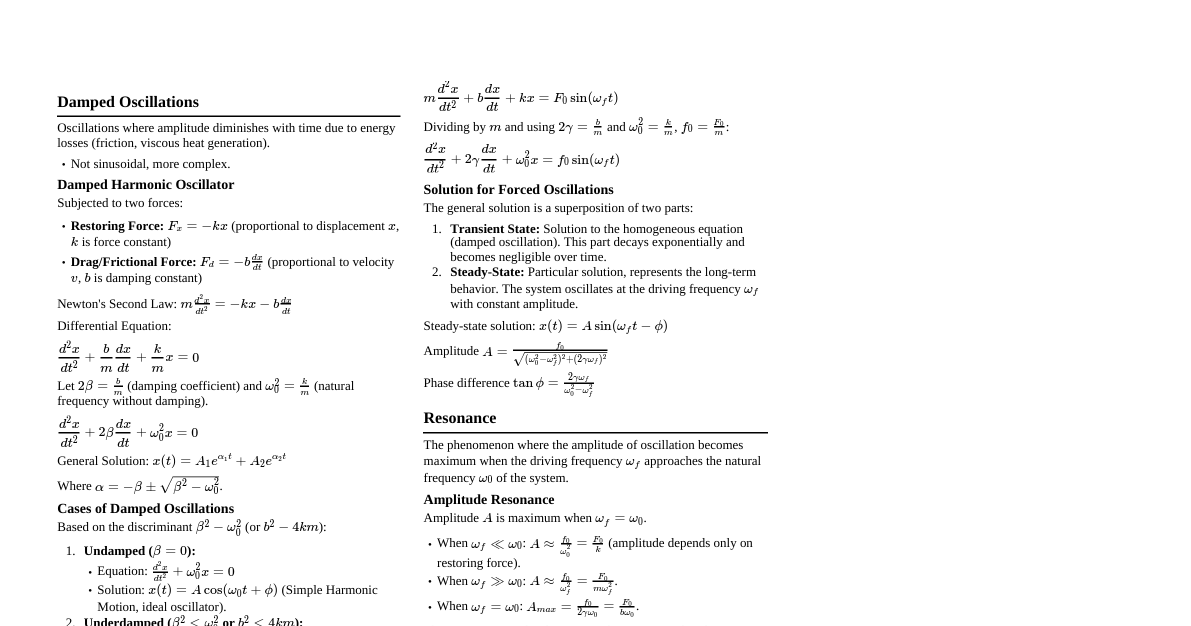
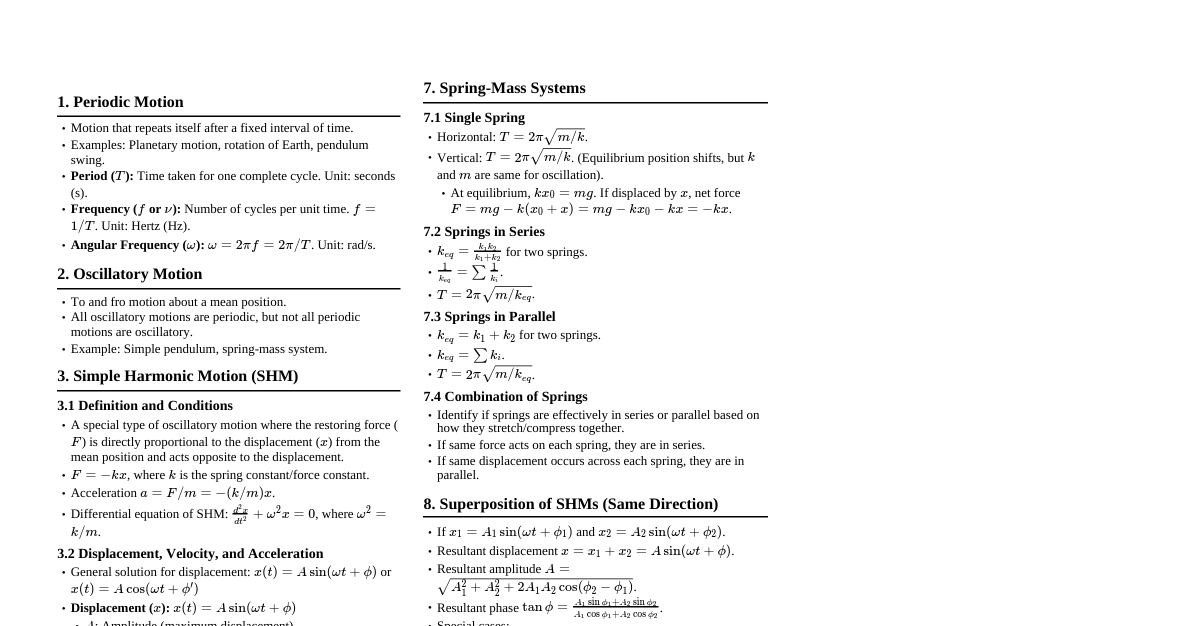
Simple Harmonic Motion (SHM) A type of periodic motion where the restoring force is directly proportional to the displacement and acts in the direction opposite to the displacement. 1. Key Concepts Displacement ($x$): Distance from the equilibrium position. Amplitude ($A$): Maximum displacement from equilibrium. Period ($T$): Time taken for one complete oscillation. $T = 1/f$. Frequency ($f$): Number of oscillations per unit time. $f = 1/T$. Angular Frequency ($\omega$): $2\pi f = 2\pi/T$. Restoring Force ($F$): $F = -kx$ (Hooke's Law), where $k$ is the spring constant. 2. Equations of Motion for SHM Displacement: $x(t) = A \cos(\omega t + \phi)$ or $x(t) = A \sin(\omega t + \phi)$ $\phi$: Phase constant (initial phase). Velocity: $v(t) = \frac{dx}{dt} = -A\omega \sin(\omega t + \phi)$ Maximum velocity: $v_{max} = A\omega$. Acceleration: $a(t) = \frac{dv}{dt} = -A\omega^2 \cos(\omega t + \phi) = -\omega^2 x(t)$ Maximum acceleration: $a_{max} = A\omega^2$. Relationship between $a$ and $x$: $a = -\omega^2 x$. 3. Energy in SHM Kinetic Energy ($KE$): $KE = \frac{1}{2}mv^2 = \frac{1}{2}m A^2 \omega^2 \sin^2(\omega t + \phi)$ Potential Energy ($PE$): $PE = \frac{1}{2}kx^2 = \frac{1}{2}k A^2 \cos^2(\omega t + \phi)$ For a spring-mass system, $k = m\omega^2$. So, $PE = \frac{1}{2}m\omega^2 A^2 \cos^2(\omega t + \phi)$. Total Mechanical Energy ($E$): $E = KE + PE = \frac{1}{2}kA^2 = \frac{1}{2}m\omega^2 A^2$ Total energy is constant and proportional to $A^2$. 4. Examples of SHM Mass-Spring System Angular Frequency: $\omega = \sqrt{k/m}$ Period: $T = 2\pi\sqrt{m/k}$ Simple Pendulum (for small angles $\theta Angular Frequency: $\omega = \sqrt{g/L}$ Period: $T = 2\pi\sqrt{L/g}$ $L$: Length of the pendulum. $g$: Acceleration due to gravity. Physical Pendulum Angular Frequency: $\omega = \sqrt{mgd/I}$ Period: $T = 2\pi\sqrt{I/(mgd)}$ $I$: Moment of inertia about the pivot point. $d$: Distance from pivot to center of mass. Damped Oscillations Oscillations where the amplitude decreases over time due to dissipative forces (e.g., air resistance, friction). 1. Damping Force Typically proportional to velocity: $F_d = -bv$, where $b$ is the damping constant. 2. Equation of Motion $m\frac{d^2x}{dt^2} + b\frac{dx}{dt} + kx = 0$ 3. Types of Damping Underdamped: $b^2 Oscillates with decreasing amplitude. Angular frequency: $\omega' = \sqrt{\omega_0^2 - (b/2m)^2}$, where $\omega_0 = \sqrt{k/m}$. Displacement: $x(t) = A_0 e^{-(b/2m)t} \cos(\omega' t + \phi)$. Critically Damped: $b^2 = 4mk$ Returns to equilibrium as quickly as possible without oscillating. No oscillations. Overdamped: $b^2 > 4mk$ Returns to equilibrium slowly without oscillating. No oscillations, slower than critically damped. Forced Oscillations and Resonance An oscillating system subjected to an external periodic driving force. 1. Driving Force $F_d(t) = F_0 \cos(\omega_{ext} t)$, where $\omega_{ext}$ is the driving frequency. 2. Equation of Motion $m\frac{d^2x}{dt^2} + b\frac{dx}{dt} + kx = F_0 \cos(\omega_{ext} t)$ 3. Steady-State Solution The system eventually oscillates at the driving frequency $\omega_{ext}$ with a constant amplitude. Amplitude: $A = \frac{F_0}{\sqrt{m^2(\omega_{ext}^2 - \omega_0^2)^2 + b^2\omega_{ext}^2}}$ $\omega_0 = \sqrt{k/m}$ is the natural frequency. 4. Resonance Occurs when the driving frequency $\omega_{ext}$ is close to the natural frequency $\omega_0$ of the system. Results in a large amplitude of oscillation. For light damping, resonance occurs approximately at $\omega_{ext} = \omega_0$. For maximum amplitude, $\omega_{ext} = \sqrt{\omega_0^2 - (b/m)^2}$.