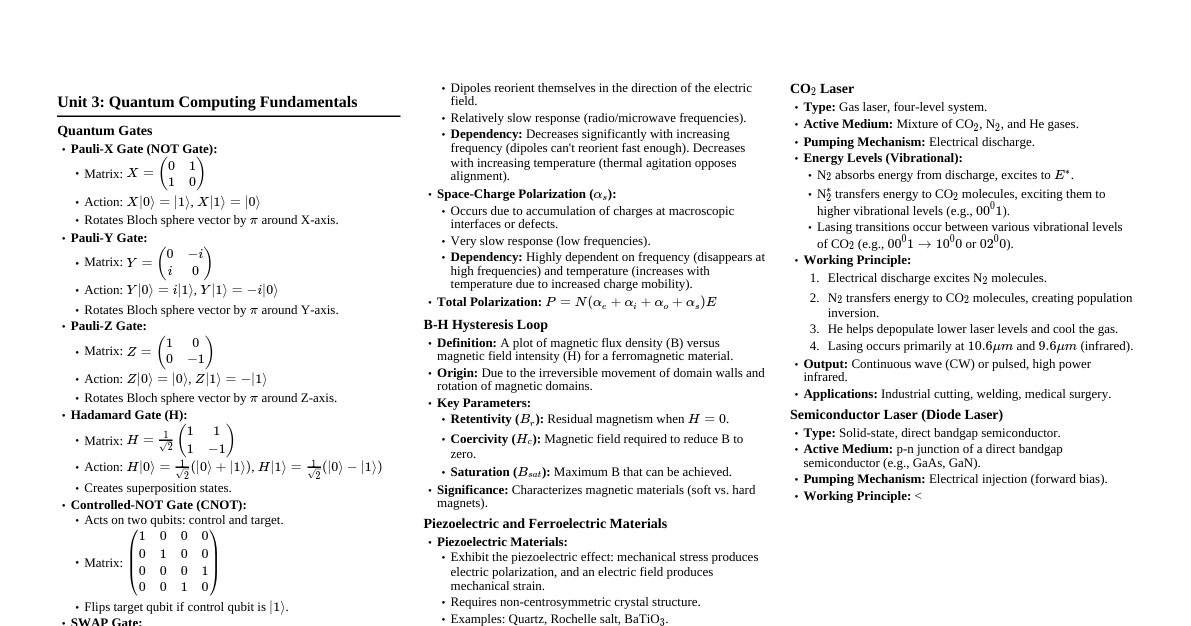
UNIT - I: Introduction to Quantum Mechanics Explain the limitations of classical mechanics in describing phenomena at the atomic level. Describe Black body radiation and Planck's radiation law. What is the Photoelectric effect? Explain its significance. Discuss the Compton effect and its implications. Elaborate on Wave-particle duality and de-Broglie's hypothesis. State and explain the Heisenberg Uncertainty Principle. Derive and solve the time-independent Schrödinger wave equation for a particle in a 1-D box. What is the physical significance of the wave function $\psi$? UNIT - II: Electronic Materials Explain the Free Electron Theory and its limitations. Describe the Drude model for electrical conductivity in metals. Discuss the Kronig-Penny model and how it explains the origin of energy bands in solids. Explain the concept of energy bands in solids, E-k diagrams, and differentiate between direct and indirect band gaps. Categorize and describe different types of electronic materials: metals, semiconductors, and insulators. Define Density of States, Occupation Probability, and Fermi Level. Explain the concept of Effective Mass and Phonons. UNIT - III: Semiconductors Differentiate between intrinsic and extrinsic semiconductors. Explain the dependence of the Fermi level on carrier concentration and temperature in semiconductors. Describe carrier transport mechanisms: diffusion and drift. Explain the formation and characteristics of a p-n junction. Discuss qualitatively the properties of heterojunctions and metal-semiconductor junctions (Ohmic and Schottky contacts). Explain the principles of photoconductivity and the photovoltaic effect. Describe the working principles and applications of optoelectronic devices such as photoconductive cells, photodiodes, solar cells, and LEDs. UNIT - IV: Lasers Explain Einstein's theory of matter-radiation interaction, including absorption, spontaneous, and stimulated emission of radiation. Derive the relation between Einstein's A and B coefficients. Discuss the concepts of population inversion and optical pumping in lasers. Differentiate between two-level, three-level, and four-level laser systems. Describe the characteristics of a laser beam. Explain the working principles and applications of different types of lasers: Gas lasers (e.g., He-Ne laser) Solid-state lasers (e.g., Ruby laser) Semiconductor lasers